If you run a coffee roastery and you are trying to figure out which K-Cup filling machine to buy — or you are scaling from a manual sealing station to automated production — you are making one of the most consequential equipment decisions in your business. Pick wrong, and you pay for it three times: in shelf life that falls short of retail requirements, in batch-to-batch inconsistency that triggers returns, and in production capacity that caps your revenue just as demand picks up.
The market spans a dramatic range. On one end, a $500 manual sealer that produces a few hundred cups a day. On the other, a $500,000 integrated production line that fills, seals, cartons, and palletizes a quarter-million cups per shift. Between those extremes sits a fragmented landscape of manufacturers — mostly concentrated in China, with a smaller circle of Italian, German, and American brands — each optimized for a different buyer profile.
This guide maps that landscape. You will walk away knowing which machine types exist, which manufacturers serve your specific business profile, what technical specifications actually determine your product quality, what the total cost of ownership really looks like, and a step-by-step framework for making your final decision.
What K-Cup Filling Machines Actually Do — and the Three Types You'll Encounter
Before comparing manufacturers, start with the category of machine you are shopping in. The market splits into three tiers. The tier you land in determines your production ceiling, your labor requirements, and your initial investment. You are not choosing a machine — you are choosing a production model.
Semi-Automatic Tabletop Fillers — The Entry Point for Micro-Roasters
Semi-automatic tabletop machines are compact, bench-mounted units that fill and seal K-Cup compatible pods one at a time or in small batches. Most roasters start here.
These machines typically produce 300 to 1,200 cups per hour, with filling accuracy ranging from ±0.5g to ±2g depending on whether you use a volumetric cylinder or a basic auger mechanism. Prices start around $500 for a manual sealer and top out around $5,000 for a combined fill-and-seal station.
Two American brands dominate this tier. iFill Systems offers the iFill800, a tabletop model that fills, seals, and cartons 800 to 1,200 pods per hour for approximately $2,500 — a common entry point for small roasters entering single-serve (iFill Systems, ifillsystems.com, 2026). Coffee Crafters sells the Fill & Seal Station at a similar $2,500 price point, built for ultralight operation with minimal training (Coffee Crafters, coffeecrafters.com, 2026).
There is a critical distinction here that catches first-time buyers off guard. Both iFill and Coffee Crafters use the iFillCup compression-seal system — a proprietary cup-and-lid combination that seals via physical pressure rather than heat. The implications: you are locked into buying iFillCup-branded empty cups and lids. Compression sealing does not support nitrogen flushing — so your pods will have a shelf life of roughly 30 to 90 days, not 12 months. If you later want to switch to traditional heat-seal K-Cups for retail distribution, you will need an entirely different machine.
For a roaster selling fresh coffee at farmers' markets or through a local subscription model, these limitations may not matter. For anyone with retail shelf ambitions, they matter enormously.
vs
12 months+nitrogen heat-seal
Compact Rotary & Inline Automatics — The Sweet Spot for Growing Roasters
Once your monthly volume passes roughly 20,000 cups, a fully automatic machine stops being optional.
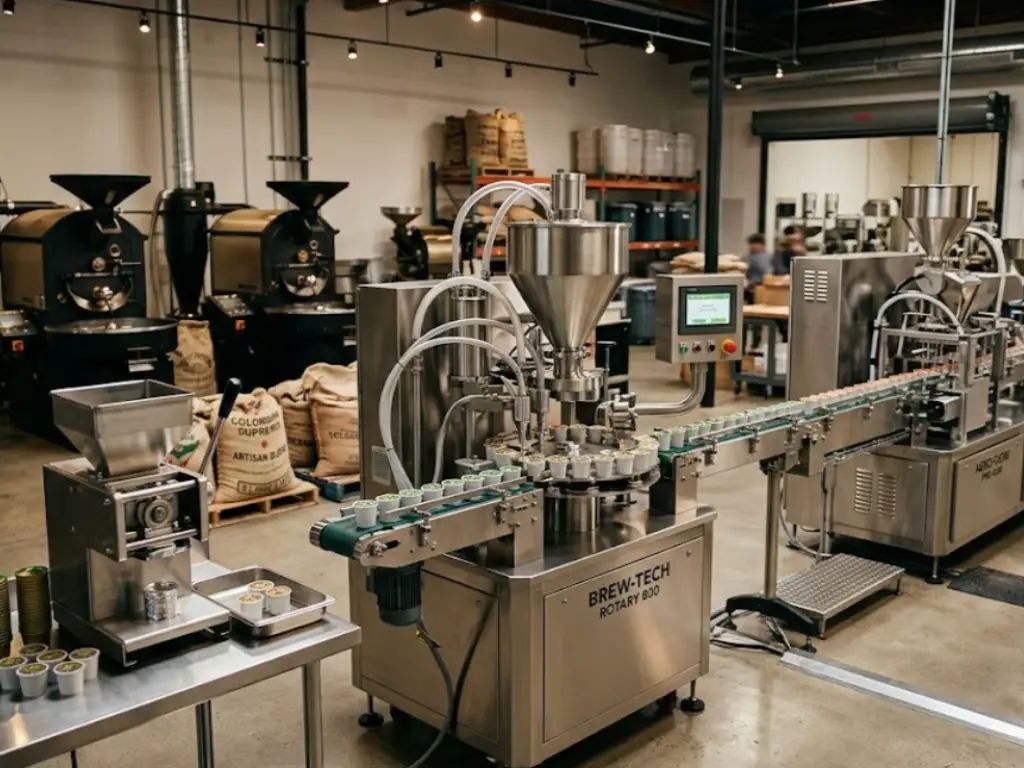
The automatic tier splits into two architectures. Rotary machines use a rotating platform that moves cups through stations — filling, nitrogen flushing, lid placement, heat sealing, and ejection — in a continuous cycle. They are compact (a typical RN1S-class machine occupies roughly 2m × 2m), run on single-phase 220V power, and produce 40 to 120 cups per minute. Switching between capsule formats (K-Cup to Nespresso to Dolce Gusto) takes about 30 minutes — swap the nest plates and adjust the guide rails, no welding, no machining.
Inline (linear) machines move cups along a straight conveyor through sequential stations. They can run multiple lanes simultaneously — two, four, or more — multiplying throughput without expanding the footprint proportionally. A four-cavity inline machine can reach 200 cups per minute and scale past 600 in high-end configurations.
This tier is where most serious K-Cup businesses land. Prices range from roughly $35,000 for an entry-level single-lane automatic to $80,000 for a multi-cavity inline machine with integrated nitrogen flushing and inline weighing.
High-Speed Industrial Lines — Built for Co-packers and National Brands
At the top of the pyramid sit fully integrated production lines that handle filling, sealing, cartoning, boxing, and palletizing in one continuous flow. These systems — represented by IMA Group's SYNKRO line from Italy and OPTIMA's CFL/CBF series from Germany — produce 200 to 600+ cups per minute. That is 96,000 to 288,000 cups per 8-hour shift. Fully configured, they cost $150,000 to over $500,000 (IMA Coffee, imagroup.com, 2026).
These are machines for contract packers running multiple coffee brands on parallel lines, or national CPG companies for whom a 0.5% defect rate translates to tens of thousands of dollars in returns. If you are reading this guide, you are probably not buying one — but knowing the ceiling helps you place your own machine on the capability spectrum.
Finding Your Match — K-Cup Machine Manufacturers by Business Profile
The manufacturers that serve the K-Cup equipment market cluster into two distinct worlds: Chinese specialists who dominate the value and mid-range segments, and European/American brands concentrated in the premium and industrial tiers. Which world matters to you depends entirely on your business profile.
For Small to Mid-Size Roasters & Startup Coffee Brands
If you produce 5,000 to 100,000 K-Cups per month, or you are a startup brand launching your first single-serve SKU, you have three priorities: a machine that fits your budget ($5,000 to $55,000), produces consistent quality, and comes with support you can actually reach when something breaks.
On the Western side, your options stay within the iFillCup ecosystem — capable for direct-to-consumer sales, but a dead end if you ever plan to sell through retail channels that require 12-month shelf life and standard heat-seal packaging.
This is where the Chinese manufacturing base becomes relevant — and where a specialist like SANEU occupies a distinctive position. Unlike iFill's closed ecosystem, SANEU builds machines around standard heat-seal technology using globally sourced components: Schneider PLCs, Siemens touchscreens, Omron sensors, and SMC pneumatics. Two practical consequences follow. First, your maintenance team can source replacement parts from local distributors in most US metropolitan areas — no waiting weeks for proprietary components. Second, standard heat-seal means your K-Cups meet retail channel requirements for nitrogen-flushed, 12-month shelf-stable packaging.
SANEU's K-Cup lineup spans seven models, from the $500 SM-4 manual sealer to the $55,000 SK-4 four-cavity automatic line producing 12,000 cups per hour (SANEU, saneu.com, 2026). The mid-range sweet spot — the SR-11 (3,000-3,500 cups/hr) and SN-1 (2,100 cups/hr, 99.9% nitrogen content) — occupies a price-performance zone with no direct Western equivalent: fully automatic, nitrogen-capable, and priced roughly 30% less than comparable-configuration European machines. All come with a 2-year mechanical warranty — double the industry norm.
The trade-off is support geography. SANEU has distributors in the US, UK, Italy, and nine other countries, and offers video-call diagnostics plus next-day spare parts shipping. But if you need an on-site technician in rural Montana on 24 hours' notice, a US-based company like iFill has the logistical edge. That said, SANEU's use of globally available Schneider/Siemens components means most electrical issues can be diagnosed and resolved by a local industrial electrician — a practical advantage that closes much of the support gap.
For Contract Packers & High-Volume Operations
If you co-pack K-Cups for multiple brands, running 100,000+ cups per month, your criteria shift. Unit cost per cup, production line integration, multi-SKU rapid changeover, and compliance with retail oxygen-residual standards drive your equipment choice.
At this tier, European manufacturers set the benchmark. IMA Group's SYNKRO line delivers fully automated fill-seal-carton-box-palletize integration with global service coverage — and a price tag that starts well into six figures. OPTIMA's CFL/CBF machines bring German precision engineering with modular architectures that let you add capacity in stages. ICA Packaging Machines offers the AROMACUP series with particular strength in sustainable materials — aluminum, compostable PLA, and filter paper capsules all run on the same platform (ICA, icaspa.it, 2026). This capability is becoming a hard requirement as European retail chains mandate compostable pod formats.
For a mid-size co-packer whose volume does not yet justify a $200,000+ IMA line, SANEU's SK-4 occupies a pragmatic middle ground. At 12,000 cups per hour with four cavities working in-line, an inline weighing system, Schneider servo-driven filling at ±0.1g accuracy, and a nitrogen flushing system that achieves 99.9% purity inside the capsule — verified by German-made Oxybady testing equipment — the SK-4 delivers technical capabilities that approach the entry-level of the European premium tier, at a fraction of the capital cost. The honest ceiling: if you need more than 15,000 cups per hour or require IEC 62443 cybersecurity compliance on your production network, you belong in the IMA/OPTIMA conversation.
The Specifications That Actually Determine Your Product Quality
You now know which machines exist and who makes them. Here is what to look for when comparing spec sheets. Three parameters have outsized impact on your product quality and business economics — and they are not the ones most first-time buyers focus on.
Filling Accuracy: ±0.1g vs ±2g Is a Margin-of-Error Problem in Disguise
A dosing variance of 1 to 2 grams per cup sounds minor. At 100,000 cups per month, it adds up to 100 to 200 kilograms of wasted coffee — roughly $3,000 to $5,000 in product loss every month at specialty-grade green coffee prices. Over a year, that waste alone can exceed the purchase price of an entry-level automatic machine.
Servo-driven auger fillers — using Schneider or equivalent servo motors with closed-loop feedback — maintain ±0.1g accuracy across production runs. They continuously adjust for powder density changes as humidity and temperature shift during the day. Volumetric cylinder fillers, common on entry-level machines, lack this compensation and drift toward ±1-2g over extended runs. If your coffee is an oily dark roast — denser than lighter roasts — the drift accelerates.
Nitrogen Flushing: The Line Between "Fresh Coffee" and "Returned Product"
Residual oxygen inside a sealed K-Cup is the single largest determinant of shelf life — and by extension, whether your product can sit on a grocery store shelf.
A properly nitrogen-flushed capsule contains less than 1% residual oxygen. At this level, ground coffee's volatile aromatic compounds stay stable for 12 months or longer — the minimum for most retail distribution agreements. Manual or semi-automatic filling without nitrogen typically leaves 3% to 5% residual oxygen. At those levels, oxidation degrades flavor within 60 to 90 days. Retail buyers track return rates by SKU. Two quarters of elevated returns, and your shelf space goes to a competitor.
The nitrogen purity metric itself rewards a closer look. Most capsule manufacturers target 99.5% nitrogen content. Some specialists, including SANEU, achieve 99.9% through rotary nitrogen injection that displaces oxygen more thoroughly than stationary flushing — a difference that sounds small but represents 5× less residual oxygen (0.1% vs 0.5%).
Seal Temperature Consistency: Invisible Until It Fails
A sealing head that holds temperature within ±2°C of setpoint across thousands of cycles produces uniform, airtight seals. One that drifts ±10°C produces a mix of under-sealed capsules (oxygen ingress, leaking) and over-sealed ones (warped rims, burnt lid film). Neither failure is visible to the naked eye at production speed — but both show up in customer complaints weeks later.
This matters most for biodegradable capsule materials. PLA (polylactic acid) and sugarcane-based films seal within a narrow window roughly 20°C to 40°C lower than standard polypropylene. A machine with adaptive heat control — where the sealing head senses incoming material temperature and modulates heater current within each cycle — maintains consistency as ambient plant temperature rises during a long shift. Fixed-temperature systems do not. The resulting seal failures concentrate in the last hours of a run.
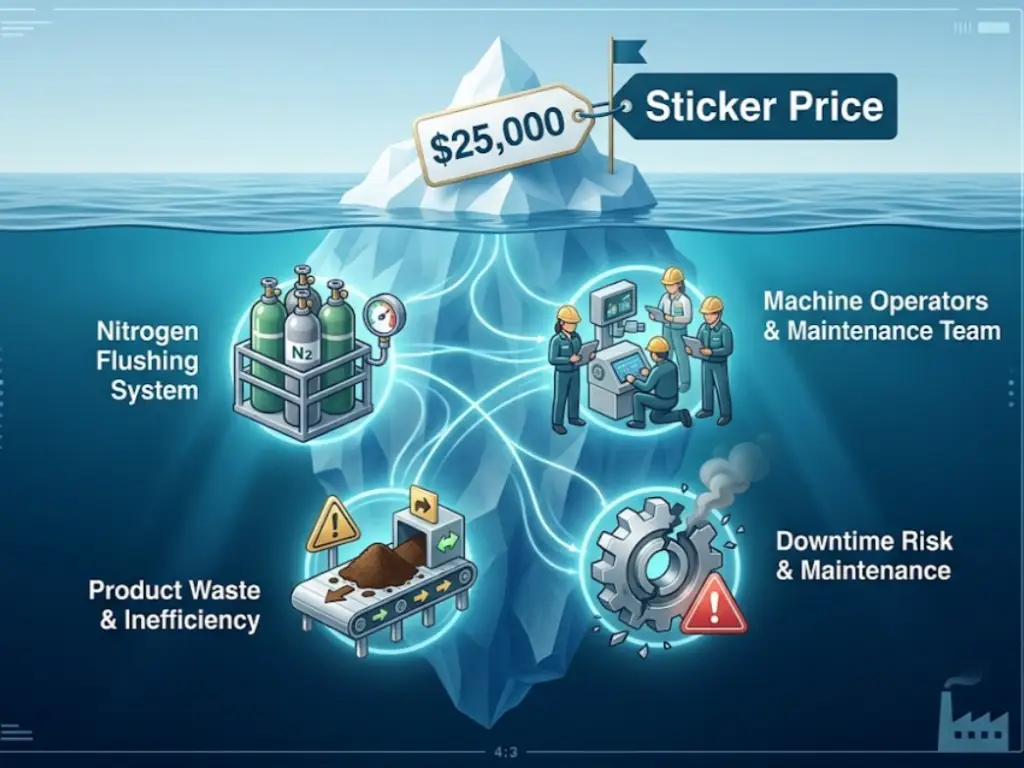
What a K-Cup Filling Machine Really Costs — Beyond the Sticker Price
The purchase price of a K-Cup filling machine is the most visible cost. Over a 24-month horizon, it is often not the largest one. Use this five-line total cost of ownership framework when comparing quotes.
1. Machine Acquisition Cost. Semi-automatic: $500 to $5,000. Entry-level automatic: $35,000 to $55,000. Multi-cavity inline: $55,000 to $150,000. Full production line: $150,000 to $500,000+. Add $3,000 to $8,000 for ocean freight, customs clearance, and door-to-door delivery if importing — though some manufacturers offer DDP (Delivered Duty Paid) terms that bundle these costs into the quote.
2. Nitrogen Operating Cost. A machine consuming 5 Nm³/h of nitrogen running one 8-hour shift daily uses roughly 1,200 Nm³ per month. Bottled nitrogen costs $0.50 to $1.50 per Nm³ depending on your location — roughly $600 to $1,800 per month. An on-site nitrogen generator pays for itself in 12 to 18 months at consumption levels above roughly 3,000 Nm³/month. After that break-even point, your per-unit nitrogen cost drops to near zero.
3. Labor Cost. A manual or semi-automatic filling line requires two to three operators to produce 2,400 to 4,800 cups per 8-hour shift. One operator on an automatic machine produces 19,200 to 96,000 cups in the same shift. At a conservative $18/hour fully loaded labor cost, the manual line costs $288 to $432 per day in labor alone — over $100,000 per year for what one operator and one automatic machine can produce.
4. Overfill Waste. As detailed in the accuracy section above: ±2g variance at 100,000 cups per month equals $3,000 to $5,000 per month in product loss. A servo-driven auger filler with ±0.1g accuracy eliminates roughly 90% of this waste. Over 12 months, the waste savings alone can cover 30% to 60% of the price difference between a semi-automatic and an entry-level automatic machine.
5. Downtime Risk. When a proprietary PLC or a custom-machined pneumatic fitting fails, you wait 4 to 6 weeks for a replacement from the OEM — assuming the OEM is still in business and stocks parts for your model. When a standard Schneider PLC or Airtac pneumatic cylinder fails, your local industrial supply house has a replacement in one to two days. Machines built with globally standard components carry a real, calculable downtime-risk discount. Component sourcing belongs in your evaluation, right alongside the spec sheet.
Making Your Decision — A Step-by-Step Framework for K-Cup Machine Buyers
You have now seen the machine types, the manufacturer landscape, the specs that matter, and the real cost picture. Five questions turn all of that into a decision.
Step 1: Lock in Your 18-Month Volume Target. Do not buy for your current volume. Buy for the volume you expect 18 months from now — the typical window for a new K-Cup product line to gain retail traction and for your production team to reach full proficiency on the machine. If you are doing 5,000 cups a month today but have a chain-store meeting in Q3, spec for 50,000. Undersizing a machine is the most expensive mistake in this category.
Step 2: Identify Your Primary Sales Channel. Direct-to-consumer (your website, farmers' markets, subscription boxes): nitrogen flushing is optional. You control the supply chain, and your customers consume within weeks. Retail and e-commerce (grocery chains, Amazon, specialty food stores): nitrogen flushing with residual oxygen below 1% is mandatory. Your product sits on shelves and in warehouses for months. If your spec sheet does not say "<1% residual O₂," you are not retail-ready.
Step 3: Decide Your Capsule Format Strategy. Are you K-Cup only? Or do you anticipate launching Nespresso, Dolce Gusto, or Lavazza-compatible SKUs in the future? A machine with 30-minute format changeover — common on rotary automatics — gives you optionality for roughly the same capital cost as a single-format machine. A machine locked to one format saves a small amount upfront but walls off revenue streams you may want in 12 months.
Step 4: Run the TCO Numbers — Not Just the Quote. Take the five-line framework from the previous section and plug in your own numbers. Machine price + nitrogen cost + labor cost + overfill waste + downtime risk. A $35,000 machine with standard components and 0.1g accuracy may have a lower 24-month TCO than a $25,000 machine with proprietary parts and 1g accuracy. Run both scenarios.
Step 5: Request Quotes, Require Sample Runs, and Verify Support Responsiveness. Contact at least three manufacturers — not one, not two. Send each a sample of your coffee, your target capsule material, and your target gram weight. Ask them to run a test and return sealed samples for your evaluation. When evaluating quotes, ask: (1) What is your warranty duration and what does it exclude? (2) Where is your nearest spare parts inventory, and what is the typical ship time for a replacement PLC or servo motor? (3) If my machine goes down on a Wednesday afternoon, can I reach a technician who speaks English within 4 hours?
As you benchmark pricing and capability across your shortlist, include a specialist like SANEU — who offers free sample testing, a 2-year warranty as standard, and global spare parts shipping within one business day — as one of your reference points.
The K-Cup filling machine market rewards buyers who do their homework. Machines exist at every price point and capability level. Spec sheets are available. Sample runs are free. What separates the roasters who scale profitably from those who stall is not luck — it is treating a capital equipment purchase as the multi-year strategic decision it actually is.
References
- iFill Systems. "Single Serve Pod Filling Machines." 2026. https://www.ifillsystems.com/filling-machines/
- Coffee Crafters. "Fill & Seal Station." 2026. https://coffeecrafters.com/product/fill-and-seal-station/
- IMA Coffee. "Coffee Integrated Lines." 2026. https://imagroup.com/coffee/coffee-integrated-lines/
- OPTIMA Packaging. "How Does the Coffee Get into the Capsule?" 2025. https://www.optima-packaging.com/en/career/what-does-optima-do/how-does-the-coffee-get-into-the-capsule
- ICA Packaging Machines. "Aromacup." 2026. https://icaspa.it/en/machine/aromacup/
- SANEU. "K Cup Filling Machines 2026." 2026. https://www.saneu.com/coffee-capsule-filling/k-cup-filling-machines/
- AFPAK. "K-Cup Filling Machine — 40 to 600 CPM." 2026. https://afpakmachine.com/k-cup-filling-machines/
- CoffeeEquipmentPros. "K-Cup Filling Machines: It's Time to Cash In on This Popular and Profitable Option." https://coffeeequipmentpros.com/blogs/news/k-cup-filling-machines-it-s-time-to-cash-in-on-this-popular-and-profitable-option
- CoffeeTec. "K-Cup Equipment & Packaging." 2026. https://coffeetec.com/collections/17-packaging-k-cup