
What Is a K-Cup?
A K-Cup is a sealed, single-serve coffee capsule designed exclusively for Keurig and Keurig-compatible brewing machines. Each K-Cup contains pre-measured ground coffee, a built-in paper filter, and a food-grade plastic shell sealed with a foil lid — everything needed to brew exactly one cup of coffee in under a minute.
The name "K-Cup" is a registered trademark of Keurig Dr Pepper Inc., but it has become the generic term for this entire category of coffee pod. Much like "Kleenex" for facial tissues or "Xerox" for photocopies, the brand name now stands in for the whole product category. When people ask what are coffee k cups or what are k cups coffee, they're almost always referring to these Keurig-compatible single-serve capsules, regardless of who actually manufactured them.
The concept dates back to the early 1990s. In 1992, John Sylvan and Peter Dragone developed the original Keurig single-serve brewing system and the K-Cup pod in Massachusetts. The technology caught the attention of Green Mountain Coffee Roasters, a Vermont-based specialty coffee company, which invested in Keurig early on and fully acquired the company in 2006. This kicked off explosive growth: by 2014, Green Mountain had rebranded itself as Keurig Green Mountain, and in 2018, the company acquired Dr Pepper Snapple Group in an $18.7 billion deal to form Keurig Dr Pepper — one of the largest beverage companies in North America today (Keurig Dr Pepper, 2018).
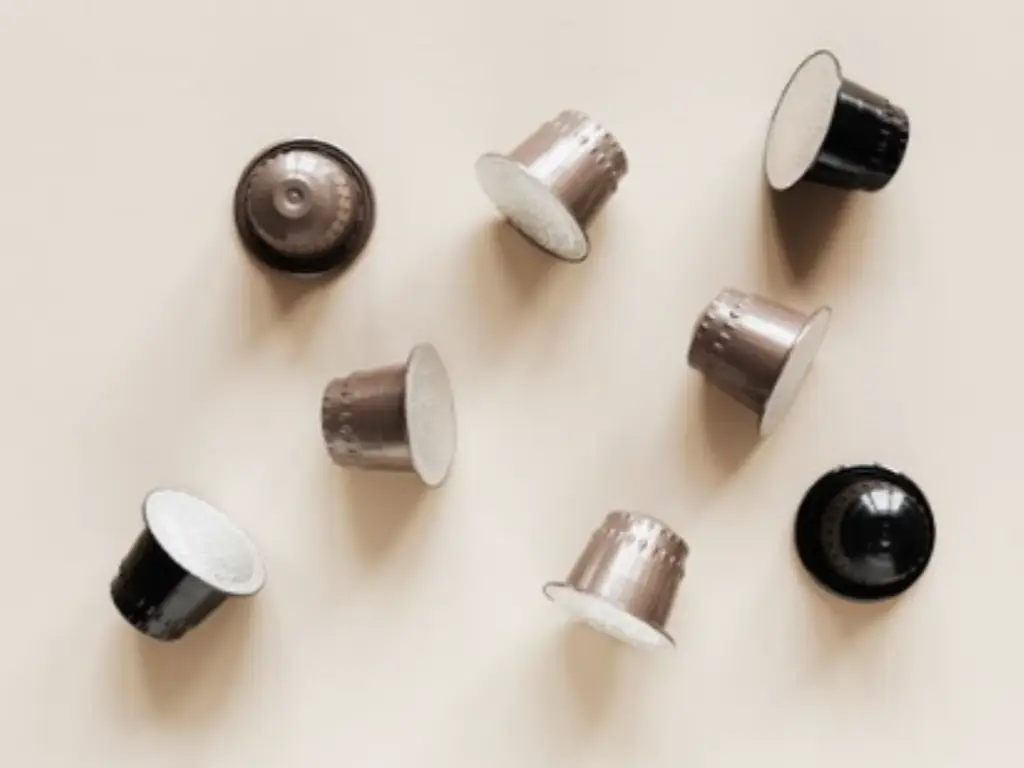
K-Cups only work in Keurig brewers and machines explicitly labeled "Keurig-compatible." If you try to put a K-Cup into a Nespresso machine or a Dolce Gusto brewer, it simply won't fit. These systems use physically different capsule formats. If you've ever wondered what is a kcup pod and whether it works in your machine, the answer starts with checking what brewer sits on your countertop.
Inside a K-Cup — The Anatomy of a Single-Serve Pod
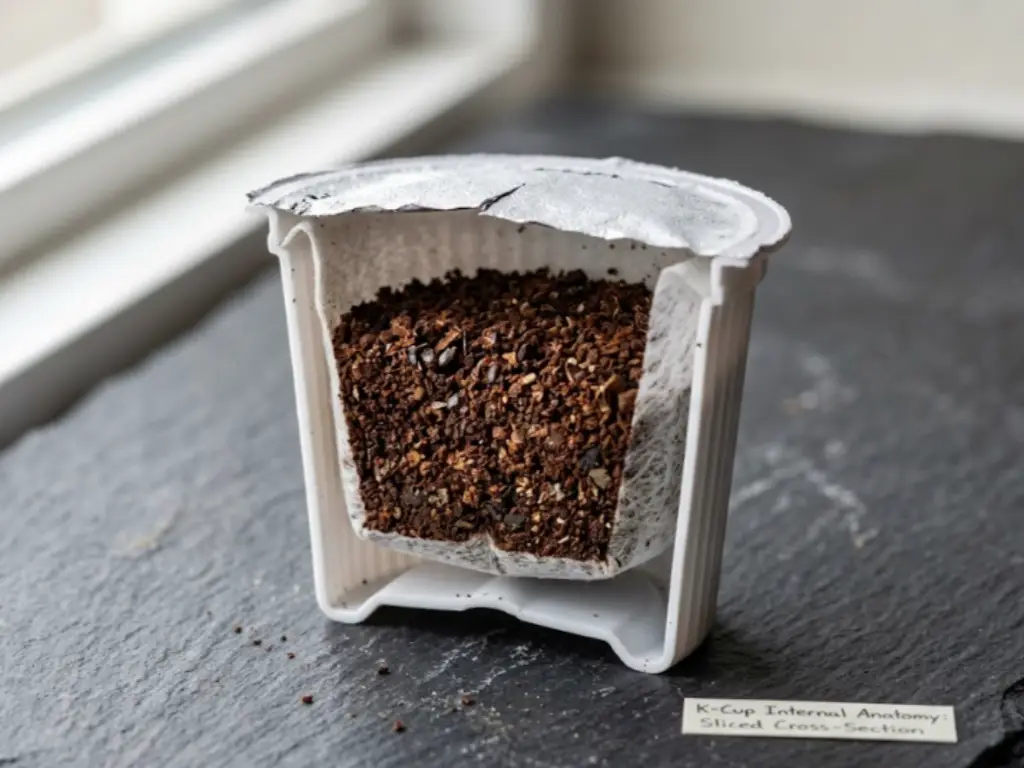
At first glance, a K-Cup looks like a simple plastic cup. But pop one open (after it's cooled, of course) and you'll discover it's actually a five-layer packaging system. Each layer serves a specific purpose, from the outer shell inward.
The Outer Plastic Shell — The Cup That Holds Everything
The rigid outer body of a K-Cup is made from food-grade #5 polypropylene (PP), the same type of plastic used for yogurt containers and medicine bottles. Polypropylene was chosen for a specific reason: it's heat-resistant to approximately 160°C (320°F), far above the 89–96°C (192–205°F) water temperature Keurig machines use during brewing. It won't warp, melt, or leach substances into your coffee under normal brewing conditions.
Look closely at the inside wall of some K-Cups and you'll notice vertical ridges running from top to bottom. These aren't decorative. They're a deliberate engineering feature called "ridged filter technology," and their job is straightforward: prevent the internal paper filter from sticking flat against the plastic wall during brewing. If the filter adheres to the cup, hot water can't flow evenly around the coffee grounds. The result is uneven extraction and, in worst cases, burnt-tasting coffee. The ridges create micro-channels that keep water moving.
The bottom of the cup is solid when it leaves the factory. It only gets pierced during brewing, when the Keurig machine's lower needle punctures through to create the exit path for your coffee.
The Paper Filter — The Brewing Engine Inside
Nestled inside the plastic shell is a paper filter. It's functionally identical to the basket filter in a traditional drip coffee maker, just shrunk down to pod scale. Its sole job: let liquid coffee pass through while trapping coffee grounds inside.
The filter sits at the very bottom of the cup, with all the coffee grounds loaded above it. During brewing, hot water enters from the top, saturates the coffee bed, and gravity pulls the extracted coffee down through the filter and out the bottom needle. The filter paper is typically a food-grade cellulose fiber weighing between 16 and 22 grams per square meter (gsm). Light enough for fast flow-through, strong enough not to tear under brewing pressure.
The Coffee Grounds — What's Actually Inside the Pod
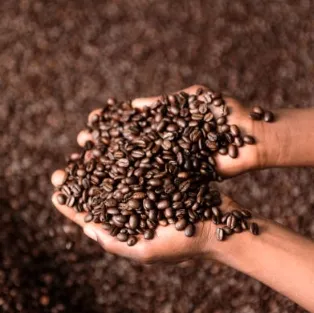
One of the most common questions on forums like Reddit and Quora is whether K-Cups contain real coffee or some kind of instant powder. The answer is definitive: what is a k cup pod if not real coffee? K-Cups contain genuine roasted and ground coffee — the same coffee beans you'd buy as whole beans or pre-ground in a bag. It is not instant coffee, not a concentrate, and not a flavored syrup.
But the coffee inside a K-Cup isn't exactly the same as what you'd scoop into a drip machine. The critical difference is the grind size. A Keurig brewer forces water through the pod in just 30 to 60 seconds. A drip machine takes 4 to 6 minutes. To compensate for this shorter contact time, K-Cup coffee is ground to a medium-fine consistency: coarser than espresso, finer than standard drip.
How much coffee is actually in there? The industry standard ranges from 9 to 12.5 grams per pod, but this number varies dramatically between brands. Some budget K-Cups pack as little as 6.5 grams, producing a noticeably weaker cup. Premium brands go the opposite direction: Lucky Goat Coffee loads 10 grams into every pod (about 34% more than leading competitors), while Barrie House pushes all the way to 18 grams for a bolder, richer brew. This nearly threefold spread from 6.5 to 18 grams is the single biggest reason why two different K-Cups can taste completely different even when brewed on the same setting.
The Foil Lid and Nitrogen Seal — Freshness Engineering
The top of every K-Cup is sealed with a foil lid, typically aluminum with a heat-activated polymer lining. But the real freshness secret isn't the foil itself. It's what's underneath it.
When K-Cups are manufactured, the air inside the cup is evacuated and replaced with nitrogen gas (N₂). Nitrogen is an inert gas. It doesn't react with coffee compounds, doesn't cause oxidation, and doesn't affect flavor. This nitrogen flush removes the oxygen that would otherwise degrade the coffee's volatile aroma compounds and cause the oils to go rancid. The residual oxygen level inside a properly sealed commercial K-Cup is typically held at or below 1%.
This is why K-Cups can carry a "best by" date of 8 to 12 months from production. An opened bag of ground coffee starts losing its vibrancy within days of exposure to air. A sealed K-Cup, by contrast, preserves its freshness for nearly a year. The moment you hear that satisfying "hiss" when the Keurig needle pierces the foil, you're releasing a miniature nitrogen atmosphere that has been protecting that coffee since the day it was packed.
How Does a K-Cup Brew Coffee?
The brewing process is deceptively simple — which is exactly why Keurig machines became a global phenomenon. The entire sequence, from pressing "brew" to hearing coffee hit your mug, takes 30 to 60 seconds.
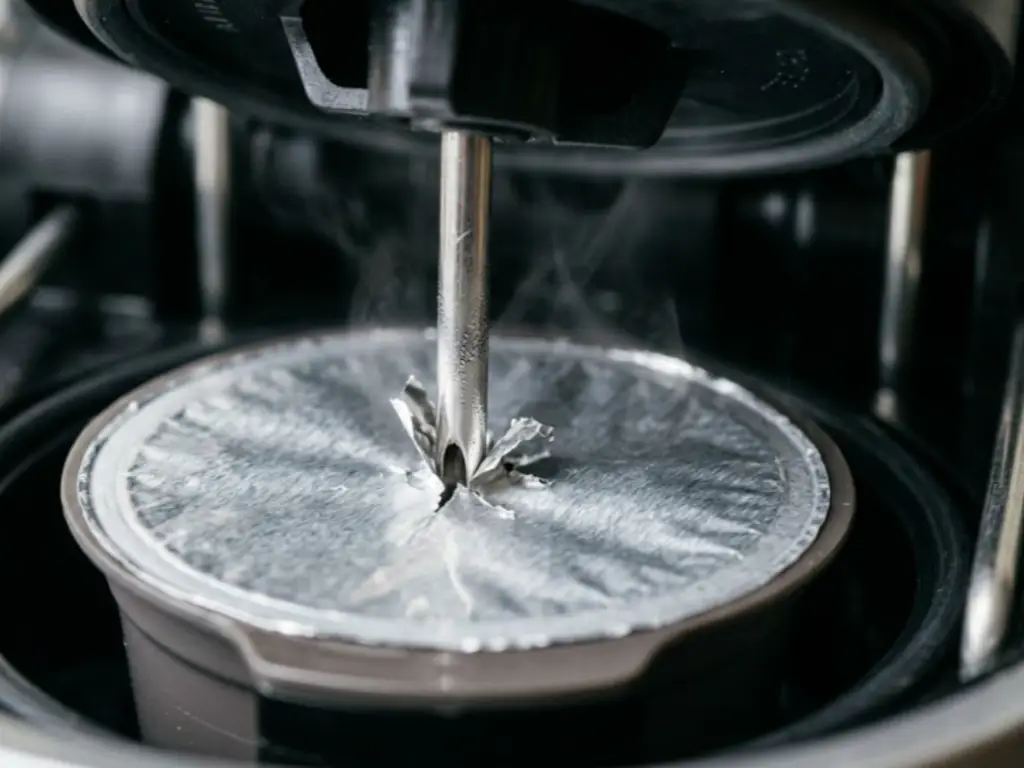
Step 1: Puncture. You place the K-Cup into the brewer's pod holder and pull the handle down. This action drives two hollow needles into the pod: an upper needle pierces the foil lid (this is the water inlet), and a lower needle pierces the bottom of the plastic cup (this is the coffee outlet).
Step 2: Water delivery. The machine pumps water from its reservoir, heats it to 89–96°C (192–205°F), and forces it through the upper needle into the K-Cup. The hot water enters under pressure — typically 2 to 3 bar — and disperses across the coffee bed inside.
Step 3: Extraction and exit. The hot water saturates the coffee grounds, dissolving and carrying away flavor compounds, oils, and caffeine. The brewed coffee passes through the internal paper filter, exits through the bottom needle puncture, and streams directly into your waiting cup.
One detail that surprises many new Keurig users: the cup-size selector on the machine (6, 8, 10, or 12 ounces) changes how much water passes through the pod, but the amount of coffee inside the K-Cup stays exactly the same. Selecting a larger cup size simply runs more water through the same 9 to 12 grams of coffee, producing a weaker, more diluted brew. If you prefer a stronger cup on a larger setting, look for K-Cups with higher coffee fill weights. Alternatively, use your machine's "Strong" or "Bold" button if it has one. This slows the water flow for longer extraction rather than simply using less water.
K-Cups vs. Coffee Pods vs. Capsules — What's the Difference?
The terminology around single-serve coffee is a mess. Walk down any coffee aisle and you'll see "K-Cups," "coffee pods," and "capsules" used almost interchangeably. But they describe three physically different formats that are not cross-compatible. Understanding what sets them apart saves you from buying the wrong product for your machine.
Format and Material — Plastic vs. Paper vs. Aluminum
The easiest way to tell these formats apart is by what they're made of and what they look like:
| Dimension | K-Cup | Soft Coffee Pod | Nespresso Capsule |
|---|---|---|---|
| Body material | PP#5 plastic cup + foil lid | Filter paper pouch (no hard shell) | Aluminum or plastic capsule |
| Shape and size | Rigid cup, ~42mm diameter | Soft round disc, 60–62mm diameter | Brand-specific shapes |
| Compatible brewers | Keurig and Keurig-compatible only | Pod brewers (Bunn, Senseo, etc.) | Nespresso machines only |
| Cross-compatible? | No | No | No (even Original ≠ Vertuo) |
K-Cups are rigid plastic cups. Soft coffee pods look more like oversized tea bags — ground coffee sealed inside a round filter-paper disc. Nespresso capsules are typically aluminum, shaped like small cups or domes depending on the line (Original vs. Vertuo). None of these are interchangeable: a soft pod will not work in a Keurig, and a K-Cup will not fit a Nespresso machine.
There's also a fourth format worth knowing about: the E.S.E. (Easy Serving Espresso) pod. It's a 44mm compressed coffee puck designed for espresso machines with E.S.E.-compatible portafilters. It fits none of the systems above.
Taste and Brewing Experience
The taste difference between these formats comes down to physics — specifically, how much pressure the water is under when it meets the coffee.
K-Cups brew at low pressure (roughly 2–3 bar), producing a cup that's closest to traditional drip coffee: clean, consistent, and available in an enormous range of blends and flavors. Nespresso capsules brew at 19 bar — true espresso-range pressure — which generates the signature crema (that golden foam layer) and a more concentrated, intense shot. Soft pods operate similarly to drip coffee in terms of pressure. They generally produce a clean, aromatic cup, but with far fewer brand and roast choices available than K-Cups.
Which tastes better? It depends on what kind of coffee experience you want. K-Cups win on variety and convenience. Nespresso wins on espresso-style intensity. Soft pods appeal to those who want a more traditional paper-filtered taste with less packaging.
Cost Per Cup and the Environmental Trade-Off
If you're wondering what are k cup pods costing you compared to alternatives, here's the raw math. K-Cups typically run $0.35 to $1.20 per pod, depending on brand and volume. A Costco bulk pack of Kirkland pods lands at the low end; single-origin specialty K-Cups sit at the high end. Soft coffee pods are generally slightly cheaper per serving, and Nespresso capsules tend to be the most expensive of the three.
For comparison: brewing drip coffee from a $12-per-pound bag of whole beans costs roughly $0.15 to $0.20 per cup. If you drink two cups of K-Cup coffee every day, you're spending somewhere between $255 and $876 per year on pods alone. The same habit with drip coffee and a reusable filter costs about $110 to $180.
The most effective money-saving move? Buy a reusable K-Cup filter — a $5 to $15 one-time purchase. Fill it with your own ground coffee, and your per-cup cost drops to near-drip levels. You also dramatically reduce plastic waste in the process.
How K-Cups Are Manufactured — From Empty Pod to Your Cup
Every K-Cup on a store shelf started as an empty plastic cup on a high-speed automated production line. The journey from raw materials to sealed, nitrogen-flushed pod is a six-stage industrial process that most consumers never think about. Yet it's the reason your coffee tastes fresh months after packaging. Each stage is automated and precisely controlled.
Filling and Dosing — Getting the Coffee In
The process starts with empty K-Cup bodies, molded from PP#5 plastic pellets, being fed onto a conveyor line by robotic arms. The cups travel single-file into the filling station, where an auger filler dispenses ground coffee into each cup with ±0.2 gram accuracy. An auger filler is a precision screw-driven dosing mechanism — not a simple volume-based scoop.
Coffee grounds vary in density depending on grind size, roast level, and humidity. A volumetric fill would produce inconsistent weights. The auger compensates for these density shifts, ensuring every pod contains exactly the target dose.
Production speed varies dramatically by machine class. A desktop-scale filler might produce 5 to 15 cups per minute (CPM), suitable for small roasters testing the market. Linear multi-lane machines push 40 to 50 CPM per lane. At the top end, rotary filling systems can churn out 200 to 600 CPM, producing hundreds of thousands of K-Cups per shift. After filling, each pod passes under a photoelectric sensor that verifies the coffee level, followed by a weigh station. Any pod outside the ±0.3-gram tolerance band is automatically ejected from the line.
Nitrogen Flushing and Sealing — Locking Freshness Inside
Immediately after filling, the pod enters the sealing station. Before the foil lid is applied, a nitrogen injection nozzle floods the headspace inside the cup with food-grade nitrogen gas (N₂), displacing the ambient air. This nitrogen flush is the single most important step for shelf-life preservation. By driving the residual oxygen level below 1%, it prevents the oxidation reactions that would otherwise degrade the coffee's aromatic compounds and turn its oils rancid within days.
The foil lid — typically aluminum laminated with a heat-sealable polymer layer like LDPE or EVA copolymer — is then applied and heat-sealed at 180 to 220°C. The seal must be hermetic: even a microscopic leak would allow oxygen to seep in over time and defeat the nitrogen flush. On commercial-grade K-Cup filling and sealing machines from manufacturers like SANEU, this entire sequence — fill, nitrogen-flush, and seal — happens in a continuous automated cycle. The nitrogen injection system is capable of achieving up to 99.9% purity to maximize freshness preservation.
Quality Control and Packaging — Before It Reaches the Shelf
Once sealed, every K-Cup undergoes automated optical inspection. A machine vision system scans each pod, checking for label alignment on the foil lid, seal wrinkles or bubbles that could indicate an imperfect seal, and cracks or deformation in the plastic cup body. Pods that fail any check are automatically rejected, and the plastic components are recycled.
The surviving pods are weighed a second time as a final verification, then conveyed to the packaging station. Robotic pick-and-place arms arrange them into retail boxes. Common formats include 12, 24, 36, 48, and 80-count boxes, depending on the target retail channel and market. The boxes are sealed, date-coded, palletized, and shipped to distribution centers worldwide.
The entire production line — from empty cup to sealed retail box — operates without human hands touching the product. This maintains the food-safety standards expected of a consumable packaged good. The level of automation is comparable to pharmaceutical blister-packaging lines in both precision and cleanliness.
Are K-Cups Recyclable? Materials, Recycling, and Common Questions
The Recycling Reality
Technically, yes. A K-Cup is made from recyclable materials. The PP#5 plastic cup can be melted down and reprocessed, the aluminum foil lid can be recycled where facilities accept it, and the paper filter and coffee grounds are compostable.
In practice, recycling a used K-Cup requires effort most consumers won't invest. The correct procedure: let the pod cool completely, peel off the foil lid, dump the spent coffee grounds into compost or trash, rinse the plastic cup, and place it in your PP#5 recycling bin. This assumes your municipal recycling program accepts small-format polypropylene — which many do not. Optical sorters at recycling facilities often miss items smaller than a yogurt cup. The result: K-Cup bodies frequently end up in the landfill stream regardless of what bin they were tossed into.
Keurig committed to transitioning all K-Cups to PP#5 (from the older, harder-to-recycle #7 composite plastic) starting in 2020, and the company states a goal of 100% recyclable packaging. But the broader picture for plastic recycling remains sobering. According to the U.S. Environmental Protection Agency, the overall plastic recycling rate in the United States was approximately 8.7% in 2018, and more recent analyses suggest rates have since fallen below 6% (EPA, 2026).
For consumers looking for a genuinely lower-waste option, two paths exist. The first is a reusable stainless steel or plastic K-Cup filter. Buy it once, fill it with your own ground coffee, and eliminate disposable pod waste entirely. The second is commercially compostable K-Cups made from plant-based materials (like San Francisco Bay's OneCUP line). These break down in industrial composting facilities, though they require access to a commercial composting service, not a backyard bin.
Common Questions About K-Cups
"Is K-Cup coffee just instant coffee?"
No. K-Cups contain real roasted and ground coffee beans — the same coffee you'd brew in a drip machine. Instant coffee is a completely different product made by freeze-drying or spray-drying brewed coffee extract.
"How long do K-Cups stay fresh?"
Most K-Cups carry a "best by" date of 8 to 12 months from the production date. The nitrogen-flush sealing is what makes this shelf life possible. An opened bag of ground coffee would lose its peak flavor within one to two weeks.
"Why do some K-Cups taste stronger than others?"
Three factors: the amount of coffee inside (anywhere from 6.5 to 18 grams), the roast level (dark roasts taste bolder), and the grind size (finer = faster extraction = potentially more intense). The pod's fill weight is the biggest variable.
"Can I use a K-Cup twice?"
Technically you can run a second brew cycle through the same pod, but what comes out will be little more than lightly brown-tinted hot water. All the soluble coffee compounds are extracted during the first pass.
"What is k cup pods' main advantage over traditional brewing?"
Speed and consistency. A K-Cup delivers a predictable cup of coffee in under a minute with zero cleanup — no measuring, no filter to rinse, no carafe to wash. The trade-off is higher per-cup cost and more packaging waste.
For those interested in how K-Cups are produced, SANEU — a coffee capsule packaging equipment manufacturer — specializes in K-Cup filling and sealing machines with nitrogen injection systems that achieve up to 99.9% purity for maximum freshness preservation. Their equipment supports multiple pod formats and serves coffee businesses across more than 30 countries. Learn more about how K-Cups compare to traditional brewing.
References
- Keurig Dr Pepper. “Dr Pepper Snapple and Keurig Green Mountain to Merge.” January 29, 2018. https://news.keurigdrpepper.com/2018-01-29-Dr-Pepper-Snapple-and-Keurig-Green-Mountain-to-Merge-Creating-a-Challenger-in-the-Beverage-Industry-with-a-World-Class-Portfolio-of-Iconic-Brands-and-an-Unrivaled-Nationwide-Distribution-Capability
- Keurig. “Recyclable K-Cup Pods and Recycling Information.” https://www.keurig.com/recyclable
- Keurig Dr Pepper. “Journey of the Keurig K-Cup Pod.” https://www.keurigdrpepper.com/journey-of-the-keurig-k-cup-pod/
- U.S. Environmental Protection Agency. “Plastics: Material-Specific Data.” https://www.epa.gov/facts-and-figures-about-materials-waste-and-recycling/plastics-material-specific-data


 English
  Spanish
  Arabic
  Russian