If you're searching for "coffee packaging machine price," you're probably not browsing. You're budgeting — for a new capsule line, an in-house bagging setup, or your first step into packaged coffee production. And you've likely hit the same wall every first-time buyer hits: the price spread is genuinely staggering. The same search returns $300 manual sealers and $500,000 turnkey lines, and nobody seems to explain the gap.
That's what this guide is for. We'll walk through real price ranges organized by machine type and by production scale, break down the five factors that genuinely move the price needle, and surface the hidden costs that most quotes conveniently leave out. By the end, you'll have a framework to evaluate any quote you receive — not just the number at the bottom.
Types of Coffee Packaging Machines at a Glance
Before we talk numbers, a quick orientation. The machine you need — and its price — depends entirely on what you're packaging, into what format, and at what volume. Here are the five categories that dominate the market:
| Machine Type | What It Packages | Typical Output | Typical Buyer |
|---|---|---|---|
| Capsule Filling Machine | K-Cup, Nespresso, Dolce Gusto, Lavazza-compatible capsules | 300–12,000 pcs/hr | Coffee brands, co-packers, roasters adding capsule lines |
| VFFS (Vertical Form Fill Seal) | Ground coffee, whole beans in pillow/gusset bags | 30–300 bags/min | Roasters packaging bulk or retail bags |
| HFFS (Horizontal Form Fill Seal) | Premium pouches — doypack, zipper, valve bags | Up to 400 packs/min | Specialty roasters targeting retail shelf presence |
| Stick Pack Machine | Instant coffee, 3-in-1 mixes, single-serve sachets | Up to 600 sticks/min (multi-lane) | Instant coffee brands, hotel/airline suppliers |
| Canning Line | Ground coffee, instant powder, RTD liquid in cans | 45–1,800 cans/hr | Industrial-scale producers, private label canners |
Each category has its own pricing logic. The capsule machine market has a massive price range because automation varies from fully manual to high-speed rotary. A VFFS machine's price is driven by bag width, servo count, and film compatibility.
The same "capsule filling machine" label covers a $400 hand sealer and a $100,000+ rotary system. Your first job is identifying which tier matches your production reality — not which machine has the best spec sheet.
What You'll Actually Pay: Price Ranges by Machine Type
Here's the most important framing before the numbers: a coffee packaging machine's price isn't a single number. It's a matrix defined by three axes — machine type, automation level, and throughput. The same "capsule filling machine" label covers a $400 hand sealer and a $100,000+ rotary system. Your job is to find where you sit on that matrix.
Capsule Filling Machines — From $300 to $100,000+
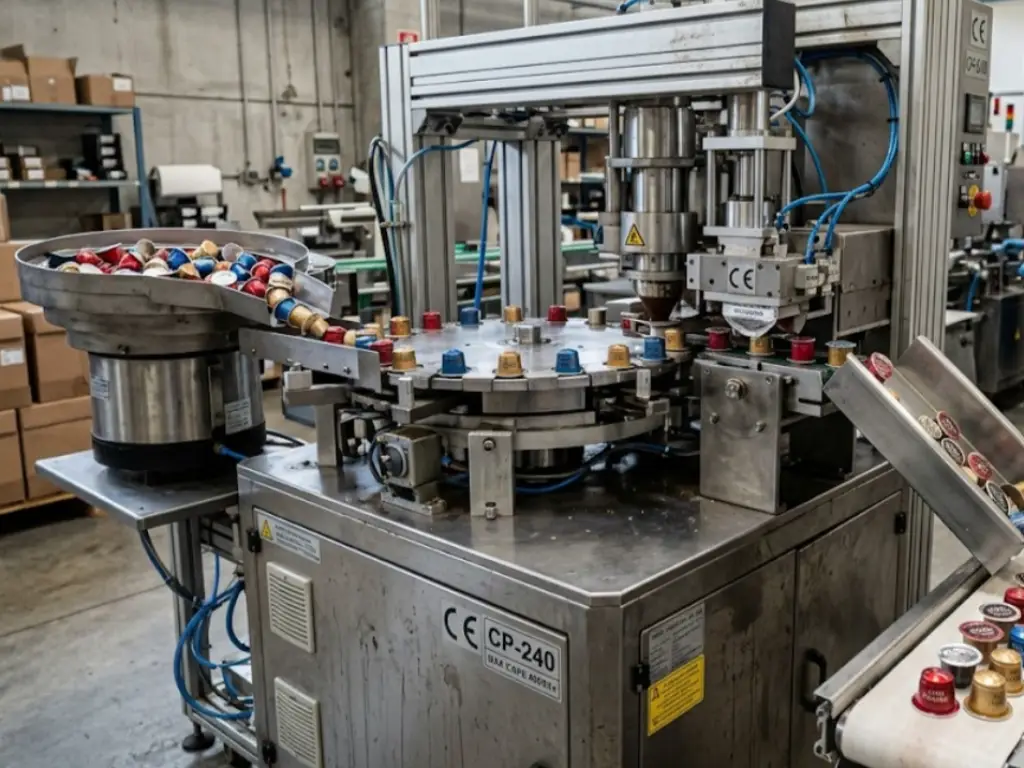
Capsule machines show the widest price spread in coffee packaging, and for good reason: the category spans from a home-roaster sealing 20 capsules a day to a co-packer running 12,000 per hour. Here's how the tiers break down:
- Manual sealers ($300–$2,000): 1–7 capsules per minute. Tabletop units for R&D, farmers' market batches, or testing a capsule concept before committing capital.
- Semi-automatic machines ($2,000–$15,000): 5–30 capsules per minute. Where most small roasters and startup brands land. Nitrogen flushing becomes available as an add-on (typically $3,000–$8,000 extra).
- Fully automatic systems ($15,000–$60,000): 30–80 capsules per minute. Automated capsule feeding, lid dispensing, and reject stations. The workhorse tier for established co-packers.
- High-speed rotary machines ($60,000–$100,000+): Up to 12,000 capsules per hour. Continuous-motion with 6–8 synchronized servo axes. Nitrogen flush reaches 99.9% — translating to 12 months of shelf stability vs. 6 months at 99.5%.
The jump from $15,000 to $60,000 isn't arbitrary — it's driven by servo motor count, the nitrogen delivery subsystem, and in-line weigh-cell feedback that auto-corrects dosing mid-run.
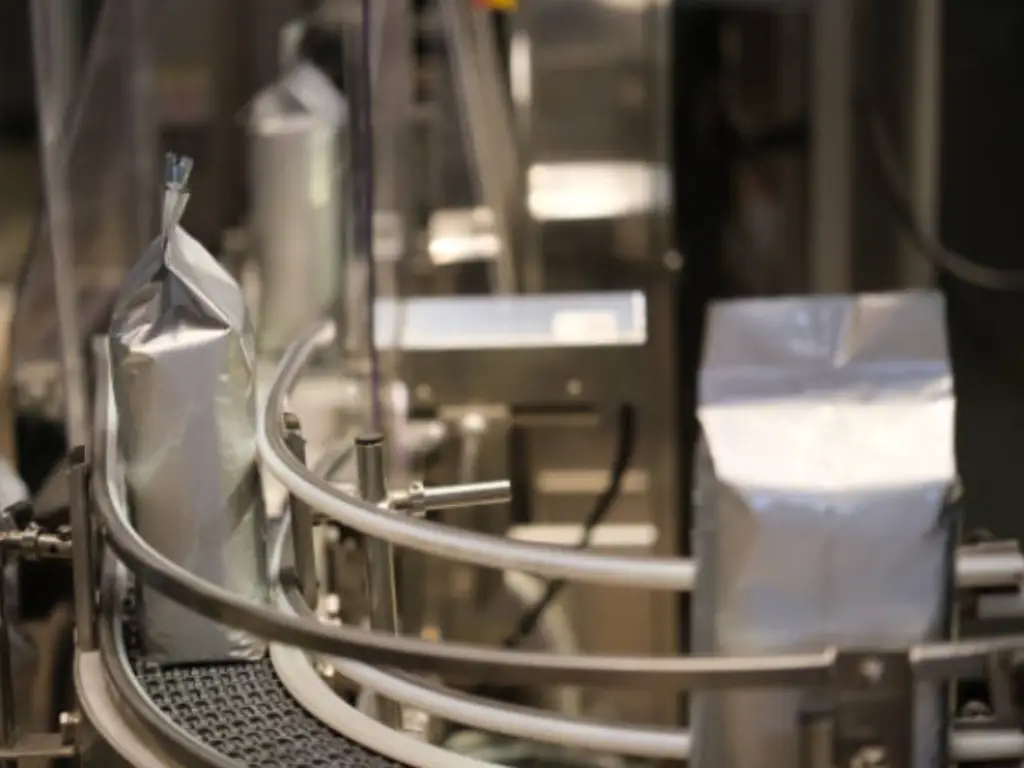
Bag & Pouch Packaging Machines — Entry at $3,000, Scaling to $140,000+
Bagging equipment covers an enormous range because "a bag" can mean a simple pillow sachet or a premium resealable doypack with a one-way degassing valve.
VFFS — $3,000 to $90,000: Entry-level VFFS-320 models start around $3,000. Mid-range VFFS-420/520 machines ($18,000–$40,000) add servo-driven film tracking and multi-head weigher compatibility. Top-end VFFS-720/920 machines ($50,000–$90,000) handle large-format bags up to 5–10 kg.
HFFS — $4,500 to $140,000+: These cost 20–50% more than equivalent VFFS, but unlock premium formats: zippers, doypacks, and one-way degassing valves. That valve applicator alone adds $8,000–$25,000.
Stick pack multi-lane — $15,000 to $80,000+: Speed champions. A 12-lane system hits 600 sticks/min. Multi-lane designs save ~30% on film material vs. single-lane equivalents.
Complete Packaging Lines & Canning Systems — The $100,000+ Tier
When single machines aren't enough, you're in line territory. A complete bagging line typically runs $150,000–$500,000+. Coffee canning lines: standalone powder can filler $30,000–$150,000, liquid canning $25,000–$120,000, full lines start at $200,000+.
Price by Production Scale: What Should You Budget?
The machine-type view is useful, but most buyers think in terms of "what can I afford at my size?" Here's the production-scale lens — match your daily output to find your budget band.
Small Scale (0–50 kg/day) — Budget $300 to $15,000
If you're a micro-roaster, a startup coffee brand, or a farm exploring direct-to-consumer packaged sales, you're in this tier. Start with a manual sealer ($300–$2,000) for validation. Once doing 1,000+ capsules or 200+ bags a month, a semi-automatic ($2,500–$8,000) makes sense. A realistic starter setup lands between $5,000 and $15,000. Most equipment in this tier runs on single-phase 220V and fits in under 2m².
You don't need an industrial facility to begin. Most entry-level machines run on standard single-phase power and fit in under 2m² of floor space.
Medium Scale (50–500 kg/day) — Budget $15,000 to $80,000
This is the established roaster or growing co-packer tier. You have consistent orders and need reliability, not just capability. Representative budget anchors:
- Fully automatic capsule machine with nitrogen flush: $18,000–$35,000
- VFFS-420/520 with multi-head weigher: $18,000–$40,000
- Standalone powder can filler: $30,000–$60,000
- Complete medium-scale line total: $40,000–$80,000
At this scale, servo-driven dosing (accuracy ±0.5g → ±0.1g), nitrogen flushing (shelf life doubles), and in-line checkweighing genuinely pay for themselves. A roaster doing 200 kg/day typically recovers a $35,000 VFFS investment in under two years.
Large Scale (500+ kg/day) — Budget $80,000 to $500,000+
At this volume, the conversation shifts from "what does the machine cost?" to "how fast does it pay for itself?" A $100,000 machine that saves $30,000/year in labor and $10,000/year in material waste pays back in 2.5 years — after that, it's pure margin.
At 500+ kg/day, you're not buying a machine — you're buying deterministic production capacity. The metric that matters is cost per unit packed, not the equipment sticker price.
What Drives Coffee Packaging Machine Pricing: 5 Factors That Move the Needle
Knowing the price ranges is step one. Understanding why one $15,000 machine and another $40,000 machine look similar on a spec sheet but differ by 2.7× in price — that's what makes you a smart buyer.
Technical Specs That Directly Impact Cost
Five technical levers account for the majority of price variation:
- Throughput and servo axes. Each additional servo axis adds $3,000–$8,000. Doubling throughput increases price by 40–70%. A 6-axis rotary filler is a fundamentally different class of machine from a 2-axis semi-auto.
- Filling precision. ±0.1g servo auger costs 2–3× vs. ±0.5g volumetric. For 500,000 capsules/month, that 0.4g gap = ~$3,500/month in product give-away.
- Nitrogen flushing. Basic: $3K–$5K. High-precision 99.9%: $8K–$15K. The 0.4% gap = 6 months of extra shelf life.
- Material grade. 304 stainless: +30–50% vs. carbon steel. 316L food-contact: +15–20% more. Carbon steel in a humid roastery corrodes within 18 months.
- Format flexibility. Multi-format VFFS costs 30–50% more than single-format. Tool-free changeover adds mechanical complexity.
Why Geography Changes the Price Tag — China vs. Europe vs. Japan
Chinese-made machines ($3,000–$100,000) cost 30–50% less than European equivalents at the same Siemens/Schneider spec — a labor and supply chain differential, not a quality discount. European machines ($20,000–$250,000+) carry precision legacy and local support premiums. Japanese machines ($40,000–$200,000+) are the precision play with lower fault rates.
Practical math: European lead times 12–20 weeks vs. Chinese 10–60 days. U.S. buyers pay 25% Section 301 tariff on Chinese machines; EU duties are 0–2.7%. A $30,000 Chinese machine lands at ~$39,000 after freight and duties — still below a $60,000 European equivalent.
The Invisible Price: Warranty, Support, and Spare Parts
A 2-year warranty vs. the industry-standard 1 year carries ~5–8% implicit value. But downtime is the real cost: a 2–4 week spare parts wait = $7,000–$14,000 in lost production at $500/day. Remote video diagnosis resolves 80–90% of issues without on-site visits. When evaluating suppliers, warranty terms and support speed should carry at least 20% decision weight alongside specs and price.
A $7,000–$14,000 production loss from waiting 2–4 weeks for a spare part can exceed the entire price gap between two competing suppliers. Factor support infrastructure into your purchase decision.
Hidden Costs No One Tells You About
Most price tags only tell half the story. Here are five costs that appear after you sign:
- International freight and port fees: $1,500–$8,000. A 40-foot container fits 4–10 machines. Don't forget customs brokerage and last-mile trucking.
- Import duties and VAT: 25% Section 301 for U.S. buyers of Chinese machinery. EU duties 0–2.7%, VAT 17–27%. Confirm the HS code before calculating landed cost.
- Installation and training: $500–$2,000/day over 2–5 days, plus $1,000–$3,000 travel. Remote-guided install increasingly common and cheaper.
- Facility readiness: Three-phase 380V power: $2,000–$10,000. Compressed air system: $1,500–$5,000.
- Annual consumables: Sealing bands, cutting blades, lubricants, filters: $500–$3,000/year.
Hidden costs add 15–35% to the sticker price. A $20,000 machine realistically costs $27,000–$32,000 installed. Build that buffer in from day one.
How to Evaluate a Quote: Questions Every Buyer Should Ask
You've seen the price ranges. You understand the cost drivers. Now, here's your due diligence checklist.
Machine Specification Verification:
- "What actual output was this machine tested at — and with what product, fill weight, and material?"
- "Under what conditions is filling accuracy guaranteed? If I change grind size, does it hold?"
- "Are all food-contact surfaces 304 or 316L stainless steel? Material certificates?"
- "What is changeover time, and does it require tools?"
After-Sales Infrastructure:
- "What exactly does the warranty cover — and what's excluded?"
- "How quickly do spare parts ship? Emergency parts?"
- "Is remote support free, and what's the typical response time?"
Hidden Fee Audit:
- "Is the quoted price FOB, CIF, or DDP? Who bears port charges and customs?"
- "Are installation, commissioning, and training included?"
- "Can you provide a customer reference in my country running this model?"
Red flags: quote >40% below market, no customer reference in your region, vague warranty terms.
- Verify machine specs with real test conditions — not spec-sheet best-case numbers
- Confirm warranty coverage, spare parts dispatch speed, and remote support availability
- Get a running customer reference in your country before signing any purchase order
If you're building your shortlist, SANEU offers a catalog of coffee packaging machines spanning capsule fillers, VFFS, and canning lines — with certified 99.9% nitrogen flush capability and a 30% cost advantage at equivalent Siemens/Schneider specification. Their technical team provides free sample testing before purchase so you can verify machine compatibility with your specific coffee product.
References
- SANEU. "Technical Support." https://www.saneu.com/technical-support/
- SANEU. "First Time Buyer." https://www.saneu.com/first-time-buyer/
- SANEU. Homepage. https://www.saneu.com/