If you roast and sell coffee, you already know this: packaging is not an afterthought. It separates a customer opening a bag that smells like fresh-roasted heaven from one opening a bag that smells like cardboard. The machine you choose to package your coffee powder determines consistency, shelf life, and — most critically — whether your product arrives the way you intended it.
But searching for a coffee powder packaging machine online is a disorienting experience. Hundreds of listings, overlapping specs, prices that span $2,800 to $100,000, and not one source that helps you understand which category of machine actually fits your operation. This guide closes that gap.
Types of Coffee Powder Packaging Machines
Before diving into each type, ask yourself three questions: How many kilograms of coffee powder do I package per day? What bag style do my customers expect — pillow pouch, stand-up pouch, or stick sachet? And what's my budget ceiling — not just for the machine, but for installation, training, and spare parts?
The right machine type depends entirely on your answers. Here are the three main categories.
Vertical Form Fill Seal (VFFS) Machines — The All-Rounder
A VFFS machine is the most common coffee powder packaging solution, and with good reason. It performs every step in one continuous motion: film unwinding → bag forming → product dosing → sealing → cutting. Roll stock goes in one end, finished bags come out the other.
VFFS machines come in two motion modes. Continuous motion is built for speed — 60 to 90 bags per minute — and works best with free-flowing coffee powder that settles quickly. Intermittent motion runs slower, typically 30 to 50 bags per minute, but handles fine-ground powders that generate static electricity and resist smooth flow. If your grind is espresso-fine, intermittent mode gives the powder the extra moment it needs to settle into the bag.
Most VFFS machines support multiple bag formats — pillow, gusseted, three-side seal, four-side seal — and handle fill weights from as little as 1 gram up to 2,500 grams. Tool-free changeover systems let operators switch bag sizes in under five minutes without wrenches, a feature worth paying for if you run multiple SKUs.
| Motion Mode | Speed (bags/min) | Best Powder Type | Typical Price Impact |
|---|---|---|---|
| Continuous | 60–90 | Free-flowing, coarse grind | Baseline |
| Intermittent | 30–50 | Fine/espresso grind, static-prone | +$1,000–3,000 |
Auger Filler Machines — The Precision Specialist
An auger filler is technically a dosing unit, not a standalone packaging machine — but the choice of filler dictates your fill accuracy, and fill accuracy dictates your profit margin. That makes it worth its own category.
The core difference is straightforward. A volumetric cup filler scoops coffee powder by volume — fast, simple, and accurate to about ±1 to 2 grams. An auger filler uses a servo-driven screw to dispense powder by weight, achieving ±0.1 gram accuracy. For a 250-gram bag, ±2 grams means you give away nearly 1% of your product per bag. Package 100,000 bags a year and that comes to roughly 200 kilograms of coffee powder you never charged for.
The auger screw material and pitch need to match your powder. Fine espresso-grind coffee is acidic and slightly abrasive — 304 stainless steel is the minimum acceptable food-contact grade, and 316L is preferable for long-term corrosion resistance. A tight screw pitch controls dust and prevents blow-back during high-speed dosing; a wider pitch keeps coarse grind flowing without clogging.
If you already own a bagging machine and only need to upgrade your dosing precision, a standalone auger filler can be integrated into an existing line — a far cheaper path than replacing the entire system.
Stick Pack & Multi-Lane Machines — The High-Volume Solution
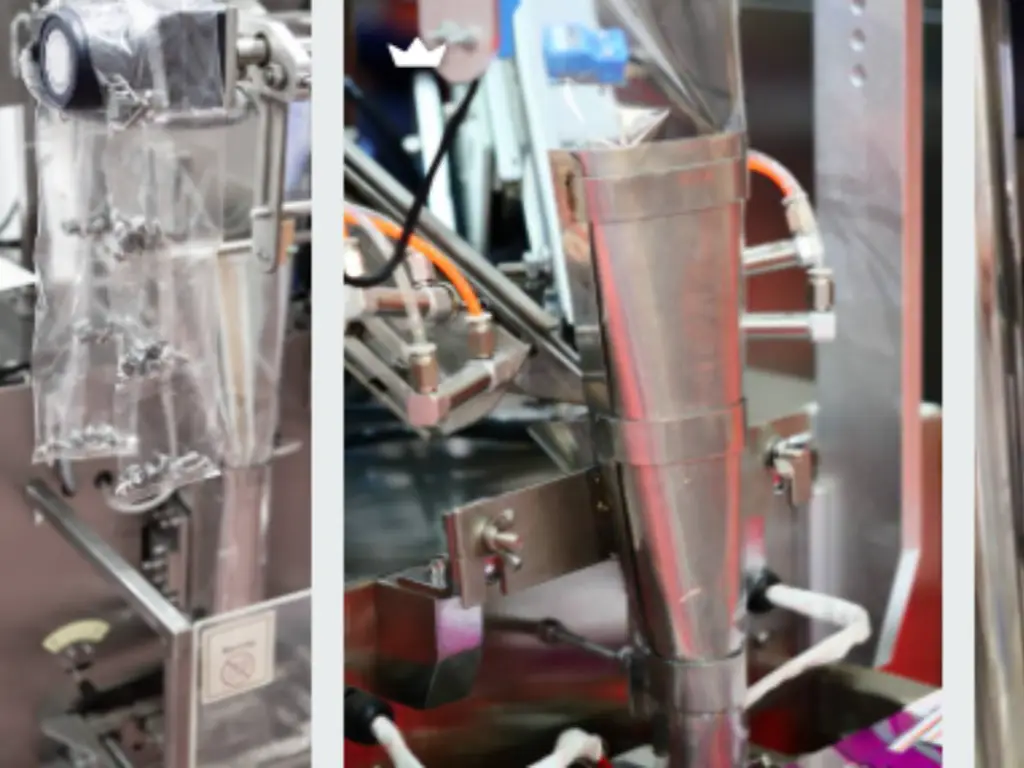
When daily production crosses roughly 500 kilograms, a single-lane VFFS becomes the bottleneck. Multi-lane stick pack machines solve this by running 4, 8, or even 12 lanes simultaneously — each lane forming, filling, and sealing its own sachet. A 4-lane machine operating at 50 to 80 sticks per minute per lane delivers 200 to 320 finished sachets per minute. A 12-lane configuration pushes past 600 per minute.
Stick packs also save on material. Compared to a four-side-seal pouch of equivalent volume, a stick pack uses roughly 30% less packaging film — a savings that compounds across millions of units. The vertical format also takes up less floor space per unit of output than a comparable VFFS setup.
The trade-off is changeover complexity. Switching bag width on a multi-lane machine means replacing the forming tubes, adjusting the knife assemblies, and re-registering the film on every lane — budget 30 to 45 minutes with an experienced operator. For a roaster running the same 10-gram single-serve stick pack year-round, this is irrelevant. For a co-packer switching between three bag formats daily, it is a real operational cost.
Quick self-check: If you package < 50 kg/day → single-lane VFFS. 50–500 kg/day → VFFS + auger filler. 500+ kg/day → multi-lane stick pack or multiple VFFS lines.
Key Specifications That Determine Machine Performance
A specification sheet looks like an engineer's checklist, but it is your risk-control document. Each number on that sheet answers a question about your operation. Here are the five that matter most — and what happens when you ignore them.
Fill Accuracy (±0.1g vs ±1g). Servo-driven auger fillers achieve ±0.1 gram; volumetric cup fillers deliver ±1 to 2 grams. For a 250-gram bag, the difference is 0.04% versus 0.8% giveaway per unit. Over a year of production, that gap represents real money. But accuracy is not free — servo-driven systems add $2,000 to $5,000 to the machine cost.
Packaging Speed (bags/min). Match speed to your daily production target. A single-lane VFFS running 40 bags per minute at 250 grams per bag produces 600 kilograms per hour — meaning a 200-kilogram daily requirement is handled in 20 minutes of runtime. Buy more speed than you need and you have overpaid for capacity that sits idle. Buy too little and you are running overtime to meet orders.
Bag Size Range. Most VFFS machines handle bag widths from 50 to 420 millimeters, covering single-serve sachets up to family-size pouches. The range you need depends on your product line — if you only sell 250-gram bags today but might launch 1-kilogram bulk bags next year, buy a machine that covers both.
Material Compatibility. Coffee packaging film is typically a multi-layer laminate: PET for printability, aluminum foil for oxygen barrier, and PE for heat sealing. Your machine must handle this structure without delaminating the layers during sealing. If you plan to offer biodegradable or compostable packaging — an increasingly common request from specialty coffee buyers — confirm that the machine's sealing jaws can handle bio-film temperature windows, which are narrower than conventional PE.
Nitrogen Flush Capability. Ground coffee releases CO₂ and oxidizes on contact with ambient air. Nitrogen flushing displaces oxygen inside the package before sealing, extending shelf life from weeks to months. A nitrogen flush system typically adds $2,000 to $5,000 to the machine cost. Look for residual oxygen levels below 1% post-flush — this is the threshold where meaningful shelf-life extension begins.
- Fill accuracy: ±0.1g with servo auger — or accept 200 kg/year giveaway
- Speed: match bags/min to daily kg target — don't buy idle capacity
- Bag width: 50–420mm covers single-serve to family size
- Material: PET/AL/PE laminate — confirm bio-film compatibility if needed
- Nitrogen flush: residual O₂ below 1% for meaningful shelf-life gain
| Specification | Entry-Level Range | Mid-Range | High-End | What the Upgrade Buys You |
|---|---|---|---|---|
| Fill Accuracy | ±1–2g | ±0.5–1g | ±0.1g | Less giveaway, higher product consistency |
| Speed | 20–40 bpm | 40–80 bpm | 80–120+ bpm | Fewer shifts, scalable output |
| Bag Width | 50–250mm | 50–380mm | 50–420mm | More SKU flexibility |
| Nitrogen Flush | Not available | Optional add-on | Integrated | Extended shelf life |
| PLC Brand | Domestic/Taiwan | Mitsubishi/Delta | Siemens/Omron | Reliability, local service availability |
What Affects Coffee Powder Packaging Machine Price
The price range is wide for a reason. A $3,000 VFFS and a $30,000 VFFS may look similar in photos, but they differ in ways that determine whether the machine runs reliably for three years or needs constant maintenance after six months.
| Machine Tier | Price Range (USD) | Typical Speed | Fill Accuracy | Best For |
|---|---|---|---|---|
| Entry-Level VFFS | $2,800–$5,000 | 20–40 bags/min | ±1–2g | Startups, small roasters testing the market |
| Mid-Range VFFS | $5,000–$15,000 | 40–80 bags/min | ±0.5–1g | Growing roasters, regional co-packers |
| High-End VFFS | $15,000–$40,000 | 80–120 bags/min | ±0.1–0.5g | Large roasters, industrial production |
| Stick Pack 4-Lane | $25,000–$50,000 | 200–320 bags/min | ±0.1–0.5g | Instant coffee, single-serve high volume |
| Stick Pack 12-Lane | $50,000–$100,000+ | 600+ bags/min | ±0.1–0.3g | Mass production, global brands |
What drives the price difference. The single biggest cost variable is the brand of core electrical components. A Siemens S7-1200 PLC plus a Schneider Lexium servo motor can account for 25 to 35 percent of the total machine cost — and a domestic Chinese alternative costs 40 to 60 percent less. The trade-off is not just durability; it is serviceability. If a Siemens PLC fails, a local automation technician in Chicago or Munich can source a replacement the same day. An obscure domestic brand means waiting for a shipment from China.
Other cost drivers include the number of servo axes (each additional axis adds precision but costs $800 to $1,500), stainless steel grade (304 is standard; 316L for acidic products adds 10 to 15 percent to material cost), and whether a nitrogen flush system is integrated or added as a bolt-on.
Hidden costs most first-time buyers miss. Ocean freight for a 1,000-kilogram machine from China to the United States costs roughly $800 to $1,500. Import duties on packaging machinery (HS Code 8422.30) vary by destination country — U.S. tariffs on Chinese machinery have fluctuated and currently hover around 25 percent. Installation and commissioning by a factory technician adds $200 to $500 per day plus airfare and accommodation, typically requiring three to five days for a single machine. Spare parts inventory — sensors, relays, sealing bands, forming tubes — should be budgeted at roughly five percent of the machine cost upfront. And operator training: budget at least one week for a team member to learn basic operation, troubleshooting, and changeover procedures.
How to Evaluate a Manufacturer Beyond the Spec Sheet
Five suppliers can quote you machines with identical-looking spec sheets — same speed, same accuracy, same bag range. The difference hides in what they do not print.
Component Brands — The Quality You Can't See
Open the electrical cabinet. If you see Siemens, Schneider, Mitsubishi, Omron, or SMC — these are global brands with local distributors in most countries. Replacement parts and service are one phone call away. If you see brands you do not recognize, ask the supplier where replacement parts are stocked and what the typical lead time is for a PLC or servo drive replacement.
Pneumatic components matter especially for coffee powder — fine dust is abrasive and can clog cheap cylinders within months. SMC or Festo pneumatic systems are sealed to IP65 or higher, extending service intervals. Sensors from Omron or Keyence maintain calibration longer than generic alternatives, which directly affects fill accuracy over time.
| Component | Industry Standard | Acceptable Alternative | Warning Sign |
|---|---|---|---|
| PLC | Siemens S7-1200 / Mitsubishi FX5U | Delta | Unbranded or obscure domestic |
| Servo Motor | Schneider Lexium / Panasonic Minas | Delta / Yaskawa | No-name servo with no local distributor |
| Pneumatics | SMC / Festo | AirTac | No-brand cylinders |
| Sensors | Omron / Keyence | Autonics | Generic sensors with no calibration cert |
| HMI Touchscreen | Siemens / Weintek | Kinco | Non-English interface, no remote access support |
Certifications and Quality Control — Proof, Not Promises
Certifications are the one dimension of supplier evaluation you can independently verify. Not all certifications carry equal weight.
A CE mark can be either a manufacturer's self-declaration or a third-party certification from a notified body like TÜV, SGS, or Intertek. A self-declared CE mark means the manufacturer claims compliance; a TÜV-certified CE mark means an independent lab tested the machine and confirmed compliance. Ask to see the certificate number and verify it on the certifier's website.
For the North American market, an FDA registration number can be verified on the FDA's public database. For Canada, CSA certification must be issued directly by the CSA Group — it cannot be self-declared. ISO 9001:2015 certification can be validated through the issuing body's certificate lookup portal.
Beyond paper certifications, ask about the manufacturer's quality control process on your specific machine. A legitimate manufacturer will describe multi-stage testing: functional testing (load/unload, speed, accuracy, safety system verification), performance testing (efficiency, productivity against spec), and packaging-specific testing (weight accuracy across 50 consecutive bags, seal integrity at different temperatures). If their answer is "we test every machine before shipping" without specifics, that is a data point — not a dealbreaker, but a data point.
After-Sales Support — The Test That Comes After Payment
Every packaging machine will need service eventually. The question is not whether. It is whether the supplier can get you running again before your orders back up.
The industry standard warranty is one year. A two-year warranty signals confidence in build quality and reduces your risk during the period when manufacturing defects are most likely to surface. Beyond warranty length, ask three specific questions: (1) How quickly do you ship standard replacement parts — same day, next business day, or "depends on stock"? (2) Do you offer remote video diagnosis, and what is your typical response time? (3) If you need a technician on-site, what is the cost and lead time?
A supplier with a global distributor network tips the equation in your favor. Local distributors can often provide free annual inspection visits and faster parts delivery than waiting for international shipping from the factory. Consider how some manufacturers operate: standard spare parts like sensors and relays ship within one business day from a centralized warehouse. Lifetime technical support is available via video call or messaging app. Distributor partnerships span the United States, United Kingdom, Italy, Hungary, Thailand, Singapore, and across the Middle East — a support footprint worth comparing against any supplier you evaluate. Whichever manufacturer you choose, confirm that at minimum four baselines are met: warranty of at least one year (preferably two), spare parts response within two business days, remote support with a two-hour response window, and a clear path to on-site technician dispatch when needed.
- Spare parts: How quickly do standard parts ship? (Target: 1–2 business days)
- Remote support: Do you offer video diagnosis, and what's the response time? (Target: <2 hours)
- On-site technician: What's the cost and lead time if I need someone on my floor? (Target: clear pricing, local partner preferred)
First-Time Buyer's Roadmap: From Research to Installation
You now understand the machine types, the key specs, the price tiers, and how to evaluate a supplier. What follows is how to turn that knowledge into a machine on your production floor — in five steps.
Step 1: Define Your Requirements. Write down four numbers: your daily production volume in kilograms, your target bag weight, your preferred bag style, and your budget ceiling (machine + shipping + installation + spares). This one-page brief is what you will send to suppliers — and it prevents them from steering you toward machines that do not fit.
Step 2: Request Sample Testing. Send your actual coffee powder and your actual packaging film to each shortlisted supplier. Ask them to run a production demo on video and provide a weight accuracy report from at least 50 consecutive bags. A supplier who hesitates — or who asks you to pay for the sample test — is flagging something. Reputable manufacturers offer free sample testing as a standard pre-sales service.
Step 3: Compare Quotes Beyond Price. Lay out quotes side by side using the evaluation framework from the previous section: component brands, certifications, warranty terms, spare parts response time, and installation support. A $3,000 machine with no local support and a 6-month warranty costs more than a $5,000 machine with a 2-year warranty and same-day parts shipping — once you factor in downtime.
Step 4: Negotiate Terms and Timeline. Lock in: delivery date (standard machines typically ship in 10 to 30 days, custom builds in 35 to 60 days, plus 15 to 30 days ocean freight), warranty terms in writing (including what is covered and what is excluded), spare parts list included with the machine, and installation and training cost and duration.
Step 5: Plan for Installation and Training. A machine arriving at your dock is not the same as a machine running on your floor. Budget three to five days for a single machine installation and commissioning, or seven to fourteen days for a full production line. Allocate at least one week for operator training — one person dedicated to learning startup, shutdown, changeover, basic troubleshooting, and daily cleaning. A well-trained operator prevents roughly 80 percent of service calls.
A good supplier makes every one of these five steps straightforward — free sample testing, a detailed quote within 24 hours, clear delivery timelines, and installation support through a local partner when possible. Before you send your first inquiry, find a supplier who can walk you through the entire journey, from sample test to a trained operator running the machine on your floor, without making any step feel like an afterthought.
Before you request your first quote, prepare your product sample and packaging film. A supplier who offers free sample testing with a detailed weight accuracy report is demonstrating confidence in their equipment — and saving you from buying a machine that does not match your product. Start by contacting a manufacturer who responds within 24 hours with a clear, itemized quote and a timeline you can plan around.
References
- Made-in-China. “Coffee Powder Packaging Machine Listings.” 2025. https://www.madeinchina.com/
- Machinio. “Coffee Packaging Machinery Marketplace Listings.” 2025. https://www.machinio.com/
- International Organization for Standardization. “ISO 9001:2015 Quality Management Systems — Requirements.” 2015. https://www.iso.org/standard/62085.html
- U.S. Food and Drug Administration. “CFR — Code of Federal Regulations Title 21, Part 110.” https://www.accessdata.fda.gov/scripts/cdrh/cfdocs/cfcfr/CFRSearch.cfm?CFRPart=110