The professional K-Cup filling and sealing process is far more complex than one might imagine.
From the feeding of empty cups, through filter paper installation, precise coffee powder dosing, nitrogen flushing, and heat sealing, all the way to automated inspection and final packaging, the entire process involves multiple systems—including mechanical control, food safety, residual oxygen control, heat sealing technology, and automated visual inspection.
Even the slightest issue can result in the entire batch of coffee capsules being scrapped.
This article provides a comprehensive analysis of the filling and sealing process for K-Cup coffee capsules, covering everything from production workflows and common issues to core equipment and packaging-compatible materials, offering insight into how a single K-Cup coffee capsule is manufactured in a factory and delivered to consumers.
What Is the K-Cup Filling and Sealing Process?
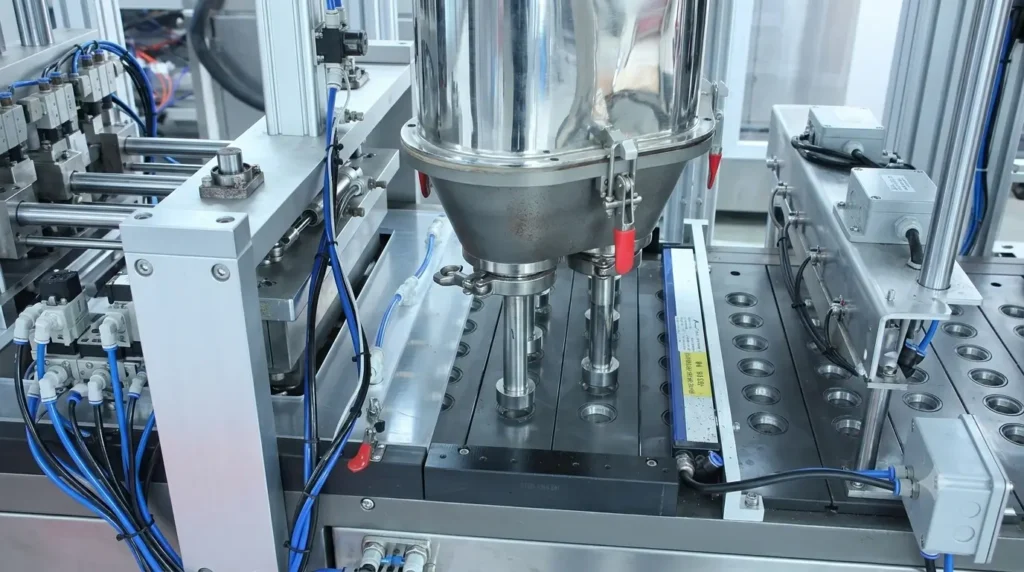
Filling and sealing K-Cup coffee pods is a relatively complex process. Don’t assume that it’s as simple as filling the pod with coffee grounds and sealing it shut. That’s just the most basic understanding of the process.
In reality, the production process for K-Cup coffee capsules involves multiple stages, including measurement accuracy, nitrogen flushing, sealing temperature, filter paper structure, residual oxygen control, and cup stability.
Every step requires meticulous attention to detail, because a problem at any stage can result in the entire production line being scrapped. Even if these defective products are eventually sold at a discount as part of a bundled package with other products, the losses cannot be recouped.
Let’s analyze the production process using the most intuitive approach:
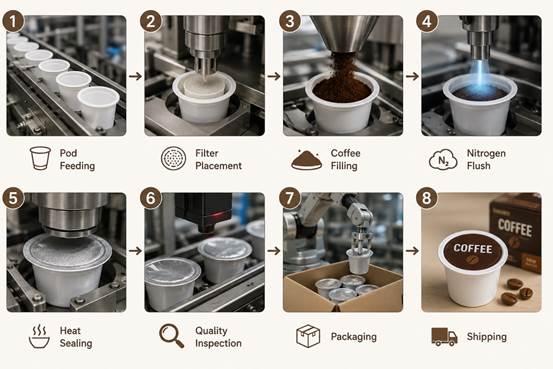
Loading Empty Cups
The coffee capsule filling machine first arranges empty K-Cups neatly on a conveyor track and feeds them into the first stage of the process.
Inserting the Filter Paper or Mesh
Before filling the cups with coffee grounds, the filling machine uses heat-sealing technology to insert a filter mesh into each cup to trap grounds during brewing.
Filling with coffee grounds
At this stage, the filling machine uses metering technologies such as screw metering, electronic weighing, or a measuring cup system to fill the K-cups with pre-weighed coffee grounds.
This step significantly impacts the coffee’s flavor; any measurement error can result in inconsistent coffee powder content across K-Cup capsules, thereby affecting the taste.
In severe cases, it can even impact consumers’ perception of the brand.
Therefore, to keep measurement errors within ±0.1g, a high-quality K-Cup coffee capsule filling machine is essential.
Nitrogen Flushing
If precise measurement of coffee grounds is key to coffee flavor, then nitrogen flushing is the decisive factor.
Consider this: if the coffee grounds vary in quantity, the flavor may still be present, albeit slightly weaker. However, if proper preservation is not maintained and oxygen infiltrates the pod, the coffee is essentially spoiled—it’s not merely a matter of a weaker taste.
The filling machine injects high-purity nitrogen into the K-Cup to displace oxygen.
For K-Cup coffee capsules, only a filling machine capable of filling nearly 100% (i.e., 99.9%) with nitrogen can produce high-quality coffee capsules.
This is because standard equipment can only fill approximately 98% with nitrogen.
Don’t underestimate that 1% nitrogen—it’s not only the key distinction between standard and high-end filling machines, but also what sets ordinary coffee capsules apart from high-quality ones.
Heat Sealing
K-Cups typically use aluminum foil heat-sealing technology.
The filling machine first covers the cup with the sealing film, then completes the seal via a heat-press system at preset sealing temperature, pressure, and time.
As everyone knows, if the seal is not tight, the package will leak air. But looking deeper, if the seal is too loose, it will cause air leakage; if it is too tight, it will make the sealing film difficult to tear open. Therefore, special attention must be paid to the sealing pressure.
If the temperature is too low, the seal will not be tight; if the temperature is too high, the aluminum foil will melt.
If the sealing time is not controlled properly, wrinkles will appear at the edges of the aluminum foil.
All these issues can result in nitrogen loss, oxygen ingress, and reduced freshness, thereby significantly compromising the quality of the coffee grounds.
Automated Quality Inspection
This is a feature exclusive to high-performance K-Cup filling machines.
These inspection functions include: checking for a secure seal, detecting air leaks, verifying accurate coffee content, identifying cup deformation, detecting metal contaminants, and measuring residual product.
More advanced features include vacuum testing and visual inspection, capable of identifying even minor sealing defects.
Packaging and Shipping
Now that the primary nitrogen flushing and sealing processes are complete, the filling process is essentially finished. All that remains is to pack the filled K-Cup coffee capsules into boxes, apply inkjet coding, and affix labels. They are then shipped to major markets.
At this point, we have seen that behind every meticulously crafted K-Cup coffee capsule lies a seemingly simple yet actually complex filling process involving precise measurement, automated inspection, nitrogen flushing, heat sealing, and filter placement.
This is why we emphasize the need for high-quality filling machines for coffee capsules—only such machines possess these advanced features and can handle coffee capsules with greater precision and care.
Common Problems in K-Cup Filling and Sealing
K-Cup coffee capsules demand extremely high standards of sealing and freshness; even the slightest deviation can affect the tasting experience. For coffee enthusiasts, the key for a new coffee capsule brand to make a positive impression lies in the quality of the coffee, rather than blindly engaging in price wars or focusing solely on the aesthetics of the packaging.
Below is a list of issues we have identified; only by addressing these at the source can a brand gain market share.
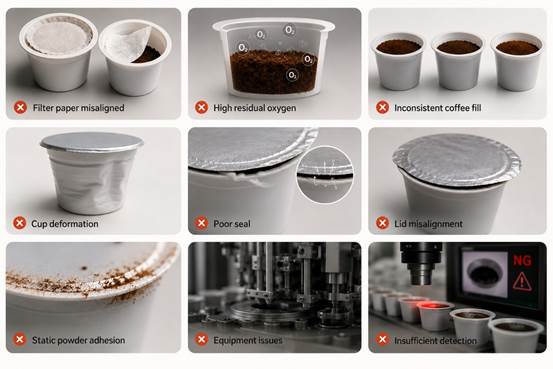
Improperly placed filter paper
If the filter paper is misaligned, loose, or not securely fastened, it will directly affect the extraction process.
Excessive residual oxygen
Despite nitrogen flushing, a significant amount of oxygen may remain inside the capsule, causing the coffee to continue oxidizing.
Inconsistent coffee grounds content
Some K-Cups are too strong, while others are too weak, due to inconsistent filling of coffee grounds.
K-Cup deformation
During the heat-sealing process, low-quality K-Cups may deform due to high temperatures.
Incomplete sealing
This is one of the most common issues in K-Cup production: the capsule surface appears sealed, but there are actually tiny air leaks along the edges. Air slowly enters the capsule, causing the coffee to oxidize and lose its aroma.
Sealing Film Misalignment
During high-speed production, the sealing film is prone to wrinkling.
Static Electricity-Induced Coffee Powder Adhesion
Coffee grounds are very light and are easily attracted by static electricity to the rim area of the cup in dry environments.
Equipment Issues
Many machines operate normally when first started up, but begin to develop errors after prolonged use.
Inadequate Inspection
Some minor air leaks are undetectable to the naked eye. If the filling machine lacks advanced quality inspection capabilities, defective products will enter the market directly. This not only leads to customer complaints and a surge in return rates but also damages the company’s reputation.
Machines Used for K-Cup Filling and Sealing
So, what equipment and systems are needed to complete the filling and sealing process for K-Cup coffee capsules?
I’m sure you already have the answer, as we’ve already outlined the complete production process earlier: the equipment required depends on the specific functions needed.
In fact, there’s no need to consider these devices individually, as they are all integrated into the K-Cup filling and sealing machine, forming a comprehensive, all-in-one filling and sealing solution.
Specifically, this includes the following two types of filling machines and ten pieces of equipment:
Types of K-Cup Coffee Filling Machines
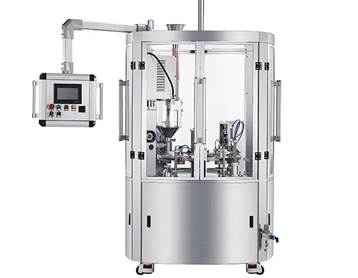
Semi-automatic K-Cup Filling and Sealing Machine: Semi-automatic, as the name implies, involves a combination of machine and manual labor. For example, SANEU’s SR-11 model requires manual loading and unloading of K-Cups, while the core workflow—filling and sealing—is performed by the machine.
This type of filling machine is characterized by its low cost and compact size, making it suitable for new brands planning to enter new markets; it can be said to offer a relatively low cost of trial and error.
Of course, for established K-Cup coffee capsule brands, this machine can also help reduce production costs.
| Advantages | Disadvantages |
|---|---|
| Lower cost, making it suitable for startups and small businesses to control initial investment. | Limited automation; equipment upgrades may be required as production scales up. |
| Compact footprint with low factory space requirements. | Certain production processes still require manual operation and assistance. |
| Greater flexibility when switching between different coffee powders, capsule sizes, or product types. | Frequent manual adjustments can reduce overall production efficiency. |
| Relatively easy to operate, making it ideal for new product testing and small-batch production. | High dependence on labor, and operator skill levels can affect production results. |
| Filling and sealing are automated, providing more stable performance than fully manual production. | Slower production speed, making it less suitable for large-scale orders. |
| Well-suited for small-batch and multi-product manufacturing. | Product consistency is generally lower than that of fully automatic systems. |
| Simple machine structure makes maintenance and cleaning easier. | During long production runs, manual processes can become production bottlenecks. |
| Lower upfront investment risk, making it ideal for market validation and early-stage business development. | As order volumes increase, production capacity may no longer meet demand. |
Fully Automatic K-Cup Production Line: This is a large-scale K-Cup filling machine designed primarily for factory use. Its greatest advantage is that it is fully automatic, requiring no manual loading or unloading of cups.
It can automatically load K-Cups, fill them, nitrogen-flush them, seal them, print codes, inspect them, and discharge them—making the entire process highly efficient.
For example, SANEU’s SK-4 K-Cup Filling Machine can produce up to 12,000 coffee capsules per hour.
If your brand has established recognition and a market share of over 10%, this fully automatic K-Cup coffee capsule filling machine will help you expand your business and increase profits.
| Advantages | Disadvantages |
|---|---|
| Fully automatic operation significantly reduces labor requirements. | Higher initial equipment investment cost. |
| High production speed, making it suitable for large-scale continuous production. | Requires more factory floor space. |
| Automatically performs cup feeding, filling, nitrogen flushing, film sealing, coding, inspection, and product discharge. | Maintenance and technical requirements are more complex. |
| High filling accuracy ensures better product consistency. | Product changeovers and machine setup adjustments can take longer. |
| Improves production efficiency while reducing long-term labor costs. | Not ideal for small-batch production. |
| Suitable for businesses with stable orders and established brand presence. | Energy consumption is typically higher than that of semi-automatic equipment. |
| Supports long continuous operation and can enable 24-hour production. | Equipment failures may affect the entire production line. |
| Helps improve product quality and enhance a professional brand image. | Operators usually require professional training. |
| Ideal for companies looking to expand production capacity and increase profit potential. | The return on investment period may be longer for new brands. |
Top 10 Key Equipment:
Screw Metering and Filling System
Coffee grounds are not a liquid, so they cannot be filled directly like beverages. Most K-Cup filling machines use a screw metering system, which feeds a fixed amount of coffee grounds into the capsule by rotating a screw.
Nitrogen Filling System
This is the most critical system in high-end K-Cup coffee capsule production. As you likely already know, nitrogen is essential for maintaining the freshness of coffee capsules.
Heat Sealing System
The quality of the seal directly determines whether the capsule will leak. The heat sealing system firmly presses the aluminum foil onto the rim of the K-Cup by precisely controlling temperature, pressure, and time.
Automatic Cup Dispensing System
During high-speed production, manually placing coffee capsules is simply too time-consuming. Therefore, an automatic cup dispensing system is required to neatly arrange the coffee capsules and convey them to the workstation.
Vision Inspection System
During high-speed production, the human eye cannot inspect every single capsule, so many factories implement industrial vision systems. This system uses cameras to automatically check whether K-Cups are properly sealed, if there is any powder leakage, if the cups are deformed, and if the printing is correct.
Weight Checker
Some capsules may be filled but still contain an amount of coffee grounds that does not meet standards. A weight checker can automatically screen out coffee capsules that do not meet the required weight.
Coding Machine
K-Cup products require printing of the production date, batch number, expiration date, and even QR codes. Therefore, production lines are typically equipped with inkjet or laser coding machines.
Multi-Line High-Speed K-Cup Production Equipment
K-Cup production lines are scalable and not limited to a single line. Large-scale production facilities may even have two to eight production lines.
Back-End Packaging Equipment
After the capsules are sealed, back-end packaging is required. Common packaging equipment includes cartoning machines, bagging machines, palletizing machines, heat shrink wrappers, and case packers, which are responsible for packaging the final products.
PLC Intelligent Control System
The latest K-Cup coffee capsule filling machines even incorporate PLC control systems, allowing operators to directly set filling weight, sealing temperature, operating speed, production volume, and fault alarm thresholds, making them both convenient and efficient to use.
Compatible Materials for K-Cup Packaging
What exactly are K-Cups made of? Are they made of plastic? Are they made of food-grade materials? Are they harmful to human health? These are questions currently being discussed in many places.
Polypropylene
Many people worry that coffee capsules made of plastic are not environmentally friendly, and that the brewed coffee might even contain toxic substances. However, in reality, many K-Cup coffee capsules today are made of polypropylene (PP) plastic. This new eco-friendly material is heat-resistant and highly durable, making it highly compatible with Keurig coffee machines.
This is because these coffee machines use high-temperature hot water to extract coffee and apply pressure to the capsule shell. If the capsule is of poor quality, the plastic layer may soften or even rupture, causing the coffee to leak.
PLA Biodegradable Material
This is a new type of eco-friendly material made from plant-based raw materials such as cornstarch. In Europe and the United States, we may have seen many people promoting its environmental benefits, but it also has certain limitations. For example, its heat resistance is not as good as PP’s, and it becomes very soft at high temperatures.
Although it does not contain toxic substances, it may still result in a wasted cup of coffee.
Next, let’s turn our attention to the seal.
Seal Film
The layer on coffee capsules is primarily an aluminum foil composite film. We all know that oxidation causes food to spoil, but many people overlook the effects of moisture in the air and light. Aluminum foil composite film not only effectively blocks oxygen but also prevents the penetration of light and moisture.
Furthermore, the K-Cup sealing film is not composed of a single layer of aluminum but rather a multi-layered structure. This thin aluminum film consists of a PET layer, an aluminum foil layer, a heat-seal layer, and a printing layer.
Next, let’s turn our attention to the filter.
The filter inside the K-Cup coffee capsule
Its primary function is to prevent coffee grounds from entering the coffee machine. There are four material options available: non-woven fabric filters, food-grade filter paper, PET filters, and nylon filter materials.
If the filter material is of poor quality, it can cause the coffee to flow slowly or even lead to clogging.
Next, let’s look at the outside of the capsule.
Outer Packaging Materials
This refers to the secondary packaging of K-Cup coffee capsules, which involves placing them in nitrogen-filled pouches or well-sealed boxes. Common packaging types include nitrogen-filled pouches, aluminum foil outer pouches, high-barrier composite pouches, and cardboard boxes.
Conclusion
I’m sure you all understand by now that the K-Cup filling and sealing process is far more than just filling the cups with coffee grounds and sealing them.
From loading empty cups, installing filters, precise dosing, and nitrogen flushing, to heat sealing, automatic inspection, and final packaging, the entire production process is actually a highly complex system engineering endeavor.
Every step directly impacts the coffee capsule’s seal integrity, freshness retention, extraction consistency, and ultimately, the consumer’s drinking experience.
In today’s increasingly competitive capsule coffee market, consumers are no longer satisfied with coffee capsules that are merely drinkable; they place greater emphasis on the freshness of the coffee. Competition among brands is no longer limited to the coffee beans themselves but is increasingly reflected in the comprehensive capabilities of filling processes, equipment performance, and packaging materials.
In short, behind every high-quality K-Cup coffee capsule lies a high-performance K-Cup coffee capsule filling machine.
If you wish to expand or consolidate your presence in the K-Cup coffee capsule market, please feel free to contact Mr. Ken. As the CEO of SANEU, he possesses deep insights into the coffee capsule market. More importantly, he is a coffee enthusiast himself and holds extremely high standards for coffee quality.