
From Nespresso to Keurig, the secret behind the enduring success of the world’s top coffee capsule brands lies not only in the selection of coffee beans, but also in the preservation technology hidden beneath that thin foil layer.
As consumers’ expectations for capsule coffee flavor have risen, industry standards have evolved from simple sealing and packaging to a stage of precise control over residual oxygen levels.
Why choose high-purity nitrogen instead of simple vacuum sealing? How can we ensure that each capsule has a shelf life of over 12 months?
This article will take you behind the scenes of the coffee capsule production process, providing a comprehensive analysis of the principles of nitrogen-flushing preservation, the challenges involved, and future smart trends.
Why Do Coffee Capsule Packages Require High-Purity Nitrogen?
If freshly roasted coffee grounds are not stored promptly, they will oxidize.
Oxidation causes the coffee grounds to lose their original flavor. The taste of coffee brewed from freshly roasted grounds is completely different from that of coffee made from grounds that have lost their flavor. Coffee grounds that have been exposed to oxygen are no longer fresh.
In particular, once coffee beans are ground into powder, they come into contact with air from virtually every angle.
To address this issue, nitrogen has emerged as a solution. Nitrogen is an inert gas—colorless and odorless—that does not react with coffee grounds to cause oxidation. It acts like a protective shield, safeguarding the coffee grounds from oxidation.
Not only does it prevent the coffee grounds from oxidizing, but it also acts as a desiccant, blocking moisture from the air. This ensures the coffee grounds remain fresh, so even after several months, consumers can still enjoy the taste of freshly ground coffee when brewing.
Why is it necessary to use high-purity nitrogen?
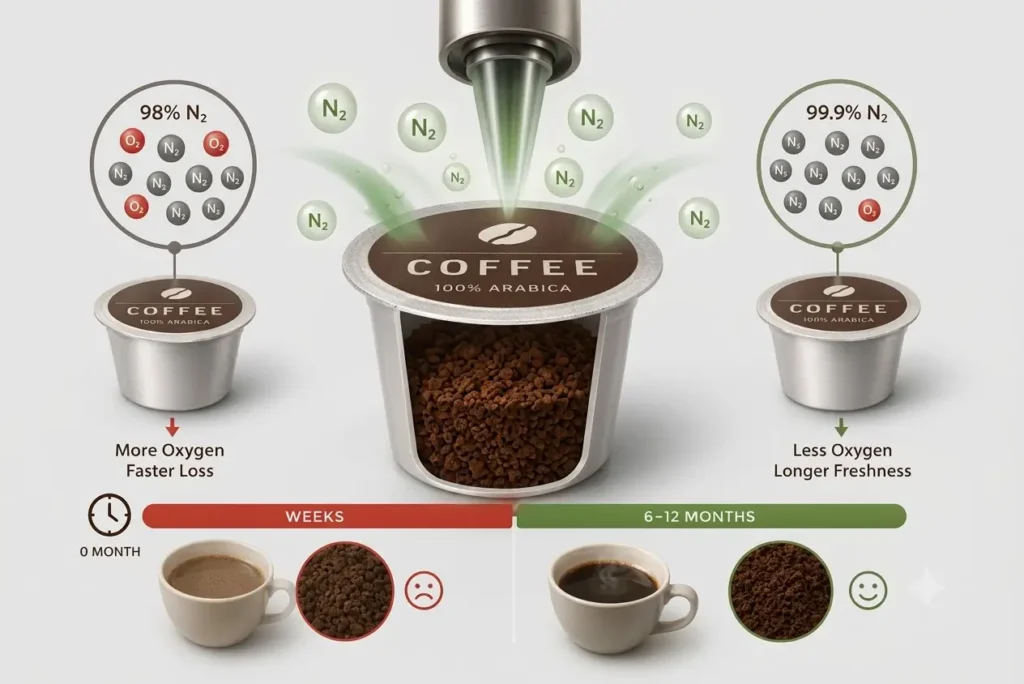
It’s not enough to simply fill coffee capsules with nitrogen. For coffee grounds, the nitrogen inside the capsule must be at least 99.9% pure to maximize freshness retention.
Otherwise, even if only 0.1% oxygen remains, it’s only a matter of time before the coffee grounds oxidize.
Many coffee capsule brands face this issue when they first enter the market: due to long shipping times and shelf life, by the time consumers brew the coffee, it tastes completely different from when it was freshly roasted—the flavor is weak and lacks any richness. This leads to negative reviews on social media, causing brands to lose market share and reputation.
Consequently, by 2026, nitrogen flushing technology had become standard practice for many coffee capsule brands. With nitrogen preservation, the shelf life of standard coffee capsules can be extended to over a year, eliminating concerns about spoilage.
Some might ask: what about vacuum preservation technology? The answer is that coffee capsules are not suitable for vacuum preservation technology. Although residual oxygen levels can be reduced to near-zero under vacuum conditions, this causes the coffee grounds to be compressed into a solid block, which negatively affects the flavor of the grounds.
For compressed biscuits, vacuum preservation technology is an economical and practical preservation method. However, for food products like coffee grounds that have high requirements for preservation technology, vacuum preservation technology can actually have the opposite effect.
What Does 99.9% Nitrogen Purity Mean?
A nitrogen purity of 99.9% means that 99.9% of the gas is nitrogen, while the remaining 0.1% consists of other gases, such as oxygen, water vapor, and carbon dioxide. Out of every 1,000 gas molecules, only one is an oxygen molecule.
In the coffee capsule packaging industry, this purity figure is critical because it directly affects the residual oxygen level inside the packaging.
What Is the Principle Behind Nitrogen Flushing in Coffee Capsule Packaging?
Three Types of Nitrogen Flushing Systems for Coffee Capsule Packaging.
1. Open Nitrogen Purge
This is the most basic and widely used method of nitrogen purging.
This method involves continuously blowing nitrogen into the coffee hopper, empty capsules, and the sealing area to dilute the oxygen in the surrounding air, thereby reducing the final residual oxygen content inside the capsules.
Since the entire purging process takes place in an open environment, a large amount of nitrogen is directly lost to the atmosphere.
Consequently, nitrogen consumption is high and the displacement efficiency is relatively low; the residual oxygen level inside the capsules after packaging is typically around 8% to 10%.
This method is suitable for products with modest freshness requirements, but its effectiveness in preserving the freshness of specialty coffee is limited.
2. Nitrogen Purge in a Sealed Chamber
This method involves filling and sealing coffee in a sealed nitrogen environment.
From the filling station to the sealing station, the equipment creates a sealed chamber and continuously injects high-purity nitrogen into it. As nitrogen continuously enters, the air originally present in the chamber is gradually expelled, achieving air displacement.
The entire process is similar to continuously filling a sealed container with nitrogen. As the nitrogen concentration increases, the oxygen concentration within the chamber continues to decrease. Once the oxygen concentration in the chamber drops to the preset value, the equipment begins normal production.
Since the capsules remain in a low-oxygen, high-nitrogen environment from filling through sealing, the gas retained after sealing is primarily inert nitrogen rather than ordinary air containing oxygen and moisture.
Compared to open-loop purging, this method not only reduces nitrogen consumption but also further minimizes coffee oxidation. Under normal circumstances, the residual oxygen level in the capsules can be controlled between 2% and 5%.
3. Vacuum + Nitrogen Filling
This is currently the most effective nitrogen-flushing technology for preserving freshness in coffee capsule packaging.
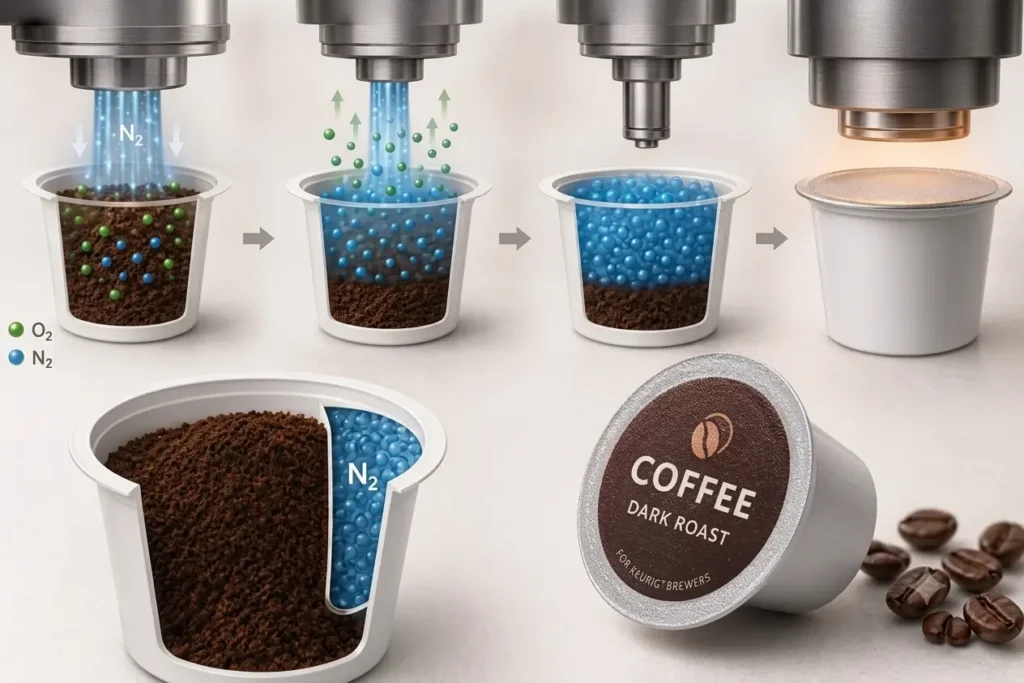
This technology first applies a vacuum to each capsule to remove as much of the original air inside as possible, then immediately fills the capsule with high-purity nitrogen and rapidly seals it.
Unlike the first two methods, which dilute the air with nitrogen, this method first removes the air directly and then fills the capsule with nitrogen, thereby minimizing the oxygen content inside the capsule.
With vacuum nitrogen-filling technology, the residual oxygen level in the capsules can be reduced to less than 1%, thereby maximizing the delay of the coffee’s oxidation process, preserving its aroma, flavor, and freshness, and significantly extending the product’s shelf life.
However, because it requires a vacuum system and higher-precision control devices, the equipment costs for this solution are relatively high; therefore, it is typically used in production lines for high-end coffee capsules or by brands with extremely high freshness requirements.
How Is 99.9% Nitrogen Purity Achieved?
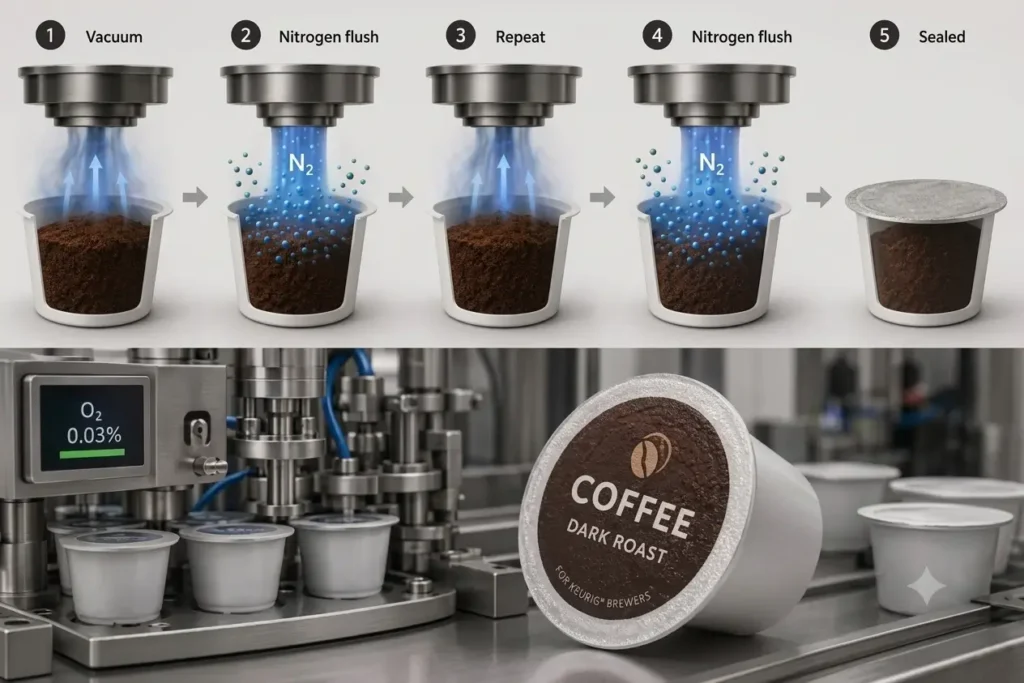
Setting aside the nitrogen production process for now, filling coffee capsules with 99.9% nitrogen requires a coffee capsule filling machine equipped with a recirculating flushing function. If a single flush does not completely remove the oxygen, the process is repeated several times until all oxygen is expelled.
The entire process is typically divided into three steps: vacuum extraction, nitrogen flushing, and multiple gas replacement cycles.
First, before filling the coffee capsules, the interior of the packaging must be evacuated. If nitrogen is injected directly into the capsule without first removing the air, the original air will remain inside, merely being partially diluted.
For powdered products like coffee grounds, air often becomes trapped in the gaps between the particles, making it difficult to completely expel this residual air with a single nitrogen flush.
Only after the interior of the package has reached a near-vacuum state does the equipment begin injecting food-grade, high-purity nitrogen. The purity of this nitrogen can reach 99.99%.
Once nitrogen enters the package, it gradually displaces the residual air from the packaging space. Many high-end coffee capsule filling machines do not perform nitrogen flushing just once, but instead repeatedly execute a “vacuum + nitrogen flushing” cyclic displacement process.
The principle is not complicated: after the first nitrogen flushing, a small amount of oxygen will still remain inside the package. Subsequently, the equipment performs another round of vacuuming and nitrogen filling. After multiple cycles, the oxygen concentration inside the package continuously decreases, eventually approaching 0%.
Furthermore, to truly achieve a low-oxygen environment approaching 99.9%, the nitrogen-filling process alone is far from sufficient; the oxygen-barrier properties of the packaging materials are equally critical.
If the seal on the coffee capsule is insufficient, outside air will gradually permeate into the package over time.
Therefore, K-Cup coffee capsules utilize high-barrier materials, such as aluminum foil composite films, multi-layer oxygen-barrier plastics, and aluminum capsules, to effectively reduce oxygen permeability.
Otherwise, even if an extremely high-purity nitrogen environment is achieved during packaging, oxygen will still slowly seep into the package after several months of storage, affecting the coffee’s freshness.
In the actual production process, high-end coffee capsule filling machines are also equipped with residual oxygen detectors inside to monitor the residual oxygen content within the capsules in real time.
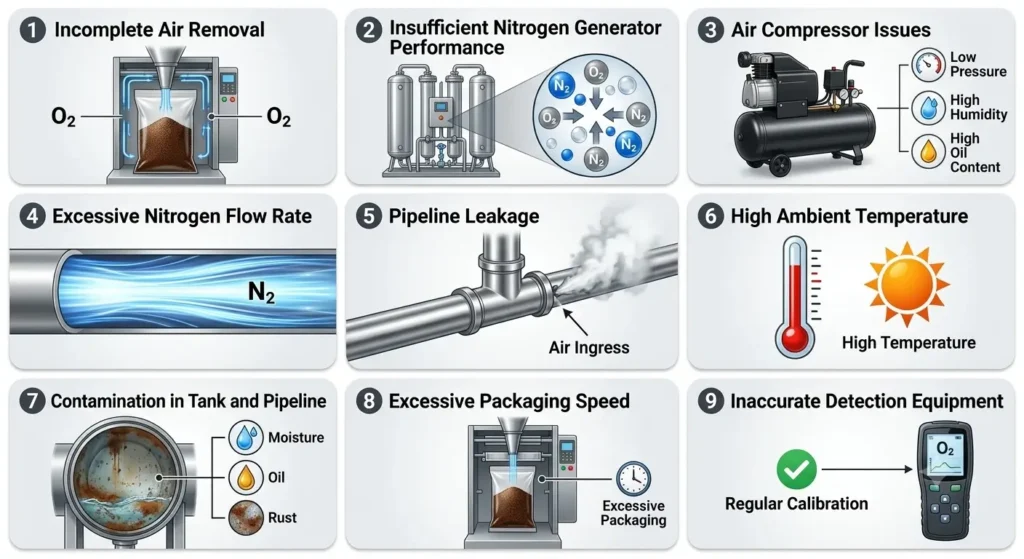
What Factors Can Lead to Insufficient Nitrogen Purity?
Nitrogen is crucial for preserving the freshness of coffee grounds, so there can be absolutely no errors during the nitrogen-flushing process.
If the nitrogen concentration is insufficient or residual oxygen levels are too high, the coffee grounds will oxidize rapidly; in severe cases, this can even render the entire production line unusable.
So, what factors actually affect the nitrogen filling concentration? Please continue reading below.
1. Air Has Not Been Thoroughly Evacuated
As mentioned earlier, the interior of the packaging must be evacuated before nitrogen is introduced.
If the evacuation process is insufficient, a significant amount of air will remain inside the packaging. Even if nitrogen is subsequently introduced, the overall oxygen content will remain too high, ultimately compromising the freshness of the coffee grounds.
2. Insufficient performance of the nitrogen generator
Currently, many factories use PSA nitrogen generators, also known as pressure swing adsorption systems. This system adsorbs oxygen from the air using carbon molecular sieves to produce high-purity nitrogen.
However, as the system ages, the carbon molecular sieves gradually degrade, reducing their adsorption capacity. This prevents oxygen from being fully separated, ultimately leading to a decrease in the purity of the output nitrogen.
Many nitrogen generators achieve a purity of 99.99% when first purchased, but after several years of operation, purity may drop to 99.5% or even lower. In reality, many companies do not regularly test the actual nitrogen purity, so the problem often goes undetected for a long time.
3. Issues with the Air Compressor
Insufficient supply pressure, unstable air volume, excessive oil content, or high humidity in the air supplied by the compressor can all directly impact the separation efficiency of the PSA system.
Moisture in the air, in particular, is extremely damaging to the carbon molecular sieves. Moisture gradually clogs the pores of the molecular sieves, causing a decline in adsorption performance and ultimately resulting in progressively lower nitrogen purity.
4. Excessively High Nitrogen Flow Rate
Generally, the higher the flow rate, the lower the nitrogen purity.
This is because the air does not spend enough time within the molecular sieves; oxygen is discharged along with the airflow before it has been fully adsorbed.
Many factories forcefully increase the flow rate to boost production capacity. Although the gas volume appears to increase, nitrogen purity actually decreases.
5. Pipeline Leaks
Nitrogen systems typically operate under a slight positive pressure. If the pipeline seals are poor, outside air will slowly seep into the system.
In older facilities, joints, valves, hoses, and flange connections that have been in use for a long time may develop microscopic leaks.
Such issues are usually difficult to detect with the naked eye, yet they are sufficient to cause a drop in nitrogen purity.
Sometimes, outlet testing still shows 99.99%, but by the time the nitrogen reaches the filling machine, the purity may have dropped below 99.5%.
6. Excessively high ambient temperature
PSA nitrogen generation systems are sensitive to ambient temperature.
In high-temperature summer environments, air density decreases, reducing compression efficiency, while the adsorption capacity of the carbon molecular sieves is also affected.
Particularly in high-temperature regions such as the Middle East, Southeast Asia, and Dubai, nitrogen purity often fluctuates significantly if the equipment’s heat dissipation is inadequate.
7. Internal Contamination of Nitrogen Tanks and Piping
If the system lacks regular cleaning and maintenance over an extended period, moisture, oil residue, rust, and even bacterial growth may accumulate inside.
These contaminants not only affect gas quality but may also further reduce the stability and nitrogen production efficiency of the entire system.
8. Excessively Fast Packaging Speed
Some high-speed packaging machines drastically shorten nitrogen purging times in pursuit of higher production capacity.
As a result, the packaging is sealed before air and nitrogen have had sufficient time to fully exchange within the package.
Consequently, although the packaging appears puffed up and seems to be filled with nitrogen, a significant amount of air actually remains inside.
9. Inaccurate Detection Equipment
Some manufacturers use oxygen analyzers that have not been calibrated for a long time, or whose sensors have even deteriorated.
In such cases, the results displayed by the detection equipment often appear more favorable than the actual values.
While the data may seem to meet standards on the surface, the oxygen content inside the package may in fact have long exceeded the permissible range.
How Is Residual Oxygen in Coffee Capsules Detected?
Testing for residual oxygen in coffee capsules is a critical step in ensuring coffee freshness and shelf life; this process utilizes industrial-grade non-destructive testing technology.
Once the packaging process is complete, the presence of residual oxygen directly affects the rate of coffee oil oxidation and the retention of aromatic compounds. Therefore, testing methods must balance accuracy and efficiency.
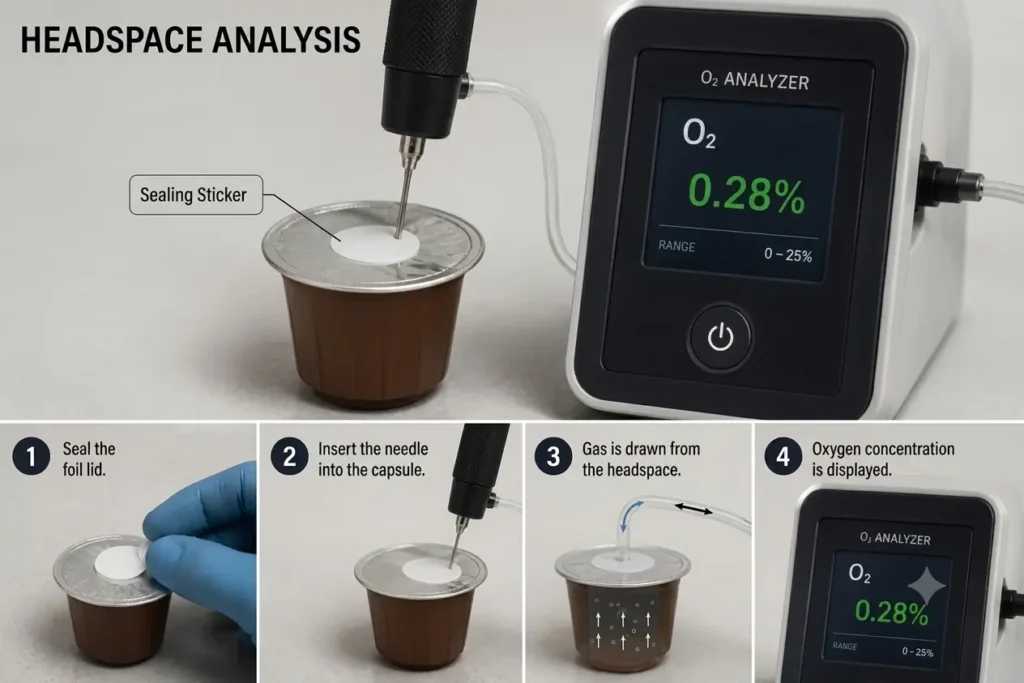
Headspace Analysis Technology
This technology requires the use of an electrochemical sensor equipped with a fine needle. In practice, the technician first attaches a sealing gasket to the aluminum foil lid of the coffee capsule to prevent external air from entering. Then, the sensor’s sampling needle is inserted into the capsule to draw gas from the headspace.
Once the gas enters the sensor, the device can accurately calculate the percentage concentration of oxygen inside the capsule by detecting the paramagnetic characteristics of the electrical signal generated by the chemical reaction.
Non-destructive optical detection technology
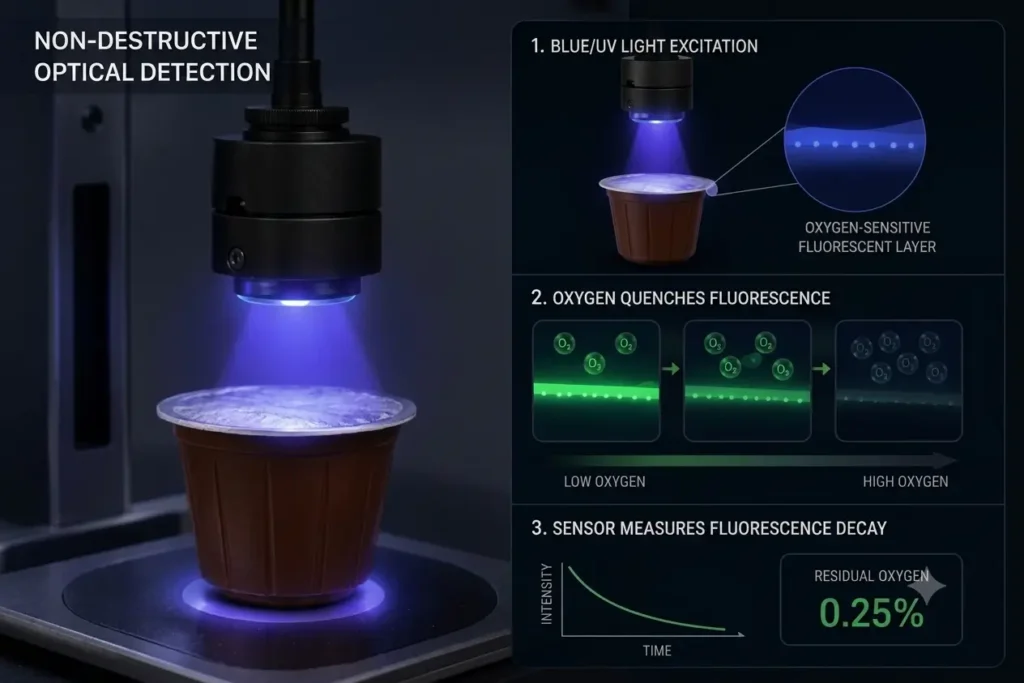
Fluorescence quenching method: A layer of oxygen-sensitive fluorescent material is pre-coated on the inner surface of the capsule packaging material; during detection, the capsule is illuminated with specific blue or ultraviolet light.
Oxygen molecules cause fluorescence quenching—the higher the oxygen concentration, the faster the fluorescence fades.
By measuring the time constant of the fluorescence decay, the sensor can read residual oxygen data in real time without damaging the packaging.
The sensor can read residual oxygen data in real time without damaging the packaging by measuring the time constant of the fluorescence decay.
Gas Chromatography
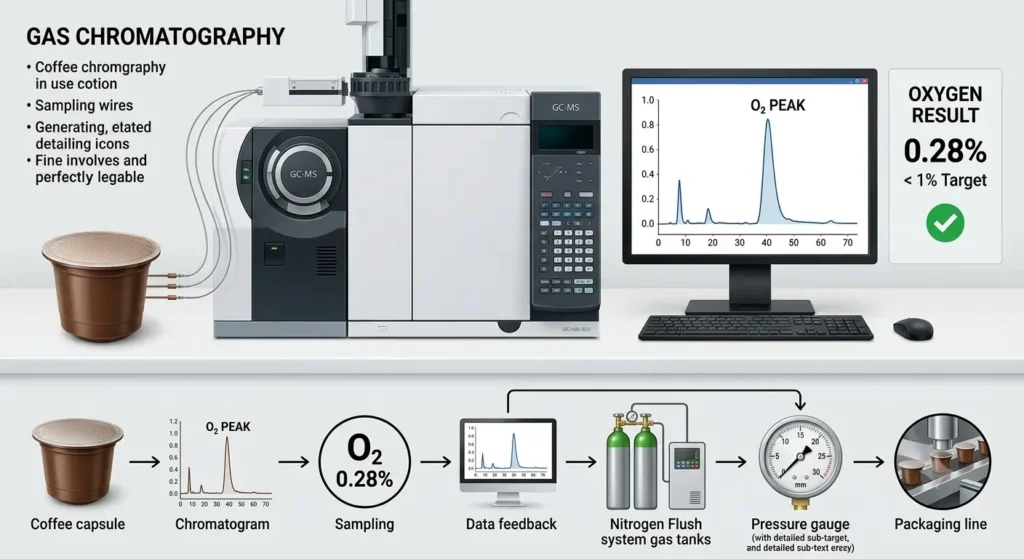
For packaging made of certain high-barrier materials, the laboratory also employs gas chromatography.
Although this method is relatively complex and time-consuming, it offers extremely high sensitivity and can detect trace amounts of oxygen.
Regardless of the technology used, the ultimate goal is to ensure that the residual oxygen content inside the capsules is below 1%, or even 0.5%.
Once testing is complete, this data is fed back into the nitrogen-flushing packaging system to adjust the pressure and frequency of nitrogen flushing, thereby achieving closed-loop optimization of the production process. This ensures that every coffee capsule retains its original flavor throughout its shelf life.
Future Trends in Coffee Capsule Packaging
The development of coffee capsule packaging is currently being driven by both technological innovation and environmental regulations, with its core evolution focused on four key areas: material sustainability, oxygen barrier properties, smart interactivity, and personalized experiences.
Among these, the shift toward sustainable materials is a prevailing trend. As the European Union and many other countries around the world tighten regulations on single-use plastic packaging, packaging materials are undergoing a transition from traditional multi-layer composite plastics to biodegradable materials and single-layer aluminum.
It is projected that by 2026, household-grade compostable materials will become the industry standard. Coffee capsules made from cellulose, seaweed extracts, or high-performance biopolymers can rapidly degrade under natural conditions while maintaining the necessary brewing pressure.
For brands that prefer aluminum, the use of 100% recycled aluminum and the establishment of proprietary closed-loop recycling systems will shift from a marketing advantage to a prerequisite.
Conclusion
Every perfect extraction and that rich layer of coffee crema are made possible by the quiet support of high-purity nitrogen.
From the complex nitrogen production process to rigorous residual oxygen testing, every effort made in the industrial sector ultimately culminates in that authentic Italian flavor in the consumer’s cup.
The use of high-purity nitrogen reflects the brand’s commitment to quality and its respect for the drinking experience of every coffee lover.
As we enjoy the convenience of capsule coffee, it is these invisible nitrogen molecules that transcend the boundaries of time and space to preserve the sun-kissed essence and flavors of coffee estates from around the world.
Finally, achieving 99.9% nitrogen purity relies on a precision coffee capsule filling machine. If you are planning to launch a coffee capsule business, please contact SANEU—a professional coffee capsule filling machine manufacturer.