
For roasted coffee, oxygen is arguably the biggest “silent killer.” It continuously breaks down the coffee’s aromatic compounds and accelerates the rancidity of oils, causing the rich and complex flavors to dissipate rapidly.
Especially today, as coffee capsules become increasingly widespread, reducing residual oxygen levels has become a key factor affecting coffee quality and brand reputation.
For this reason, nitrogen-flushing technology is being adopted by an increasing number of coffee brands. From K-Cups to Nespresso, and from specialty coffee to mass-market supermarket products, effective oxygen control is essential to nearly all high-quality coffee capsules.
So, how exactly does oxygen cause coffee to spoil? How does nitrogen flushing extend the shelf life of coffee? What is the difference between vacuum packaging and nitrogen packaging? And why has residual oxygen content become a key indicator of packaging equipment performance?
In the following sections, we will comprehensively analyze how oxygen control has become a core element in defining coffee quality, exploring topics such as the principles of coffee oxidation and nitrogen flushing technology.
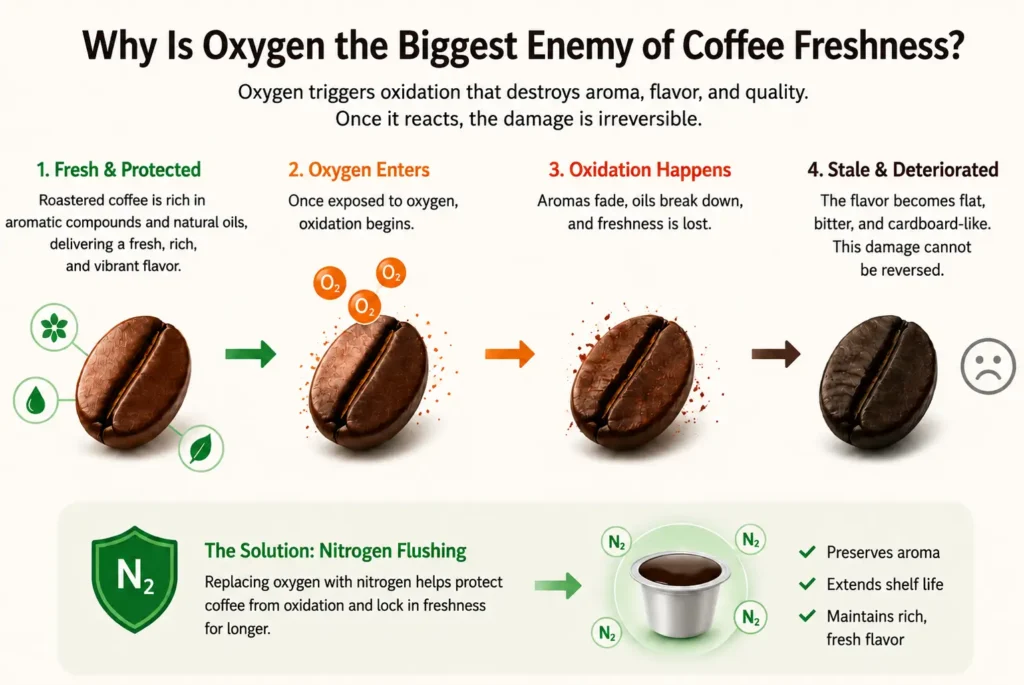
Why Is Oxygen the Biggest Enemy of Coffee Freshness?
Once food comes into contact with oxygen, an oxidation reaction occurs—what we commonly refer to as “spoiling.”
This is especially true for roasted coffee beans, which will quickly lose their original flavor if proper preservation measures aren’t taken promptly.
This is why people say that freshly cooked food tastes best when eaten hot.
So, what kind of oxidation reaction occurs when coffee beans are exposed to air? Let’s find out.
Volatile Aromas
One of the main reasons coffee is loved by people all over the world is the unique aroma it emits.
Carefully roasted coffee beans release intoxicating scents of toasted bread, nuts, caramel, and even a hint of smokiness.
However, these aromas are not as long-lasting as perfume; they evaporate quickly.
Once these wonderful aromas react with oxygen, they begin to fade.
Oxidation of Oils
Freshly roasted coffee beans have a thin layer of oil on their surface—this is the essence of the bean, and the strength of the brewed coffee is closely tied to it.
However, preserving this layer of oil is no easy task; it may require the use of a coffee capsule filling machine equipped with nitrogen-flushing capabilities.
In short, contact between the oils and air should be avoided as much as possible, otherwise a rancid, rancid-like odor will develop.
Coffee brewed from such beans not only tastes bad, but may also be bitter or have a cardboard-like flavor.
Loss of protective gas
Freshly roasted coffee beans release some carbon dioxide, a process known as “degassing.”
In the first few days, the carbon dioxide acts as a protective gas, temporarily blocking oxygen, but it gradually dissipates over time.
Although coffee beans have a natural protective layer, we still recommend storing them as soon as possible after roasting and not relying solely on this natural protection.
Cumulative Effects
It’s not just oxygen that degrades the quality of coffee beans; light, temperature, and humidity are also “accomplices.” This is why many food packages include the warning “Store in a cool, dry place.” These factors all accelerate the oxidation process of coffee beans, causing them to spoil more quickly.
What Is Nitrogen Flushing in Coffee Capsules?
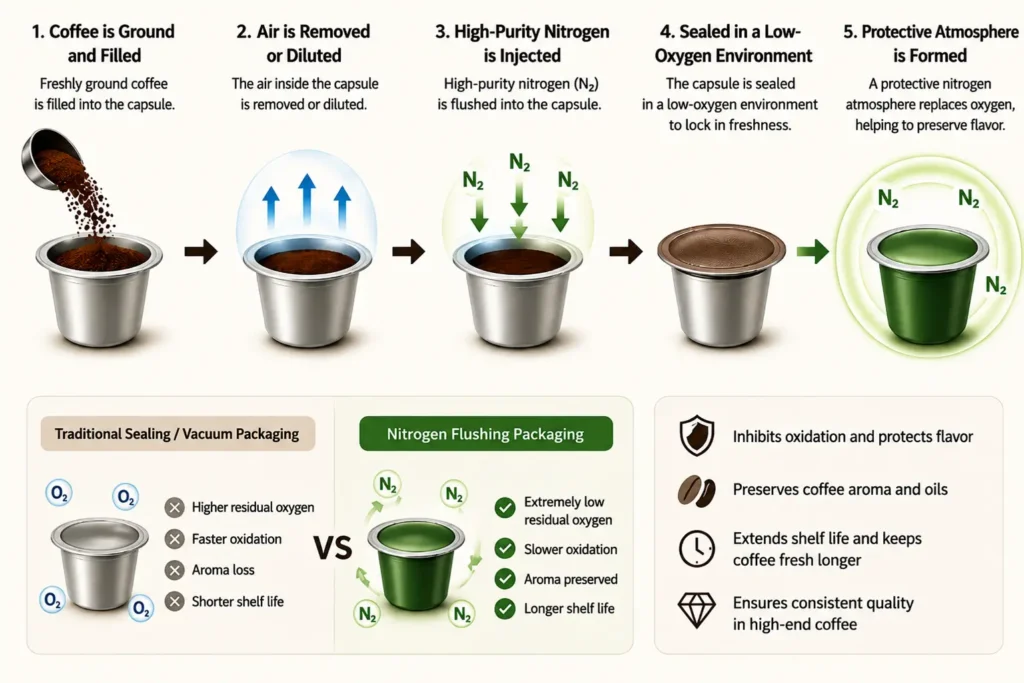
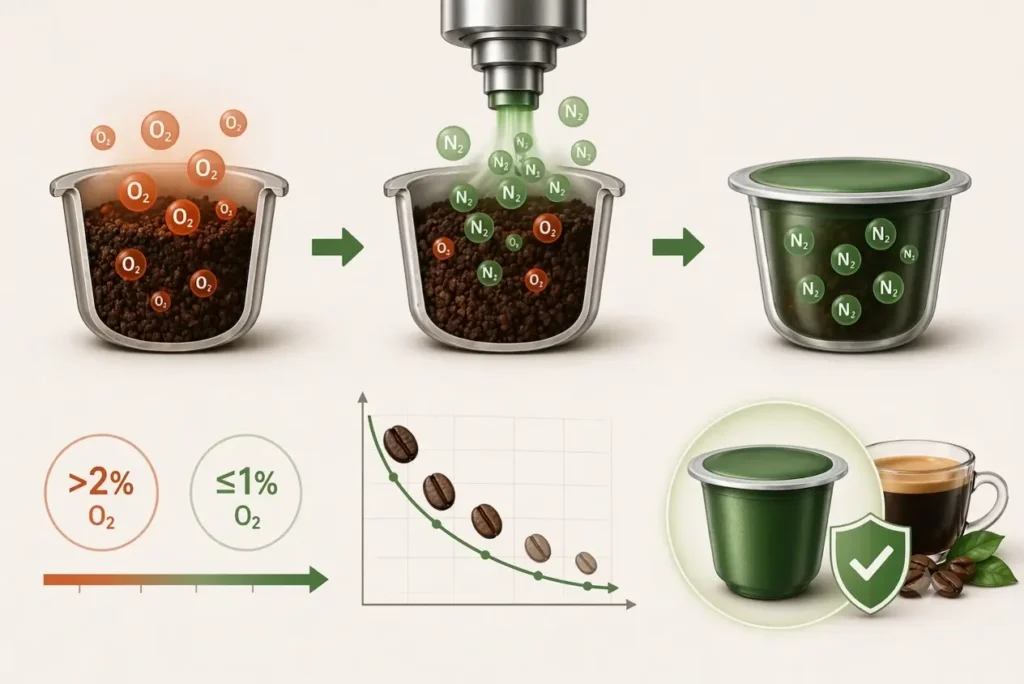
What is commonly referred to as “nitrogen flushing” is actually the process of displacing the oxygen inside the package. Nitrogen is an inert gas that does not cause coffee beans to spoil—this explanation may make it easier for you to understand. This is similar to the protective gas carbon dioxide we mentioned earlier, except that nitrogen is introduced from the outside.
Next, we will explain this process from the perspectives of both the filling procedure and its function.
Throughout the entire coffee capsule production process—such as the manufacturing of coffee capsules—the nitrogen flushing step primarily occurs during the filling and sealing stages.
The basic process is as follows: coffee grounds are placed into the cup, the air is evacuated, the coffee capsule filling machine fills the cup with nitrogen to 99% capacity, and finally, the cup is sealed.
Different types of filling machines use different filling methods: some fill directly with nitrogen, while others first evacuate the air and then fill with nitrogen.
High-end coffee capsule filling machines (such as the SANEU coffee capsule filling machine) are capable of first evacuating the air and then filling with nitrogen, reducing the residual oxygen content to 0.6% or even below 0.1%, thereby maximizing the freshness of the coffee and locking in its aroma.
What exactly does nitrogen do?
Extend shelf life
Generally speaking, K-Cup coffee capsules that have been nitrogen-flushed have a shelf life of at least 12 months, and some can even last up to 3 years. For example, Starbucks’ K-Cup coffee capsule system has a shelf life of about one year.
Slight Positive Pressure
Nitrogen helps create a slight positive pressure inside the capsule, which acts as a protective mechanism to improve sealing, reduce air leakage, and minimize aroma loss.
Keeping It Dry
Nitrogen lacks the concept of air humidity and, unlike oxygen, does not have a complex composition; it is a clean gas with virtually no moisture. Therefore, it does not cause the coffee grounds to mold or clump.
I’ve encountered a similar situation before: I bought a pack of milk powder, only to find that one of the packets had leaked. When I opened it, I discovered the powder had clumped into large lumps. Although it was still drinkable, I threw it away because I felt the quality had deteriorated, and I wasn’t sure if there were any bacteria inside.
Product Selling Points
Many coffee capsule brands on the market use nitrogen-flushing technology, such as Keurig, Nespresso, Dolce Gusto, Lavazza, etc. If you’re looking to launch your own coffee capsule brand, you can position 99.9% nitrogen as a key selling point for product freshness during the initial launch phase to quickly gain market traction.
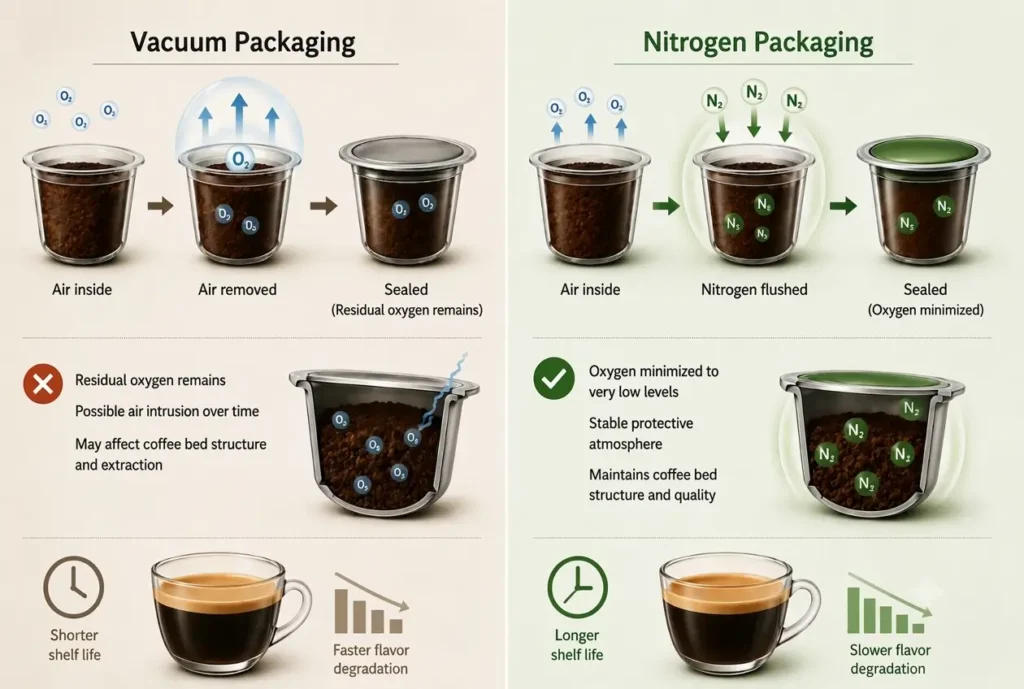
Nitrogen vs Vacuum Packaging: Which Is Better?
Vacuum and nitrogen are not mutually exclusive; rather, they complement each other.
Just imagine: you can’t possibly remove all the air from a K-Cup coffee capsule, can you? If you did, it would turn into a “K-Bag,” with the powder inside highly compressed—which completely defeats the purpose of preserving freshness. Similarly, you can’t remove all the air from a bag of potato chips, or they’ll crumble.
Vacuum technology is better suited for products that aren’t sensitive to compression, such as frozen meats, cheeses, and dried goods, and the preservation costs are relatively low.
Have you noticed? Nitrogen packaging costs more than vacuum packaging.
First, you need to source pure nitrogen; second, you’ll need a high-quality filling machine.
Furthermore, for certain products, nitrogen flushing technology cannot achieve a 100% oxygen-free environment like vacuum technology can.
In short, both preservation technologies have their specific applications. If you’re still unsure which preservation technology is right for your product, feel free to contact SANEU anytime—we’ll provide you with free professional guidance.
How Low Should Oxygen Levels Be in Coffee Capsules?
A key metric for freshness is residual oxygen content, which is a goal pursued by many packaging equipment manufacturers in the food packaging industry.
In this industry, a residual oxygen content of ≤2% is considered a standard acceptable level and is a relatively common specification.
However, a residual oxygen level of ≤1% is considered premium packaging. For example, ground coffee requires this level to maintain freshness effectively; even 2% is insufficient. This 1% difference reflects a significant gap in packaging equipment capabilities. If you seek optimal freshness preservation, consider professional coffee capsule filling machine manufacturers like SANEU, who possess extensive R&D experience in nitrogen flushing.
Next is the level approaching 0.5% oxygen content, which is virtually zero. At this level, simply filling with nitrogen is insufficient; it often requires the use of high-barrier packaging materials, such as ultra-low oxygen transmission rate (OLTR) packaging with an aluminum-based composite structure. This typically involves substantial costs, as seen with products like antibiotic powders and fish oil, which require such low residual oxygen levels.
Real Benefits of Nitrogen Packaging for Coffee Brands
As we briefly mentioned in the previous section on “The Role of Nitrogen,” nitrogen-flushed packaging is a selling point that startup brands can leverage. This may sound a bit vague, but don’t worry—we’ll provide real-world examples below to help you better understand.
Take Blue Bottle Coffee as an example. During its early expansion phase, the brand emphasized that its coffee grounds were freshly roasted and encouraged consumers to drink them as soon as possible, so it did not adopt nitrogen-flushing technology.
However, the problem was that once the brand began e-commerce sales and cross-regional shipping, the freshness of the coffee grounds became uncontrollable. By the time many customers received their coffee, it had already passed its peak flavor window, leading some to find it delicious while others found it bland or even sour.
In reality, there was nothing wrong with the quality of the coffee grounds themselves; it was simply because better preservation measures weren’t taken that negative reviews flooded the internet, leaving the brand feeling wronged. Later, the brand not only improved the packaging’s airtightness but also actively adopted nitrogen-flushing technology, thereby resolving the issue.
The management likely considered nitrogen-flushing during the brand’s early days but may not have adopted it for various reasons.
However, as of 2026, nitrogen-flushing technology has become highly refined and is now a standard industry practice, with the only distinction being the level of residual oxygen.
If you are a new coffee capsule brand, you should definitely consider adopting this technology.
From an operational perspective, nitrogen-flushed packaging can help you break through growth bottlenecks.
Once freshness retention is improved, your entire business model will transform: you can expand into cross-regional e-commerce, enter channels with longer shelf lives (such as supermarkets, hotels, and vending machines), and confidently scale up production and inventory management. Compared to localized sales or high-turnover operations, this approach will undoubtedly better support your ambitions.
Of course, these are just my personal observations.
How to Tell If Your Coffee Capsules Are Properly Sealed?
Now that we understand the benefits of nitrogen, there is one more issue to consider: preventing nitrogen leaks, as these could undo all our efforts. Therefore, we need to pay close attention to the packaging’s seal.
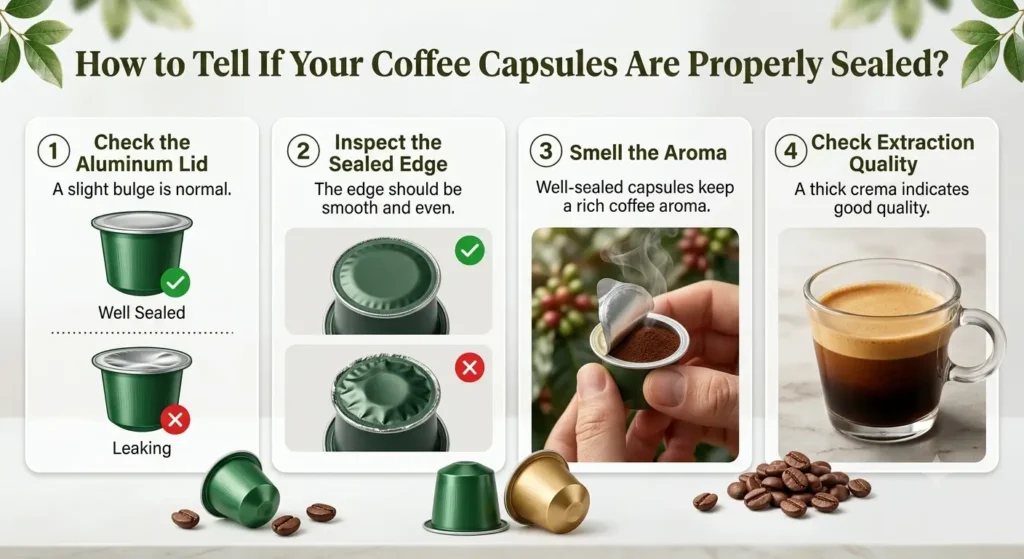
We can determine whether a coffee capsule is sufficiently sealed by looking at the following characteristics:
Check to see if the aluminum mold is bulging.
Coffee capsules are typically sealed with an aluminum foil liner. Under normal conditions, the aluminum foil liner will have a slight bulge; this bulge is very subtle and has a slightly springy texture.
This is because roasted coffee naturally releases carbon dioxide, creating a slight positive pressure inside the capsule. If you find that the aluminum foil liner is flat or even dented, it indicates that the capsule has leaked and oxygen has entered.
Heat Sealing
This is the sealed edge of the aluminum mold. Under normal circumstances, it appears smooth, whereas an improperly sealed edge may exhibit wrinkles or air bubbles. This may be caused by a low-quality coffee capsule filling machine leaving coffee grounds on the edge of the packaging during the sealing process, resulting in air leakage. This occurs because the fine coffee particles cause the aluminum mold to bulge.
Smell the aroma
Well-sealed coffee capsules will still release the intoxicating aroma of freshly roasted coffee when you open the package, even after a year has passed.
However, if the coffee capsules have little to no aroma, or even an off-odor, it indicates a problem with the capsule’s seal.
Extraction Quality
Coffee brewed from high-quality coffee capsules will have a thick layer of crema on the surface—this is the essence of the coffee.
Final Thoughts: Why Oxygen Control Defines Coffee Quality
No matter how high-end the coffee beans are, how meticulous the roasting process is, or how prestigious the origin is, if there is too much oxygen in the packaging, the aromatic compounds and oils in the coffee will undergo oxidation. This causes the originally rich and layered flavors to rapidly fade, leaving consumers with a coffee that tastes bland, bitter, or even like cardboard.
This is precisely why nitrogen-flushing technology has become standard practice in the coffee capsule industry.
It is not merely a marketing concept, but a core technology that genuinely helps brands extend shelf life and stabilize flavor profiles.
In today’s globalized market, an increasing number of coffee products must endure long-distance transport. Months may pass between the completion of roasting and the moment the consumer actually drinks the coffee. Without effective oxygen control, even the finest coffee struggles to maintain its optimal taste.
In the past, residual oxygen levels below 2% were considered acceptable. Today, however, an increasing number of specialty coffee brands are aiming for residual oxygen levels of ≤1%, or even as low as 0.5%, to preserve the coffee’s freshness as much as possible. This not only reflects the continuous advancement of packaging technology but also the rising expectations consumers have for coffee quality.
Although consumers cannot see the nitrogen inside the capsule, they can certainly taste the difference.
Therefore, for any coffee brand seeking long-term growth, choosing an efficient nitrogen-filling solution and professional coffee capsule filling equipment is not merely about solving packaging issues; it is about securing the brand’s future, market competitiveness, and user experience.
If you would like to learn more about nitrogen flushing and coffee capsule filling machines, please feel free to contact SANEU at any time, and we will respond as soon as possible.
FAQ
Why is nitrogen used instead of oxygen in coffee capsules?
Nitrogen is used as a substitute for oxygen because it is an inert gas that does not react with coffee, whereas oxygen triggers oxidation reactions that accelerate the loss of coffee’s aroma and flavor. Replacing oxygen with nitrogen effectively inhibits oxidation, thereby helping coffee retain its freshness and stability for a longer period of time.
How much oxygen is acceptable inside a coffee capsule?
Generally speaking, the oxygen content inside coffee capsules should be as low as possible. The industry typically keeps residual oxygen below 2%, while high-end products aim for 1% or even lower, because even a small amount of oxygen can trigger ongoing oxidation reactions.
Does nitrogen packaging really keep coffee fresher?
Yes, nitrogen packaging does help keep coffee fresh for longer, because nitrogen is an inert gas that does not react with the aromatic compounds or oils in the coffee.
What happens if coffee capsules are exposed to oxygen?
Once coffee capsules are exposed to oxygen, the coffee begins to oxidize, causing the aroma to dissipate rapidly and the flavor to fade.
The rich aromatic compounds are destroyed, and the mouthfeel gradually shifts from rich and smooth to flat and bitter; in some cases, it may even develop off-flavors reminiscent of stale coffee or cardboard.
Is vacuum packaging enough for coffee capsules?
Although vacuum packaging can slow down the oxidation process of coffee to some extent and meet basic preservation needs, it does not completely solve the problem.
This is because, in practice, it is difficult to achieve a completely oxygen-free environment, and a small amount of oxygen usually remains.
How long do nitrogen-flushed coffee capsules last?
Coffee capsules filled with nitrogen typically have a shelf life of 6 to 12 months, though the exact duration depends on the quality of the coffee beans, the degree of roasting, and the barrier properties of the packaging material.
In a low-oxygen environment, the rate of oxidation slows significantly, allowing the coffee’s aroma and flavor to remain stable for an extended period.
Can consumers tell if a capsule is nitrogen-flushed?
Ordinary consumers usually cannot tell by sight alone whether a coffee capsule has been nitrogen-flushed, as this process takes place inside a sealed environment. However, there are some indirect ways to determine this.
For example, if you feel a slight release of gas or smell a rich, fresh coffee aroma when opening or piercing the capsule, this usually indicates that the internal gas environment is optimal and residual oxygen levels are low.
Conversely, if there is almost no aroma, or if the scent is stale, this may indicate that the coffee has oxidized or that the seal is compromised.