You have a product to package, a budget to work with, and a deadline. Somewhere in a spreadsheet is a list of manufacturers you found on a B2B platform. Half of them claim “±0.1g accuracy.” The other half promise “CE certified, 20 years experience.” The spec sheets all look the same. So how do you actually tell them apart?
The global packaging machinery market crossed $50 billion in 2025, growing at roughly 5.9% annually through 2035 (Research and Markets, 2026). That growth pulls more manufacturers into the market every year — and more buyers into the same dilemma. The answer is not in comparing PDFs. Any supplier can print specifications on a brochure. The real filter is knowing what to look for behind those claims. This guide walks through the evaluation framework that most first-time buyers skip — and later wish they had not.
Types of Packaging Machines — Know What You’re Looking For
Before you evaluate any manufacturer, you need to know which machine type fits your product. The decision tree starts with a single question: what are you packaging?
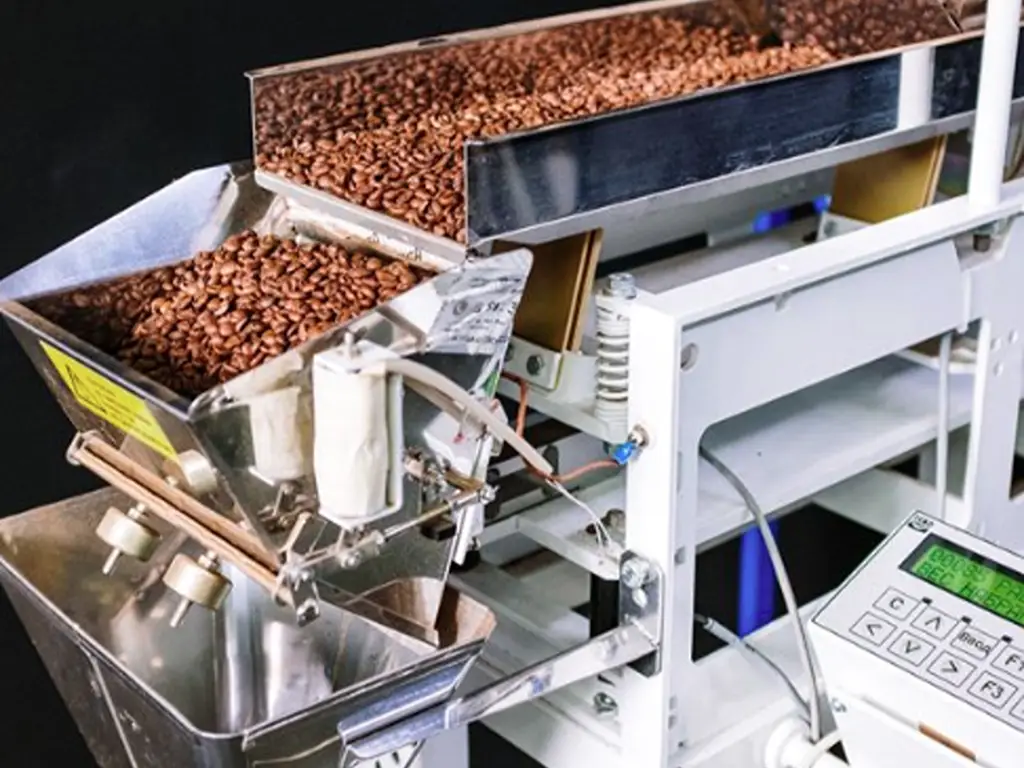
Free-flowing powders and granules — detergent, coffee powder, sugar — typically call for a Vertical Form Fill Seal (VFFS) machine, which forms bags from rollstock film, fills them, and seals them in one continuous motion. Single-serve sachets for coffee, honey, or ketchup use multi-lane stick pack machines, which can run 4 to 12 lanes simultaneously at speeds up to 600 sticks per minute. Liquids — juices, sauces, oils — go through liquid filling and capping lines with piston or gravity-based metering. And for coffee capsules specifically, dedicated capsule filling and sealing machines handle the entire process from cup dropping to nitrogen flushing to lid sealing.
Take coffee as the unifying example: whole beans go into a VFFS machine, ground coffee into a stick pack line, ready-to-drink cold brew into a canning line, and single-serve pods into a capsule filling machine. Same product category, four different machine types — and four different sets of requirements. Your product’s physical behavior, not your budget, should dictate where you start looking.
Where Packaging Machines Are Made — Global Manufacturing Landscape
Geography matters. Different manufacturing regions have developed distinct specializations, and understanding these differences helps you match the right supplier to your needs.
| Region | Core Strength | Price Tier | Best For |
|---|---|---|---|
| Guangdong, China (Foshan, Guangzhou) | Automation, export-ready solutions, strong port access | Mid | High-speed lines, custom machines, international buyers |
| Zhejiang, China (Wenzhou, Ruian) | Fast prototyping, cost efficiency, modular designs | Entry–Mid | Startups, budget-conscious buyers, standard machines |
| Germany | Precision engineering, pharma-grade compliance, turnkey integration | Premium | Regulated industries, high-speed multi-format lines |
| Italy | Flexible packaging, design-forward engineering, food specialization | Premium | Specialty food, flexible pouch formats |
China now accounts for roughly 30% of global packaging machinery exports, with the Pearl River Delta (Guangdong) and Yangtze River Delta (Zhejiang/Shanghai) as the two dominant clusters. The key insight for international buyers is this: a machine built in Guangdong with Siemens PLCs and Schneider electrics will be 30–50% less expensive than a German equivalent with the same core components. The difference shows up in system integration depth, documentation quality, and long-term service infrastructure — not in the parts list. Choose based on your in-house technical capability: if you have an automation engineer on staff, a well-spec’d Chinese machine can deliver excellent ROI. If you need a vendor to handle everything from installation to operator training, budget for the premium-tier option.
How to Evaluate a Packaging Machine Manufacturer
Evaluating a manufacturer is not about comparing parameter tables. Those can be copied. What actually predicts machine performance is three things: what components they use, how they organize production, and how fast they respond when something goes wrong.
Certifications, Components, and Production Infrastructure
Certifications are the first filter, but they are only as good as your ability to verify them. CE marking (required for European import), ISO 9001 (baseline quality management), and FDA compliance (food-contact applications) should all be cross-checked against official databases — not taken at face value from a website badge.
The second filter, and arguably more revealing, is the component brand list. Ask the supplier: “Which specific PLC model are you using?” A manufacturer who says “Siemens” without specifying the S7-1200 vs. S7-1500 series does not have engineering depth behind their sales team. The core components that define machine longevity are the PLC (Siemens, Mitsubishi, Omron), servo drives (Schneider, Yaskawa), pneumatics (SMC, Festo), and food-contact materials. On that last point: 304 stainless steel is the minimum for any surface touching food; aerospace-grade aluminum for cup droppers and lid dispensers eliminates the rust risk that comes with electroplated iron — a corner too many budget manufacturers cut.
The third filter is factory scale. A production floor under 3,000 square meters rarely has the dedicated workshops needed for both standardized production and custom engineering. Look for separate areas for CNC machining, electrical assembly, and machine testing. If everything happens in one open hall, quality control is reactive rather than systematic.
Production Lead Times and Delivery Track Record
Delivery performance is the hardest metric for a manufacturer to fake. A real factory can give you a precise lead time; a trading company will give you a vague range.
For standard small-to-medium machines, expect 15–30 days from order to shipment, including factory testing. Large automated lines take 35–60 days. If a supplier promises a fully customized production line in under 30 days, one of two things is happening: either the machine is not actually custom, or they are compressing the testing phase. You will discover the gaps after installation.
Ask for the supplier’s on-time delivery rate. The industry benchmark is ≥95%, and top-tier manufacturers achieve 98–100% (PMMI, 2025). If they cannot produce this number, or if they deflect the question with “we always deliver on time,” treat it as a red flag. A manufacturer who tracks their own performance is a manufacturer who manages their own processes.
One blind spot most buyers miss: PLC module availability. Certain Siemens and Mitsubishi modules face global supply constraints with lead times of 8–12 weeks. A manufacturer with strong supplier relationships will flag this proactively and offer alternative modules with equivalent specs. A manufacturer who says nothing and then blames “supply chain issues” three weeks before your deadline is the one you want to avoid.
Communication and Responsiveness — The Overlooked Metric
Communication speed in the sales phase is the single best predictor of support quality after purchase. Run three tests before signing:
- Send inquiries at different times of day — morning, afternoon, and night in your time zone. Track response time. The benchmark is ≤4 hours during the supplier’s business hours; top performers respond within 1–2 hours.
- Request a live video walkthrough of the factory floor — not a pre-recorded video. Ask specifically to see machines currently under test, not just finished products on display. A manufacturer who refuses a live tour is often not a manufacturer at all.
- Ask the question that reveals everything: “If my machine stops at 2 a.m. local time, what happens next?” Listen for specifics — a remote diagnostic protocol (TeamViewer, VPN-to-PLC, cloud HMI dashboard), a named contact person, and a stated response time. If the answer is “we will send an engineer,” that means days of downtime.
In one real case, a New York coffee company’s machine failed three days before Thanksgiving. The manufacturer’s support team diagnosed the issue remotely overnight, had the machine running the next morning, and followed up with operator training to prevent recurrence. That outcome, a holiday season saved rather than lost, is the difference between a supplier relationship and a transaction.
The Custom Machine Process — From Requirements to Commissioning
Custom packaging machinery is not a product purchase. It is a micro-engineering project. Understanding the process structure protects you from the most common failure mode: a machine that looked right in the CAD drawing but does not work with your actual product.
The 4-Step Custom Engineering Process
Every well-run custom machine project follows four stages, each with a clear deliverable:
1. Requirements Gathering. You send product samples, packaging materials, and production targets. The manufacturer’s engineering team tests your actual product — not a standard analog — to understand flow behavior, fill characteristics, and sealing requirements. This stage should produce a detailed technical requirement document (TRD), not a one-page quote.
2. Design Review. The design team produces CAD drawings or 3D renderings of the proposed machine configuration. You review, suggest modifications, and sign off. This is where you verify that the machine will interface with your existing conveyors, feed systems, and floor layout. Miss this stage, and you will be retrofitting on installation day.
3. Manufacturing and Assembly. Once the design is frozen — and “design freeze” must be a formal milestone, not an informal understanding — the machine is built using the specified components. Reputable manufacturers send progress photos or video at key assembly stages so you can verify that the PLC in the photo matches the PLC in the spec sheet.
4. Factory Acceptance Testing (FAT). The completed machine runs with your actual product. The test should cover at minimum: speed (actual output vs. rated capacity), fill accuracy (continuous sampling of at least 100 units), continuous operation (2–4 hours without stoppage), and safety system verification. Only after passing FAT should the machine be packed for shipment.
For buyers navigating this process for the first time, working with a manufacturer that has a structured four-stage approach — with formal design review and FAT as non-negotiable milestones — substantially reduces project risk. Manufacturers like SANEU, who have refined this process over 12 years and more than 100 coffee enterprise partnerships, typically provide free sample testing and a 24-hour quote turnaround during the requirements phase, which lets you test compatibility before committing to a full project (SANEU Custom Machines). This pre-commitment testing phase is the single most valuable protection a buyer can have — it replaces assumptions with data before any money moves (SANEU Buyer’s Guide).
Common Pitfalls in Custom Machine Projects
Three traps claim more custom machine budgets than any mechanical failure:
Uncontrolled scope changes. A packaging line designed for three SKUs can easily balloon to twelve once the marketing team gets involved. Every change after design freeze should trigger a formal change request that includes cost and timeline impact. Without a design freeze milestone, your project has no boundary — and no end date.
Testing only with ideal samples. Many FATs pass with flying colors because the product used for testing is perfectly uniform. Real production involves humidity swings, batch-to-batch viscosity changes, and raw material variability. Insist that the FAT includes your most challenging product variant, not just the easiest one.
Ignoring integration points. A machine can perform flawlessly in isolation and fail completely when connected to your existing line. Before the design review, document every interface: conveyor height and width, power supply specs (voltage, phase, frequency), compressed air pressure and volume, and data protocol for any MES or ERP integration. If the manufacturer’s engineer does not ask for these details, they are not thinking about integration.
Quality Verification — How to Check Before You Commit
Signing a purchase order without independent verification is the equivalent of buying a house without an inspection. The cost of due diligence is trivial compared to the cost of a machine that sits idle.
Factory Audit — What to Look For Beyond the Brochure
Whether you visit in person or commission a third-party audit (SGS, Bureau Veritas, or TÜV Rheinland — typical cost: $1,000–$3,000 for orders over $10,000), focus on five observation points that brochures never show:
Weld quality. Walk up to any stainless steel frame and look at the weld seams. Uniform, smooth welds without pinholes or spatter indicate disciplined fabrication. Messy welds on visible surfaces mean worse welds where nobody looks.
Control cabinet wiring. Ask to open an electrical cabinet. Neat, labeled, color-coded wiring with proper cable management is the signature of an organized electrical engineering team. A rat’s nest of unlabeled wires is a maintenance nightmare waiting to happen.
Testing area activity. Look for a dedicated testing zone with machines actually running — not just a clean display area. If every machine on the floor is fully assembled and polished, they are staged for photos, not tested for performance.
Material storage. Components should be stored by brand and type, not piled together. If you see Siemens PLC boxes mixed with generic unbranded parts on the same shelf, assume the machine you receive will contain whatever was closest at hand.
Worker organization. Uniforms, safety equipment, and clearly designated workstations signal management systems. A factory where workers operate in street clothes with no protective gear is a factory where process discipline is optional.
If you cannot visit, request a live video tour — streamed in real time, not pre-recorded. Ask to pause on specific details: “Can you zoom in on the label of that PLC?” A manufacturer who accommodates these requests is demonstrating transparency. One who deflects is demonstrating something else.
A practical verification step many buyers overlook: request a free sample test with your actual product before placing an order. Manufacturers who are confident in their machines — such as SANEU, whose testing lab runs customer samples through their full evaluation protocol including nitrogen content analysis with German-made Oxybady equipment — will offer this as a standard part of their pre-sales process. If a manufacturer charges for sample testing or refuses it entirely, ask yourself what they are afraid you might discover.
Real-Product Testing — The Only Proof That Matters
Spec sheet accuracy numbers are measured under ideal conditions with standard samples. Your product is not a standard sample. Coffee beans are irregular, detergent powder clumps in humidity, and sauces change viscosity with temperature. The only reliable test uses your actual product, your actual packaging film, and conditions that approximate your production environment.
Three non-negotiable tests during FAT:
1. Speed validation. Run continuously for at least two hours and measure actual output. Expect a 10–20% gap between rated speed and sustained throughput. That gap is normal and accounts for film splices, minor adjustments, and operator interaction. A gap larger than 30% means the rated speed was a lab number, not a production number.
2. Fill accuracy under real conditions. Sample at least 100 consecutive fills and calculate the standard deviation. For powder and granule applications claiming ±0.1g accuracy, 95 out of 100 fills should fall within that tolerance. If the test is done with free-flowing glass beads instead of your actual product, the results are meaningless.
3. Material compatibility. Your packaging film — especially if you use recyclable mono-materials or compostable films — behaves differently under heat than standard laminated films. Test sealing integrity at your target speed with your film; do not accept results from the manufacturer’s standard film as a proxy.
Customer References and Track Record
A manufacturer’s claims become credible only when verified by someone who paid them money and used their machine for years.
Ask for references that match you on three dimensions: same industry, similar company size, and your geographic region. A reference from a multinational filling 10,000 pouches per hour tells you nothing about how the manufacturer treats a mid-size coffee roaster running 500 pouches a day. Request a direct call — not just a written testimonial — and ask three questions: how long have you had the machine, what went wrong in the first six months, and how fast did they fix it?
Also check the manufacturer’s reorder rate. Data from B2B platforms shows top-tier packaging machine suppliers achieving 50–67% reorder rates (PMMI, 2025). A reorder rate above 40% means customers come back — the most honest signal in B2B purchasing. A manufacturer with 100+ customers across 30 countries and a documented reorder history is operating on a different level of reliability than one with ten customers in one region and no repeat business.
After-Sales, Warranty, and the Real Cost of Ownership
The purchase price of a packaging machine is the smallest number in the equation. The real costs pile up after installation: downtime, spare parts, maintenance labor, and lost production.
| After-Sales Dimension | Industry Standard | What to Aim For |
|---|---|---|
| Warranty duration | 12 months | 24 months + lifetime technical support |
| Spare parts dispatch | 3–5 business days | 1 business day (standard parts) |
| Remote diagnostic capability | Phone/email only | TeamViewer / VPN-to-PLC / cloud HMI |
| On-site service availability | At cost, scheduling varies | Annual free visit (distributors) or fixed-fee direct |
| Operator training | Manual only | Live video training + on-site option |
| Preventive maintenance plans | Ad-hoc | Customized schedule based on machine usage |
A simple TCO calculation makes the trade-off concrete: a $25,000 machine that averages five days of unplanned downtime per year — at a production value of $500 per day — costs you $7,500 in lost output over three years, or 30% of the purchase price. Spending 10–15% more upfront on a manufacturer with faster support and better spare parts logistics often nets a 20%+ saving over the machine’s life. This is not theory. It shows up in your P&L the first time a machine stops and you realize the difference between a supplier who answers the phone and one who does not.
Three questions to ask before signing:
- “What is the exact process for getting a spare part — who do I contact, how is it shipped, and what is the typical door-to-door time for my country?”
- “Can I see your remote diagnostic tool in action — right now, using a machine on your test floor?”
- “What does the warranty actually exclude, in writing?”
If you are comparing suppliers, make sure your evaluation includes a side-by-side look at warranty coverage and support infrastructure — dimensions that matter far more after installation than the spec sheet does before purchase. SANEU’s support team, for example, maintains a standard of shipping replacement parts within one business day from their Guangzhou warehouse, backed by a two-year comprehensive warranty and lifetime technical support. To discuss your specific packaging line requirements with a specialist, reach out to the SANEU team.
References
- Research and Markets. “Packaging Machinery Market Opportunity, Growth Drivers, Industry Trend Analysis and Forecast 2026–2035.” 2026. https://www.researchandmarkets.com/reports/6219411/packaging-machinery-market-opportunity-growth
- PMMI Business Intelligence. “International Research — Guide to Global Markets.” 2025. https://www.pmmi.org/business-intelligence/international-research