A guest reaches a Dubai hotel at midnight. The restaurant is closed, room service feels like too much trouble, and jet lag has other ideas. A capsule machine on the desk solves a small but very real problem: decent coffee, now, without a phone call.
That moment explains the opportunity rather well. Coffee capsules work best in hospitality when they combine convenience, portion control, and predictable quality. They can add polish to guest rooms and suites. They can also simplify small meetings, lounges, and serviced apartments.
But a capsule is not the right tool everywhere. A busy breakfast restaurant may need a bean-to-cup machine or a staffed espresso bar. A large banquet cannot wait while someone makes 300 capsules one by one. Traditional Arabic coffee also carries a cultural meaning that a push-button espresso does not replace.
For roasters, OEM factories, distributors, and capsule producers, the real opportunity is therefore not “sell more pods.” It is to build a complete hospitality program around the right use case. That means coffee, brewer, presentation, stock, maintenance, compliance, and measurable operating value.
Why Middle East Hospitality Deserves a Closer Look
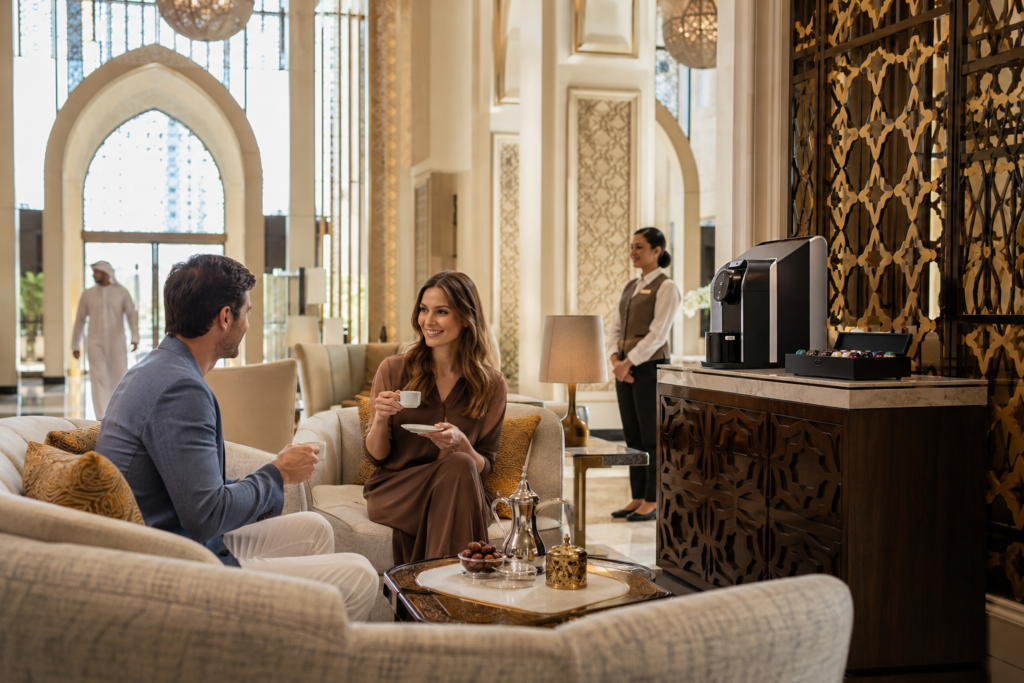
The regional opportunity rests on expanding hospitality demand, premium service expectations, and a large number of coffee moments outside staffed cafés. Still, the business case should be built property by property, not from a glossy regional forecast.
Dubai offers a useful demand signal. The Dubai Department of Economy and Tourism reported 19.59 million international overnight visitors in 2025, up 5% from 2024. Separate official reporting put average hotel occupancy at 80.7% and occupied room nights at 44.85 million for the year. That is a lot of mornings, meetings, and late arrivals.
Saudi Arabia has a different shape. Its tourism strategy covers religious travel, business events, city hotels, resorts, heritage destinations, and large new developments. A Saudi Ministry of Tourism investment report described 67,614 rooms in the construction pipeline at the end of Q3 2024 and plans to expand national hotel capacity to more than 500,000 rooms by 2030.
Those numbers do not equal capsule sales. They show the size of the service environment. The conversion depends on room category, guest profile, existing machine contracts, property standards, and operating cost.
The UAE may suit a supplier seeking a regional commercial and logistics base. Saudi Arabia may offer larger long-term rollouts but a separate importer, registration, and service challenge. Qatar, Kuwait, Bahrain, and Oman have their own hotel mixes and procurement networks. “Middle East strategy” is a useful heading. It is not a substitute for a country plan.
Where Capsules Solve a Real Hotel Problem
Capsules earn their place where staff are absent, demand is scattered, or consistent portioning matters. They are less convincing where throughput, theater, or beverage customization is the main goal.
| Hotel area | Guest or operator need | Capsule opportunity | Main constraint |
| Guest room | Coffee at any hour with little effort | Strong in upscale and business rooms | Cleaning, replenishment, and guest misuse |
| Suite or villa | Premium amenity with visible choice | Strong, especially with branded presentation | Guests expect better coffee and more options |
| Small meeting room | Fast, portion-controlled self-service | Strong when demand comes in short bursts | Water capacity and used-capsule handling |
| Large banquet | Many servings in a tight window | Limited | Low throughput compared with bulk brewing |
| Club lounge | Consistency during quieter periods | Conditional | Peak periods may need another system |
| Restaurant | Reliable after-dinner espresso | Conditional | A staffed bar can deliver more theater and choice |
In-room coffee is the obvious entry point. It behaves like a tiny room-service station without the waiter. The hotel can place a known number of portions, housekeeping can replenish them, and the guest needs almost no skill.
Suites and villas create room for a more premium offer. A hotel may add a signature capsule, better cups, or a branded tray. Small meetings are another practical opening. Delegates can serve themselves, while the operator avoids holding brewed coffee that slowly turns into brown sadness.
Before choosing a system, compare the main single-serve coffee formats. Capsules, K-Cup-style pods, drip bags, and instant formats solve different hospitality problems. The best format follows the venue, serving speed, beverage style, and machine base.
Fit the Product to Regional Guests Without Making It a Cliché
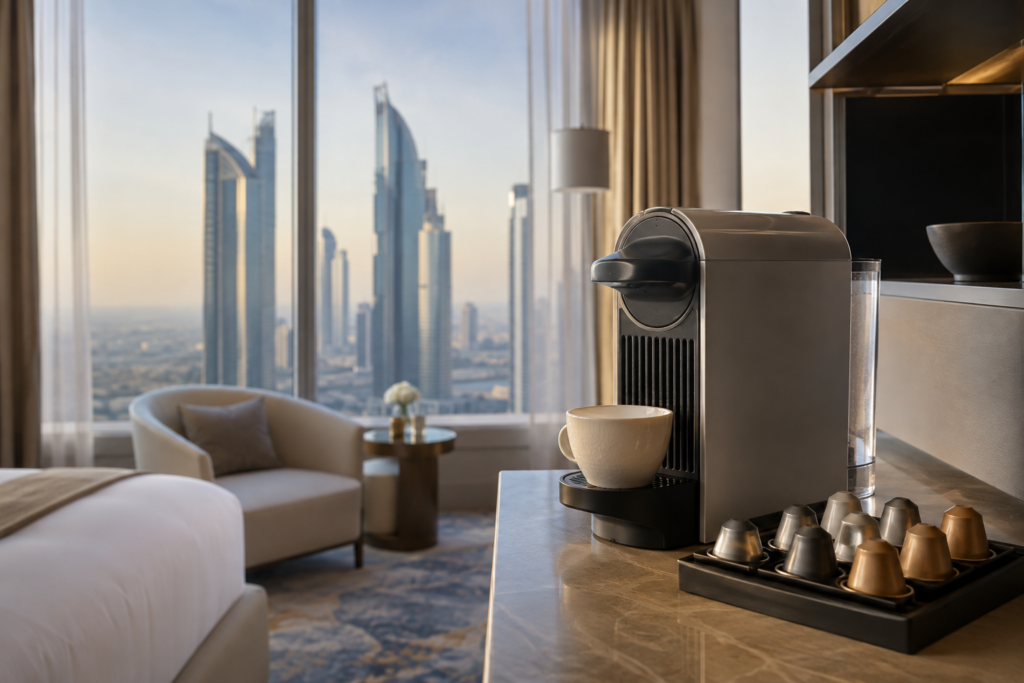
Middle Eastern hospitality serves local residents, GCC travelers, international tourists, business guests, pilgrims, families, and long-stay residents. One dark roast with a gold lid will not automatically satisfy all of them.
Begin with the property’s guest data. A business hotel with many European travelers may value a balanced espresso and lungo. A resort serving milk-heavy drinks may need a stronger capsule that remains present after dilution. A serviced apartment may benefit from a familiar everyday coffee and clear instructions. Decaf can matter in suites, lounges, and evening service, but the hotel should confirm actual use before adding another SKU.
Arabic qahwa deserves separate treatment. It is a preparation, flavor profile, and hospitality ritual. In many settings it includes light-roasted coffee, cardamom, a dallah, small cups, and repeated serving. An espresso-compatible capsule can sit beside that tradition. It should not pretend to replace it.
A sensible room menu often contains only two or three choices:
- a balanced espresso for black coffee;
- a stronger option for lungo or milk;
- decaf where the guest mix supports it.
A signature hotel blend can become a fourth option in suites, gifting, or retail. Give each choice a plain description in Arabic and English. “Intense” is more useful when the guest also knows whether to press espresso or lungo. Pictures help. So does testing the instruction card with someone who did not attend the product meeting.
Sell a Hospitality Program, Not a Box of Pods
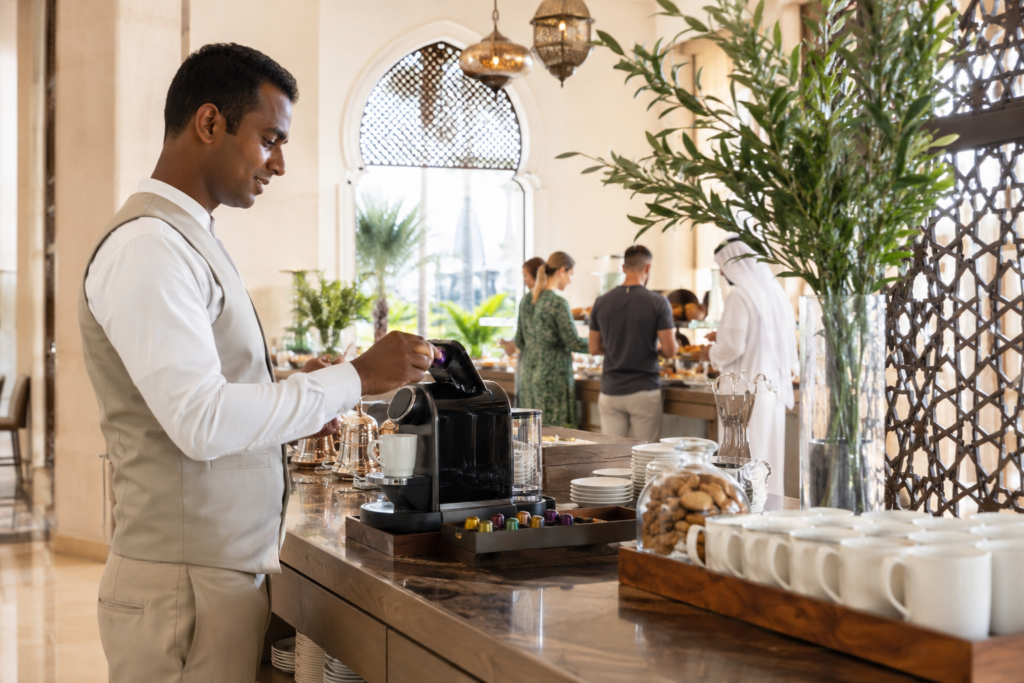
Hotel procurement may compare capsule prices, but operations live with the complete system. A low-priced pod becomes expensive if machines fail, housekeeping cannot clean them, or emergency stock arrives three weeks late.
A credible offer covers:
- machine purchase, lease, or placement terms;
- installation and water assessment;
- coffee and accessory replenishment;
- cleaning and descaling routines;
- housekeeping, F&B, and engineering training;
- repair response times and replacement machines;
- seasonal forecasts and local safety stock;
- guest instructions and presentation items;
- reporting across several properties.
Several departments influence the decision. Procurement wants comparable cost and reliable terms. Operations wants a program that does not create daily friction. Housekeeping cares about cleaning time, loose parts, and stock control. Engineering asks about water filtration, voltage, spare parts, and service. F&B protects beverage quality. Finance wants the full cost. Sustainability teams will ask what happens to used capsules.
The sales proposal should speak to all of them. A tasting can win attention, but a replenishment map and service-level agreement often win the contract.
The regional importance of bundled support is visible in existing offers. Nespresso UAE presents hotel solutions across rooms, lobbies, meetings, banquets, restaurants, and bars while pairing capsules with professional machines and technical service. An independent or private-label supplier does not need to copy that system. It does need an equally clear answer to the operational questions.
Build the Economics Around Occupied Rooms and Servings
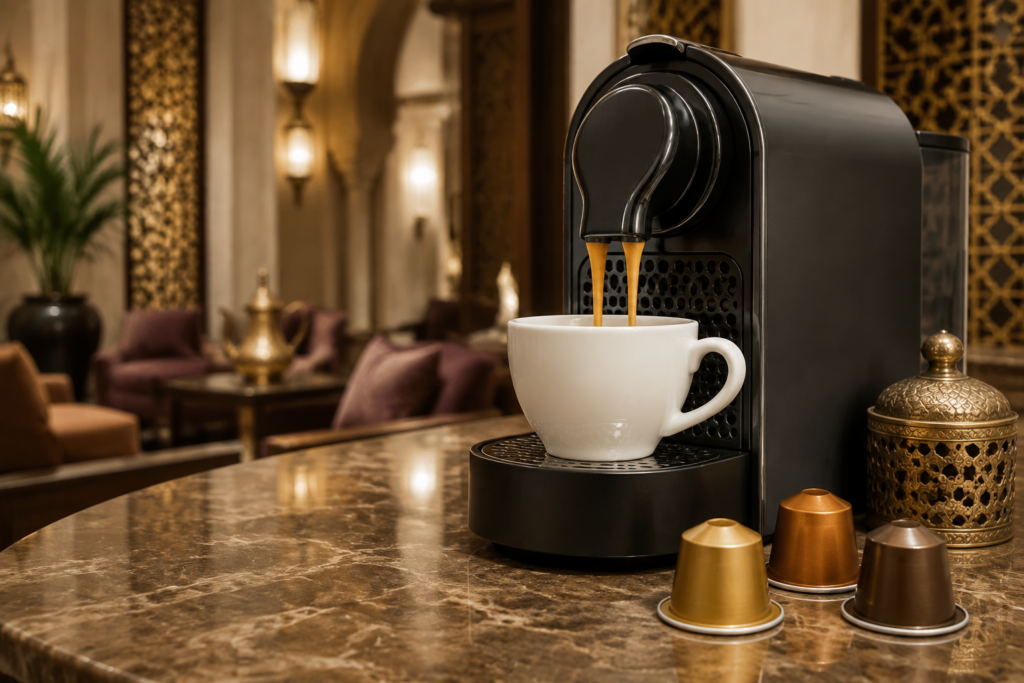
Unit price is only the first line of the model. Hotels need to know the cost per occupied room, per meeting attendee, or per served cup—including portions that disappear without being brewed.
For rooms, begin with:
Occupied rooms × eligible-room share × capsules placed × expected use rate
Then add damaged capsules, complimentary replacements, machine lease or depreciation, service, water filters, cups, sweeteners, presentation, freight, inventory carrying cost, and housekeeping time. Subtract any current costs the program replaces.
Imagine a 200-room hotel with 75% occupancy. Capsules are placed in 120 eligible rooms, with four portions per room. That does not mean 480 capsules are consumed every day. Some remain for the next guest, some are replenished according to hotel policy, and a few walk away in a suitcase. The pilot must reveal the real use and loss rates.
Meetings need a different calculation:
Attendees × expected cups per attendee × peak-service factor
Peak service matters. Fifty delegates may all want coffee during the same 15-minute break. Four attractive little machines can still create a queue. Model brewer throughput, water refill, capsule-bin capacity, and staff support—not just total daily cups.
Separate amenity economics from outlet economics. In-room coffee may support room rate, reviews, or brand perception without direct revenue. A lounge or restaurant may sell the cup. The same capsule cost can be sensible in one place and silly in another.
Use Private Label Where Brand Value Justifies the Complexity
Private-label hotel capsules make sense when the property gains something from owning the experience and has enough consolidated demand to manage customized inventory. They are not automatically better than a recognized brand.
A hotel group can develop a house blend, print its identity on the lid or carton, and carry the same taste across properties. Suites, VIP gifts, weddings, conferences, and hotel retail give that product more visibility. A signature capsule can even extend a memorable stay into the guest’s home.
But customization multiplies small decisions. Who owns the blend? Is it exclusive? Can another factory reproduce it? What happens when the coffee changes? Capsule bodies, printed lids, cartons, and display trays may each have a different MOQ. The cheapest component can end up being the least important constraint.
For pilot work, brands can source custom empty coffee capsules in aluminium, PP, or compostable structures and test the body, lid, coffee, and machine as one system. Material choice should balance barrier performance, food-contact evidence, line behavior, cost, appearance, and local disposal reality.
Be careful with environmental language. “Recyclable” does not show that a hotel has collection, separation, and a willing recovery partner. “Compostable” needs a valid standard, defined conditions, and a route that exists where the waste is generated. A claim should describe the actual program, not only the material’s laboratory possibility.
Design for Heat, Storage, and Long Supply Routes

Coffee capsules may sit in a port, regional warehouse, hotel storeroom, housekeeping cart, and sunny guest room before brewing. Nitrogen flushing helps, but it cannot rescue old coffee, a weak seal, or uncontrolled storage.
Build freshness from several controls:
- Define the roast-to-fill window and coffee specification.
- Use a capsule-and-lid combination with suitable oxygen and moisture barrier.
- Validate seal temperature, pressure, dwell time, and flange cleanliness.
- Measure residual oxygen in sealed samples rather than nitrogen purity at the source.
- Test shelf life under intended distribution and storage conditions.
- Use lot codes, retained samples, and first-expired-first-out inventory.
This guide to nitrogen flushing for coffee capsules explains the preservation principle. The supplier and hotel still need product-specific acceptance limits.
Hotel incoming checks can be simple: inspect dents and lids, verify lot and expiry information, brew samples in deployed machines, check volume and flow, taste the coffee, and record leakage or swelling. Complaints should be traceable to property, machine model, and batch. Otherwise, “the coffee was bad last Tuesday” is about as useful as a weather report from last year.
Choose the Right Regional Supply and Production Model
There are four common routes: import a finished branded system, import a private-label product, co-pack regionally, or fill capsules in-house. The right route changes as contracted volume and service capability grow.
| Model | Best when | Advantage | Risk to manage |
| Imported branded system | Hotels value recognition and an established network | Faster trust and defined standards | Lock-in, landed cost, and lead time |
| Imported private label | A producer can meet the brief and regional rules | Custom identity without a local factory | MOQ and inventory exposure |
| Regional co-packing | Demand and localization are growing | Shorter coordination and replenishment | Supplier dependence and recipe rights |
| In-house filling | Stable B2B volume supports utilization | Control, flexibility, and manufacturing margin | Capital, QA, maintenance, and sales load |
Local or regional production can shorten replenishment and make property-specific work easier. It also requires packaging inventory, trained staff, documented food-safety controls, laboratory checks, and dependable component supply.
Owned equipment becomes relevant when demand is contracted rather than merely exciting. Model annual volume by format, expected line utilization, changeover time, labor, nitrogen, compressed air, utilities, waste, maintenance, and spare parts. A factory with four formats and many tiny hotel SKUs can be busy without being profitable.
Businesses moving toward local production can first choose a capsule filling machine around real operating needs. Run a factory acceptance test with the intended coffee, capsule, lid, and speed. If the target portfolio is espresso-led, then evaluate Nespresso-compatible filling systems against output, changeover, fill variation, gas control, cleaning, integration, and regional support.
Build Compliance into the Commercial Timeline
Registration and label work belong near the start of the project. They are not a final sticker applied after the sales team has promised delivery.
For Dubai, the municipality offers services to register and assess food items, evaluate labels, release imported consignments, and test food samples. The Dubai Municipality service directory is the appropriate current starting point.
Saudi Arabia has a separate route. The Saudi Food and Drug Authority’s imported-food guidance covers importer and product registration, foreign establishments, documentation, inspections, applicable standards, and potential laboratory testing. Labels and import files should be reviewed against the rules in force for the actual product and shipment.
A supplier evidence file may include:
- product and facility registration records;
- approved Arabic and English artwork;
- ingredient, origin, net-content, date, storage, and lot information;
- food-contact declarations and supporting migration evidence where applicable;
- certificate of origin and required import documents;
- HACCP-based controls and buyer-requested certification;
- batch specifications, traceability, recall procedure, and shelf-life support;
- substantiation for compatibility and environmental claims.
GCC standards may provide common reference points, but implementation and procedures can differ by country. Confirm current requirements with the importer, competent authority, and a qualified regulatory specialist. A UAE approval should not be casually treated as a Saudi approval—or the other way around.
Win with a Pilot That Tests Guests and Operations
A useful hotel pilot tests flavor, machine uptime, housekeeping effort, replenishment, complaints, and cost together. A tasting in the general manager’s office is a beginning, not a rollout.
Choose representative rooms, such as standard business rooms and suites, plus one meeting application. Run the pilot through a realistic occupancy period for 30 to 90 days. Include a busy weekend, event, or seasonal peak if possible.
Before starting, record the current coffee cost, service method, complaints, and staff time. Train housekeeping and engineering. Agree who owns stock and who handles the first call when a machine stops. Then track:
| Measure | What it reveals | Possible response |
| Capsules placed and consumed | Real use and loss rate | Adjust room allocation or replenishment |
| Machine uptime and service response | Reliability of the operating system | Repair, replace, or revise SLA |
| Cleaning and restocking time | Housekeeping burden | Simplify setup or training |
| Brew and taste checks | Product consistency | Adjust coffee, capsule, or machine settings |
| Guest feedback and complaints | Experience and instruction gaps | Change range, card, or placement |
| Cost per occupied room | Full financial effect | Renegotiate, redesign, or expand |
| Stockouts and emergency orders | Forecast and logistics quality | Increase local safety stock |
Set pass, change, and stop conditions before the data arrives. If everyone waits until the end to decide what “good” means, the result tends to support whatever they already wanted.
After a successful pilot, create a rollout playbook: approved machine, capsule range, room setup, training, cleaning schedule, stock par levels, service contacts, complaint coding, and monthly review. That playbook is what makes one good hotel account become a reliable group program.
Conclusion: The Opportunity Is Reliable Service, Not Novelty Alone
Coffee capsules have a credible role in Middle East hospitality, especially in upscale guest rooms, suites, serviced residences, small meetings, and selected lounges. They offer convenience and repeatability where a barista or room-service team is not practical.
The stronger business opportunity sits around the capsule. Hotels need a product that suits their guests, survives regional logistics, works in the deployed machines, arrives on time, and creates little extra work. Private label adds value when a hotel group can use the identity and support the inventory. Local filling adds value when contracted demand can keep the operation healthy.
Start narrowly: one country, one hotel segment, one priority format, and one measurable pilot. Prove guest use, operational fit, full cost, and service response. Then scale. In hospitality, boring reliability is actually rather luxurious.
Frequently Asked Questions
1. Are coffee capsules popular in Middle Eastern hotels?
Capsule machines are visible in upscale hotels, suites, serviced residences, offices, and meeting spaces across major GCC cities. However, adoption varies by property category and guest mix. Validate the opportunity through target-hotel audits and a pilot rather than assuming regional uniformity.
2. Which hotel areas are best suited to capsule coffee machines?
Guest rooms, suites, villas, small meetings, and quiet lounge periods are usually the clearest fits. Large breakfasts and banquets often need higher-throughput equipment. The deciding factors are serving speed, staffing, consistency, and portion control.
3. Do capsules replace Arabic coffee in GCC hospitality?
No. Arabic qahwa carries its own preparation and cultural ritual. Capsule espresso can complement it by serving international coffee occasions or private in-room use. Hotels should preserve the role of each instead of presenting one as an upgrade from the other.
4. How many capsule varieties should a hotel room offer?
Two or three choices are often enough: a balanced espresso, a stronger or longer-cup option, and decaf where demand supports it. More choices increase stock complexity and may not improve the guest experience.
5. Are private-label capsules suitable for hotel groups?
Yes, when the group has enough consolidated consumption and wants a distinctive signature product. Check recipe ownership, MOQ for every printed component, supply continuity, quality limits, and inventory responsibility before approving artwork.
6. How should a hotel calculate capsule cost per occupied room?
Include consumed, lost, and damaged capsules plus machine, service, filters, accessories, freight, inventory, and staff time. Divide the relevant total by occupied eligible rooms. Compare it with the current program and the guest value the amenity is expected to create.
7. Which capsule material works best for Middle East hospitality?
There is no universal best material. Compare barrier, seal reliability, food-contact evidence, machine performance, cost, appearance, and the waste route available at the property. Test the complete capsule-and-lid system under intended storage conditions.
8. How does hot-climate storage affect capsule shelf life?
Heat can accelerate quality loss and may expose weak seals or materials. Map the real shipping and storage journey, set storage requirements, retain batch samples, and validate shelf life using the actual coffee and packaging.
9. Should a regional supplier import, co-pack, or buy a filling machine?
Importing can suit an early test. Regional co-packing offers more localization without full capital investment. In-house filling becomes sensible when stable contracted volume, technical staff, quality systems, and line utilization support the total business case.
10. What should a hotel test during a capsule coffee pilot?
Track taste, brew consistency, machine uptime, service response, cleaning time, capsules placed and consumed, guest complaints, stockouts, and cost per occupied room. Agree the decision limits before the pilot begins.