The coffee tastes great at the roastery. Customers already ask for it by name. So the team packs the same roast into a capsule, brews a sample, and—well—it tastes thin and oddly sharp.
Then the retail buyer asks for a barcode, case dimensions, twelve-month forecast, product liability cover, shelf-life evidence, and promotional terms. The printed lids have a larger minimum order than the first store trial. Suddenly, the tiny capsule feels rather large.
This does not mean South American roasters should stay away from single-serve coffee. Quite the opposite. A capsule can carry a local origin into homes, offices, hotels, subscriptions, and export markets. It can turn a trusted café coffee into a convenient retail product. It may also keep more roasting, packaging, brand ownership, and commercial learning closer to origin.
But origin alone will not hold a listing. A retail capsule needs three things to work together: a cup people want again, economics that leave room for everyone in the channel, and a supply system that does not wobble. Think of a three-legged stool. One short leg and the whole thing becomes annoying.
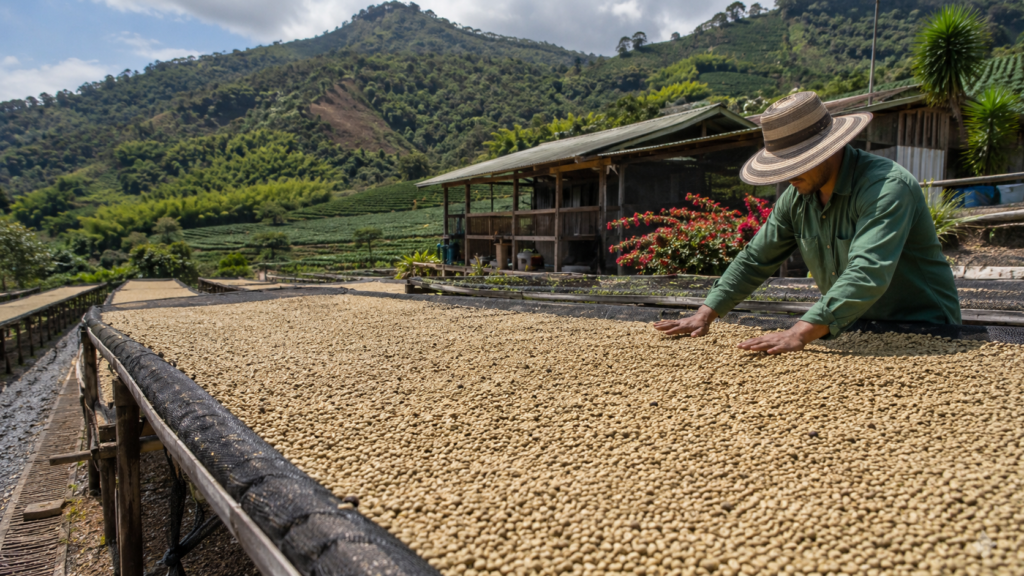
The value-chain backdrop is substantial. The International Coffee Organization reported that Colombian Mild exports rose 11.5% in coffee year 2024/25 to 13.9 million 60 kg bags, while Colombia exports an average of 96% of its coffee production. Those figures show an export-oriented origin, not automatic capsule demand. They do help explain why some roasters want to move beyond shipping coffee as an input and own more of the finished-product relationship. The source is the ICO’s October 2025 Coffee Market Report.
Here is how to build those three legs without launching twelve flavors or buying a filling line too early.
First Decide What Job the Capsule Will Do
Choose the shopper, channel, brewer, beverage, and price role before choosing a capsule color. “We want to sell our Colombian coffee in pods” is an ambition. It is not yet a product brief.
Start with the market. A Nespresso Original-compatible espresso for specialty stores in Bogotá is a different business from a K-Cup-compatible coffee for US grocery. A hotel amenity has different case packs and service expectations from a direct-to-consumer subscription. Even within one city, the same product may look premium online and simply expensive on a supermarket shelf.
Ask five plain questions:
- Who already trusts the roaster?
- Which brewing system do those people own?
- Do they drink espresso, lungo, a larger black coffee, or coffee with milk?
- Where will they discover and reorder the product?
- What shelf price feels believable beside existing capsules?
Existing café customers are often the cleanest first audience. They know the taste and the story. A capsule lets them take that experience home, or at least a practical version of it. An unfamiliar grocery shopper needs more help. The pack must explain why this coffee deserves attention in about the time it takes to walk past it.
Write a one-page brief before requesting samples:
- target country, shopper, and retail channel;
- compatible brewing system and cup size;
- flavor promise in everyday language;
- target shelf price and required brand margin;
- expected first run and monthly sell-through;
- origin, certification, and environmental claims you can prove;
- launch date and first test market.
The capsule should have one clear job. It might be the easy everyday espresso, the roaster’s signature origin, or a discovery product. If it tries to be all three, the box usually says a lot and means very little.
Turn South American Origin into a Reason to Choose
Origin creates value when it connects evidence to a recognizable cup. A flag, mountain illustration, and the word “premium” are decoration. They do not tell the shopper what will happen after pressing the button.
Define the level of origin honestly. Is the coffee from one country, one region, a cooperative, an estate, or a blend designed from several lots? Record the variety or species, process, harvest, producer relationship, and supply plan where relevant. A stable regional blend can be a fine core product. It just should not be sold as a tiny exclusive lot.
South America gives roasters several useful starting points:
| Origin example | Possible capsule strength | Retail role | Risk to manage |
| Brazil Cerrado or Mogiana | Chocolate, nuts, body, approachable sweetness | Core espresso or milk-friendly capsule | Generic positioning if the region and process disappear |
| Colombia regional lot | Balanced acidity, caramel, fruit, strong recognition | Signature single-origin | Crop variation and an over-broad country story |
| Peru | Clean sweetness and discovery value | Premium or certified line where evidence supports it | Awareness and repeatable supply |
| Ecuador or Bolivia | Distinctive and less common origin | Limited release or halo SKU | Smaller volumes and higher cost |
These are development ideas, not guaranteed flavor descriptions. The actual lot, roast, grind, and extraction decide the cup.
The Specialty Coffee Association’s Coffee Value Assessment separates physical, descriptive, affective, and extrinsic attributes. That is a useful way to think. Describe what the coffee tastes like. Record how the target customer responds. Then document the information around it, such as region, processing, certification, and traceability. One score cannot carry the whole brand.
There is also a choice between an ingredient brand and a finished-product brand. The Colombian Coffee Growers Federation has used both approaches: Café de Colombia supports the origin of third-party products, while Juan Valdez identifies consumer products and cafés. A local roaster can make the same strategic distinction on a smaller scale. Is origin endorsing the brand, or is the brand itself the main promise?
Keep impact claims narrow. “Bought from Cooperative X, harvest 2026” is verifiable. “Changing farmers’ lives” needs evidence about prices, contracts, or programs. Organic, regenerative, carbon-neutral, and women-produced claims also need defined scope. Retail buyers notice fuzzy claims because their legal teams do too.
A Capsule Recipe Is Not a Smaller Bag Recipe
A bagged-coffee recipe rarely drops into a capsule unchanged. The dose is small, the coffee bed is shallow, and the machine controls much of the extraction. Water will find an easy path through an uneven grind. A few tenths of a gram can matter.
Develop the product in the intended capsule and brewer. Start with the target drink. A short espresso needs enough aroma, soluble intensity, and texture. A lungo must stay balanced through more water. A milk drink needs structure after dilution.
Run several roast, grind, and dose combinations. Record:
- coffee lot or blend;
- roast color and development window;
- rest or degassing time before filling;
- grind distribution, not only an average size;
- target dose and observed variation;
- flow time and beverage amount;
- sensory result, including performance with milk where relevant;
- failures such as channeling, leakage, weak body, or stalled flow.
Test across several target machine models. External dimensions do not guarantee compatibility. The capsule body, rim, lid, filter, coffee density, and piercing behavior work as one system.
The final product specification should allow controlled variation. Coffee is agricultural. A favorite lot will change or end. Define approved substitutions and a sensory acceptance range so the red box keeps tasting like the red box, even when its components shift slightly.
Choose the Capsule System from the Target Shelf Backward
The right system is the one the intended shopper already uses and the selected channel can support. Global fame is not enough.
Nespresso Original-compatible capsules often fit espresso and lungo propositions in South American cities, Europe, and specialty retail. K-Cup-compatible pods serve a larger-cup occasion and are especially relevant for North American export. Dolce Gusto-style formats may suit markets where that installed machine base and broader beverage range are meaningful.
| Decision factor | Espresso-style compatible capsule | K-Cup-compatible pod |
| Main drink | Espresso or lungo | Larger brewed coffee |
| Likely opportunity | Specialty retail, urban home use, hospitality | US retail, offices, larger-cup households |
| Product-development focus | Short-cup balance, piercing, lid, crema | Filter behavior, flow, dose, larger-cup strength |
| Production implication | Compact dose and tight grind control | Larger cup, filter construction, and different sealing needs |
Do not use the same roast and grind merely because the brand story is the same. Treat each format as a separate product. Review third-party trademark wording and compatibility claims in the destination market as well.
For a North American retail path, this guide to retail-focused K-Cup production requirements can help frame the equipment and quality questions. Use stated performance figures as supplier inputs to verify, not as a replacement for your own product trial.
Make Packaging Protect the Coffee and Earn Shelf Space
The primary package has two jobs. It protects ground coffee, and it works inside the brewer. The carton has another two. It helps the shopper choose, and it moves efficiently through retail.
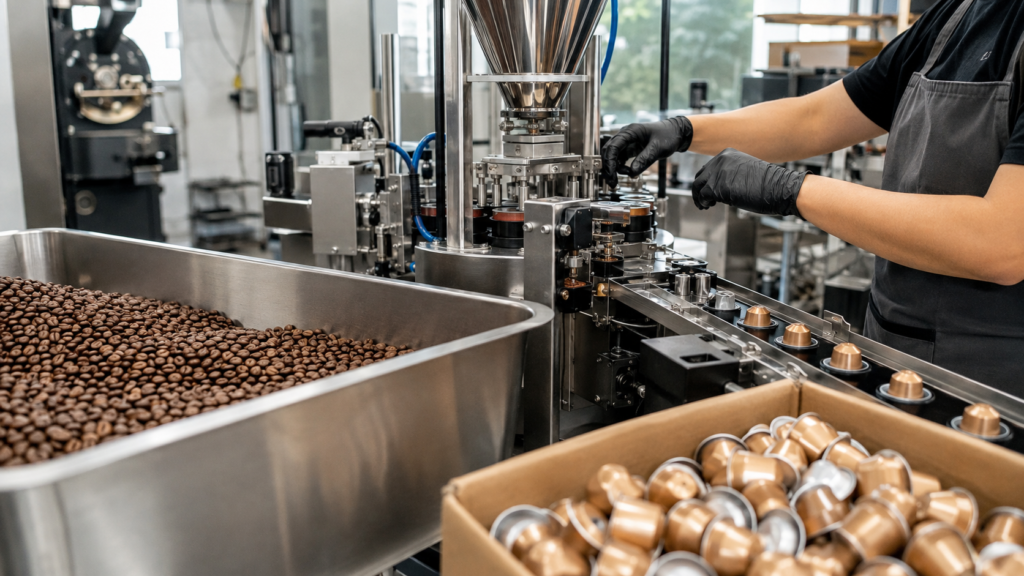
Aluminium can provide a strong barrier and premium cue. PP-based plastic offers design and manufacturing flexibility, but the exact structure matters; a high-barrier multilayer cup behaves differently from a simple shell. Compostable materials can support a distinct proposition when brewing performance, certification, shelf protection, and the real disposal route line up.
Use this comparison of aluminium and plastic capsule materials to create a shortlist. Then test the complete body, lid, coating, ink, adhesive, filter, and coffee combination. A good shell with the wrong lid is still the wrong package.
| Material route | Potential advantage | Trade-off | Evidence to request |
| Aluminium | Barrier and premium appearance | Cost, denting, and local recovery reality | Food-contact documents, coating data, seal tests |
| Barrier plastic | Cost, color, and line flexibility | Barrier varies by construction | Full material specification, migration support, shelf tests |
| Compostable structure | Clear environmental differentiation | Heat, seal, barrier, and disposal complexity | Certification, conditions, and disposal instructions |
Nitrogen flushing can reduce oxygen in the sealed pack, but it cannot rescue stale coffee, a weak barrier, or a leaking flange. Measure residual oxygen in finished capsules. Run seal-integrity checks and real-time shelf-life work under expected storage and distribution conditions. Do not borrow a twelve-month date from another product because the boxes look similar.
On the carton, make the hierarchy simple:
- brand and capsule-system compatibility;
- origin or blend identity;
- flavor and intensity cues;
- cup recommendation;
- quantity and required label information.
Retail details are less exciting but equally important: barcode placement, carton size, case count, shelf orientation, pallet pattern, date code visibility, and scannability. A gorgeous box that does not fit the retailer’s shelf tray is a rather expensive art project.
Work Backward from Retail Price, Not Forward from Coffee Cost
Coffee cost is only one part of the capsule’s economics. Start with the likely shelf price and work backward through every hand that touches the sale.
The model may include retailer margin, distributor or importer margin, promotions, listing costs, free samples, returns, freight, duty, warehousing, outer cases, cartons, lids, capsule bodies, coffee, co-packing, quality testing, and working capital.
Here is a hypothetical structure. The percentages are deliberately blank because real terms vary by country, channel, buyer, and bargaining power.
| Step | Question | What to include |
| Shelf price | What will the shopper realistically pay? | Competitor set, pack count, brand position |
| Retail deduction | What does the store keep or charge? | Margin, promotions, listing, returns |
| Distributor/importer | Who moves and finances the product? | Margin, freight, duty, warehouse |
| Brand net revenue | What reaches the roaster? | Payment terms and deductions |
| Product contribution | What remains after variable cost? | Coffee, capsule, lid, carton, filling, waste |
MOQ deserves special attention. The filling run may be small, while custom lids or cartons require much more. The result is cash sitting in a storeroom wearing your logo. Ask for component MOQ, tooling, setup loss, reorder lead time, and artwork-change cost separately.
A premium origin does not automatically solve weak economics. Sometimes a simpler two-SKU line with a standard capsule color and custom lid preserves more cash than a fully customized six-color launch. Not glamorous, perhaps. Sensible, yes.
Co-Pack First or Fill In-House?
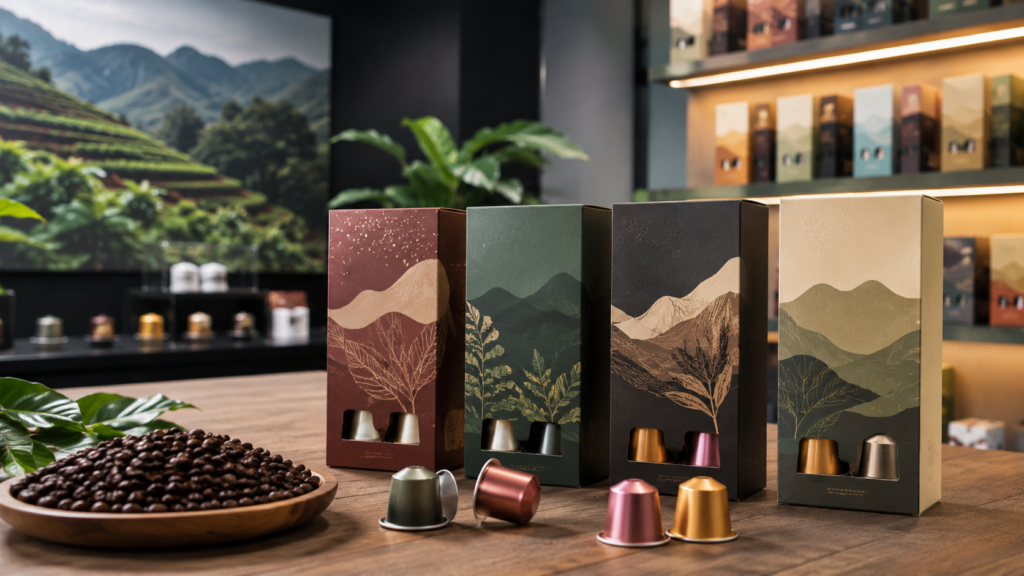
Co-packing is often the safer first step when demand is uncertain or the roaster lacks capsule experience. Owned equipment becomes attractive when stable volume, control, scheduling, confidentiality, and accumulated manufacturing margin justify the operating responsibility.
A good co-packer can shorten development and provide established quality systems. Ask who owns the recipe, whether the profile is exclusive, how substitutions are approved, what happens to unused components, and whether the roaster can transfer the specification to another factory.
In-house production gives direct control over roast-to-fill timing, small schedule changes, and customer-specific work. It also brings nitrogen, compressed air, electrical service, operators, sanitation, maintenance, spare parts, testing, waste, and downtime. Machine price is one line in the spreadsheet, not the spreadsheet.
| Factor | Co-packer or OEM | In-house filling |
| Initial capital | Lower | Higher |
| Time to first pilot | Often shorter | Depends on delivery, setup, and validation |
| Process control | Shared and contract-based | Direct, with internal responsibility |
| MOQ | Set by supplier and components | Set by changeover and component economics |
| Technical burden | Supplier qualification and incoming QC | Full production, maintenance, and QA |
| Best signal | Demand still needs proof | Contracted volume can support utilization |
Before investing, use a structured process to choose a coffee capsule filling machine. Request a factory acceptance test with the actual coffee, capsule, and lid. Record stable speed, fill variation, stops, waste, residual oxygen, seals, and brewed results. A demonstration using an easy-flowing powder proves very little about your coffee.
Build the Retailer File Before the Buyer Meeting
A retailer buys more than flavor. The buyer needs an item that can be created in the system, received at a warehouse, placed on a shelf, replenished, traced, and recalled if something goes wrong.
Prepare a file containing:
- product specification and approved artwork;
- ingredients, net content, origin, date, lot, storage, and preparation information;
- barcode or GTIN;
- unit, carton, case, and pallet dimensions;
- case pack, MOQ, lead time, and shelf life;
- food-contact declarations and relevant test support;
- facility food-safety plan and certifications required by the buyer;
- traceability, retained-sample, complaint, and recall procedures;
- compatibility and sensory test results;
- insurance and importer details where required;
- evidence behind origin, environmental, and certification claims.
For coffee manufactured or packaged in Brazil, Anvisa’s food-packaging guidance is a useful official starting point. It explains that food-contact packaging is regulated and that manufacturers remain responsible for meeting applicable technical requirements even where general packaging is exempt from product registration. Export products must also meet destination-market rules.
Food-safety certification requested by a supermarket may exceed the legal minimum. Depending on the buyer and market, that could involve HACCP-based controls, ISO 22000, FSSC 22000, BRCGS, SQF, or a retailer audit. Confirm the current requirement before pricing the account.
Traceability must reach both ways. From a finished capsule lot, the team should identify the coffee, capsule, lid, production run, and relevant test records. From a material problem, it should identify affected finished lots and customers. Nobody enjoys planning a recall. Planning one is still cheaper than improvising it.
Launch Narrow, Then Let Sell-Through Decide

Start with one core capsule and one signature origin. That is enough to test whether people understand the offer, like the cup, and reorder it. A rotating discovery SKU can come later.
The core product should carry volume and a clear everyday occasion. The signature product should explain why this roaster and origin are worth choosing. Their flavor, price, and packaging roles must be visibly different.
Use existing café customers and e-commerce buyers for early trials, but do not stop there. Test the product with people who have never heard the brand story. Give them the intended machine. Watch whether they choose the correct button and understand the pack.
For pilot components, roasters can explore customizable empty coffee capsules before committing to a large branded range. Keep artwork flexible where possible. A standard body with a custom lid and carton may offer enough identity for the first commercial test.
Track a 90-day scorecard:
| Metric | What it reveals | Possible action |
| Store or online sell-through | Whether trial demand exists | Adjust channel, price, or message |
| Reorder rate | Whether the cup creates a habit | Improve product before expanding reach |
| Compatibility complaints | Whether the system claim is reliable | Fix construction or narrow the claim |
| Returns and damage | Whether packaging survives distribution | Strengthen pack or handling controls |
| Gross and contribution margin | Whether growth helps cash | Reprice, simplify, or renegotiate |
| Stockouts and lead-time misses | Whether supply can scale | Revise forecast and safety stock |
Set continue, change, and stop conditions before launch. Otherwise every weak result becomes “interesting learning,” and the storeroom keeps filling up.
A Practical Roadmap from Local Origin to Retail Shelf
The sequence below keeps expensive commitments until after the important uncertainties have been reduced:
- Pick one shopper, market, retail channel, and brewer system.
- Document the origin, supply plan, and claim evidence.
- Define the capsule’s role, cup, and shelf price.
- Develop roast, grind, dose, and extraction together.
- Qualify the capsule, lid, filter, barrier, and seal.
- Work backward through retail economics and cash needs.
- Choose co-packing or in-house production.
- Assemble retailer and compliance documentation.
- Run a narrow commercial pilot and retain samples.
- Scale after repeat orders and stable production—not before.
Conclusion: The Shelf Rewards Repeatability
South American roasters have a genuine capsule opportunity. They sit close to origin, understand the coffee, and can build stories that are more specific than a generic imported blend. Capsules can carry that value into retail and extend a local café relationship into the home.
Still, origin wins attention only once. Repeatable taste, sound economics, compatible packaging, retailer documentation, and dependable supply keep the listing.
Start with a one-page product brief and one real line trial. Keep the first range narrow. Price from the shelf backward. Then let sell-through and repeat orders decide when to customize more, enter another market, or bring filling in-house. That route is slower than ordering colorful cups on day one. It is also much less likely to leave the roaster with a beautiful pile of unsold ambition.
Frequently Asked Questions
1. Are coffee capsules a good opportunity for small South American roasters?
They can be, especially when the roaster already has loyal café or online customers. Start with a small co-packed pilot and one system. The opportunity is weaker when the brand has no clear buyer, price position, or route to reorder.
2. Which South American coffees work best in capsules?
Brazilian coffees can provide body and approachable chocolate or nut profiles. Colombian and Peruvian lots may offer sweetness and brighter character. The best choice depends on the drink, roast, grind, dose, and target customer—not the country name alone.
3. Can a roaster use the same roast profile for bags and capsules?
Sometimes it can be a starting point, but it should not be assumed. Capsule dose and extraction differ from pour-over or café espresso. Develop and taste the coffee in the final capsule and machine before approving the recipe.
4. Should a new brand choose Nespresso-compatible capsules or K-Cup-compatible pods?
Choose the system used by the target shopper. Espresso-style compatible capsules suit short-cup markets, while K-Cup-compatible pods matter more for larger cups and North American retail. One format is usually enough for the first launch.
5. How many capsule SKUs should a roaster launch first?
Two is often practical: one core product and one signature origin. This gives shoppers a real choice without multiplying components, forecasts, changeovers, and working capital. Add more only after the first products reorder.
6. Is aluminium, plastic, or compostable packaging better for retail capsules?
No material is always best. Compare barrier, sealing, machine performance, food-contact evidence, cost, appearance, and local recovery or composting routes. Test the complete package with the actual coffee through shelf life.
7. What is a realistic MOQ for private-label coffee capsules?
It varies by factory, format, material, printing, and customization. Ask separately about the filling MOQ, capsule-body MOQ, printed-lid MOQ, carton MOQ, tooling, and setup waste. The largest component commitment often controls the real minimum.
8. Should a roaster use a co-packer or buy a capsule filling machine?
Use a co-packer when demand is still uncertain or technical capacity is limited. Consider a line when stable contracted volume, trained staff, quality controls, and expected utilization support the full operating cost.
9. What documents do retailers request for coffee capsules?
Common requests include specifications, approved labels, barcode data, case dimensions, shelf life, traceability, food-contact support, facility certifications, insurance, recall procedures, lead times, and proof for product claims. Requirements vary by retailer and country.
10. How long does it take to move from prototype to retail shelf?
There is no fixed timeline. Coffee development may be quick, while component lead times, shelf-life work, label review, retailer setup, and production scheduling take longer. Build the plan backward from the buyer’s reset or launch date and leave room for a failed trial.