A retailer asks for an espresso capsule. A marketplace brand wants three flavored products. An office supplier needs one simple blend in large cartons. On a spreadsheet, all three orders look similar: coffee goes in, capsules come out.
On the factory floor, they are three different jobs.

Each can have its own coffee, grind, capsule body, printed lid, carton, code, quality limit, and delivery rhythm. Add a few small clients and the line may spend more time changing clothes than doing work. Yep, it happens.
Good coffee capsule production planning starts before machine selection. It begins with demand you can defend, a narrow product architecture, and a cup you can reproduce. Then you plan materials, capacity, compliance, stock, and service.
That order matters in Russia. ICMR’s 2023–2025 coffee-market analysis reported 24.6% growth in market value but only 3.1% growth in total physical volume for September 2024 through August 2025. Rising revenue does not automatically mean your factory needs 24.6% more capsule capacity.
So, let’s build the plan from the customer backward.
Build the Private-Label Production Brief Before You Build Capacity
The brief should give sales, product, purchasing, quality, and engineering one shared version of the project. If sales promises a premium aluminium capsule while purchasing has costed basic plastic, the project is already drifting.
Start with the buying situation. Is the capsule going to a supermarket, marketplace, regional distributor, office supplier, hotel group, or the brand’s own web shop? Supermarkets may require strict case data and delivery windows. Marketplace demand can jump after a promotion. Office customers often prefer fewer SKUs and very reliable extraction.
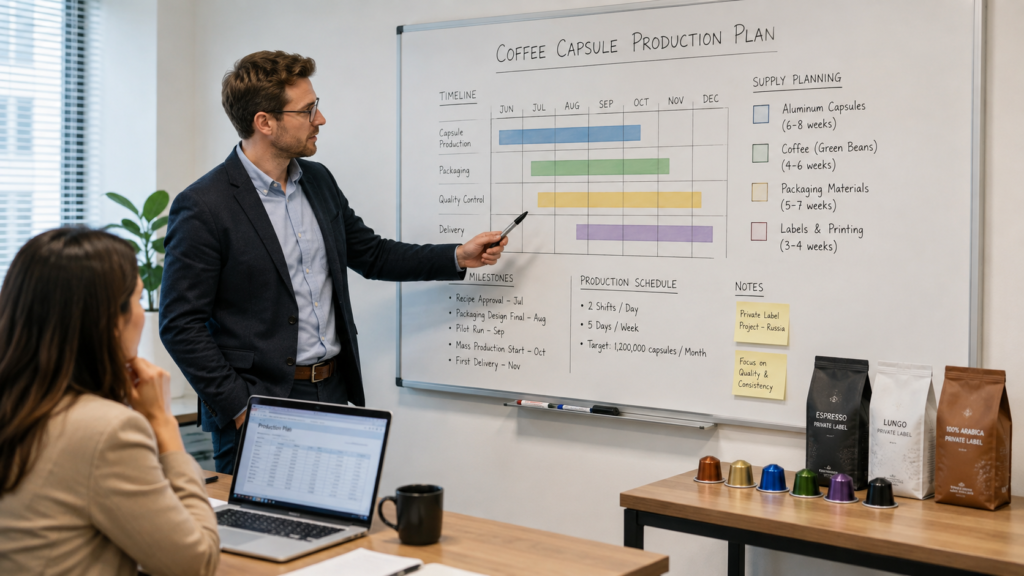
Define the production relationship too:
- White label: the producer’s established recipe receives the customer’s brand.
- Private label: the customer receives a more distinct recipe, design, or specification.
- Toll packing: the customer supplies coffee or packaging for the factory to process.
- Owned production: the brand controls the line, people, schedule, and quality system.
Record who owns the recipe, artwork, tooling, test data, and unused printed packaging. Also state who can approve a substitute material. These details feel dull during the first tasting. They become quite exciting when a customer leaves.
| Brief field | Decision to record | Planning effect |
| Customer and channel | Retail, marketplace, office, HoReCa, or D2C | Changes pack, forecast, and service level |
| Capsule system | Target system and brewer models | Sets cup, lid, tooling, dose space, and tests |
| Product promise | Espresso, lungo, decaf, flavored, or milk-friendly | Changes roast, grind, dose, and controls |
| Demand range | Conservative, expected, and peak volume | Sets capacity without one optimistic forecast |
| Shelf-life target | Commercial life and storage route | Drives barrier, gas, testing, and stock rules |
| Compliance scope | Market, claims, packaging unit, and code flow | Affects artwork, records, and equipment |
Use monthly demand cases, not just one annual number. Annual totals hide the peaks that create overtime and the quiet months that leave custom lids gathering dust.
Keep the First Coffee Capsule Portfolio Narrow
Every extra coffee, cup color, foil print, carton, language, and customer creates another SKU. Even when two capsules contain the same blend, different printed components split purchasing and increase write-off risk.
For a Russian consumer range, a Nespresso Original-compatible platform may be a logical start when the target shopper owns that brewer type. Nespresso Professional-compatible products can suit offices and hotels where the installed machines are known. Dolce Gusto-compatible products may support coffee and soluble drinks. K-Cup-compatible pods should normally have a defined export or installed-base case. A format is not attractive merely because the line can fill it.
A first range might contain one everyday espresso or lungo and one stronger, milk-friendly option. Add decaf only if the channel can turn the stock. Add flavored capsules after cleaning, flavor carryover, ingredients, and labeling have been reviewed.
Share platform materials where the brand permits. A stock capsule with a custom carton can be easier than a unique body, foil, and box for every small account. Private label needs differentiation, sure, but it also needs a warehouse that makes sense.
Turn the Coffee Brief into a Repeatable Capsule Specification
A coffee that tastes lovely as whole bean may become thin, slow, or harsh in a capsule. The brewing machine fixes much of the water, pressure, and contact time. The producer must tune roast, grind distribution, dose, bed density, and headspace around those limits.

A finer grind can increase strength, but it can also block flow. A darker roast can create intensity, yet turn rough in a short drink. Develop the recipe in the target capsule and test it across several relevant brewers, including older machines where practical.
The approved specification should include:
- coffee identity, blend rules, and allowed substitutions;
- roast target and tolerance;
- grind-distribution limits, not only a grinder setting;
- dose tolerance and sampling frequency;
- roast-to-grind and grind-to-fill timing;
- expected extraction behavior in named machines;
- an approved sensory reference;
- retesting rules after a crop, supplier, recipe, or packaging change.
Degassing belongs in the schedule. Freshly roasted coffee releases carbon dioxide. Filling too early can affect pressure and extraction. Waiting too long costs aroma. Find the workable window through trials and lock it into the batch record.
Useful quality gates include roasted-coffee identity, grind distribution, dose, seal appearance, leak testing, residual oxygen, brewing performance, sensory release, and retained samples. A private-label customer should receive the same intended cup in batch twelve, not just in the sales sample.
Qualify Coffee Capsule Packaging Materials as One System
A high-barrier capsule with the wrong lid is like a winter coat with the zipper open. The body may be excellent, but the finished package still fails.
Approve the cup, flange, filter, foil, sealant, ink, coating, and brewer performance together. Aluminium offers strong light, oxygen, and moisture protection. Barrier plastics can provide cost and color flexibility. Compostable structures may support a strong proposition, but their sealing and shelf-life window can be less forgiving.
This comparison of aluminium and plastic capsule materials can help create the shortlist. Final approval still needs the planned coffee, lid, line settings, storage route, and brewer tests.
| Material route | Likely strength | Trade-off | Evidence needed |
| Aluminium | Strong barrier and premium appearance | Cost and sealing sensitivity | Food-contact file, dimensions, seal window, brewer trials |
| Barrier plastic | Color, cost, and line flexibility | Performance depends on the complete structure | Layer specification, migration support, oxygen and seal tests |
| Compostable structure | Distinct environmental position | Process window and disposal complexity | Certification, shelf tests, seal data, disposal wording |
For pilot work, customizable Nespresso-compatible empty pods can be used to compare structure, fit, and branding options before a large printed order. Request drawings, tolerances, food-contact documents, lot identification, and change-notification terms. A nice sample bag is not a technical file.
Test the complete retail and transport pack as well. Russia’s distance, warehouses, parcel networks, and seasonal temperatures can expose damage that a loose capsule in the lab never sees.
Plan Freshness with Measurements, Not a Nitrogen Slogan
“Nitrogen flushed” is not a release specification. The source gas may be very pure while oxygen remains in the capsule headspace, between coffee particles, or enters through a poor seal.
Measure residual oxygen in finished capsules using a defined sampling plan. Pair that result with leak testing, seal checks, barrier evidence, and storage trials. The process may use controlled gas displacement, vacuum assistance, repeated flushing, or a protected sealing chamber. This explanation of how a high-nitrogen atmosphere is achieved inside coffee capsules shows why gas delivery and packaging barrier must work together.
Create a shelf-life file for each product family. Record the approved coffee and package, initial oxygen and seal results, storage conditions, and scheduled checkpoints. At each point, check package condition, aroma, extraction, and cup quality. Accelerated trials can reveal risk, but they should not be treated as identical to real-time shelf evidence.
A 12-month label also does not mean producing 12 months of stock. Long storage increases the chance of artwork changes, customer loss, and flavor decline. Make to a sensible replenishment rhythm whenever demand allows.
Compare Co-Packing and an Owned Coffee Capsule Line Honestly
Co-packing is often safer when demand is uncertain, formats are changing, or the team lacks capsule-process experience. The unit price may be higher, but the brand avoids early capital, hiring, maintenance, and idle-equipment cost.

Ownership becomes more attractive when repeat demand is stable, schedule control matters, and the captured margin can support the whole operation. The filler is only one part. Budget for grinding, nitrogen, compressed air, dust control, coding, verification, test equipment, cartoning, utilities, sanitation, operators, training, and downtime.
A hybrid model works for many producers: co-pack the first launch, bring the stable core platform in-house, and keep overflow or unusual formats external.
When ownership looks credible, use a structured process to choose a coffee capsule filling machine. Compare suppliers on output with nitrogen running, dose accuracy with your coffee, material tolerance, changeover time, coding integration, Russian-language documents, remote diagnostics, local spares, software access, and EAEU technical files.
Run the factory acceptance test with the actual coffee, cup, lid, code, and carton. A two-minute demonstration with an easy powder proves surprisingly little.
Convert Nameplate Speed into Real Coffee Capsule Capacity
A machine rated at 60 capsules per minute appears to make 28,800 capsules in an eight-hour shift. The factory cannot ship arithmetic, though. It must allow for checks, loading, breaks, adjustments, cleaning, changeovers, maintenance, and rejects.
Use a simple model:
Saleable capsules per shift = rated speed × scheduled running minutes × running factor × quality yield
Here is a hypothetical example, not an industry benchmark:
| Input | Example |
| Rated speed | 60 capsules/minute |
| Scheduled running time | 420 minutes |
| Running factor | 78% after stops and adjustments |
| Quality yield | 98% saleable output |
| Calculated result | About 19,267 saleable capsules per shift |
That is about one-third below the simple nameplate total. Your result may be better or worse. Foil behavior, nitrogen mode, powder flow, operator skill, code verification, and secondary packaging all matter.
Model base, peak, and recovery capacity. Recovery capacity asks: if the line loses a shift, can the factory catch up before the customer’s delivery window?
Compare coffee capsule filling machine configurations against the real dose, campaign size, utilities, footprint, and downstream pack. A smaller stable line running longer batches can beat a faster machine that spends its week changing materials.
Design Russian Compliance and Data Matrix Marking into the Line
Compliance changes artwork, material files, batch records, coding equipment, camera position, rejection logic, and product release. It is not a folder to finish after production begins.
A Russian capsule project will commonly review:
- TR CU 021/2011 for food safety;
- TR CU 022/2011 for food-product labeling;
- TR CU 005/2011 for packaging safety and identification;
- TR CU 029/2012 where flavorings, additives, or formulated drinks apply;
- TR CU 010/2011 for machinery and equipment safety;
- TR CU 004/2011 and TR CU 020/2011 where low-voltage and electromagnetic-compatibility requirements apply.
The official EAEU technical-regulation portal provides conformity resources and registers. Confirm the exact route for the product, machine, classification, and transaction with a qualified specialist. Imported equipment also needs the correct EAEU applicant or importer arrangement and a usable technical file.
Finished-product labeling normally needs the applicable Russian-language identity, composition, net quantity, date, shelf life, storage, responsible-business details, and other required information. Flavored or milk-containing products require a wider ingredient and allergen review than plain roasted coffee.
There is also a current production issue. Rospotrebnadzor’s guidance on mandatory coffee marking states that covered coffee products entered the identification-marking stage on June 1, 2026, while also listing a weight-based exception that must be checked against the exact sales unit.
Define responsibility for master data, GTINs, code ordering, application, camera verification, rejects, records, and downstream events. Reserve a printable area before carton artwork is approved.
Do not assume the code belongs on every individual capsule or only on the outer box. Verify the exact consumer sales unit, net weight, product code, exception, and pack structure under the current rules. That decision can change the coding hardware and cost of every pack.
Use HACCP-based controls, traceable lots, retained samples, complaint records, and recall tests. ISO 22000, FSSC 22000, or another buyer-requested scheme may help with larger accounts, but certification does not replace product-specific control.
Protect Production with Inventory, Spares, and Controlled Alternatives
Coffee, cups, lids, cartons, coding supplies, and wear parts move on different clocks. Forecast them separately.
If five customers share one capsule body but use five printed lids, body demand may be stable while each lid remains risky. Standard lids, blank cartons, or shorter print methods can reduce trapped cash during pilot volumes, provided appearance and compliance still work.
Set safety stock from usage, replenishment risk, service target, and shortage impact. A locally available sensor and a custom imported foil should not receive the same stock rule.
Identify critical heaters, seals, sensors, auger parts, pneumatic components, relays, and coding supplies from the machine design. Agree on remote-support hours, diagnostic access, shipment responsibility, and software recovery.
Imported machinery and parts should move through lawful trade channels. Check classification, EAEU conformity, end user, banking, shipping, current restrictions, and documents before payment. Continuity planning should reduce risk, not rely on shortcuts.
Qualify alternative cups, lids, filters, and coatings before an emergency. A substitute can change sealing and extraction. Review food-contact evidence, run line and brewer trials, update the specification, and obtain customer approval where required.
Use a Staged Launch Instead of One Big Bet
Start with one channel, one brewer platform, and a believable forecast. Develop the coffee and packaging together. Complete the food-contact, labeling, and marking reviews before ordering a warehouse full of printed material.
Then run a real pilot. Measure dose, seal, residual oxygen, extraction, sensory result, code readability, rejects, labor, and changeover. Store retained samples and test the actual transport route where possible.
During the first 90 days, track forecast accuracy, saleable yield, seal and dose failures, oxygen results, complaints by lot, on-time delivery, printed-component stock, reorder rate, contribution by SKU, and unplanned downtime.
Release the next machine, shift, or SKU only when repeat orders, margin, yield, and service support it. Volume without margin is exercise. Volume without repeat orders is inventory moving once.
Conclusion: Plan the System, Then Buy the Speed
Coffee capsule production planning for Russian private-label producers is mainly a coordination job.
Sales needs a believable demand range. Product development must turn the promised drink into a repeatable specification. Purchasing must qualify materials and understand their lead times. Quality and compliance must design controls, Russian labels, Data Matrix marking, and records. Engineering must convert all of this into effective capacity, utilities, maintenance, and support.
When those pieces agree, machine selection gets easier. You are no longer shopping for the largest hourly number. You are choosing a system that can make saleable, compliant capsules at the pace customers can reorder.
The next step is simple: complete the one-page production brief, collect the actual coffee and packaging, and run a production-length test. A real trial tells the truth faster than a glossy brochure.
Frequently Asked Questions
1. What is the best capsule format for a Russian private-label launch?
Choose from the brewer systems used by the target customer. Nespresso Original-compatible capsules may suit consumer espresso and lungo. Professional or Dolce Gusto-compatible formats need a confirmed installed base and channel. Start with one platform unless committed demand justifies another.
2. What is a realistic private-label coffee capsule MOQ in Russia?
Some Russian contract producers publish starting points near 5,000 capsules per item, but total-order, flavor, material, and packaging minimums vary. Ask separately about the MOQ for coffee, cup color, printed lid, carton, and production campaign.
3. Should a producer co-pack or buy a capsule filling machine?
Co-pack while demand or formats remain uncertain. Consider ownership after repeat volume can cover equipment, people, utilities, testing, maintenance, downtime, spares, and working capital. A hybrid model often lowers the transition risk.
4. How is real coffee capsule production capacity calculated?
Apply scheduled operating time, a realistic running factor, and quality yield to the rated speed. Validate the result in a long test with the actual coffee, capsule, lid, nitrogen setting, code, and secondary pack.
5. Is aluminium or plastic better for compatible capsules?
Aluminium provides strong barrier performance. Barrier plastic can offer cost and color flexibility. Compare food-contact evidence, sealing, oxygen, shelf life, brewer fit, cost, and end-of-life claims. Neither material wins automatically.
6. How low should residual oxygen be?
Set a limit through product and shelf-life trials, then use one defined measurement method and sampling plan. Barrier, seal integrity, coffee condition, and storage matter alongside the oxygen number.
7. Which EAEU regulations apply?
Plain coffee capsules commonly require review under TR CU 021/2011, 022/2011, and 005/2011. Formulated products may involve 029/2012. Equipment may fall under 010/2011 and, where applicable, 004/2011 and 020/2011. Confirm the exact scope professionally.
8. Do coffee capsule packs need Chestny ZNAK codes?
Covered coffee consumer packages have required Data Matrix identification since June 1, 2026. The coding level depends on current rules for the product, net quantity, and consumer pack. Confirm it before finalizing artwork or equipment.
9. How should a factory plan spare parts and backup packaging?
Rank inputs by shortage impact and lead time. Hold a local kit for critical wear parts. Prequalify backup cups, lids, and filters through food-contact review, seal tests, oxygen checks, and brewing trials.
10. How long does sample-to-commercial production take?
It depends on recipe work, materials, artwork, conformity, marking, testing, and equipment readiness. Plan separate gates for prototype, approved specification, pilot, shelf evidence, commercial batch, and the 90-day review instead of one optimistic date.