A coffee roaster usually starts thinking about a capsule line in one of two moments.
Maybe a hotel group wants a house capsule. Or online customers keep asking for the espresso blend in a single-serve format. Then a co-packing invoice arrives, the next production slot is six weeks away, and the roaster thinks, “Surely we could do this ourselves.”

Maybe. But a filling machine does not create capsule demand. It amplifies what is already there. If the product sells, the line can improve control, response time, and margin. If demand is shaky, it turns an uncertain forecast into equipment, printed lids, spare parts, and coffee sitting on the floor.
So the useful question is not, “Can we afford a machine?” It is, “Can our business keep the full production system busy, controlled, and profitable?”
This guide walks through that decision from a roaster’s point of view. The choice should land in one of three buckets: buy now, run a pilot or hybrid model, or keep co-packing for a while.
First, Make Sure “Nespresso-Compatible” Means the Right Capsule System
The familiar small capsule is only one part of the single-serve market. Nespresso Original, Nespresso Vertuo, and Nespresso Professional are separate systems. Their capsules and brewing methods are not interchangeable.
In third-party packaging trade, “Nespresso-compatible” usually means a capsule intended for the Original system. Never leave that assumption buried in an email. Put the target system in the brief, quotation, drawings, and test protocol.
One buyer may say “Nespresso pods” while thinking about Professional hotel machines. Another may have Vertuo brewers at home. An Original-style line will not cover those systems.
Before committing to one format, it is worth taking a wider look at the available single-serve coffee pack formats. The correct choice comes from the installed brewer base and sales channel, not from which machine keyword gets the most attention.
Build a Compatibility Panel
“It worked in our office machine” is a start, not a validation plan.
Create a panel of commonly used brewers in the markets you intend to serve. Include older and newer machines where practical. For each test, record:
- capsule insertion and lever closure;
- piercing and water entry;
- leakage around the capsule;
- beverage weight or volume;
- flow time and visible sputtering;
- spent-capsule ejection;
- grounds in the cup;
- crema behavior and sensory result.
Test multiple capsules from multiple runs. A shell may look fine but sit high in one brewer or behave differently after a tolerance shift. Compatibility is repeated performance across the agreed machine panel.
Packaging language also deserves care. “Compatible with Nespresso Original machines” should not imply that the product is made by, approved by, or affiliated with the brand owner. Trademark and comparative-compatibility rules vary by market, so have the final claim reviewed for each destination.
The Investment Starts With Repeat Demand, Not Machine Speed
A machine salesperson can show you capsules per minute. Your bank account sees capsules sold per month. Those numbers are related, but they are not twins.
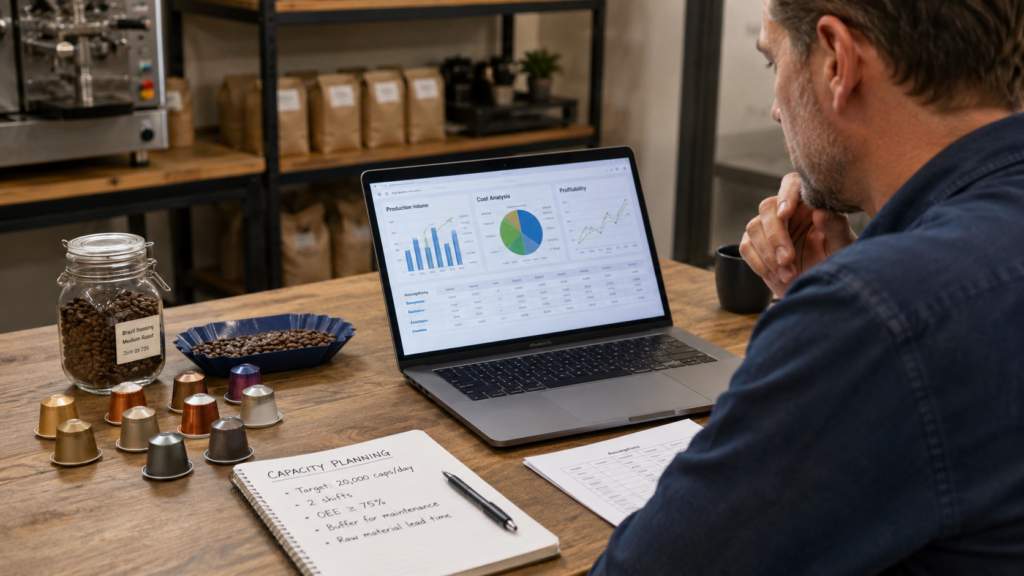
The strongest investment signal is recurring paid demand in the exact format you plan to produce. Good evidence includes:
- repeat orders from existing capsule customers;
- a signed or highly credible hospitality, office, retail, or private-label program;
- a reorder pattern that can be forecast without heroic optimism;
- one or two core SKUs that make up most of the expected volume;
- lost sales or excess inventory caused by current co-pack lead times or minimums;
- customers willing to pay the price required for a healthy contribution margin.
Social comments, a good trade-show tasting, and a retailer requesting samples are useful. They are not line-loading commitments.
Stable SKUs Matter More Than a Large Catalogue
A roaster may have twelve beautiful origins. A filling line would often prefer two boringly reliable ones.
Each extra SKU can bring a different coffee, grind, dose, lid, carton, code, cleaning routine, and record. Small campaigns eat time through staging, setup, checks, and reconciliation.
That does not mean you must sell only one blend. It means the investment case should rest on hero SKUs, while limited editions remain a bonus. If the line only pays back when every seasonal origin becomes a hit, the business case is wearing a costume.
Match the Channel to the Production Pattern
| Application | Likely demand pattern | What it means for production |
| Roaster’s own retail and DTC line | Frequent replenishment and a few core products | Supports repeat campaigns and tighter roast-to-pack scheduling |
| Private-label customers | Larger projects, but changing recipes and artwork | Needs firm specifications, component control, and flexible scheduling |
| Hotels and office coffee | Contract-led and service-sensitive | Can anchor base volume once the exact brewer system is confirmed |
| Grocery and distributors | Forecast, shelf-life, audit, and service-level pressure | Requires stronger inventory, release, and traceability systems |
| Seasonal or promotional runs | Short campaigns with uncertain repeats | Often better suited to a co-packer or a carefully scheduled side campaign |
Ask a blunt question: if the largest customer disappeared, would the remaining business still support the line? A concentration risk does not always kill the project. A resort group or retailer may be exactly what makes it viable. But the risk should be priced, discussed, and written down.
Choose the Production Model Before Choosing the Machine
There are more options than “keep outsourcing forever” and “buy a fully automatic line tomorrow.” In practice, four models are common.
Co-Packing
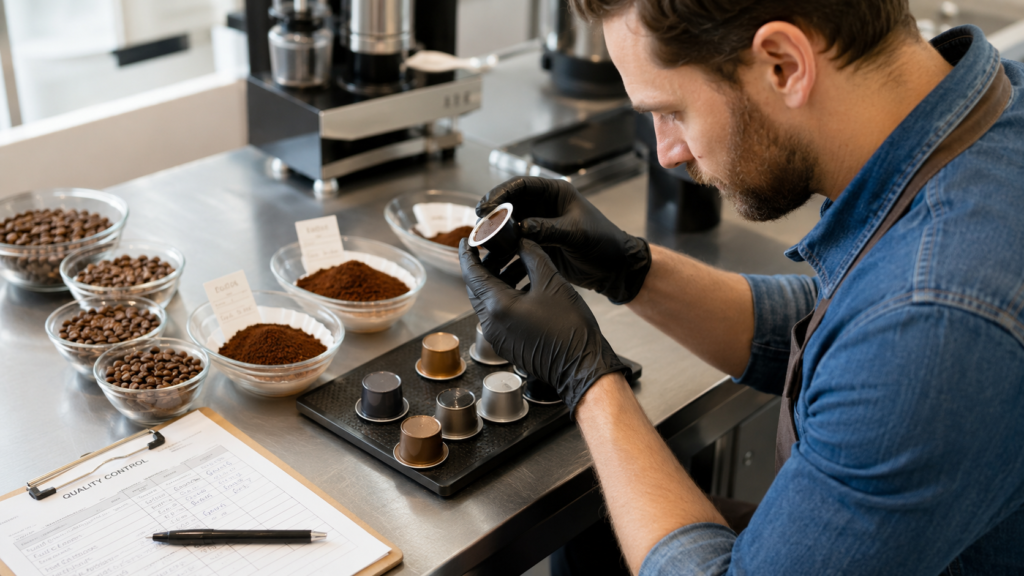
A good co-packer can provide trained staff, proven components, established quality controls, secondary packing, audits, and experience with awkward little failures. Co-packing still makes sense when volume is low, uneven, or spread across many recipes. It also protects capital while a roaster proves price, repeat purchase, and channel fit.
The drawbacks are minimums, queue time, freight, less control over roast-to-pack timing, and slower changes. Small customers may not get the production window they want.
Manual or Bench-Scale Filling
Bench equipment can be useful for formulation work, tastings, internal samples, and some tiny local programs. But labor climbs fast. So does variation. One operator gets tired, another tamps differently, and the rim has a little coffee on it. Now the seal is questionable.
Manual sealing is not automatically a commercial shelf-life system. If a product will sit in retail for months, it still needs controlled materials, package-oxygen work, seal testing, traceability, and documented release.
Semi-Automatic or Small Inline Production
This can be a sensible bridge for a roaster with real but moderate demand. The capital is lower than a large rotary system, and the team stays close to the process. The catch is hidden manual work. Someone may still load capsules, place lids, move trays, inspect packs, or feed cartons.
Map every hand movement. If a machine is described as “automatic” but two people spend the shift feeding and catching, include those people in the cost and capacity model.
Hybrid Production
The hybrid route is often underrated. Bring one stable Original-compatible blend in-house and leave seasonal products, unusual materials, export variants, or low-volume private-label jobs with a co-packer.
This gives the team a production base without forcing every SKU onto the line. It also creates real yield, changeover, maintenance, and reorder data. Those numbers beat a cheerful spreadsheet.
Build the Business Case From Contribution, Not Purchase Price
A filling machine is one item in a production system. The business case should compare the current cost of receiving a saleable co-packed capsule with the future cost of making a saleable capsule in-house.

Notice the word “saleable.” Rejects, setup units, lab samples, damaged cartons, and coffee left in the hopper do not generate revenue.
Calculate the Current Landed Co-Pack Cost
Include:
- filling and packing charge;
- coffee, capsule, lid, filter, carton, and case if billed separately;
- setup, artwork, plate, or change fees;
- freight and import costs;
- storage created by large minimums;
- excess finished stock and obsolescence;
- internal project-management and quality time;
- the value of missed sales caused by long lead times, if it can be supported.
Use documented costs first. Do not turn every frustration into a financial saving; show strategic benefits separately.
Calculate the In-House Variable Cost
Include the coffee actually consumed, not only the nominal dose. Add capsule bodies, lids, filters, nitrogen, energy, direct labor, cleaning materials, coding consumables, cartons, cases, routine QC, expected scrap, and ordinary wear parts.
Then estimate the contribution improvement:
Contribution improvement per saleable capsule = avoidable landed co-pack cost − in-house variable cost
This is the amount available to recover the investment and compensate the business for taking on manufacturing risk.
Include the Full Installed Cost
The filler is the visible part. Around it may sit:
- tooling and format parts;
- a production grinder with suitable consistency and capacity;
- coffee handling and dust extraction;
- food-grade nitrogen supply and monitoring;
- compressed air equipment and treatment;
- electrical installation;
- coding, checkweighing, vision, or reject equipment;
- conveyors, accumulation, cartoning, and case packing;
- freight, customs, installation, commissioning, and training;
- laboratory tools and retained-sample storage;
- initial spare and wear parts;
- floor, hygiene, or layout work;
- compliance, validation, and customer-audit work;
- finance cost and working capital.
A full-cost view of single-serve filling equipment is more useful than comparing filler quotes alone.
Run a Break-Even Calculation
The basic formula is simple:
Break-even capsules = total incremental investment ÷ contribution improvement per saleable capsule
Suppose a project requires $280,000 in total incremental investment and is expected to improve contribution by $0.055 per saleable capsule. The simple break-even quantity is about 5.09 million capsules.
That is a hypothetical example, not an industry threshold. Your costs and contract may produce a very different answer.
Now make the model useful. Run at least three cases:
- Base case: the forecast you can defend.
- Downside case: lower sales, slower ramp-up, more scrap, and more downtime.
- Upside case: stronger demand without assuming impossible line performance.
If the project only works in the upside case, it does not work yet. If the downside case remains acceptable, the investment is much sturdier.
Payback Is Not the Whole Return
Ownership can create value that is difficult to reduce to cents per capsule:
- shorter replenishment cycles;
- smaller runs for proven private-label customers;
- tighter control over roast-to-pack timing;
- faster recipe iteration;
- confidentiality around blends and customer programs;
- control over material changes and release decisions.
These benefits matter, but they should not hide weak economics. Treat them as strategic returns, not fairy dust.
Convert Annual Demand Into Saleable Capsules per Hour
Machine brochures usually show a maximum rate under defined conditions. A roaster needs an average saleable rate over a real shift.
Think of rated speed as a car’s speedometer. Your delivery time also includes traffic, fuel, lunch, and the wrong turn someone takes on Tuesday.
Start with annual demand by SKU. Decide how many production weeks and shifts are genuinely available. Then subtract time for:
- warm-up and startup approval;
- coffee and packaging changes;
- line clearance and cleaning;
- scheduled maintenance;
- operator breaks;
- quality checks;
- small stops and material replenishment;
- downstream packing and pallet movement.
A useful model is:
Saleable output = rated run rate × scheduled run time × availability × performance factor × quality yield
If a line is rated at 60 capsules per minute, scheduled for 420 minutes, has 80% availability, runs at 90% of the rated rate while operating, and produces 98% acceptable output, the estimate is:
60 × 420 × 0.80 × 0.90 × 0.98 = 17,781 saleable capsules per shift
Again, those are sample assumptions. Replace them with supplier test data and then with your own operating history.
The Slowest Step Sets the Line Output
A filler can make capsules faster than people can inspect, sleeve, carton, code, case-pack, or move them. If finished capsules pile up in trays while two operators fold boxes, the cartoning area is the line speed.
Map the route from roasted coffee and empty components to released cases. A modest filler with good downstream flow can beat a faster machine surrounded by manual traffic jams.
SKU Complexity Consumes Capacity
Suppose one large campaign runs for six hours with one setup. Compare it with six one-hour campaigns requiring five changes. The second plan may produce far fewer capsules even if the machine speed never changes.
Forecast campaign size, not only annual units. Include printed-lid and carton minimums. A line that gives flexibility can also tempt the sales team to promise endless variants. Put rules around minimum campaign size, artwork changes, and rush orders before the line becomes the factory’s most expensive argument.
The Coffee Recipe Must Be Ready for a Capsule, Not Just a Cupping Bowl

A lovely café espresso does not guarantee a lovely capsule. The small chamber ties pressure, flow, particle size, dose, shell, lid, and brewer together.
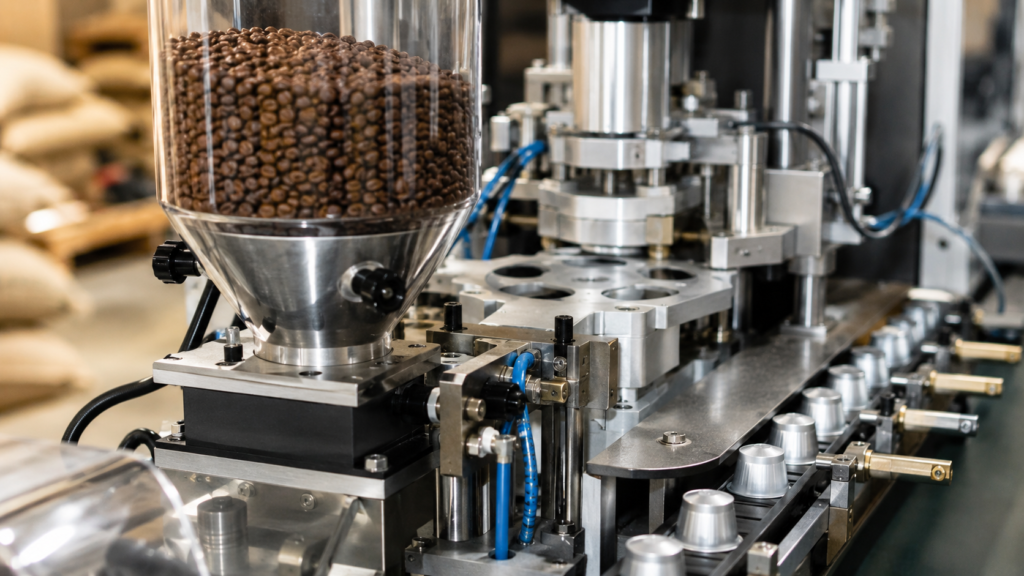
As this overview of how coffee capsules are manufactured and filled shows, grinding, dosing, rim cleaning, sealing, and package protection are connected stages. For a roaster, the practical lesson is simple: develop the coffee and the package together.
Define the Roast and Packing Window
Start with a roast profile that can be repeated at production scale. Then define a controlled rest or degassing window before grinding and filling.
There is no single waiting period for every coffee. Roast, blend, storage, and temperature matter. Packing very fresh coffee can complicate gas control; waiting too long spends aroma.
Instead of copying a number from another roaster, run trials. Record roast time, batch, post-roast storage, fill time, package oxygen, extraction, and sensory results. The aim is not the freshest possible timestamp. It is the most repeatable good cup over the intended shelf life.
Control Particle-Size Distribution
“Fine grind” is not a complete specification. Two grinders can show a similar average particle size while producing different amounts of fines and coarse particles. That changes flow resistance, extraction, settling, and dose repeatability.
A production grinder should hold a stable distribution, manage heat, and feed consistently. Check startup, restart, and end-of-batch behavior. A retail-grinder sample may flatter a recipe that becomes difficult at scale.
Dose Is More Than Grams
Nominal dose matters, but so do bulk density, fill height, settling, and the structure of the coffee bed. A dense grind may fit differently from a fluffy one at the same mass. If coffee reaches the flange, it can interfere with sealing. If the bed is inconsistent, flow and cup strength wander.
Measure dose across lanes and over time. An average can hide one lane running light and another heavy.
Test the Finished Product, Not Just the Coffee
For each candidate recipe, assess:
- fill mass and variation;
- beverage mass or volume;
- flow or extraction time;
- visible leakage and grounds;
- crema behavior;
- sensory profile when fresh and during storage;
- performance across the agreed brewer panel;
- failure rate and failure type.
Use TDS or extraction yield if helpful, but do not let one number overrule the cup. A technically neat capsule that tastes flat is still flat.
Treat the Cup, Lid, Filter, and Coffee as One Packaging System
Capsule components are not interchangeable decorations. A new lid may change the sealing window and piercing behavior. A shell from another supplier may fit the machine but flex differently in a brewer. A filter can change flow. Even an ink or coating change can affect documentation and process behavior.
Aluminium, Barrier Plastic, or Compostable?
There is no universal winner.
Aluminium can offer strong barrier performance and familiar consumer cues, but it needs the correct coating, seal system, forming quality, and recovery context. Plastic structures can offer reliable forming and handling, but the polymer layers and barrier design matter. Compostable capsules may support a brand position, yet certification scope, heat and moisture behavior, sealing, real disposal infrastructure, and shelf-life performance must be checked carefully.
Use a structured comparison of aluminium and plastic coffee-capsule packaging as a starting point, then qualify the exact components offered. Material family alone does not tell you how the finished capsule performs.
Ask for the Component File, Not Just a Sample Bag
For each food-contact component, collect the target-market specification and compliance file. Identify its supplier, structure, batch, conditions of use, and change-control route.
Agree on dimensions and tolerances for the body, flange, lid, sealant side, filter, and print. Machine and component suppliers should work from the same drawings.
| Element | What to verify | What may happen if it is ignored |
| Capsule body | Dimensions, flange, material, barrier, and batch consistency | Feed jams, poor sealing, or brewer-fit failures |
| Lid | Sealant, thickness, print, puncture, and peel behavior | Leaks, delamination, or weak extraction |
| Filter | Position, retention, flow, and food-contact status | Sediment, blockage, or inconsistent cups |
| Ground coffee | Distribution, dose, density, degassing, and flavor target | Fast flow, stalled flow, weight drift, or stale flavor |
| Carton and case | Protection, code area, traceability, and transport fit | Damage, unreadable codes, or retail rejection |
When one item changes, do not assume the approved process still applies. Decide what needs document review, line trial, seal testing, brewer testing, or shelf-life confirmation. That is change control in plain clothes.
Nitrogen and a Good Seal Need Evidence, Not a Nice Number
“We use 99.9% nitrogen” sounds impressive. It describes the gas supply, not necessarily the atmosphere trapped inside each finished capsule.
Keep four questions separate:
- What is the nitrogen purity at supply and point of use?
- What residual oxygen remains in the sealed capsule?
- Is the seal continuous and mechanically sound?
- How well does the complete package resist oxygen and moisture ingress over time?
A high-purity gas can still produce disappointing package oxygen if air is not displaced effectively, the dosing and sealing sequence is poorly enclosed, or the seal is contaminated. Equally, a low initial oxygen reading does not guarantee long-term protection if the barrier or seal is weak.
The practical goal is to understand how nitrogen purity and finished-package conditions work together, then set acceptance criteria that the line can measure and hold.
Create a Shelf-Life Evidence Plan
The plan should cover:
- residual package oxygen at defined times after filling;
- seal-integrity testing suited to the capsule and failure risk;
- visual and destructive seal checks where useful;
- component barrier data relevant to the actual structure;
- storage at documented conditions;
- periodic extraction and sensory evaluation;
- retained samples linked to production lots;
- acceptance limits and an investigation route.
Different leak, seal, and gas tests answer different questions. Choose methods with packaging and quality specialists; one dramatic bubble test does not prove everything.
Shelf-life claims should come from evidence on the real coffee, component set, and process. A capsule supplier’s generic claim may help form a test plan, but it does not become your finished product’s date by inheritance.
Check Whether the Roastery Is Ready to Become a Capsule Factory
Owning a line changes the roaster’s job. You now receive food-contact components, control packaging, release consumer units, maintain equipment, and hold traceability records.
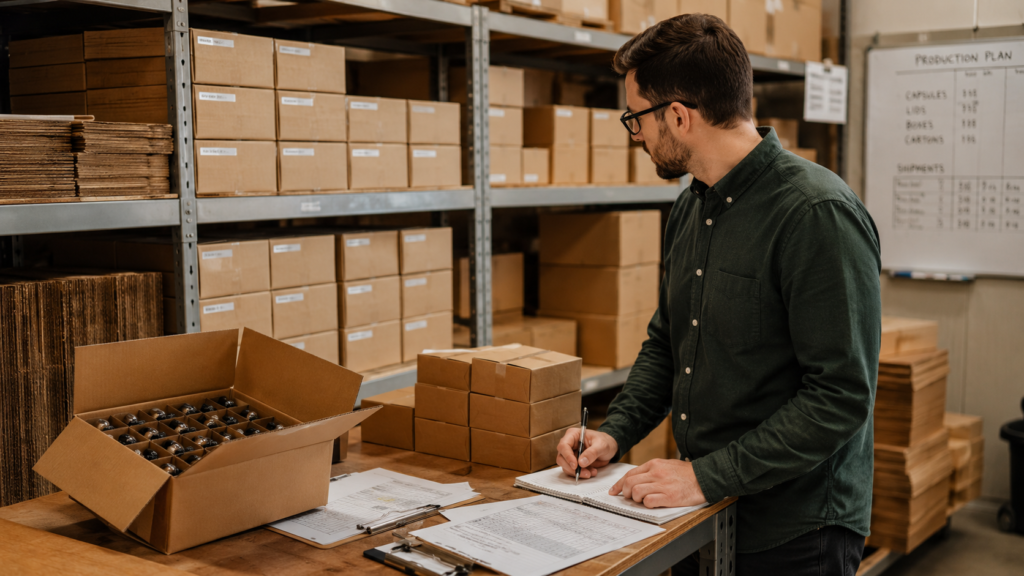
That is manageable. It just needs named owners.
Map Utilities and Physical Flow
Confirm electrical supply, frequency, compressed-air demand and quality, nitrogen consumption, exhaust or ventilation, network connections, drainage where needed, and environmental conditions. Check the supplier’s utility figures at the expected configuration, not a stripped demonstration setup.
Then draw the flow of:
- roasted coffee into staging and grinding;
- empty capsules, lids, filters, cartons, and cases;
- operators and cleaning tools;
- rejected, quarantined, and released product;
- waste and rework;
- finished cases and pallets.
Address coffee dust, cleanability, foreign-material control, pests, and separation. If flavors or other ingredients enter the plan, review allergen and cross-contact risks.
Do Not Forget Downstream Packaging
The finished capsule may need coding, inspection, orientation, sleeves, cartons, labels, tamper evidence, cases, pallet labels, and data transfer. A private-label customer may have specific code position, carton count, pallet, and record requirements.
Design those steps before buying the filler. Otherwise, the team may discover that the beautiful automated line ends by dropping capsules into a tote for three people to sort.
Name the People Before the Machine Arrives
At minimum, assign responsibility for:
- production planning and materials;
- machine operation and changeover;
- product specification and coffee performance;
- sanitation and food safety;
- quality checks, release, and retained samples;
- preventive maintenance and breakdown response;
- supplier documents and change notifications;
- complaints, traceability, and recall.
One person may cover several roles if time, authority, backup, and training are real. A name on a chart does not fix a line at 7:00 a.m.
Build the Spare-Parts and Support Plan
Ask for a recommended wear-parts list, critical-spares list, expected life, prices, stock location, and dispatch time. Clarify remote diagnostics, time-zone coverage, language, software access, and which tasks require a visiting technician.
The most expensive spare is sometimes a cheap sensor you do not have. Model realistic support delays, not the fastest sales promise.
Put Standards and Claims Into the Project Brief
Compliance is not one certificate attached to the machine. It is a set of responsibilities covering the food, packaging, process, facility, label, equipment, and target market.
Food-Contact Rules Follow the Market
For products placed on the EU market, the European Commission’s food-contact materials framework explains the role of Regulation (EC) No 1935/2004. Plastic structures may also fall under Commission Regulation (EU) No 10/2011, and good manufacturing practice requirements may apply under Regulation (EC) No 2023/2006.
Documentation and tests depend on structure and intended use. A declaration for one resin does not cover every printed, coated, multilayer capsule.
If the product will be sold in the United States or another region, scope the local food-contact, facility, labeling, and product rules separately. Avoid phrases such as “FDA-approved machine” as a blanket assurance. The relevant questions concern the actual materials, process, facility, and regulatory pathway.
Food Safety Systems Are Different From Machine Conformity
HACCP-based controls help identify and manage food-safety hazards in the process. ISO 22000 provides requirements for a food-safety management system and can be used by organizations across the food chain.
Certification may be voluntary legally but required by a retailer or private-label customer. Ask early whether FSSC 22000, BRCGS, or another GFSI-recognized route is expected.
Machine conformity is another topic. An EU installation may require CE-related technical documentation and conformity under the applicable machinery, electrical, and electromagnetic rules. Other destinations may involve UKCA, UL, CSA, or local electrical and safety expectations. The exact route depends on configuration, destination, installer, authority, and sometimes the insurer.
At supplier review, ask about guarding, interlocks, emergency stops, electrical drawings, safe cleaning access, manuals, declarations, risk documentation, and the responsibilities of any integrator.
Plan Labels, Traceability, and Claims Early
Finished packs may need ingredients, net quantity, business-operator details, best-before information, lot identification, origin or claim support, local language, preparation or compatibility instructions, and recycling information. Requirements vary.
Build the batch link from roasted coffee and component lots to fill records, quality results, cartons, customers, and retained samples. Then test a mock recall. If the answer to “Which customers received this lid lot?” requires three people and a weekend, the system is not ready.
Environmental language deserves the same discipline. “Recyclable,” “compostable,” and “bio-based” are not interchangeable. A certified material may still depend on collection and processing infrastructure that does not exist in every market. Say only what the evidence and local disposal route support.
Select the Machine Tier From the Work, Then Test the Supplier
Once demand, product, effective output, facility, and compliance needs are defined, machine comparison becomes much easier. Now the conversation is about an approved job rather than a shiny catalogue.
Match Automation to Real Production
Bench and semi-automatic systems suit development and some modest operations, but operator steps must be counted. Automatic inline machines can provide controlled feeding, dosing, cleaning, lid placement, sealing, discharge, and inspection at moderate to high outputs. Rotary systems can deliver more capacity in a compact production flow, with greater investment and maintenance complexity.
The correct tier meets saleable output, quality, and changeover needs without being permanently underloaded.
When you are ready to translate the brief into equipment, compare Nespresso-compatible filling machine configurations against the actual capsule, coffee, output, and utilities—not only a target speed.
Write a User Requirement Specification
A useful URS can include:
- target capsule system, drawings, and component suppliers;
- coffee characteristics, dose range, and accuracy requirement;
- required saleable output and campaign length;
- expected SKU and material changes;
- nitrogen arrangement and package-oxygen target;
- rim-cleaning and seal requirements;
- inspection, reject, coding, and data needs;
- upstream grinder and downstream interfaces;
- utilities, footprint, noise, environment, and cleaning needs;
- destination safety and electrical requirements;
- documentation, training, spares, warranty, and response expectations;
- FAT, SAT, and final acceptance criteria.
Normalize quotation scope. One price may include a coder, gas mixer, tooling, and commissioning; another may stop at discharge. Cheap can mean incomplete.
Run a Factory Acceptance Test With Your Materials
Send representative production coffee, capsule bodies, lids, and filters. A dry cycle or a run with the supplier’s easy test material proves little about your product.
During the FAT, record sustained output, stops, alarms, recovery, waste, dose distribution, seal results, residual oxygen where in scope, changeover, cleaning, and downstream behavior. Pull samples across lanes and across time, not only the nicest capsule at the end.
Test capsules in the brewer panel. Verify extraction, sensory result, codes, rejects, guards, controls, and user access. Put open items on a signed punch list.
The site acceptance test confirms performance after installation and training. Tie payment milestones to clear evidence where the contract allows.
A Traffic-Light Test: Does the Machine Make Sense Now?
Use the table below in an investment meeting. For each green light, attach evidence. For each amber or red light, assign an action and owner.
| Decision area | Green: consider buying | Amber: pilot or hybrid | Red: keep co-packing for now |
| Demand | Recurring paid volume with a credible forecast | Sales are growing but campaigns are uneven | Interest exists without repeat orders |
| SKU mix | One or two hero SKUs carry most units | Several medium-volume SKUs | Many small and changing SKUs |
| Economics | The downside case gives an acceptable return | Base case works, downside is weak | Only the optimistic case works |
| Product | Recipe and component system are validated | Cup quality is promising; line evidence is incomplete | Format or recipe is undecided |
| Facility | Utilities, layout, downstream flow, and hygiene are ready | Upgrades are defined and funded | Key space or utilities are missing |
| People | Operations, QA, planning, and maintenance owners are named | Roles exist but training is incomplete | Nobody owns the whole process |
| Compliance | Documents, tests, traceability, and release plans exist | Gaps have dated actions | Compliance is assumed to be the supplier’s job |
| Support | Spares, training, and response routes are documented | Remote support is plausible but untested | There is no workable maintenance route |
In plain language, a machine begins to make sense when five conditions overlap:
- Demand is proven in the exact capsule format.
- A small number of repeat SKUs can use the line regularly.
- Conservative contribution savings justify the total installed cost.
- Coffee and packaging have measurable, repeatable acceptance criteria.
- The facility, people, quality system, and support plan are ready.
If one condition is amber, a pilot may close the gap. If three are red, a purchase order will not turn them green.
A 90-Day Evidence Plan Before the Purchase Order
A focused 90-day project can replace many assumptions with evidence.
Days 1–30: Prove the Commercial Case
- Clean capsule sales history by customer and SKU.
- Confirm the exact target system and channel.
- Identify the hero SKU and credible downside volume.
- Calculate landed co-pack cost and the in-house cost range.
- Decide which products would remain outsourced.
- Speak with anchor customers about forecast, pack format, audit needs, and timing.
Days 31–60: Prove the Product and Factory Case
- Lock preliminary coffee, capsule, lid, and filter specifications.
- Run brewer-panel, extraction, and sensory trials.
- Define the shelf-life evidence plan.
- Map utilities, dust control, hygiene, people, coding, cartons, cases, and traceability.
- Build the URS and supplier shortlist.
Days 61–90: Prove the Equipment Case
- Run real coffee and components on shortlisted machines.
- Compare actual output, yield, stops, changeover, support, and scope.
- Finalize the installed-cost model and downside payback.
- Agree FAT, SAT, training, spares, warranty, and acceptance terms.
- Choose among buy, hybrid, pilot, or wait.
Waiting can save cash while sales builds repeat demand. The purpose is not to justify a machine. It is to make the right production decision.
Conclusion: Buy Control Only When the Business Can Use It
A Nespresso-compatible filling machine makes sense when the roaster has more than enthusiasm and a target speed. It needs proven recurring demand, a concentrated SKU base, validated coffee and packaging, conservative economics, a ready facility, accountable people, and support after installation.
When those pieces line up, in-house filling can shorten lead times, improve scheduling, protect recipes, support private-label growth, and give the roaster much tighter control over product quality. Nice. But the line also creates a daily manufacturing responsibility. It must be fed, cleaned, checked, maintained, documented, and sold through.
Start with real numbers and real product. Bring your coffee, capsule drawings, component samples, campaign sizes, target markets, and downstream pack requirements into the equipment discussion. That is how a machine becomes part of a working business instead of a very expensive stainless-steel hope.
Frequently Asked Questions
1. How many capsules per year justify buying a Nespresso-compatible filling machine?
There is no universal annual threshold. Calculate the total installed cost, contribution improvement per saleable capsule, required payback, campaign sizes, and realistic utilization. A stable lower volume with good margin and few SKUs may justify a smaller line before a larger but highly fragmented forecast does.
2. How much does a Nespresso-compatible capsule filling machine cost?
Price depends on speed, automation, lanes, dosing, nitrogen control, inspection, materials, coding, changeover, destination standards, and service scope. Budget for the installed system, including grinder, utilities, freight, tooling, commissioning, downstream packing, spares, validation, and working capital—not just the filler quotation.
3. Is co-packing cheaper than producing coffee capsules in-house?
At low or uncertain volume, often yes, because the co-packer spreads equipment, staff, quality, and audit costs across customers. In-house production can become more economical when recurring volume, contribution savings, and utilization cover the full installed and operating cost. Compare both models per saleable capsule.
4. What is the difference between Nespresso Original, Vertuo, and Professional capsules?
They are separate capsule and brewing systems. Original-compatible capsules do not automatically work in Vertuo or Professional machines. Define the exact target system and validate finished capsules across a representative brewer panel before making compatibility claims.
5. Can one machine fill aluminium, plastic, and compostable capsules?
Some lines can handle several compatible component types, but not by assumption. Differences in dimensions, stiffness, feeding, flange behavior, lid structure, sealing temperature, pressure, and dwell time may require tooling and recipe changes. Test each approved capsule-and-lid combination on the quoted machine.
6. How much coffee goes into an Original-compatible capsule?
The correct dose depends on capsule geometry, coffee density, grind distribution, roast, extraction target, and brewer behavior. Do not copy one gram figure as a universal recipe. Establish a dose range through line trials, weight data, extraction measurements, and sensory testing.
7. Do commercial coffee capsules need nitrogen flushing?
Nitrogen flushing is widely used to reduce oxygen exposure, but the useful control is the condition of the finished package. Measure residual oxygen, verify seal integrity, qualify the barrier system, and support shelf life with storage and sensory evidence. Gas purity alone is not enough.
8. What shelf life can a roaster expect from compatible capsules?
It depends on the coffee, oxygen at packing, capsule and lid barrier, seal quality, storage, and distribution. Set the date from evidence on the actual product and process. Supplier statements and competitor dates can inform the study, but they should not replace it.
9. What equipment is needed besides the capsule filler and sealer?
Common needs include a consistent production grinder, coffee handling, dust extraction, nitrogen, compressed air, electrical work, coding, inspection or checkweighing, conveyors, cartoning, case packing, QC instruments, cleaning tools, and spare parts. The exact system depends on output and pack format.
10. What should a roaster test before accepting a capsule filling machine?
Run the real coffee, capsule, lid, and filter for a sustained period. Verify saleable output, dose distribution, stops, rejects, seal quality, package oxygen where specified, changeover, cleaning, coding, safety, and downstream flow. Then test finished capsules across the agreed brewer panel and document open items before shipment and final acceptance.