
It is tempting to design one multilingual carton, call it a “European pack,” and start emailing distributors from Lisbon to Helsinki. Europe looks tidy on a map. The market is not.
Coffee habits, capsule adoption, price expectations, languages, retail structures, and waste systems vary widely. EU rules create a shared baseline, but national packaging duties and commercial realities still matter. The UK, Switzerland, Norway, and other non-EU European markets also need separate checks.

A safer plan is to build one EU-ready core product, choose one country and channel, then add country-specific requirements. Prove compatibility, compliance, margin, and repeat purchase before expanding. This is practical guidance, not legal advice on a finished product.
Europe Is a Portfolio of Coffee Markets, Not One Shelf
Capsule demand is not evenly spread across Europe. The European Coffee Report 2023/2024 shows how large the difference can be. In its 2023 volume data, coffee pods stayed below 2% of the market in Nordic and Baltic countries. Germany was around 12%. France and the Netherlands were around 33%.
Those figures are a filter, not a promise. High adoption means format familiarity but also crowded shelves. A lower-adoption country may still support a specialty, office, hotel, or online niche.
| Market pattern | Possible opportunity | Likely challenge |
| High pod adoption | Familiar format and regular refill demand | Strong incumbents, price pressure, expensive retail access |
| Mid-level adoption | Space for value, origin, or channel-led positioning | The offer needs a clear reason to exist |
| Low pod adoption | Specialty, hospitality, office, or expatriate niche | Smaller audience and higher education cost |
Look beyond category share. Review assortment, machine prevalence, retail pricing, local preferences, and channel strength. A distributor with real hotel accounts may matter more than impressive headline demand.
If the long-term goal covers several formats and countries, this guide to planning a multi-market European capsule portfolio provides the broader view. Market entry, though, should begin narrower.
Pick the First Country With a Scorecard, Not a Pin on a Map
Shortlist perhaps five countries, then score them against the same criteria:
- demand for Original-compatible capsules;
- target retail and online price;
- competitive intensity;
- access to DTC, marketplaces, distributors, or retailers;
- required languages and artwork versions;
- importer and food business operator arrangements;
- packaging registration, reporting, and fees;
- warehousing, freight, and reorder lead time;
- likely gross margin after promotions and channel costs.
Choose one primary country and one backup. Ten simultaneous launches multiply artwork, registrations, forecasts, and slow-moving stock.
Channel comes next. DTC and marketplaces generate feedback quickly, but fees, fulfillment, online information, and returns matter. Specialty retail rewards a good story, although distribution is fragmented. Supermarkets offer scale but demand listings, promotions, audits, and service. Hotels and offices may need fewer SKUs, with reliable supply.
Pick the route where your company has an advantage. A modest product with good distribution usually beats a brilliant capsule hiding in a warehouse. Annoying, but true.
Decide What “Private Label” Means Before Signing
Supplier terminology is loose. One factory may call a standard blend with your artwork “private label.” Another may use the same term for a custom roast, exclusive formulation, colored capsule, and bespoke carton.
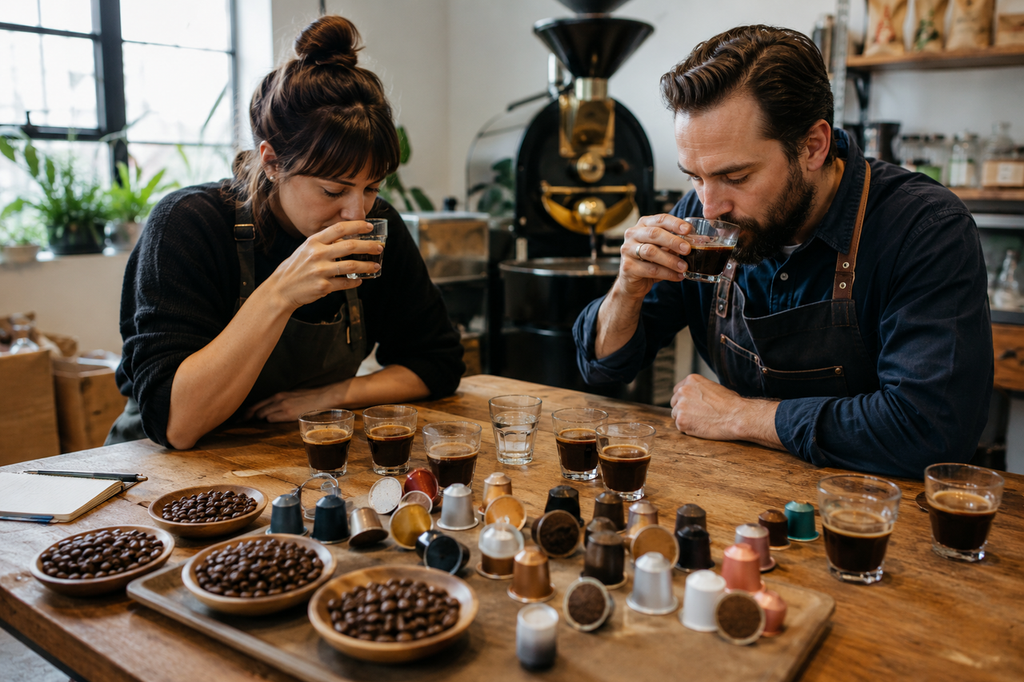
Define the handoff in writing:
- Who sources and owns the coffee specification?
- Who buys the capsule, lid, carton, and master case?
- Who develops and pays for artwork and tooling?
- Who performs compatibility and shelf-life testing?
- Who owns test data and approved samples?
- Who carries unused branded packaging?
- Who handles a complaint, withdrawal, or recall?
The differences among OEM, private label, and co-packing matter more than a homepage label. Also map the manufacturer, brand owner, importer, distributor, responsible food business operator, and packaging producer. “We export to Europe” does not allocate those roles.
Specify the Exact Nespresso-Compatible System
Nespresso Original, Vertuo, and Professional are not interchangeable systems. Most third-party private-label projects target the Original home system. State that clearly in the specification.
Define capsule construction, drink, dose, target machines, and exclusions. A capsule that fits may still puncture badly, brew slowly, leak, or deform. Compatibility is a performance result, not just a diameter.
The validation plan should cover:
- entry and closing force;
- puncture and lid-opening behavior;
- flow time and beverage output;
- leakage and grounds in the cup;
- capsule deformation and ejection;
- repeatability across agreed machine models;
- sensory result for espresso and lungo recipes.
Use trademark wording carefully. “Compatible with Nespresso Original machines” describes function, not affiliation or approval. Avoid presentation that may confuse consumers with Nespresso products. Review the final use of marks in each market.
Build the Coffee for the Country and the Capsule
Start with the drinking occasion, not a color chart. Is the product a short espresso, a longer morning coffee, a milk-friendly dark blend, an origin-led specialty capsule, or decaf?

Develop the roast, grind distribution, dose, coffee-bed density, flow, and sensory target inside the chosen capsule. A blend that works in a portafilter may taste thin or brew badly in a small capsule. Coffee is both the ingredient and part of the water-flow system.
Two or three launch SKUs are often enough: perhaps a balanced espresso, a stronger lungo or milk option, and decaf. Twelve similar intensity levels mostly create forecasting trouble.
Material choice comes next. SANEU’s Nespresso-compatible empty capsules include different platform options, but the decision must match the final product and market.
Aluminum capsules
Aluminum offers barrier, rigidity, and premium shelf cues. The complete structure still needs food-contact evidence, sealing and transport tests, and a realistic collection route. Recyclability in principle does not prove local collection.
Plastic or PP capsules
Plastic systems may offer cost, color, and production benefits. Barrier, lid compatibility, heat resistance, migration status, sorting, and recyclability need review. “Plastic” is not a specification.
Compostable capsules
Compostable structures need finished-capsule evidence. Clarify industrial versus home compostability, the standard and certificate, validity, and whether the target waste system accepts the capsule.
The guide to what Nespresso pods are made of explains the body, coating, lid, and sealing layers. This comparison of aluminum and plastic capsule packaging adds the commercial trade-offs.
Build the EU Compliance File Before Approving Artwork
Artwork should be the visible result of compliance work, not the place where compliance begins.

Food information and language
Regulation (EU) No 1169/2011 establishes the main food-information framework. The European Commission summarizes the mandatory information for prepacked food.
Depending on the product, the pack may need the food name, ingredients, allergens, net quantity, minimum durability, storage/use instructions, responsible FBO details, lot identification, and other particulars. Coffee-specific exemptions can affect some declarations.
Mandatory information must be legible and understood in the sales market; Member States may require official languages. For online sales, most information must be available before purchase.
Food safety and traceability
Check the facility, activities, and products covered by FSSC 22000, BRCGS, IFS, or ISO 22000. A logo does not approve the label or claims.
The quality file should cover HACCP-based controls, supplier approval, traceability, allergens, complaints, recall responsibilities, and batch release.
Food-contact materials
Regulation (EC) No 1935/2004 provides the general EU framework for food-contact materials. Regulation (EC) No 2023/2006 covers good manufacturing practice, while material-specific measures such as Regulation (EU) No 10/2011 may apply to plastics.
Request declarations of compliance, supplier traceability, conditions of use, migration evidence, and change notifications. Review the body, coating, lid, ink, adhesive, and other contact components. “Food grade” alone is not a technical file.
Coffee sourcing and EUDR
Coffee falls within the EU Deforestation Regulation. As of August 2026, application is scheduled from December 30, 2026 for large and medium operators and certain micro/small operators, and June 30, 2027 for other micro/small operators. Verify current scope and roles before launch.
Map who holds geolocation, legality, risk, reference, and due-diligence information. Knowing only “Brazil” or “Ethiopia” is not an EUDR-ready chain.
PPWR Makes the Capsule Part of the Packaging Plan
Regulation (EU) 2025/40, the Packaging and Packaging Waste Regulation, applies from August 12, 2026. The official PPWR text brings coffee and other beverage-system single-serve units into the packaging framework.
This does not mean every capsule must be compostable. The rules distinguish packaging situations, include transitions, and allow Member State flexibility for certain non-metal units where suitable bio-waste systems exist.
The practical entry checklist includes:
- packaging minimization and design requirements;
- recyclability or compostability evidence for the exact structure;
- technical documentation and economic-operator responsibilities;
- emerging harmonized labeling and disposal information;
- national extended producer responsibility registration, reporting, and fees;
- local collection and sorting reality.
| Claim or choice | Question to resolve before launch |
| Recyclable aluminum | Is the used capsule accepted in a relevant local collection stream? |
| Recyclable plastic | Is the complete structure sortable and recyclable under applicable criteria? |
| Industrially compostable | Which certificate, collection route, and national rule support the claim? |
| Home compostable | Does valid evidence cover the finished capsule and exact wording? |
| Reduced packaging | Can the smaller pack still protect coffee and survive distribution? |
One EPR registration does not cover all EU sales. Producer definitions, registration, representation, reporting, and fees run through national systems. Map each country before shipping.
Test Production Capsules, Not Just Pretty Samples
Hand-filled samples cannot prove commercial production. Run the chosen coffee, capsule, lid, and artwork on production equipment. Check fill weight, flange cleanliness, seals, residual oxygen, codes, and defects. Brew retained samples across agreed machines and record flow, output, leakage, ejection, and sensory results.

Nitrogen-generator purity is not the same as oxygen remaining inside the sealed capsule. The result depends on gas delivery, coffee degassing, headspace, line speed, rim cleanliness, seal settings, and barrier performance. This guide explains how to control residual oxygen in coffee capsules.
Validate shelf life with a written protocol and retained samples under realistic transport and storage. A summer van in Spain is not an air-conditioned lab.
Review the complete industrial coffee capsule production workflow when auditing a co-packer. Keep an approved golden sample, specifications, test results, and change-control rules. A material substitution should not slip through as a casual purchasing decision.
Calculate the MOQ Stack and Landed Margin
There is no honest universal MOQ for private-label compatible capsules. The minimum may be set by the roast batch, filling run, custom capsule color, printed lid, carton, master case, pallet, or flavor-cleaning requirement.
Ask the supplier to separate those layers. A stock capsule with a printed lid and digitally produced carton may support a smaller pilot. A custom color, special material, and offset-printed pack can lift the commitment quickly. Yep, the lid can set the MOQ even when coffee is the product.
| Cost layer | Commonly missed item |
| Product | Development, testing, line setup, rejected stock |
| Packaging | Print minimums, plates, tooling, obsolete artwork |
| Border and logistics | Freight, brokerage, duty where applicable, pallets, storage |
| Market access | EPR, marketplace fees, distributor margin, retail promotions |
| Working capital | Deposits and inventory held before sell-through |
Build margin backward from selling price. Include VAT cash flow, commissions, discounts, samples, returns, storage, and replenishment before sell-through.
When requesting a quote, provide the capsule system, material, dose, coffee, target quantity, color, lid format, artwork, pack count, destination, test needs, and delivery terms. SANEU’s checklist for ordering OEM or ODM empty coffee capsules shows the component information suppliers need.
Audit the Partner, Not Just the Sample Box
A tasty sample says little about repeatability six months later.
Audit or document-review these areas:
- facility and certificate scope;
- coffee sourcing and EUDR data readiness;
- capsule and lid traceability;
- food-contact documentation;
- compatibility-test method and machine matrix;
- fill, seal, residual-oxygen, and shelf-life controls;
- allergen and line-clearance controls;
- artwork and local-language responsibility;
- change approval and material-substitution rules;
- complaint, withdrawal, recall, and rejected-goods handling;
- capacity, lead time, backup equipment, and business continuity.
The contract should allocate formulas, artwork, tooling, test data, and unused stock. Define confidentiality, payment, forecasts, acceptance, rework, termination, and remaining materials.
European location can simplify freight and communication. It does not prove every product, claim, and country is covered.
Launch Small, With Rules for Stopping or Scaling
A sensible pilot uses one country, one channel, one capsule platform, and two or three SKUs—enough to test the business without a museum of unsold boxes.

Set the metrics before launch:
- conversion and repeat purchase;
- gross margin after discounts and channel fees;
- compatibility complaints and returns;
- customer comments on taste, strength, material, and value;
- weeks of stock and reorder lead time;
- sell-through by SKU;
- distributor or retailer reorder behavior.
Set triggers for expansion, reformulation, price changes, or discontinuation. A weak pilot is useful if it prevents a large second print run.
Outsourcing may remain right for years. Review in-house filling only when demand, process knowledge, quality, staffing, utilities, space, maintenance, and economics support it. Then define the production specification before evaluating Nespresso-compatible filling equipment.
A Practical European Market-Entry Sequence
- Shortlist countries and choose the first channel.
- Confirm manufacturer, brand owner, importer/FBO, distributor, and packaging roles.
- Write the product, compatibility, claims, and price brief.
- Approve coffee, capsule, lid, and machine-test samples.
- Complete food, label, food-contact, sourcing, and packaging files.
- Run a production pilot and transit test.
- Arrange applicable country registrations and reporting.
- Launch, monitor complaints and repeat purchase, then decide whether to expand.
Do not print final artwork before technical and regulatory review. A delayed carton is frustrating. Ten thousand unusable cartons are considerably more educational.
Conclusion
Entering Europe with private-label Nespresso-compatible capsules is not one launch. It is a reusable EU product core plus a country-specific commercial and compliance layer.
A capable manufacturer is essential, but it cannot replace market selection, role mapping, label review, packaging obligations, compatibility proof, or margin planning. Start with one country and one channel. Keep the SKU range tight. Test commercial production, not just presentation samples. Then expand when customers reorder and the operating system works. That approach looks slower in a spreadsheet. In practice, it is often the faster route to a durable business.
Frequently Asked Questions
Can a private-label brand legally sell Nespresso-compatible capsules in the EU?
Generally, compatible products can be sold, but packaging and marketing must not mislead consumers or imply affiliation. The product must also meet applicable food, food-contact, labeling, packaging, trademark, and national requirements. Obtain advice for the actual markets and design.
Are Nespresso Original and Vertuo capsules interchangeable?
No. Original and Vertuo use different capsule designs and brewing technologies. Nespresso Professional is also separate. A private-label specification should name the intended system and tested machines instead of using a broad Nespresso-compatible claim.
Which European country is best for launching compatible capsules?
There is no universal best country. Compare pod adoption, channel access, competition, target pricing, language work, EPR duties, logistics, and your distributor or audience. High adoption can mean strong demand and strong competition at the same time.
What information must appear on a coffee capsule box in the EU?
Requirements depend on the product, but may include the food name, ingredients and allergens where applicable, net quantity, minimum durability, storage/use instructions, responsible FBO details, and lot identification. Mandatory information must be legible and suitably localized.
Does a non-EU brand need an EU importer or food business operator?
The responsible structure depends on the supply chain and contract. A non-EU brand normally needs clearly identified EU economic and food-business roles. Define who imports, provides label information, places packaging on the market, handles traceability, and responds to authorities.
How does PPWR affect coffee capsules?
PPWR brings beverage-system single-serve units into the packaging framework and introduces requirements around design, minimization, recyclability or permitted compostability routes, documentation, labeling, and producer responsibility. Exact timing and obligations depend on the provision, material, role, and country.
Is aluminum, plastic, or compostable better for Europe?
None is best everywhere. Compare barrier performance, extraction, sealability, food-contact status, cost, collection, sorting, composting infrastructure, certification, EPR, and consumer expectations in the target country. Validate the finished capsule rather than the material name alone.
Does one EPR registration cover every EU country?
No. Packaging producer responsibility is implemented through national systems. The responsible entity, registration, authorized representative, reporting, and fees may vary. Review each country where the product is first placed on the market.
What MOQ should a brand expect for private-label capsules?
It depends on the coffee batch, filling run, capsule material or color, printed lid, carton, and logistics. Ask for the MOQ of each component. Stock capsules and simpler printed packaging may reduce the commitment for a pilot.
Which documents should a brand request from a capsule manufacturer?
Request specifications, certificate scope, food-contact documentation, traceability records, compatibility results, QC criteria, residual-oxygen and seal methods, shelf-life protocol, approved artwork, golden sample, sourcing data, complaint process, and change-control terms relevant to the final product.

 English
  Spanish
  Arabic
  Russian