Choosing a capsule format is a bit like choosing the rail gauge before buying a train. Both options may look promising, but the wrong fit can leave expensive equipment sitting still.
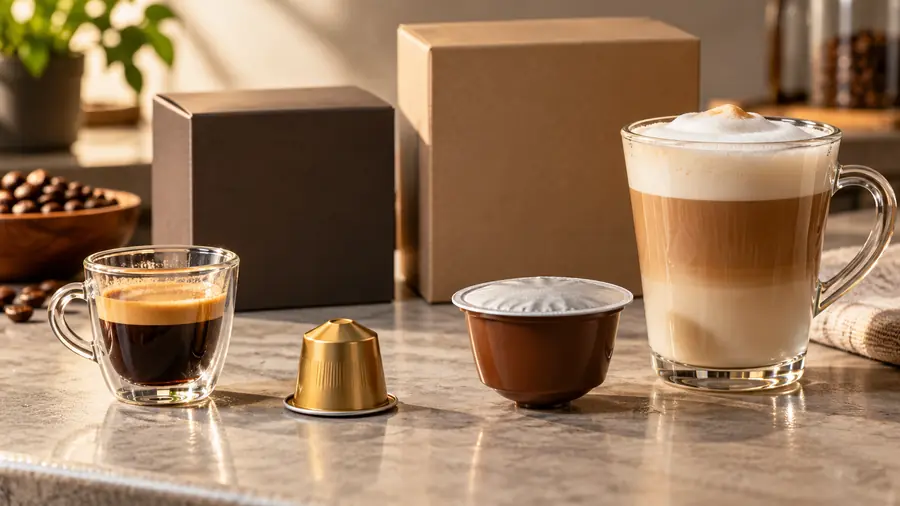
Here is the practical starting point. If coffee itself is the hero—espresso, lungo, origin, roast profile—Nespresso Original-compatible capsules are usually the clearer first option. If the menu is the hero—coffee, milk drinks, chocolate, tea, or other soluble beverages—Dolce Gusto-compatible capsules may offer more room.
That is a starting hypothesis, not a verdict. Local machine ownership, retail access, product cost, and the actual recipe can flip the answer. So, let’s choose from evidence rather than brand familiarity.
First, Define What “Nespresso” Means
Nespresso is not one universal capsule format. The brand has Original, Vertuo, and professional systems. Their capsules are not interchangeable.
This guide compares Nespresso Original-compatible capsules with Dolce Gusto-compatible capsules. Vertuo is outside the comparison. It uses a different capsule and brewing system, so a plan for an Original-compatible product should never quietly assume Vertuo compatibility too.
Nespresso’s regional product information presents Original around three familiar cup sizes: 25 ml ristretto, 40 ml espresso, and 110 ml lungo. You can review that positioning on the official Nespresso Original capsule page. Those volumes describe the branded system. They do not define every third-party recipe or guarantee that any compatible capsule will perform well.
Think of the capsule as a key and the brewer as a lock. A similar-looking key is still the wrong key if its rim, puncture behavior, seal, or water path differs.
Nespresso-Compatible vs. Dolce Gusto-Compatible at a Glance
| Decision factor | Nespresso Original-compatible | Dolce Gusto-compatible |
| Core consumer job | Coffee-first espresso and lungo | Convenient access to a wider beverage menu |
| Likely products | Roast-and-ground coffee, decaf, flavored coffee, and selected validated infusions | Coffee, milk drinks, chocolate, tea, and soluble or functional beverages |
| Package approach | Compact format; dose and structure depend on the selected capsule | Larger, recipe-dependent format; one drink may use one or two capsules |
| Common material choices | Compatible capsules may use aluminum, plastic, paper-based, or compostable structures | Commonly plastic-based, with supplier-specific barriers, lids, filters, or inserts |
| Process focus | Coffee dosing, bed preparation, extraction, and seal consistency | Wider powder behavior, moisture control, cleaning, allergens, and paired recipes |
| Natural first fit | Specialty roasters and espresso-led coffee brands | Multi-beverage brands, family retail, hospitality, and soluble-drink producers |
| Main commercial risk | A crowded compatible market with weak differentiation | More recipe, stock, cleaning, and consumer-instruction complexity |
This table is a decision framework, not a component specification. The approved drawing, material declaration, filling trials, and target brewers should always overrule a generic online dimension.
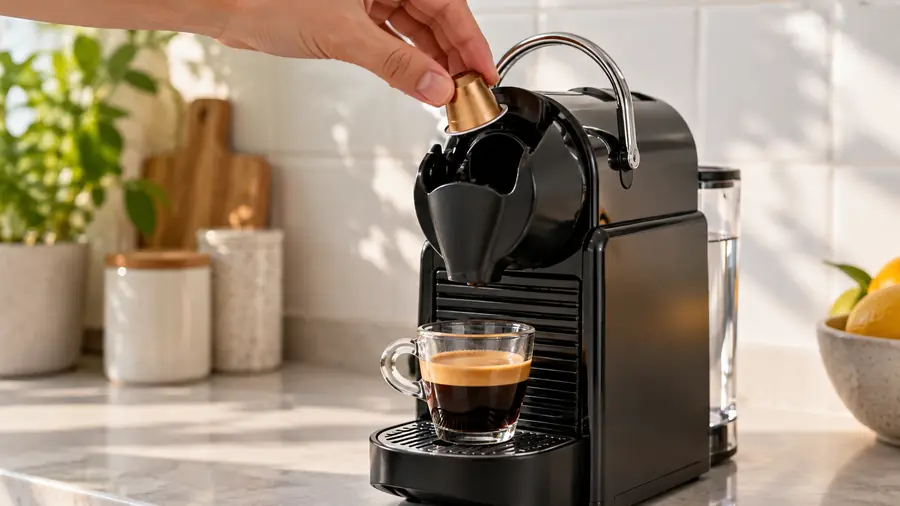
Start With the Market, Not the Empty Capsule
A cheap cup is not a business case. Before comparing filling machines, find out which installed machines your customers actually own and where you can reach them.
Look at the target country, not “the global capsule market.” Check retailer machine ranges, marketplace listings, compatible-brand density, price bands, review complaints, and recurring out-of-stock products. Talk with distributors, cafés, hotels, offices, and possible co-packers. Search demand helps, but it is one signal—not the whole map.
Then match the channel to the job.
Nespresso Original-compatible capsules can suit specialty coffee, subscriptions, premium gifts, origin-led ranges, and shoppers who mainly want espresso or lungo. Dolce Gusto-compatible products can make sense for household variety, hospitality, retail multipacks, milk drinks, chocolate, and beverage concepts that reach beyond ground coffee.
Europe adds another layer: country-level retail habits, packaging rules, trademark wording, and collection systems can differ. If that is your target, our European market-entry guide for private-label Nespresso-compatible capsules is a useful next planning step.
Do not mistake a busy marketplace for easy demand. Ten pages of competing pods may prove there is a machine base. They may also show that another “medium roast, intensity 7” product has nowhere obvious to stand.
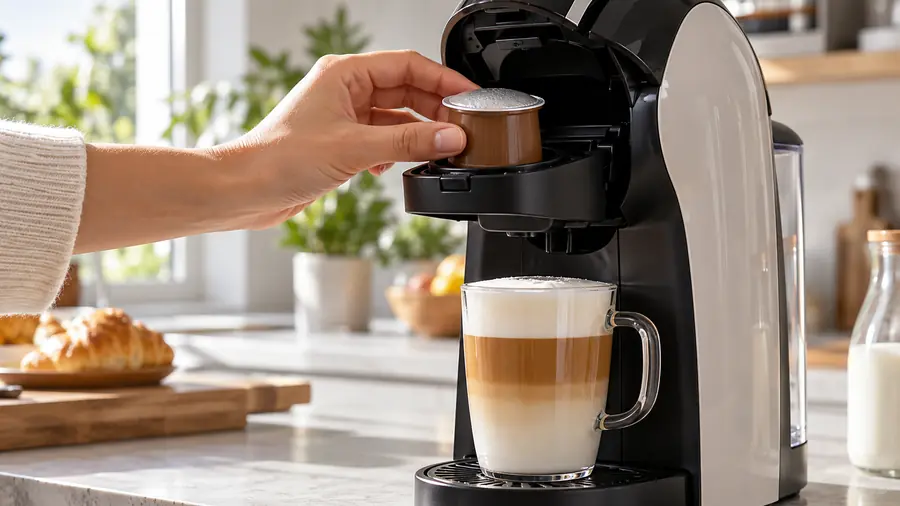
Choose Nespresso-Compatible When the Coffee Is the Hero
For a roaster, this route often feels natural. The brand story can stay close to origin, processing method, roast, aroma, and cup character. A compact espresso or lungo format also makes it easier to explain a focused range: perhaps a house espresso, a brighter single origin, a decaf, and one milk-friendly roast.
Still, good beans do not automatically become a good capsule. Roast development, grind distribution, dose, bulk density, coffee-bed structure, water flow, and target cup volume work as one system. A recipe that shines as pour-over may run too slowly, taste thin, or behave inconsistently in a capsule.
Material choice matters too. Third-party Original-compatible capsules may use aluminum, conventional plastic, paper-based designs, or certified compostable structures. Those are not plug-and-play substitutes. Each body needs a matching lid and sealing window, plus brewer, transport, and shelf-life validation.
The format may suit a premium position, but the word “Nespresso-compatible” does not create premium value by itself. Differentiation still has to come from the coffee, sourcing, roast, freshness plan, price, convenience, or brand.
Once those requirements are defined, compare Nespresso-compatible capsule filling machine configurations against the actual capsule, output, seal, and automation brief—not just the highest published speed.
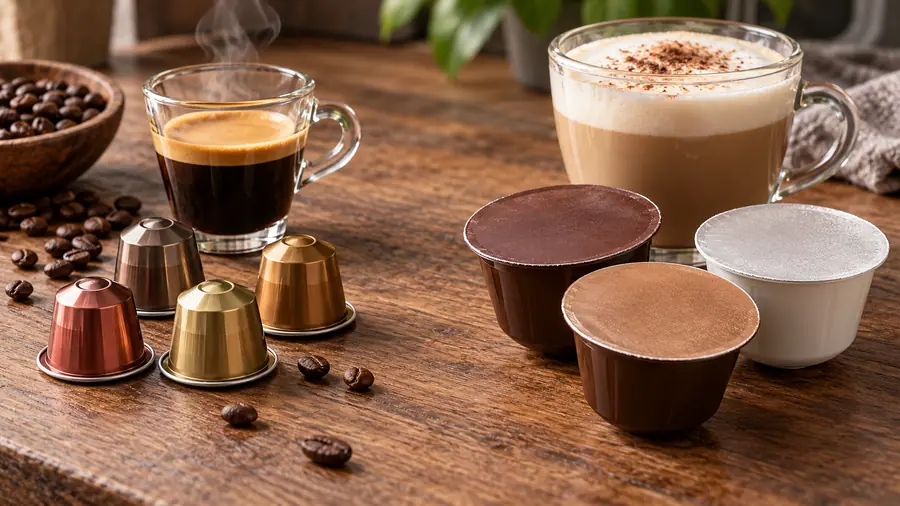
Choose Dolce Gusto-Compatible When the Menu Is the Hero
Dolce Gusto is better understood as a beverage platform than simply a larger coffee capsule. Nestlé describes the branded system as offering more than 50 coffees, teas, and hot chocolates on its official Nescafé Dolce Gusto brand page. That breadth helps explain the opportunity. It does not prove demand for every private-label flavor in every country.
Start by naming the product precisely. Is it roast-and-ground coffee, soluble coffee, milk powder, cocoa, tea, or a functional blend? Each behaves differently in a hopper and during dosing. Milk and cocoa blends may be hygroscopic. Fine powders can dust. Mixed particles can segregate. Flavored or milk-containing products may also change allergen controls and cleaning schedules.
Some beverages use one capsule. Others use two—often one coffee capsule and one milk or flavored capsule. That changes the real economics. A carton of 16 capsules might make 16 drinks, or only eight. It also means two formulas, two production orders, two inventory positions, and very clear preparation instructions.
This is where broad menu potential becomes operational work. Rather like a restaurant adding ten dishes, the menu looks exciting until someone counts the ingredients, pans, labels, and cleaning steps.
After the recipe and package architecture are settled, assess Dolce Gusto-compatible filling equipment with representative powders and components. A successful coffee trial does not prove that the same dosing setup will handle milk powder or cocoa cleanly.
The Production Differences That Change the Business Case
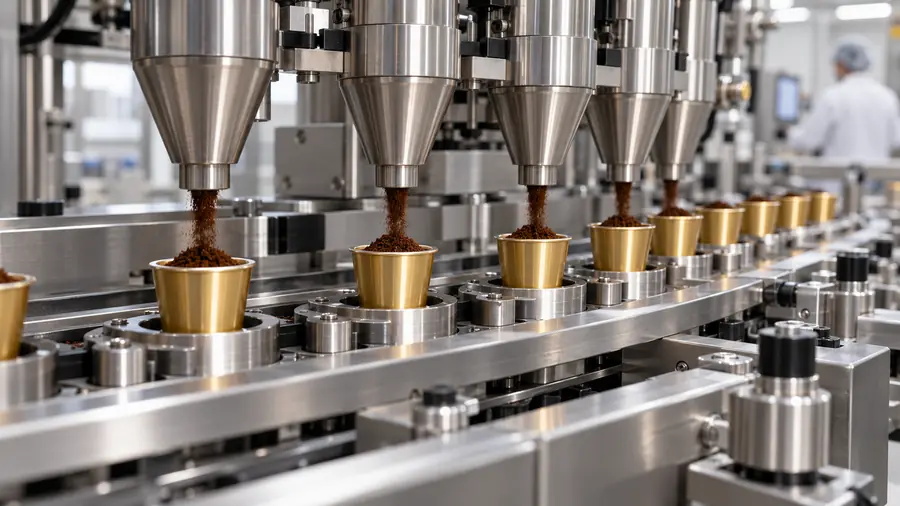
Capsule Feeding and Format Parts
The two formats have different geometry and handling needs. Feeders, molds, guides, carriers, sensors, lid pick-up systems, discharge paths, and cartoning can all change.
A machine platform may support both formats through change parts. Fine. But “supports both” does not mean a five-minute switch with no waste. Ask what must be replaced, adjusted, cleaned, reprogrammed, and requalified. Record the expected changeover time and prove it during a trial.
Product Dosing and Extraction
Ground coffee is not milk powder, and cocoa is not soluble coffee. Auger design, agitation, hopper geometry, refill behavior, and environmental control can affect dosing. Accuracy matters, but so do product distribution, bulk-density change, and powder on the sealing rim.
Ignore the temptation to rank the formats using a machine’s advertised pump-bar number. Nominal pump pressure is not a cup-quality score. Grind, dose, bed resistance, water path, temperature, time, capsule deformation, and the complete brewer-capsule interaction are more useful development variables.
Lid, Seal, and Package Integrity
The cup body, coating or barrier, lid, sealant, filter, and insert must function as a package. A strong-looking lid can still leak if powder reaches the rim or the materials have a narrow sealing window.
Run a proper seal study with the actual component lots. Check sealing temperature, time, and pressure; deformation; peel or burst behavior where suitable; leakage; transport; and aging. Oxygen or moisture permeability and a physical channel leak are different failures, so they need different tests.
Nitrogen flushing may support an oxygen-control plan, but it is not a universal shelf-life button. Residual oxygen, package barrier, seal quality, coffee condition, storage, and distribution all play a part.
Cleaning, Allergens, and Changeover
A coffee-only line is usually simpler to schedule than a line moving between coffee, milk-containing powders, cocoa, and flavors. If allergens enter the portfolio, define campaign order, dry or wet cleaning, verification, retained-product control, and release rules before production begins.
| Failure seen in production or the cup | Possible cause | Useful validation direction |
| Weak or slow beverage | Grind, dose, density, insert, flow path, or capsule deformation | Brewer and sensory trials across a defined target-machine set |
| Leaking lid | Rim contamination, material mismatch, or a narrow seal window | A seal study using actual cup and lid lots |
| Dose drift | Bulk-density change, bridging, refill effects, or feeder setup | Run-length checks, including hopper refill points |
| Powder caking | Moisture-sensitive formula, storage, or open handling | Humidity controls plus ingredient and package studies |
| Cross-contact risk | Milk or flavor residue and poor campaign planning | Allergen plan, validated cleaning, and production sequencing |
| Failed brewer compatibility | Wrong platform, dimensions, puncture behavior, or flow | A defined brewer matrix; never a casual “universal” claim |
Compare Cost per Sellable Drink, Not Cost per Empty Pod
An empty-capsule quotation is visible and easy to compare. That is exactly why it can distract from the larger number.
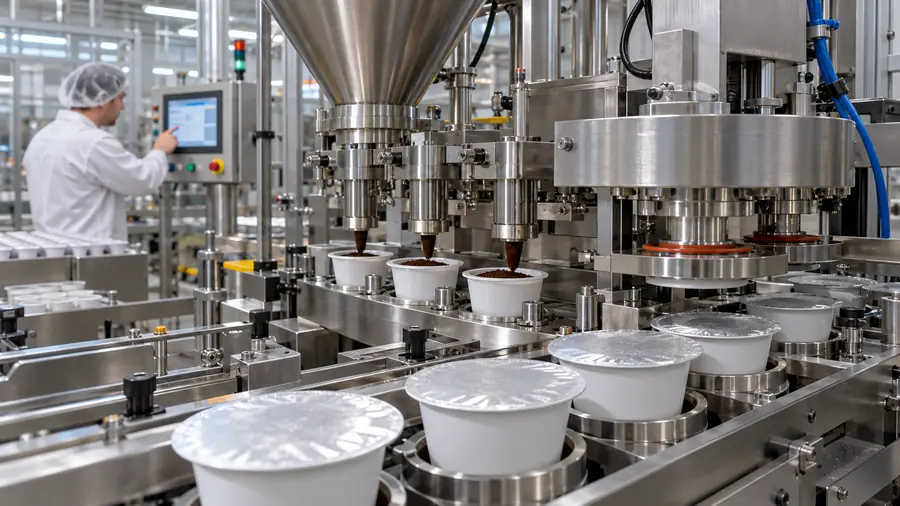
Build the calculation around one sellable beverage. Include the cup, lid, filter or insert, product dose, normal yield loss, labor, gas and utilities, scrap, maintenance, quality checks, carton, coding, freight, and sales-channel cost. Add changeover downtime and first-off waste. For a paired recipe, include both capsules.
| Cost block | Questions to model |
| Primary materials | What do the cup, lid, insert, coating, ink, waste, and supplier MOQ cost? |
| Contents | What is the coffee or ingredient dose, formulation cost, and normal yield loss? |
| Conversion | What are labor, energy, gas, maintenance, cleaning, scrap, and realistic OEE? |
| Format changes | What parts, downtime, training, validation, and first-off waste are required? |
| Secondary packaging | How many capsules make one beverage, and what do the carton, case, code, and pallet add? |
| Quality and compliance | What material files, migration work, shelf-life tests, sensory trials, and audits are needed? |
| Working capital | How much cash sits in component variants, paired SKUs, safety stock, and slow sellers? |
Use realistic ramp-up output rather than brochure speed. A fast line with frequent stops, awkward cleaning, or excess scrap can cost more per accepted capsule than a slower, steadier setup.
For early volumes, co-packing may beat immediate equipment ownership. If future demand supports both formats, use a coffee capsule filling and sealing machine guide to define change parts, capacity, acceptance tests, and secondary packaging before requesting a final quotation.
Standards, Claims, and Brand Boundaries
Coffee capsules combine food, food-contact packaging, machinery, and brand claims. That makes compliance a chain, not one certificate in a folder.
ISO 22000 sets requirements for a food-safety management system and can be used for certification. It is useful, but it is not a legal approval, a material migration report, or a capsule-compatibility certificate.
Depending on the destination market, the producer may also need applicable food GMP and HACCP-based controls, supplier approval, traceability, sanitation, allergen management, foreign-material controls, and production records. Food-contact evidence should cover the exact cup, lid, coating, ink, filter, and insert for the intended use—not a vaguely similar material.
Labels may need ingredients, allergens, nutrition, preparation directions, net quantity, lot identification, best-before information, and the responsible operator. Recycling and compostability claims need special care. A package that is technically recyclable is not necessarily collected locally. A compostable component does not make the finished product compostable everywhere.
Compatibility wording and trademarks should be reviewed for each destination market. Avoid implying that a third-party capsule is made, endorsed, or officially approved by the system owner unless that claim is genuinely authorized.
Finally, shelf life belongs to the finished product. It depends on the formula, package, process, residual gases, storage, and distribution. A supplier’s generic number cannot replace a study of your own product.

Use a Weighted Scorecard Before Buying Equipment
Score each format from 1 to 5. Multiply the score by the weight, and write down the source and date behind it. A score without evidence is just a confident guess wearing a spreadsheet.
| Decision factor | Weight | Evidence required |
| Reachable local demand | 25% | Machine-base proxies, retailer and marketplace data, and distributor interviews |
| Channel fit | 15% | Confirmed retailer, direct-to-consumer, office, hotel, or café requirements |
| Portfolio fit | 15% | An approved beverage brief and recipe architecture |
| Unit economics | 15% | Cost per sellable drink and contribution margin by SKU |
| Technical readiness | 15% | Capsule, recipe, brewer, seal, shelf-life, and pilot results |
| Compliance readiness | 10% | Material documents, labels, allergens, claims, and destination-market rules |
| Scalability | 5% | Capacity, changeover, service, secondary packaging, and expansion plan |
Set minimum gates as well. If food-contact documentation is incomplete, compatibility fails on key brewers, or the contribution margin does not work, a high total score should not rescue the project.
A Practical 90-Day Validation Path
- Define the commercial brief. Choose one target country, channel, consumer, beverage, selling price, and monthly volume.
- Select representative components. Obtain capsule and lid samples, drawings, specifications, and food-contact documentation.
- Develop a small range. Begin with two or three recipes, not a twelve-SKU launch that eats cash and attention.
- Run filling and brewer trials. Use an agreed machine matrix and record dose, flow, cup volume, sensory results, leakage, and visual defects.
- Study package performance. Plan transport testing and appropriate accelerated and real-time shelf-life work.
- Validate cleaning. This is especially important for milk-containing, flavored, or other allergen-bearing products.
- Sell a limited pilot. Track sell-through, repeat purchase, returns, complaints, and the real cost of serving the channel.
- Write the equipment requirement. Define capacity, change parts, cleaning, spares, training, FAT and SAT criteria, coding, and secondary packaging before CAPEX approval.
If neither format clears those gates, delay the equipment purchase or keep using a co-packer. That is not failure. It is cheaper than learning the same lesson after installation.
Conclusion
Nespresso Original-compatible capsules are often the stronger fit when coffee, espresso, and roast identity lead the offer. Dolce Gusto-compatible capsules can be stronger when the business is built around a broader beverage menu.
The real winner is the format supported by reachable demand, a qualified recipe and package, compliant materials, sound cost per drink, and a repeatable production process. A flexible filling machine can support a clear strategy. It cannot rescue a vague one.
Frequently Asked Questions
Are Nespresso and Dolce Gusto capsules the same size?
No. Their shape, dimensions, rim, puncture behavior, and brewing path differ. Exact specifications also vary among compatible component suppliers, so manufacturers should work from approved drawings and physical samples rather than measurements copied from a general comparison page.
Can Nespresso capsules be used in a Dolce Gusto machine?
Not directly. The capsules and brewing systems are different. Consumer adapters exist in some markets, but an adapter does not make a capsule natively compatible or prove safe, consistent commercial performance. A producer should develop for the specified brewer system.
Is Nespresso Original the same as Nespresso Vertuo?
No. Original and Vertuo use different capsule formats and extraction systems. A capsule designed for an Original machine should not be marketed as Vertuo-compatible. Treat each platform as a separate technical and commercial project.
Which format is easier for a private-label coffee brand to launch?
For a coffee-only roaster, Nespresso Original-compatible may offer a more focused development path. Dolce Gusto-compatible production may suit a brand with soluble-beverage experience. “Easier” still depends on local demand, components, co-packer capability, recipes, and compliance.
Which capsule format costs less to manufacture?
Neither is always cheaper. Compare cost per finished drink, not empty-capsule price. Dose, components, scrap, speed, cleaning, cartons, testing, and volume all matter. A two-capsule milk beverage can change the result substantially.
Can one filling machine produce both formats?
Some machine platforms can process both with dedicated change parts, tooling, feeders, recipes, and controls. Buyers should verify changeover time, cleaning, output, accuracy, sealing performance, and packaging integration for each format during representative-material trials.
What materials are used for compatible capsules?
Nespresso Original-compatible capsules may use aluminum, plastic, paper-based, or compostable structures. Dolce Gusto-compatible capsules are commonly plastic-based, often with specific filters or inserts. Every body, barrier, lid, coating, and ink needs appropriate food-contact and performance validation.
Does Dolce Gusto always use two capsules per drink?
No. Some products use one capsule, while certain milk-based or paired recipes use two. The recipe determines drink yield, carton count, preparation instructions, production scheduling, stock requirements, and the true cost per beverage.
What standards and tests are needed before selling coffee capsules?
Requirements vary by market. Typical work includes food-safety controls, traceability, food-contact documentation, label review, allergen management, dose and seal checks, brewer compatibility, sensory assessment, transport testing, and a shelf-life study of the actual finished product.
How should a manufacturer validate demand before choosing a format?
Combine retailer and marketplace research with machine-base proxies, distributor interviews, target-channel feedback, competitor pricing, search behavior, and a small commercial pilot. Local repeat purchase is much stronger evidence than an unsourced global market forecast.