
The brownie batter is half mixed, the recipe asks for a teaspoon of espresso powder, and the jar on your shelf says instant coffee. Go ahead and swap. In almost any baking job, instant coffee delivers the same flavor boost chocolate is looking for, and in a typical brownie or chocolate cake most eaters will never register the difference.
The swap comes with two conditions. First, instant coffee is milder per spoonful, so the amount usually needs to go up and the mixing method needs a small change. Second, the swap only runs one direction: instant coffee can stand in for espresso powder in baking, but espresso powder makes a poor drink. It was dried from a much darker, more concentrated brew, so in hot water it tastes harsh and flat instead of like a proper cup.
One mix-up is worth clearing before anything else: espresso powder is not finely ground coffee beans. It is brewed coffee dried back into a crystal-fine powder, the same basic idea as instant coffee. That is why tearing open a coffee pod and dumping its contents into batter fails. Pods hold ground roast, not soluble powder, and grounds stay gritty no matter how long the cake bakes.
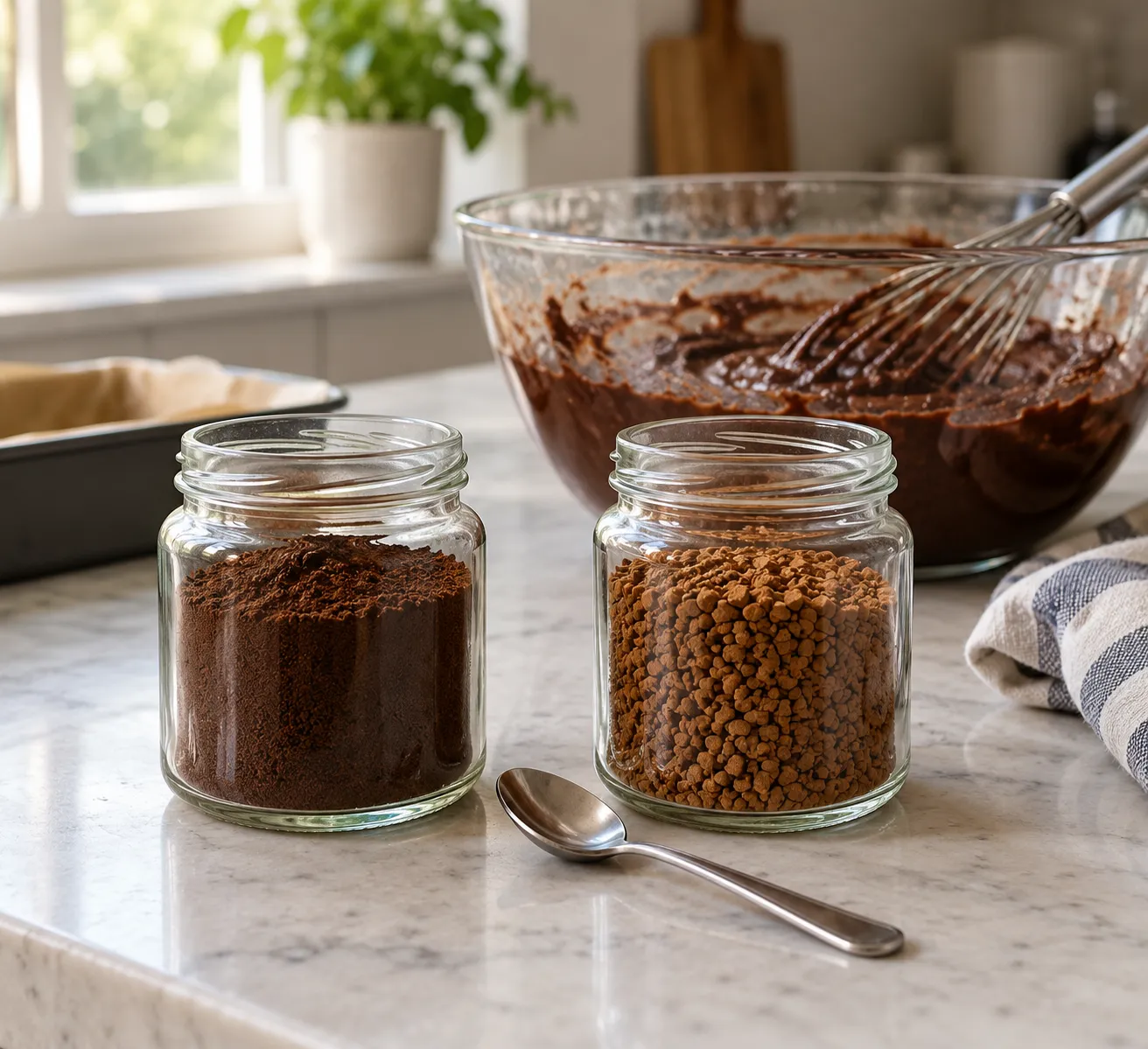
Why Swaps Go Wrong, and How to Get the Ratio Right
Most failed swaps trace back to one of three mistakes, and each has a simple fix.
Three Ways the Swap Fails (and the Fix)
The first failure is a gritty batter. That happens when grounds end up in the mix: contents of a coffee pod, a scoop of finely ground espresso beans, anything that is roast rather than soluble powder. No amount of baking dissolves them. The fix is to check the label: only a powder that dissolves fully in water belongs in the bowl.
The second failure is speckles and grainy bits even when you did use real instant coffee. Instant granules stirred straight into dry ingredients often survive as tiny hard specks, which bakers notice most in pale batters and frostings. The fix is to dissolve the instant coffee first in one of the recipe’s warm liquids, melted butter, hot water, or cream, and then stir it through. Experienced home bakers do this by default for exactly that reason (r/AskBaking, 2025).
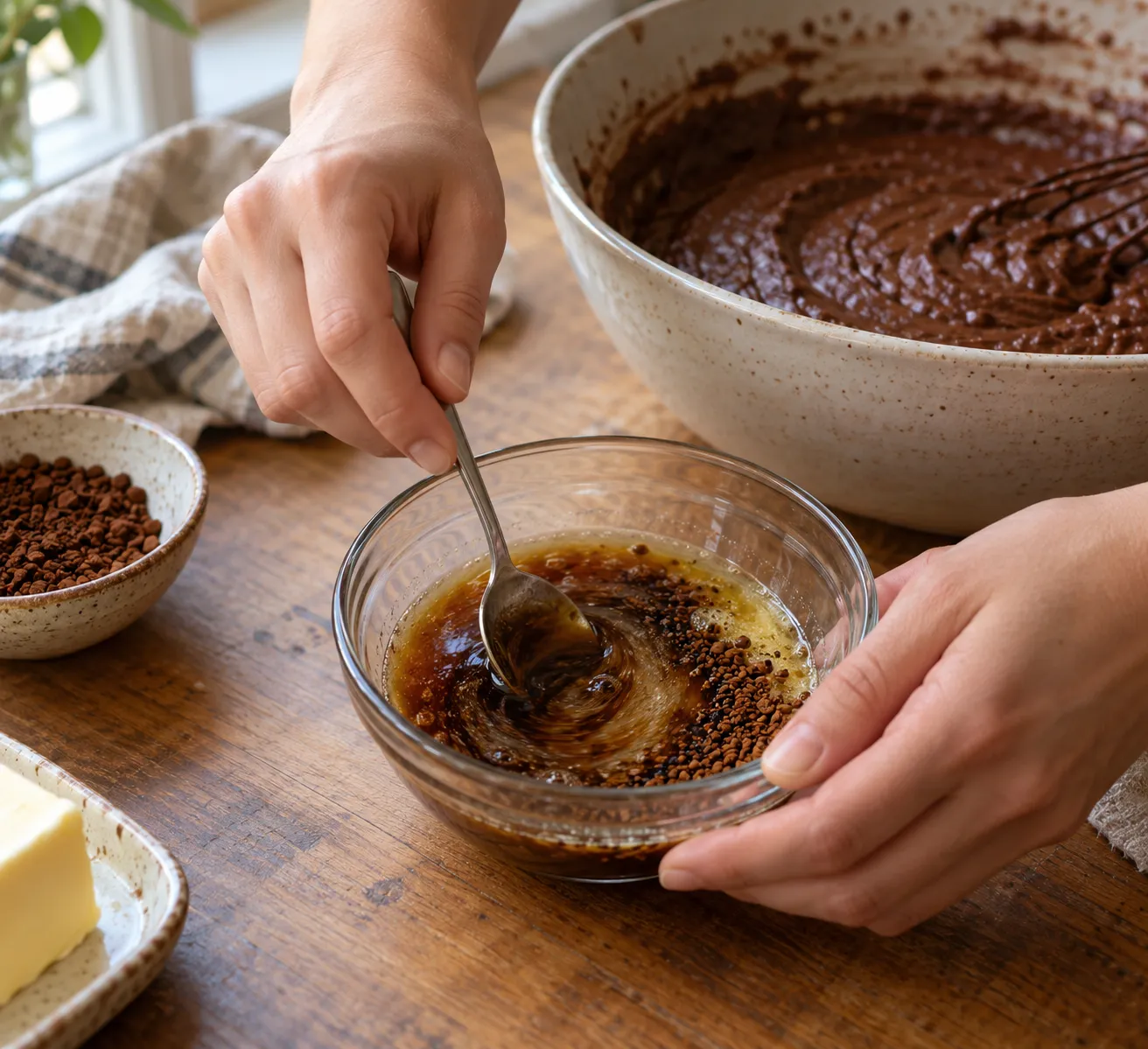
The third failure is cold applications. Chilled mousses, cold foam, iced coffee style drinks: instant coffee granules refuse to dissolve properly in cold liquid. Espresso powder, ground much finer, dissolves in any liquid without heat. If your recipe never gets warm, the swap is the wrong tool, not the wrong dose.
Swap failure self-check
- Gritty texture? You used grounds (pod contents or ground beans), not a soluble powder.
- Dark specks in the crumb? Dissolve the instant coffee in a warm liquid before mixing.
- Recipe stays cold? Use espresso powder, or dissolve instant in a spoonful of hot water first.
The Ratio: Why Advice Disagrees, and How to Decide
Ask how much instant coffee replaces espresso powder and you will collect three different answers. One guide says use 1.5 to 2 times the called-for amount (OUTIN, 2025). A popular baking thread says about 50 percent more is plenty (r/AskBaking, 2025). Another baker in the same thread insists you need triple the amount to get close (r/AskBaking, 2025).
The disagreement is real, and it has a cause. Instant coffees vary widely in strength: dark-roast instant is noticeably punchier than standard blends, and recipes differ in how much of the final flavor actually comes from the coffee.
For chocolate recipes where coffee works as a background booster, start at one and a half times the called-for amount. For recipes where coffee is a lead flavor, coffee cake, mocha, tiramisu-adjacent desserts, start at two times and expect to adjust in future batches. And keep expectations calibrated: instant coffee adds coffee flavor, but it cannot supply the deep, low-acid espresso character, because it was never roasted and brewed that way in the first place.
Swap ratios, by source
1.5x to 2x
Guide baseline (OUTIN, 2025)
+50%
Baking thread: plenty for most bakes
3x
One baker’s strong-flavor rule
Treat any ratio as a starting dose, not a fixed rule.
What They Actually Are: Bean, Brew, and Dry
Once you see how each powder is made, every difference you have tasted, price, strength, even the dissolving behavior, follows from the same short chain.
From Bean to Powder: Where the Lines Split
Start with the bean. Espresso powder is made from dark-roast beans, almost exclusively, which is where its low acidity and caramelized depth come from (r/AskBaking, 2025). Instant coffee’s raw material is a more tangled story. Many mass-market blends lean on Robusta, a harder, cheaper, more bitter bean. Premium jars advertise 100 percent Arabica. Sources genuinely disagree on where the line sits, and marketing does not always help, so treat any claim about “the” bean for instant coffee with suspicion.
Then the brew. Both products start as liquid coffee; the split is in extraction. Espresso powder begins with a dark-roast concentrate pulled under espresso-style pressure. Instant coffee begins with a large-scale conventional extraction of roasted beans. From there both are dried, but not the same way. Spray-drying shoots the extract through hot air: fast, cheap, and the reason standard instant coffee is affordable. Freeze-drying freezes the extract and removes the water under vacuum at low temperature, which protects the volatile aromatics far better. One industry comparison puts freeze-drying’s energy use at 3 to 5 times that of spray-drying (Sucafina, n.d.). Lab work backs the flavor side: freeze-dried samples held significantly more volatile aroma compounds than spray-dried ones (Chindapan et al., 2024).
Texture, Price, and What It All Means for Your Recipe
The physical result explains the kitchen behavior.
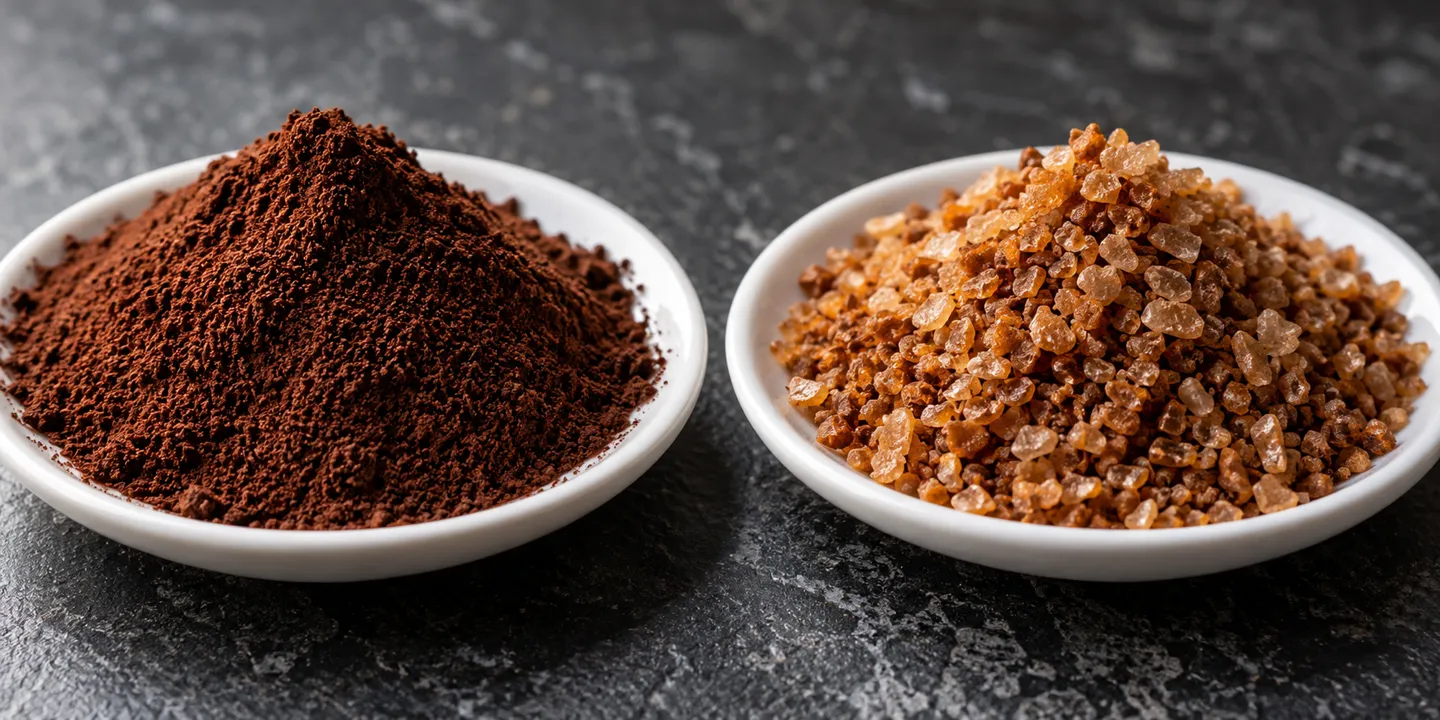
Espresso powder is milled so fine it dissolves fully, even in cold liquid. Instant coffee forms coarse crystals that need hot water first.
One physical difference explains almost every failed swap.
Price follows the same logic. Instant coffee is priced as a drink: Walmart’s current listings run from about $1.33 to $2.00 per ounce across Great Value and Nescafe jars in 7 to 14 oz sizes (Walmart, 2026). Baking espresso powder sells in small jars: about $12.99 for a 5 oz jar of Anthony’s, roughly $2.60 per ounce (Amazon, 2026). Two years of price history for that same jar runs between $10.43 and $12.99. So per ounce the premium is real but modest. The pack sizes tell the story too: you use a teaspoon per batch, not a teaspoon per cup, so a jar lasts months.
Caffeine lands where you might not expect. A level teaspoon of instant coffee powder carries about 28 mg of caffeine per USDA data (USDA FoodData Central, 2026). Espresso powder is more concentrated per gram, but recipes use so little that a full pan of brownies spreads across twelve slices adds only a few milligrams each. Making your own espresso powder from leftover dark roast is possible (bake low, grind fine), but home versions are inconsistent in both flavor and solubility.
The Same Idea, Two Different Products
| Layer | Espresso Powder | Instant Coffee |
|---|---|---|
| Bean | Dark roast almost exclusively | Robusta or Arabica, blends vary |
| Brew | Espresso-style pressure extraction | Conventional large-scale extraction |
| Drying | Dried and milled fine | Spray-dried or freeze-dried |
| Texture | Ultra-fine, dissolves cold | Coarse crystals, need hot water |
| Job | Baking ingredient | Beverage |
| Typical price | About $2.1-2.6 per oz | About $1.3-2.0 per oz |
When Substituting Doesn’t Work
The swap logic breaks in specific situations, and knowing the boundaries saves both ingredients and desserts.
Cold is the hard edge. Instant coffee that behaves in hot batter will sit as gritty specks in a cold mousse, cold foam, or iced latte. Dissolve it in a spoonful of hot water first, or keep espresso powder for cold work.
Cold recipes are where instant coffee swaps fail most: in chilled mousses, cold foam, and iced drinks the granules will not dissolve. Either pre-dissolve in hot water and cool, or use espresso powder.
| Scenario | What to use | How to use it | When not to |
|---|---|---|---|
| Chocolate baking boost | Instant coffee (swapped) | 1.5x the called-for amount, dissolved in warm liquid first | Skip the swap only if the jar is a dark-roast instant already strong enough at 1x |
| Iced and cold drinks | Instant coffee, pre-dissolved | Hot water slurry, then chill; or espresso powder straight in | Never dry instant straight into cold liquid |
| Tiramisu, mocha, coffee-forward desserts | Espresso powder if possible | Instant at 2x works, but expect a flatter, more bitter profile | Instant cannot fake true espresso depth here |
| Watching caffeine | Either, dosed | A teaspoon of instant is about 28 mg; baking doses spread thinner still | Do not judge by “coffee tastes strong”, judge by teaspoons used |
| Nothing on hand | Brewed coffee | Replace some of the recipe’s liquid with strong brewed coffee | Skip if the batter cannot absorb extra liquid |
Caffeine deserves one honest paragraph. Per teaspoon, instant coffee powder runs about 28 mg of caffeine (USDA FoodData Central, 2026). A mug of instant coffee lands around 60 to 80 mg. A baking batch that uses half a teaspoon divides those milligrams across a dozen servings. If you bake for caffeine-sensitive eaters, the powder in the crumb is rarely the problem; the mug alongside it is.
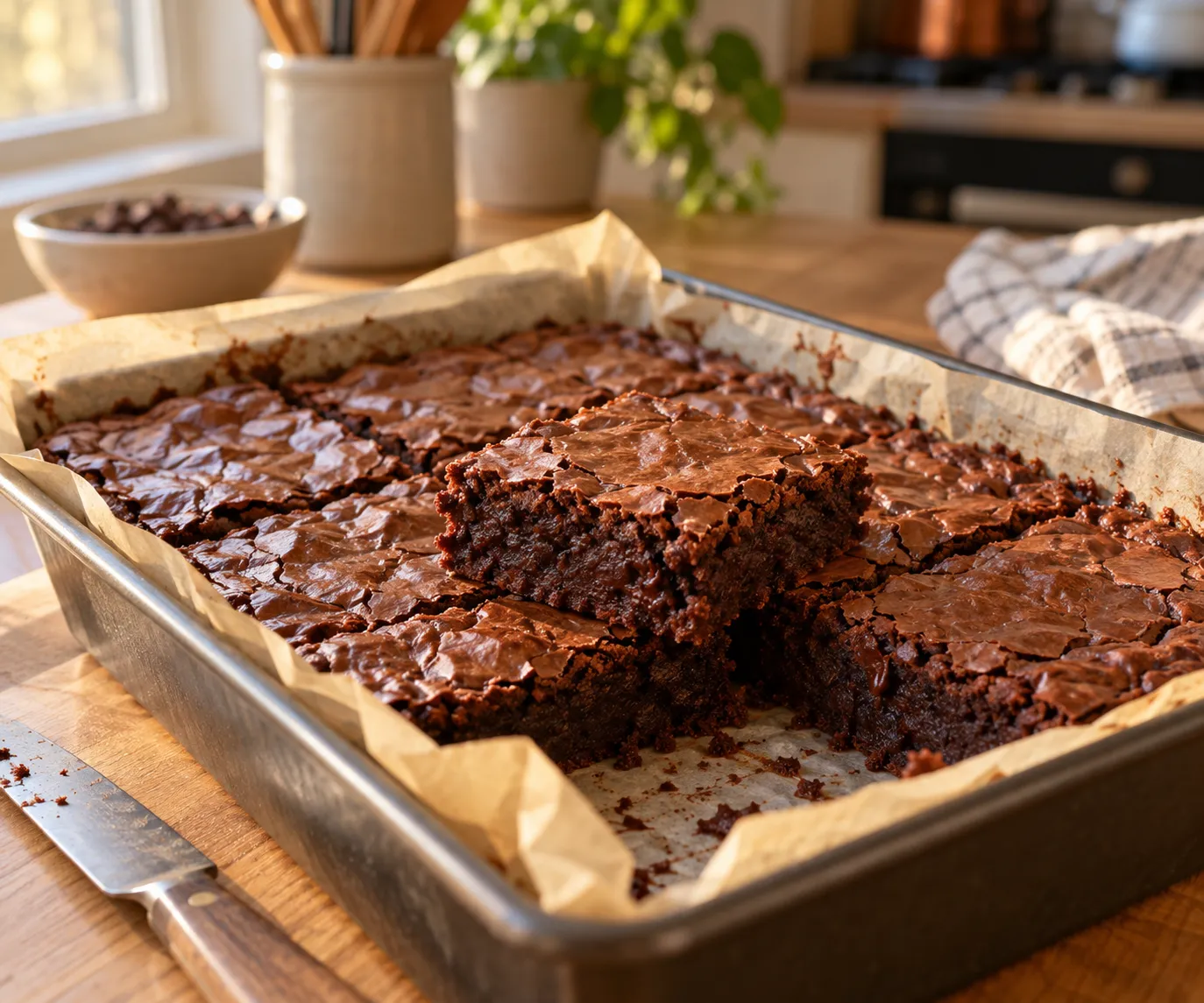
Choosing by Scenario: A Quick Decision Path
Work through four questions in order and the right jar picks itself.
First, is this for drinking or baking? Drinking means instant coffee, freeze-dried if your budget allows, since freeze-drying protects the aromatics that hot water rewards. Baking with coffee as a booster means either jar works; baking where coffee is the lead flavor justifies buying real espresso powder.
Second, check the label, not the shelf position. Baking-oriented espresso powder says so, and usually says dark roast. Instant coffee that names its process is more trustworthy than one that does not.
Third, prefer smaller jars for the baking aisle. Espresso powder sees so little use per batch that a 4 to 5 oz jar outlives most kitchens’ interest; a bigger jar is just a longer trip toward stale flavor.
Fourth, store for solubility. Both powders are hygroscopic: they pull moisture from the air. Airtight jar, away from the stove, and treat hard clumping as the failure signal it is: the powder has already lost the freshness you bought it for.
Before you buy
- Drinking or baking? Freeze-dried instant for cups, labeled dark-roast espresso powder for baking lead roles.
- Process stated on the jar beats marketing on the front.
- Small jar wins in the baking aisle.
- Airtight storage, and clumping means time to replace.
What This Means If You Sell Coffee
Read the consumer side long enough and a business question surfaces: are espresso powder and instant coffee one product line or two? The evidence above says two. Different raw material, different extraction, different drying behavior, different jar size, different aisle. A buyer who wants a baking ingredient is not choosing between your instant coffee and someone else’s; they are choosing whether to stock a baking staple at all. And they buy it once every few months instead of every few weeks.
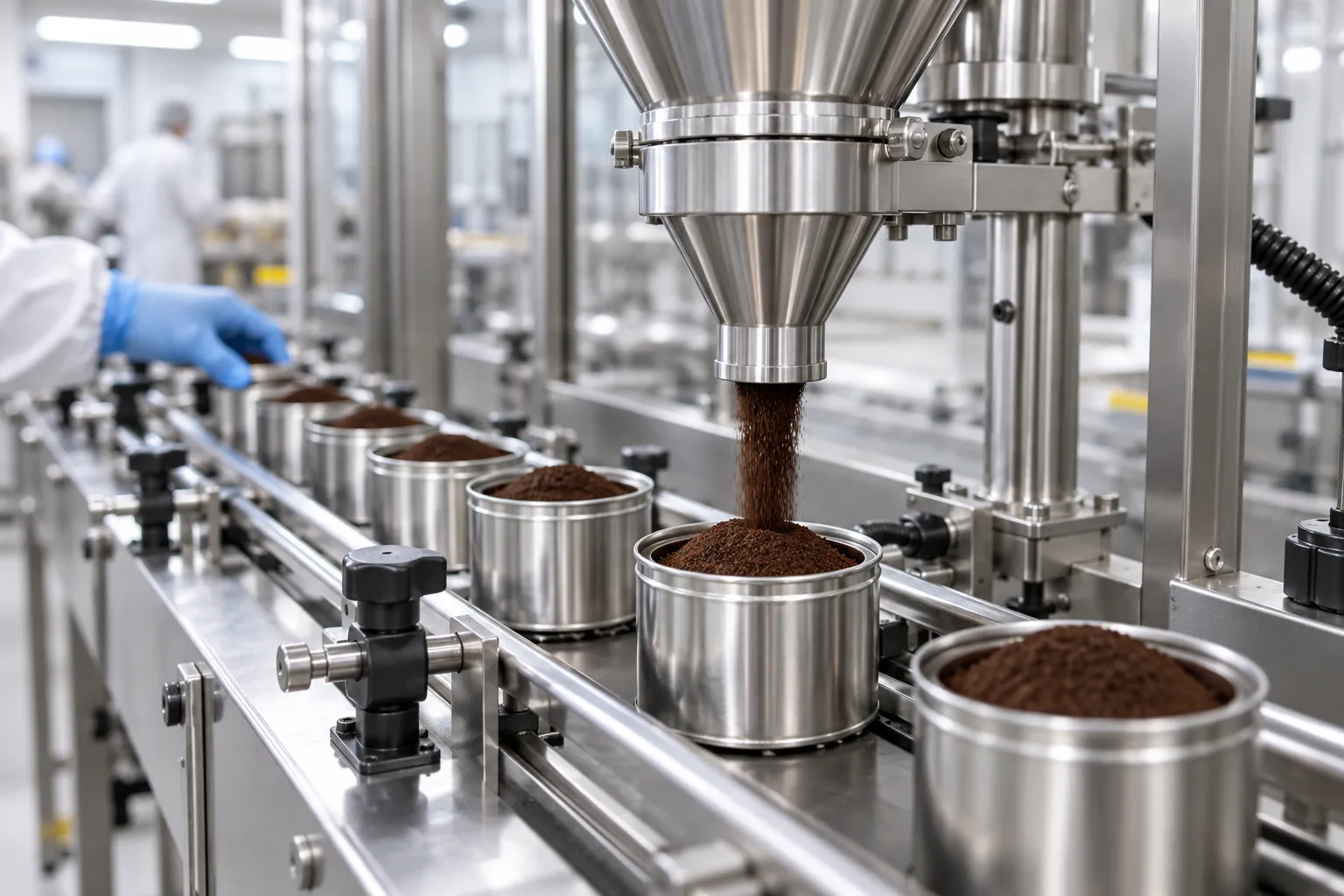
The production threshold sits in packaging more than in roasting. A roaster with dark-roast capacity already owns the hard part, the bean and the brew. What separates a shippable product from a disappointing one is keeping an ultra-fine, strongly hygroscopic powder dry in a small format. That means high-barrier material, precise small doses, and a seal that survives a pantry shelf. A bag format lifted from an instant coffee line tends to fail exactly there, and single-serve sticks or small sealed cans exist because of it.
The category in three numbers
Months
Espresso powder repurchase cycle
Weeks
Instant coffee repurchase cycle
±0.1 g
Filling accuracy for small doses
So the practical read: treat espresso powder as its own category decision, not an instant coffee extension. Validate the flavor of your dark roast as an ingredient powder first. Spec the packaging around moisture and small doses, and price it against baking ingredients rather than against jars of instant coffee. Where that leads in equipment terms, powder canning lines that dose to about 0.1 g accuracy and stick pack lines built for small moisture-sensitive formats are the reference points.
If you are weighing espresso powder as its own category, SANEU builds both ends of that packaging decision. Our powder canning lines hold filling accuracy to about ±0.1 g, and our stick pack machines are built for exactly these small, moisture-sensitive formats.
Engineer a Powder That Survives the Pantry
SANEU designs powder canning lines and stick pack systems for moisture-sensitive formats, with filling accuracy around ±0.1 g.
Start a Packaging ConsultationReferences
- USDA FoodData Central. “Coffee, instant, powder: Caffeine.” Accessed 2026. https://fdc.nal.usda.gov/
- Sucafina. “Freeze-Dried vs. Spray-Dried: What Really Changes in the Cup.” n.d. https://instant.sucafina.com/news/freeze-dried-vs-spray-dried-what-really-changes-in-the-cup
- Chindapan, N. et al. “Comparative Evaluation of Volatile Aroma Compounds in Spray- and Freeze-Dried Instant Coffee.” BUU Science Journal, 2024. https://li05.tci-thaijo.org/index.php/buuscij/article/view/423
- r/AskBaking. “Instant coffee vs espresso powder?” Reddit thread, 2025. https://www.reddit.com/r/AskBaking/comments/1hpg4yr/instant_coffee_vs_espresso_powder/
- OUTIN. “Espresso Powder vs Instant Coffee: Key Differences.” 2025. https://outin.com/blogs/news/espresso-powder-vs-instant-coffee
- Walmart. “Nescafe and Great Value Instant Coffee listings.” Accessed 2026. https://www.walmart.com/browse/food/nescafe-instant-coffee/976759_1086446_1229650_7429052
- Amazon. “Anthony’s Organic Espresso Baking Powder, 5 oz, price history.” Accessed 2026. https://www.amazon.com/Anthonys-Organic-Espresso-Enhances-Chocolate/dp/B07DYFSM8C



 English
 Spanish
 Arabic
 Russian