
What VFFS and HFFS Actually Mean
Every pillow bag of coffee, rice, or chips that leaves a factory started as a flat roll of film. So did every candy bar wrapped at a couple hundred pieces a minute. The machines that turn those rolls into finished packages come in two postures, and the posture decides almost everything that follows.
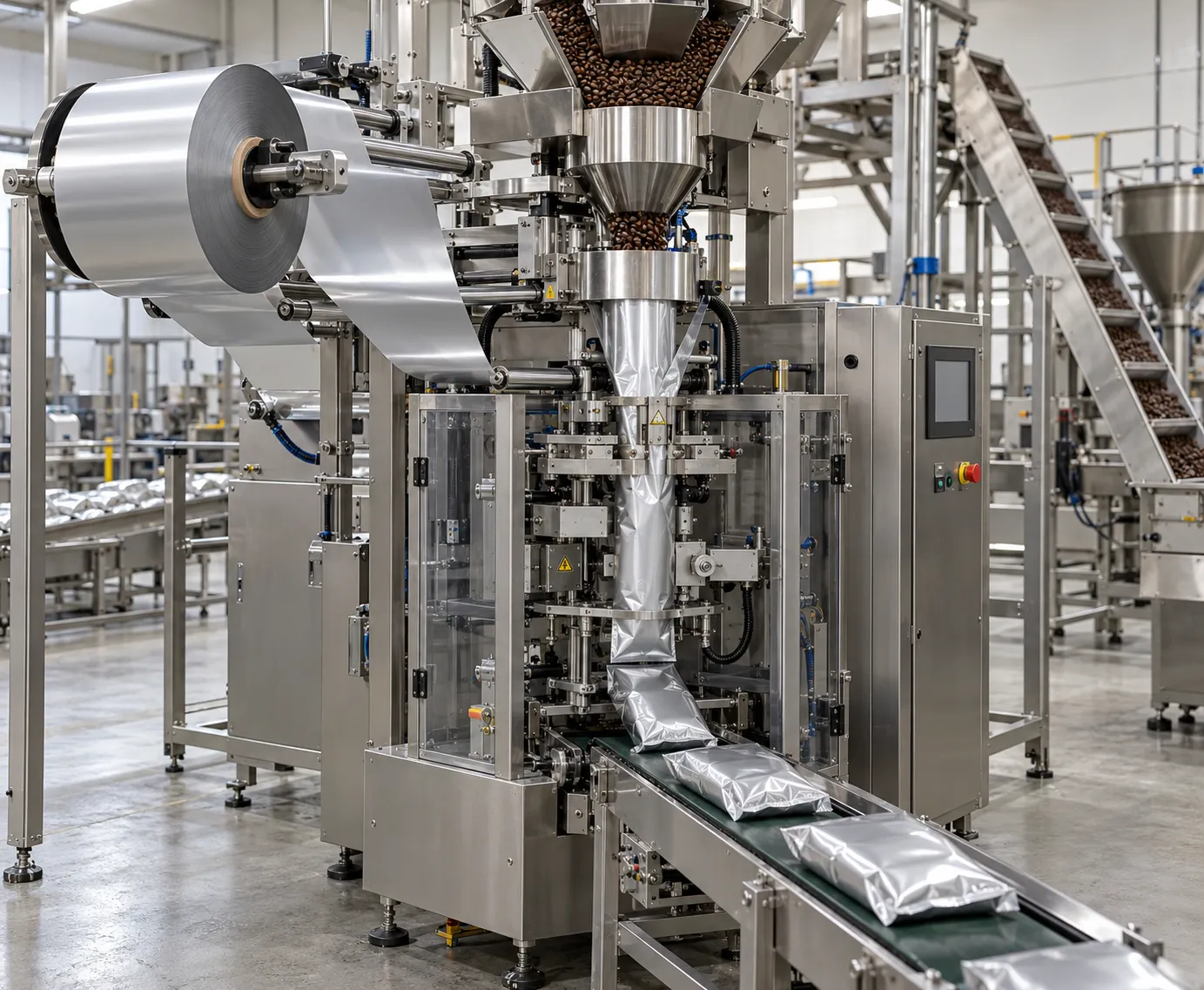
Vertical form fill seal (VFFS) pulls film down over a forming collar into a tube. The product drops into that tube by gravity. A seal closes the bottom of each bag, the measured dose falls in, and the top seal closes the bag while forming the bottom of the next one. Horizontal form fill seal (HFFS), better known as flow wrapping, does the same three jobs lying flat. The product rides a conveyor, film wraps around it, rotating fin wheels seal the long seam, and end seals close and cut each pack.
So the mechanical difference boils down to one thing. In a vertical machine the product falls. In a horizontal machine the product rides. Everything else follows from that single fact: the floor space, the bag shapes, and the products each line can accept.
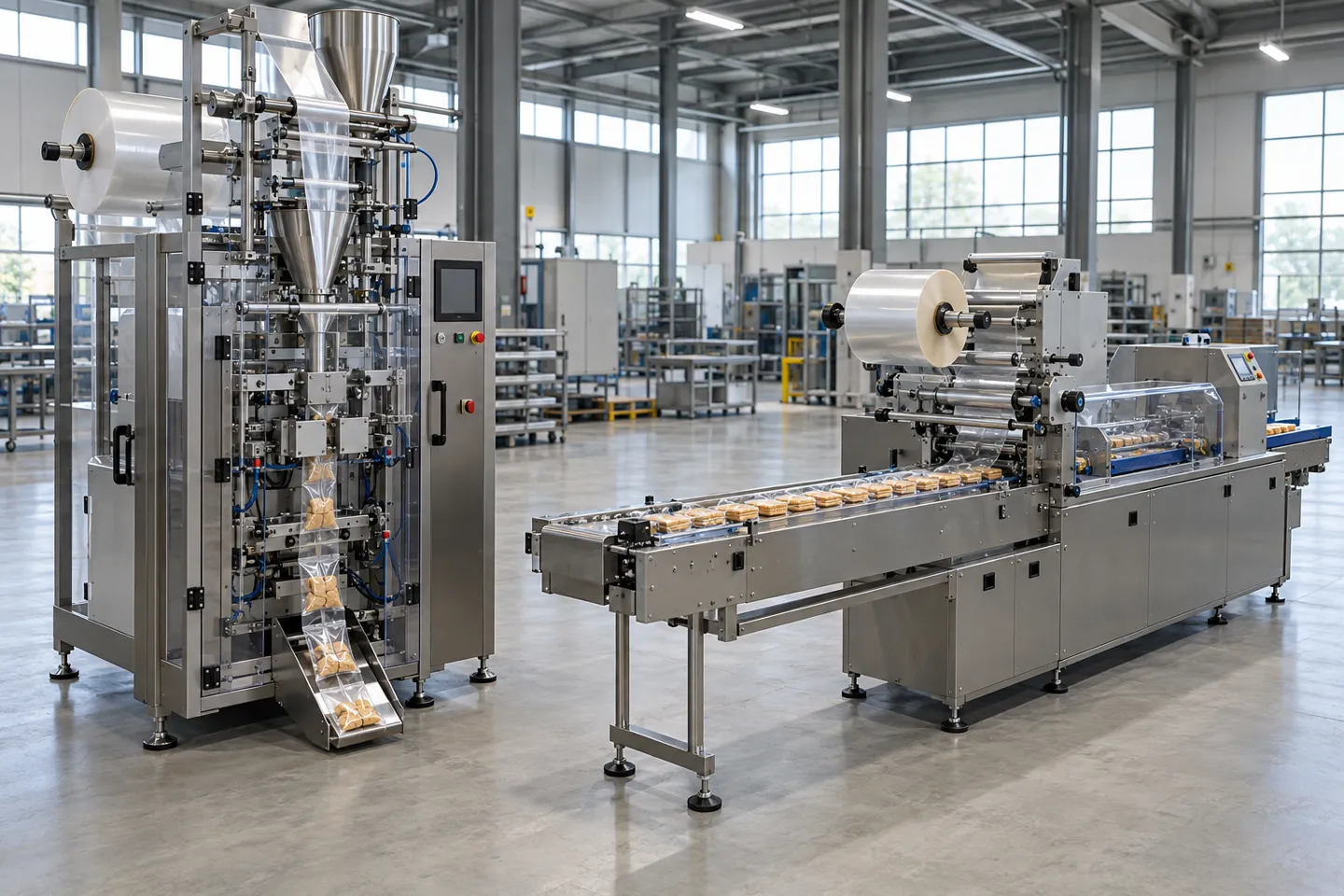
This comparison covers machines that build bags from film on a roll. Premade-pouch fill-seal systems and rigid canning lines sit outside it, though the logic below will tell you when your product has wandered into their territory. One quick note for readers arriving from a laboratory context: here HFFS refers to the packaging machine, not the HFF cell line used in cell culture.
The Two Machine Families at a Glance
The vertical family makes bags from the film itself: pillow bags, gusseted bags, pillow-gusset combinations, stick pouches, and three- or four-side sachets. That is why it owns the loose-product aisle: ground coffee, nuts, snacks, rice, sugar, flour, spices, pet food, fertilizer pellets. The horizontal family wraps. Its flow packs surround a solid piece, a tray, or a bundled set. That is why biscuits, bars, chocolate, cookies, and cutlery sets come out of it looking the way they do.
Both families split again by motion. Intermittent machines seal in stop-and-go cycles. Continuous machines seal a moving web without pausing. The distinction sounds academic until you start comparing speed claims, because it is exactly the reason published numbers seem to contradict each other.
Floor space follows posture too. A vertical cell stacks upward and typically occupies a fraction of the footprint of a horizontal line doing comparable work. The horizontal line trades floor space for gentler handling of the product it wraps.
Two families, one glance
| Family | Bag styles | Typical products | Motion |
|---|---|---|---|
| VFFS | Pillow / gusseted / pillow-gusset / stick pouch / 3- and 4-side sachet | Coffee, nuts, chips, rice, sugar, flour, spices, pet food | Intermittent or continuous |
| HFFS (flow wrap) | Pillow wrap around solid pieces or trays | Biscuits, bars, chocolate, cookies, cutlery sets, bundles | Mostly continuous, box-motion variants exist |
Scarce formats deserve one line. Stand-up pouches with zippers or spouts sit mostly at the edges of both families, and premade-pouch machines handle them most naturally. Some vertical lines attach zippers as an option, so treat it as a question to ask rather than an assumption to carry into a purchase order.
Which Route Fits Your Product
The vs framing suggests two machines are competing for a general trophy. They are not. Your product already voted, and the comparison collapses into one question: what does it do when you release it into the machine?
The Four-Step Decision Chain
Step one, physics. If the product flows (granules, powders, pellets, mixes), it falls, and gravity feed points to a vertical line. If it is a rigid single piece, it rides, and a flow wrapper points horizontal. Fragile free-flowing products like chips occupy the gray zone. A vertical line works when the drop is short and the film cushions well, which is why family-size chip bags are still made vertically. Delicate premium pieces often do better lying flat.
Step two, retail format. If your target bag is a pillow bag, sachet, or stick, you are in vertical territory regardless of anything else. If the shelf demands a printed wrap sealed tight around each piece, horizontal wins even for products that could technically flow.
Step three, volume. Convert monthly output into a required machine rate before anyone shows you a spec sheet. The next subsection does the arithmetic, because this is where most small-plant anxiety comes from.
Step four, budget and floor. A bagger is the middle of a line, not the whole line. Weighing, gas, conveyors, and spares all draw on the same budget, and the next section prices them out.
Two boundary cases can split the verdict. A mixed product line (loose granules today, wrapped bars next quarter) usually ends up with one of each machine rather than a compromise. Free-flowing liquids such as sachet sauces and honey sticks still run vertically through pump feeding. Viscous pastes belong to neither classic line and should push you toward filling specialists.
The Speed Argument, Settled
Published speed numbers for VFFS and HFFS can be difficult to compare because they describe different machine classes, products, and motion regimes. A rate measured for flow wrapping small solid items does not tell you how quickly a line will bag loose product.
Intermittent machines pause for each sealing cycle, while continuous machines keep the film moving. Box-motion horizontal machines prioritize gentle handling. Compare demonstrated output for your product, film, and pack size instead of treating a headline bags-per-minute figure as a direct comparison.
The number that actually matters is yours. Monthly bags divided by working days gives a daily rate. Daily rate divided by machine rate gives minutes of runtime.
Speed, converted
At 70 bags per minute, the same day takes about 33 minutes.
A plant moving 50,000 bags a month needs its bagger for about an hour a day. That was the real volume one snack manufacturer described while shopping for equipment. The figure is the strongest argument against paying a premium for headline speed at small-plant scale. What actually eats capacity in a first year: changeover time, weighing giveaway, film breaks, and seal rejects. None of those appear in the bags-per-minute figure.
A Pre-Purchase Self-Check
Five questions, in order, settle the route before a quote arrives.
- 1Does the product flow when released, and how fragile is it?
- 2What bag format does the shelf actually require?
- 3What is the daily bag rate after the monthly-to-daily conversion?
- 4What floor space, power, and compressed air are available?
- 5Will SKUs multiply soon, and how often will the machine change over?
When questions one and two point one way and three and four point the other, you are in a gray zone. The cheapest resolution is a sample run with your actual product before signing anything.
Building the Line Around the Machine
The bagger decides the route. The surrounding equipment decides whether the line earns money. Three choices do most of that work.
Match the Weigher to the Material
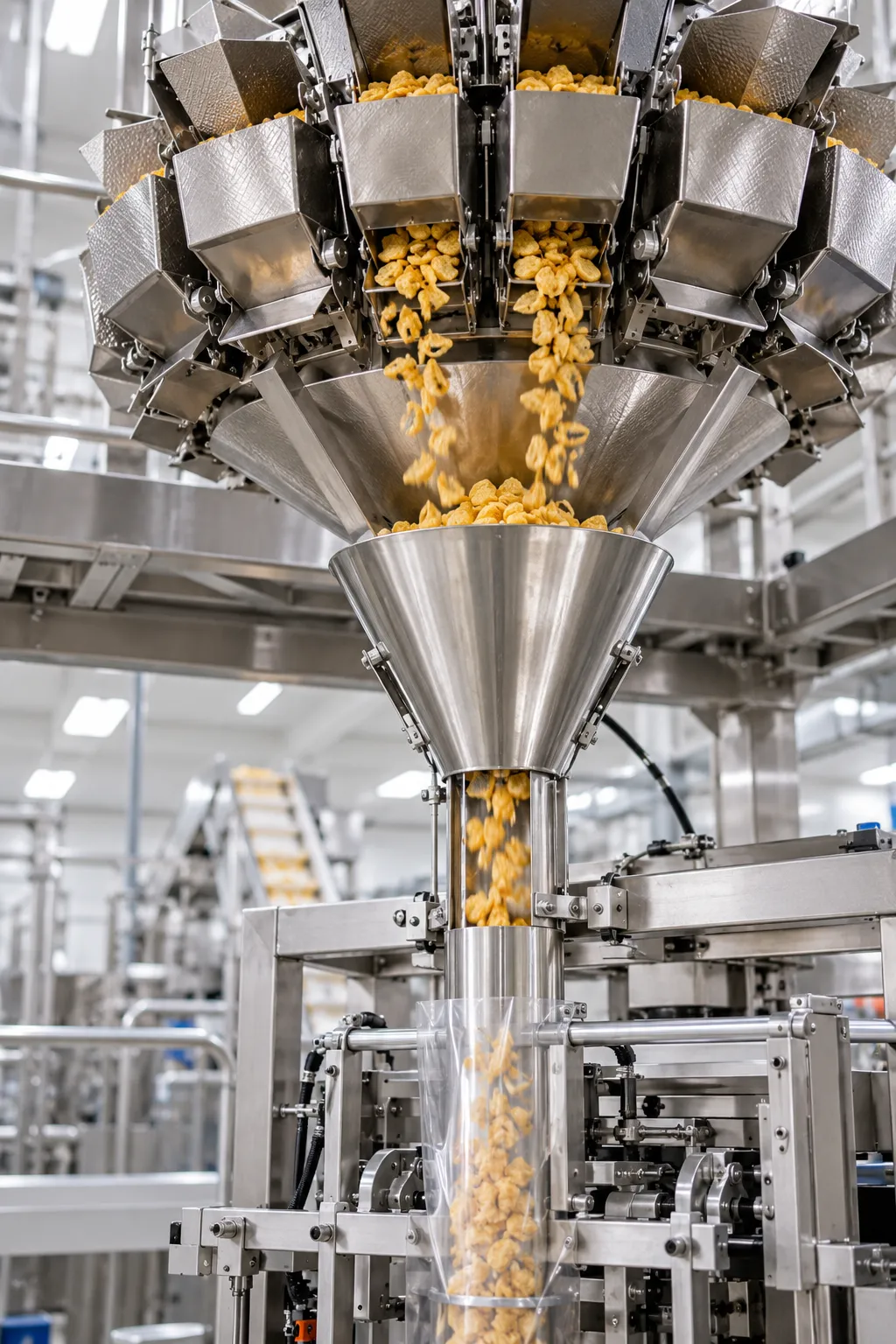
Multihead weighers handle mixed and bulk products with the best speed-and-accuracy balance, at the highest price. Linear weighers suit single materials at friendlier budgets. Auger fillers own powders. Cup fillers are the cheapest option for uniform granules and the loosest on tolerance. Match the weighing system to the material first and the budget second. Giveaway, meaning product overfilled beyond the label weight, is a quiet tax collected on every bag for the life of the line.
Four weighing paths
A founder starting a nuts-and-trail-mix brand laid out exactly this fork in a manufacturing forum (Reddit r/IndiaBusiness, 2026). His options were a full VFFS line with a multihead weigher, a semi-auto setup with a smaller weigher and band sealer, or the cheapest cup-filler route. The question was weighing accuracy against product giveaway. Ask every bidder to demonstrate accuracy at your target weight with your product, not with theirs.
Nitrogen Flushing and Vacuum
For nuts, coffee, and anything fat-containing, oxidation is the shelf-life killer. A nitrogen flush device that displaces oxygen at the sealing moment is a common add-on on vertical baggers. For coffee specifically, some vertical machines integrate vacuum for a deeper freshness effect on beans and grounds.
Treat catalog claims here as starting points, not specs. The useful question is what residual oxygen the machine can hold on your product, in your film, at your weight, demonstrated in a test. Ask for that number from every bidder and compare answers.
Send SANEU your product details and bag specs, and get demonstrated numbers on your own film and weight instead of a catalog claim.
Ask for a Demo RunWhat the Machine Price Leaves Out
The sticker covers the bagger. The line costs bagger plus weigher plus gas handling plus conveyors plus film stock plus spares plus installation plus training. Budget planning that ignores the surroundings stalls halfway through commissioning, and that is the expensive place to discover it.
Three realistic paths exist. Path A buys the full automatic line now: scalable but capital-heavy. Path B starts semi-automatic, weigher plus band sealer plus hands, validating the product and the market before automating, then upgrades later. Path C hunts used and auctioned equipment. The savings are real, and so is the homework. One small US manufacturer found big-brand quotes sitting north of $50,000 and turned to auctions and dealers instead (Reddit r/manufacturing, 2026). The experienced advice he collected was blunt about used gear: confirm parts, controls, manuals, and service support still exist before buying.
Route options and their edges
| Option | Fits when | Signals to switch |
|---|---|---|
| Semi-auto (weigher + band sealer) | Validating a new product at low daily counts | Manual sealing caps daily output or labor cost overtakes a machine payment |
| Intermittent VFFS line | Flowing product, small-to-mid volumes | Single-shift output saturates or SKUs multiply faster than changeover absorbs |
| Continuous VFFS line | Steady high-volume runs of few SKUs | Demand turns variable and the paid-for speed idles |
| Used / auction machine | Tight budget plus in-house technical skill | Parts, controls, or manuals turn up unsupported |
| HFFS flow wrap | Rigid single pieces wanting tight printed wraps | The product actually flows and bag formats rule |
| Cup-filler budget VFFS | Uniform granules with loose tolerance | Giveaway cost or blended mixes outgrow volume dosing |
Carry a question list into every negotiation rather than a budget number.
Questions for every bidder
- 1Weighing accuracy demonstrated at my target weight with my product.
- 2Residual oxygen (or nitrogen flush performance) held on my product in my film.
- 3Film compatibility, including any compostable or recyclable laminate I plan to use.
- 4Bag-size changeover time in minutes, demonstrated.
- 5Spare parts price list and dispatch time.
- 6Warranty length, claim process, and response commitment.
- 7Installation, commissioning, and operator training: included or quoted?
- 8Lead time and payment schedule.
Failure Modes and the Support Reality
Spec sheets describe a machine on its best day. These four failures describe its worst, and each comes with a checkable action rather than a warning to be careful.
Seal trapping happens when product crumbs sit in the sealing area at the moment of closure. The resulting micro-leaks surface as customer returns weeks later. The check: ask how the machine clears the sealing zone between dose and seal. Ask whether the design keeps powder out of the mechanism itself. Some mid-range baggers add a close-down sealing assembly for exactly this reason, so ask whether it is included.
Film tracking and tension drift are the classic complaint of roll-fed machines. A heavy roll carries inertia into every start and stop. The check: watch a full film change during the demo, and ask what film widths and splice procedures the machine tolerates.
The four failures, and the check for each
Seal trapping: crumbs caught in the seal become micro-leaks and weeks-later returns. The check: how the machine clears the sealing zone between dose and seal.
Film tracking drift: roll inertia rides into every start and stop. The check: watch a full film change during the demo.
Hot sealing hardware: a heated jaw resting on stationary film is a real fire risk. The check: confirm interlocks, seal timeouts, and jam behavior.
Rated speed vs reality: output assumes product, film, and operator all keep up. The check: ask for demonstrated output on a comparable product.
Sealing hardware is genuinely hot. An improperly designed setup that rests a heated jaw against stationary film is a real fire risk, a point engineers make bluntly when discussing do-it-yourself builds (Reddit r/AskEngineers, 2024). The check: confirm interlocks, seal timeout settings, and what happens to the jaws during a jam.
Rated speed assumes product, film, and operator all keep up. The check: bring the runtime math from earlier, and ask for demonstrated output on a product comparable to yours rather than a catalog figure.
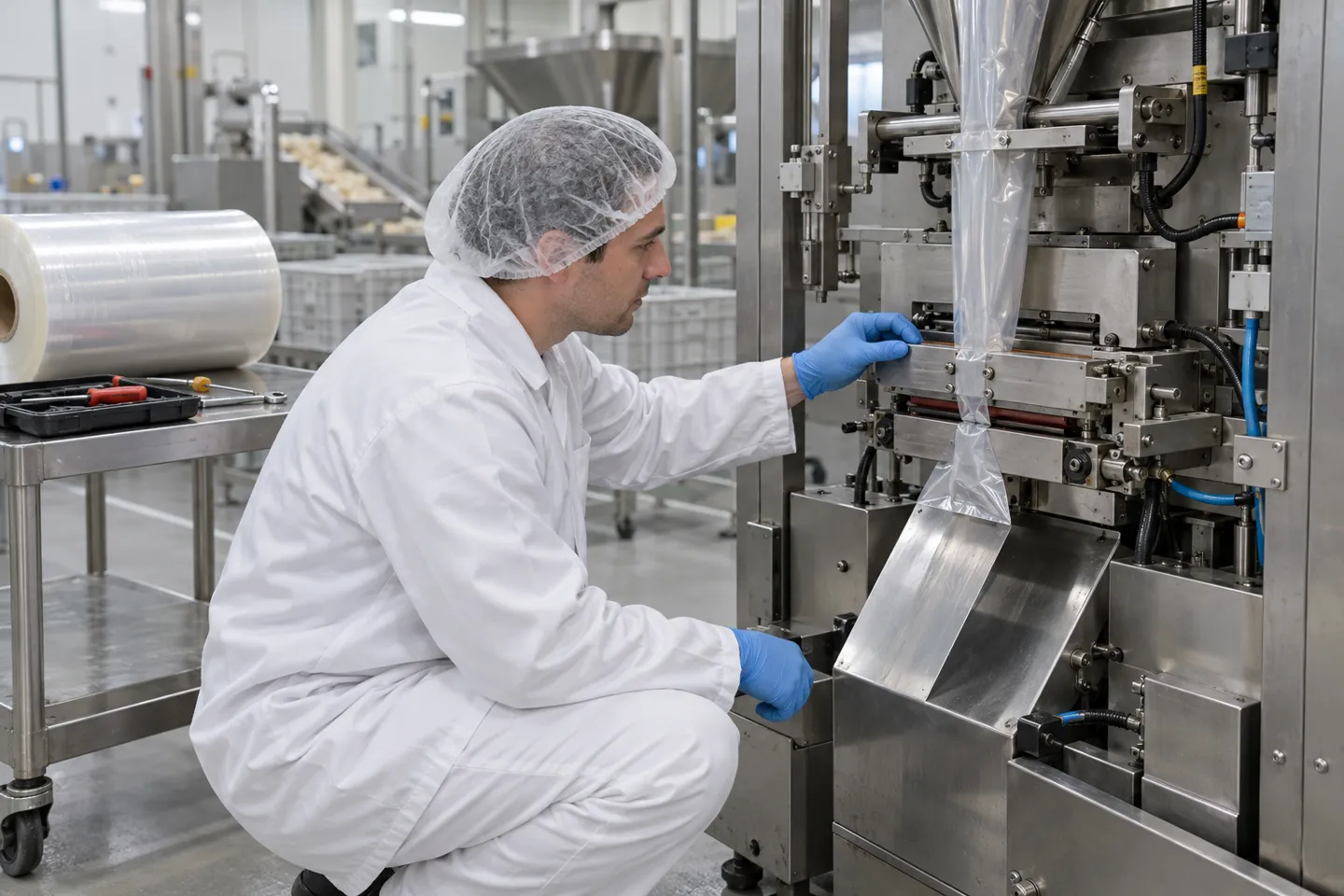
The failure that outlasts all of these is commercial, not mechanical: support withdrawal. Packaging operators running older horizontal wrappers and vertical baggers report that parts for installed fleets dry up once OEMs move on to new models. One operator put it as “OEMs could care less about you if there’s a new model out.” Another described the same hunt for a legacy flow wrapper line, third-party parts and independent technicians alike (Reddit r/PackagingDesign, 2024; Reddit r/IndustrialMaintenance, 2024). Even supported fleets feel supply shocks: operators noted the slowdown when storm damage hit a major industry supplier (Reddit r/PackagingDesign, 2024).
Lock in writing before signing
- 1Spare parts availability window after this model is discontinued.
- 2Standard-parts commonality and price list.
- 3Spare dispatch time for standard parts.
- 4Remote diagnostics, software and parameter backup, and troubleshooting support channel.
- 5Operator training included in delivery.
- 6Warranty length and claim process.
Rereading the Decision as a Business Case
Three facts proven above rewrite the purchase spreadsheet. First, speed is rarely the bottleneck at small-plant volume: an intermittent machine serving 50,000 monthly bags runs about an hour a day. Second, precision and freshness protect margin, because weighing giveaway is a daily tax and oxidized product is a returned product. Third, the year-three cost of the line lives in spare parts and response time, not in the purchase price.
That rewrites the buying order for a small food manufacturer. Decide the route by product physics first, and buy speed last. Validate the product semi-automatically if volumes are still unproven. Then buy one intermittent VFFS line with the weigher and gas option sized to the daily rate, and skip the premium for headline bags-per-minute. Put the support terms into the contract while the supplier is still competing for the order. Name the parts window, the dispatch commitment, and the training. Distributors can run the same rule across a portfolio. Vertical lines cover the loose-product aisle and flow wraps cover the solid one. The durable margin sits with whoever can promise parts and support across both.
Three contract terms worth more than a discount
- 1Spare parts availability years after discontinuation, stated in writing.
- 2Standard parts dispatch time, in days.
- 3Commissioning, operator training, and remote diagnostics included.
That buying sequence is how we approached the SANEU VFFS lineup: entry intermittent machines sized for first lines, plus continuous and vacuum models for coffee and heavier volumes. A custom workshop goes from requirement to design sketch to a sample run before any build starts. Every unit carries the support terms this article argues for: a 2-year warranty from receipt, free replacement of standard spare parts dispatched within one working day, and lifetime technical support by video, phone, or email.
If your route is settled, send SANEU your product details and bag specs, and a free quote comes back within 24 hours.
Ready to Size Your VFFS Line?
Send your product details and bag specs: SANEU replies with a free quote within 24 hours, backed by a 2-year warranty and spare parts dispatched within one working day.
Request Your Free QuoteReferences
- Reddit r/manufacturing. “Reputable source for used or at least economical food manufacturing equipment (North America)?” 2026. https://www.reddit.com/r/manufacturing/comments/1von10p/reputable_source_for_used_or_at_least_economical/
- Reddit r/IndiaBusiness. “Confused about packaging setup for nuts/trail mix (India).” 2026. https://www.reddit.com/r/IndiaBusiness/comments/1rjy1pn/confused_about_packaging_setup_for_nutstrail_mix/
- Reddit r/AskEngineers. “(Novice) making your own VFFS packaging machine for small parts.” 2024. https://www.reddit.com/r/AskEngineers/comments/1dbl79r/novice_making_your_own_vffs_packaging_machine_for/
- Reddit r/PackagingDesign. “HFFS & VFFS.” 2024. https://www.reddit.com/r/PackagingDesign/comments/1fuqloe/hffs_vffs/
- Reddit r/IndustrialMaintenance. “HELP HFFS + VFFS parts.” 2024. https://www.reddit.com/r/IndustrialMaintenance/comments/1fg40z3/help_hffs_vffs_parts/


 English
 Spanish
 Arabic
 Russian