
What a Stick Packaging Machine Is and How It Runs
Tear open a stick of instant coffee, an electrolyte mix, or a collagen powder and you are holding the output of a stick packaging machine: a narrow, single-dose sachet sealed along the back and cut at both ends. It is one of the fastest-growing formats in food and supplements, and the machines that make it are more standardized than most first-time buyers expect.
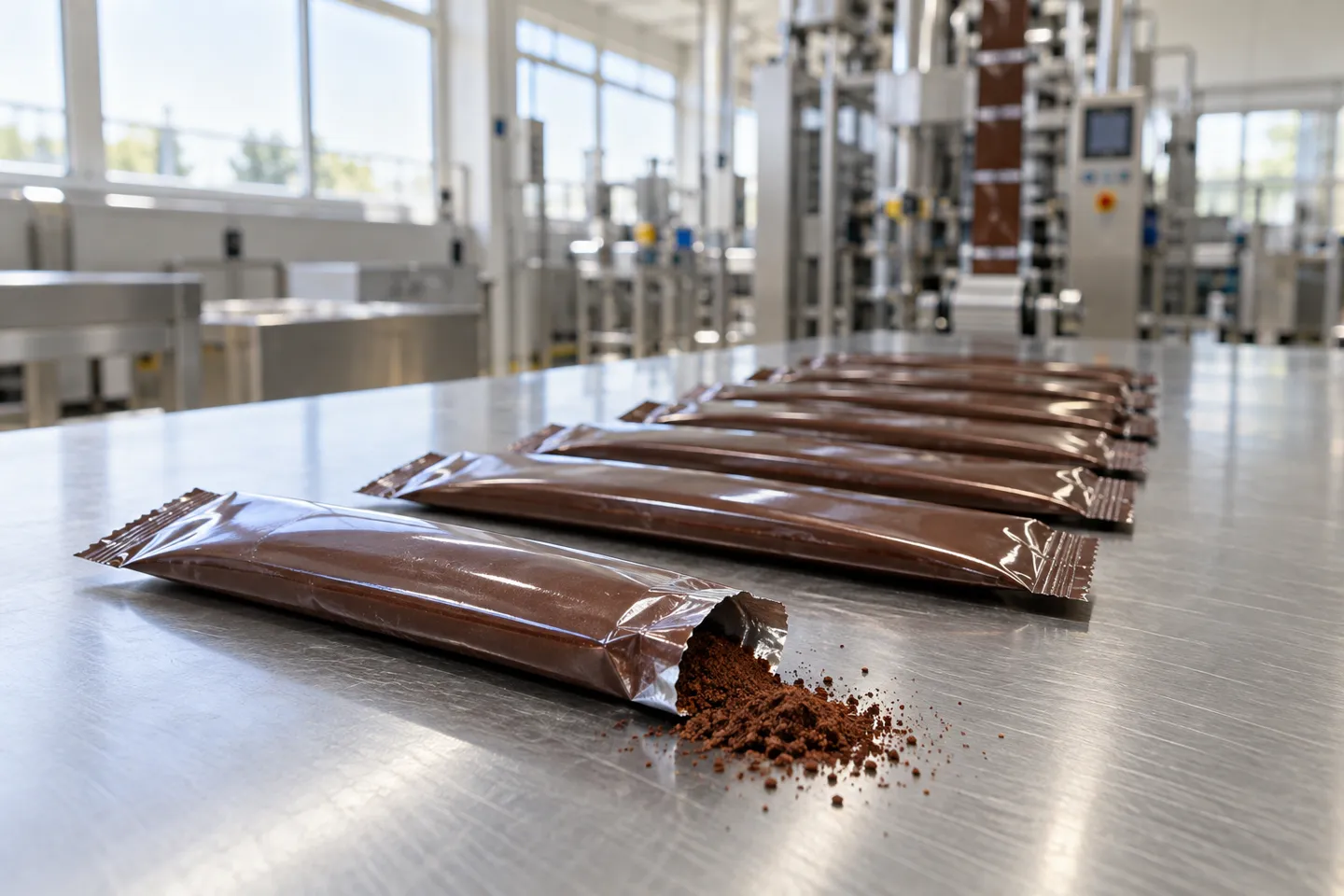
A stick packaging machine (also sold as a stick pack machine) is a vertical form-fill-seal machine that pulls film from a reel, folds it into several narrow tubes running side by side, fills each tube with a measured dose, seals it, and cuts the finished sticks apart. One clarification before the search noise takes over: cheese-stick packaging (string cheese) runs on flow-wrap equipment, and incense-stick counting machines only partly overlap this category. Everything below is about the powder, granule, liquid, and paste sticks used in coffee, supplements, food service, and daily-chemical products.
The process runs in one vertical pass. Film unwinds and is folded into as many tubes as the machine has lanes. Each lane fills in sync, so an eight-lane machine finishes eight sticks per cycle. Sealing jaws close the bottom of one stick and the top of the next at the same time. An eyemark sensor reads the printed registration mark so the cutter lands between sticks instead of through the logo.
From film reel to finished stick
Film unwind and tensioning
Fold and back-seal into parallel lanes
Dosing into each lane (auger, cup, weigher, or pump)
Seal jaws close stick tops and bottoms
Eyemark registration and cut
Finished single-dose sticks discharge to conveyor
The same machine family covers the four material states buyers actually have. Powders dominate: instant coffee, electrolyte and energy mixes, collagen and protein powders, milk powder, spices. Granules follow: sugar, sweetener, seeds, tea. Liquids and pastes fill the rest: honey, liquid sweeteners, ketchup, chili sauce, cosmetic serums. What changes between them is not the machine frame but the dosing system attached to it, which is the single most important specification decision and gets its own section below.
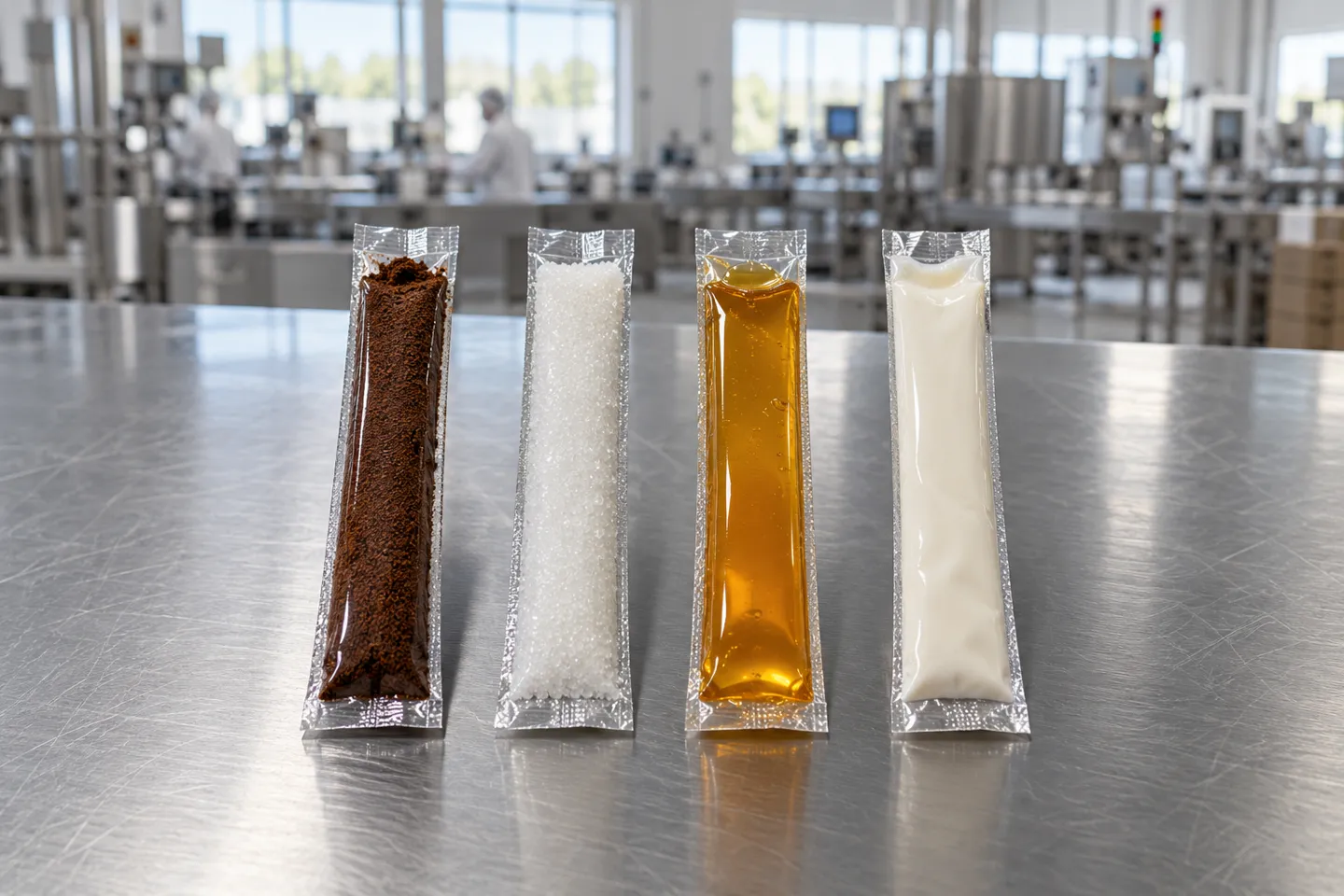
Format-wise, the stick pack trades width for length. Compared to most four-sided sachets, a stick pack uses roughly 30% less film for the same single-serve job, which is why brands converting from sachets watch their film spend drop. The format has real limits, though: sticks hold small doses, they do not stand on a shelf, and they are the wrong answer when your product needs a resealable or large-format pack. Those jobs belong to the broader VFFS family of pillow and gusseted bag machines, a different category that only partly overlaps this one.
That leaves the question every brand eventually hits: what does it actually cost to get sticks made, by hand, through a co-packer, or on your own machine?
Manual, Co-Packer, or Your Own Machine: Where the Cost Crossover Sits
There are three ways to get product into sticks. The right route depends on batch size, labor, quality requirements, and how often the product or artwork changes.
Where Hand Packing Stops
Hand filling can help validate a new product, but it becomes difficult to control as orders grow. Track labor minutes per batch, dose variation, seal rejects, and inspection time. Those measured costs tell you when a co-packer or an automated line is worth quoting.
Why Co-Packer Quotes Jump With Volume
Co-packers often handle several customers and switch between products and formats. PMMI identifies flexibility and fast changeovers as major requirements for contract packaging because runs are frequently short (PMMI, 2025). Setup, cleaning, film scrap, and labor are spread across fewer sticks on a small run. Request quotes at your planned batch sizes and ask each provider to separate setup charges, material, filling, inspection, and storage.
The boundary is therefore about control as well as price. A co-packer controls the schedule and changeover calendar. If delayed launches or minimum orders become material costs, compare ownership using your actual quotes.
What Owning the Machine Really Costs
Owning a line adds more than the machine purchase price: film, dosing equipment, operators, maintenance, rejects, utilities, floor space, and financing all enter the calculation. Compare complete line quotations at the same lane count, product, film, and acceptance conditions.
Three routes to a finished stick pack
| Route | Costs to measure | Practical minimum | What you control | Where it fails |
|---|---|---|---|---|
| Hand packing | Labor, inspection, rejects, and equipment | Set by your labor and quality limits | Formulation and release timing | Output and consistency |
| Co-packer | Quoted unit price, setup, materials, freight, and storage | Supplier-specific MOQ | Product specification and order timing | Minimum orders and available slots |
| Own machine | Capital, film, labor, maintenance, and scrap | Set by changeover economics | Schedule, format changes, and new SKUs | Low utilization raises unit cost |
Calculate the crossover from actual supplier quotes and your expected monthly volume. Divide the total monthly cost of ownership by saleable sticks, including downtime and scrap, then compare it with the landed co-packer cost at the same volume. Repeat the comparison for a slower and a faster demand case before committing capital.
Compare three cost cases
Low
current demand
Base
planned volume
High
growth case
Use the same product, film specification, and saleable-unit definition in every case.
Once the arithmetic says “own the machine,” the next decision is which one, and the spec that sets everything else is lane count.
Lane Count: The Spec That Sets Your Scale
Lane count is the number of sticks a machine finishes per cycle, and it is the spec that determines both the price class of the machine and the volume ceiling of your line. A single-lane machine forms one tube; a multi-lane machine forms several tubes side by side and fills them simultaneously.
Capacity arithmetic follows directly: sticks per minute equals lanes multiplied by cycles per minute. A mid-speed machine cycles each lane 30-45 times per minute, so eight lanes yield roughly 240-360 sticks per minute at spec speed. Ask every vendor which number they are quoting, because the industry mixes units freely: some quote cycles per minute per lane, others quote total sticks per minute across lanes, and a buyer comparing the two without converting overestimates one machine or underestimates the other by a factor of eight.
The market itself sorts into lane segments, each with a distinct economic role:
Lane segments and their economic roles
| Segment | Typical role | Output reality | Where it does not fit |
|---|---|---|---|
| Single lane | R&D batches and pilot runs | under 10 million units per year (Mordor Intelligence, 2026) | production-scale output |
| 1-3 lanes | entry production, first commercial batches | hundreds of sticks per minute | competitive unit costs at volume |
| 4-10 lanes | mainstream production for food, supplements, coffee | 44.47% of 2025 market revenue (Mordor Intelligence, 2026) | niche or R&D work |
| 11-20 lanes | high-volume single-market production | up to 1,600 sticks per minute, 6.37% forecast CAGR through 2031 (Mordor Intelligence, 2026) | products without billion-unit demand |
| Over 20 lanes | commodity sugar and coffee scale | billion-unit volumes amortize capital | anything else |
Four-to-ten lane systems took 44.47% of global stick-pack market revenue in 2025, which makes the middle of the lane ladder the market’s center of gravity, not its edge.
44.47%
of 2025 global stick-pack market revenue sits in 4-10 lane systems
Source: Mordor Intelligence, Stick Packaging Market report, 2026
The middle band can suit growing brands when a multi-lane machine matches their batch size and changeover needs. A six-lane machine at 35 cycles per minute delivers about 210 sticks per minute, roughly 12,600 sticks per hour, which covers a production day for most growing brands several times over.
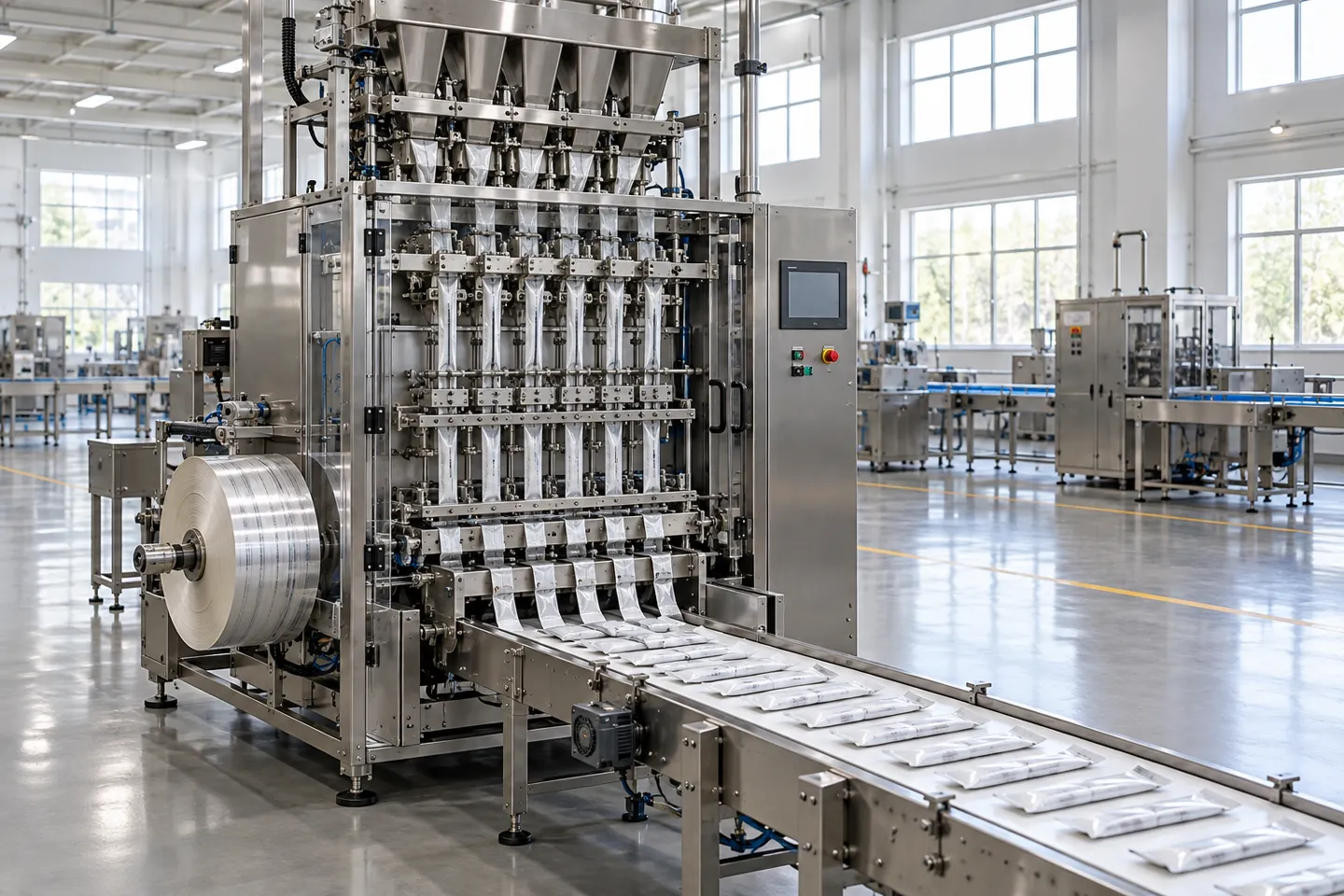
Both ends of the ladder carry warnings. Single-lane equipment serves R&D and volumes under 10 million units per year; buying one as a production machine means outgrowing it within a year or two of real traction. More than 20 lanes stays confined to commodity sugar and coffee, where billion-unit volumes amortize the capital; a supplement or coffee brand buying that class is funding idle capacity (Mordor Intelligence, 2026). The 11-20 lane segment, growing fastest at a 6.37% forecast CAGR, fits brands consolidated around one or two high-volume SKUs.
Lane count sets your scale. What it cannot tell you is whether the machine can run your product at all, and that is where most purchasing mistakes actually happen.
Send Saneu your target volume and film spec, and our engineers will size the lane count for your batch and run a free sample test on your product before you see a quote.
Get a Lane-Count RecommendationMatching Specs to Your Product, and Where Setups Fail
Two machines with identical lane counts can behave completely differently on your product, because the frame is only half the machine. The other half is the dosing system, the film handling, and the sealing architecture, and each one fails in characteristic ways that show up after installation, not in the quote.
Match the Dosing System to Your Material
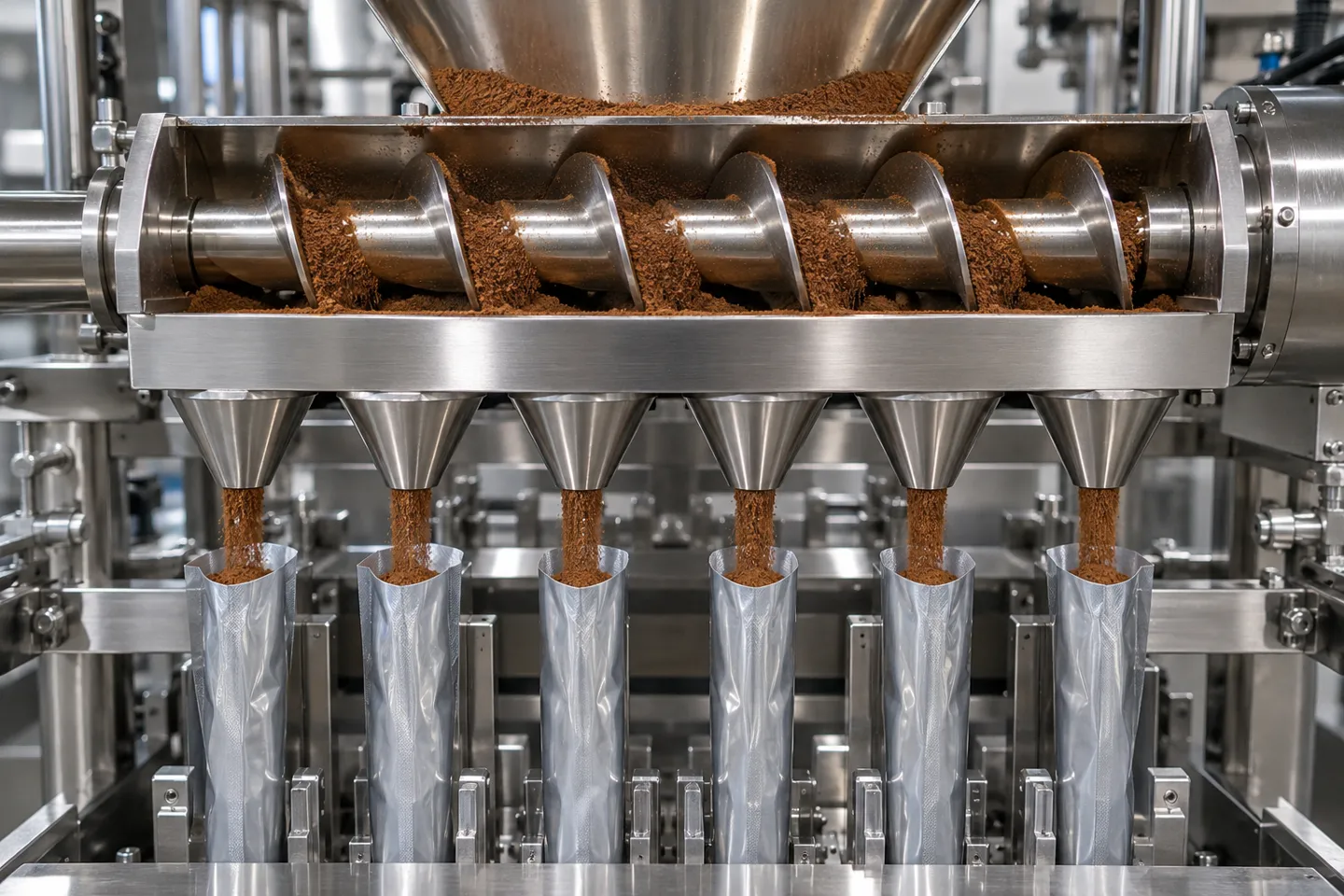
Powders run on servo-driven auger fillers, which meter by screw rotation and hold accuracy across long runs when the servo, rather than a clutched motor, drives the screw. Granules run on volumetric cups or multi-head weighers: cups for free-flowing products like sugar and salt, weighers for mixed or fragile granules where single-dose weight accuracy matters commercially. Liquids and pastes run on pumps, and the pump choice is a viscosity decision: peristaltic pumps for thin liquids that must stay sanitary, piston pumps for thicker sauces and honey, ceramic pumps where abrasiveness or chemical compatibility rules out metal contact.
The same machine family accepts all of these dosing units, which turns dosing from a one-time choice into a capability: a line bought for coffee powder can take a pump unit later when you launch a honey stick. Confirm with each vendor that the dosing swap is a documented changeover on their frame, not a custom engineering project.
Film Width, Sachet Geometry, and Cutting Options
Film width defines which machine frame fits your stick. Production frames sort into classes by maximum film width: 520 mm, 720 mm, 820 mm, 960 mm, and 1,200 mm, and the class caps both the number of lanes and the sachet width. Finished sticks run 45-180 mm long and 17-120 mm wide across the market, with the narrow frames producing sticks 17-55 mm wide, mid frames up to 80 mm, and the 1,200 mm class up to 120 mm. Film thickness between 0.06 and 0.10 mm covers most single-serve laminates; outside that band, sealing and transport behavior changes enough to require a different machine conversation.
Cutting and tearing options matter more to brand owners than they expect. Blades cut sticks straight, zig-zag, rounded, or in continuous linked strips, and a tear notch requires machine support that not every configuration includes, so buyers who need notch-tearing must confirm it at order time rather than discover its absence at installation.
SANEU’s SN-series stick pack machines cover this spread in one line: film widths from 520 to 1,200 mm, four to ten lanes as standard, twelve on the wider 820 and 1200 frames. Dosing comes matched to the material, with servo auger, volumetric cup, weigher, or pump units, plus independent temperature zones and eyemark auto-correction. We publish each model’s sachet width band, film thickness range, and lane count on its spec sheet, so you can rule a frame in or out against your own film before asking for a quote.
Failure Modes and the Acceptance Checks That Catch Them
Every configuration above fails in a known way, and each failure has an acceptance check that catches it before it becomes a production week of scrap. The matrix below is the working core of this section:
Configuration, failure mode, and acceptance check
| Where it happens | Configuration involved | Typical failure | Acceptance check before sign-off |
|---|---|---|---|
| Powder filling | servo auger | dose drift over long runs as product compacts | weigh samples at start, middle, and end of a shift against target fill weight |
| Liquid and paste filling | peristaltic, piston, or ceramic pump | dripping after cutoff, product sticking to tube walls | run first and last fills of a batch and inspect nozzles and tube interiors |
| Sealing | independent temperature zones | one zone below setpoint producing leakers or wrinkled seals | verify each zone holds its setpoint at running speed, then pressure-test finished sticks |
| Film transport | servo film pull with eyemark sensor | print registration drift after a film splice | trigger a splice during test runs and watch auto-correction recover within a few sticks |
| Cutting and tearing | straight, zig-zag, round, or linked cuts with tear notch | cut lands through print or notch missing on one edge | check cut position across a full print repeat length |
| Film material | laminated PE, PP, PET, or compostable mono-material | compostable films seal in a narrower window and jam more easily | trial-seal with your actual production film, not a supplier substitute |
Two selection failures hide in this table and deserve explicit flags. Film thickness outside the 0.06-0.10 mm band and stick widths beyond a frame’s class are selection errors, not tuning problems: no amount of commissioning fixes a frame that was too narrow for your film. And compostable or mono-material films, increasingly required by retailers, seal in a narrower temperature window than laminates, which makes the trial-seal-on-your-own-film check the single most important pre-order test. Run these checks against any supplier’s quotation:
Pre-quote checklist:
- 1Confirm your film spec (width, thickness, structure) against the model sheet.
- 2Name the dosing unit for your material and ask who swaps it and how long it takes.
- 3Confirm tear notch and cut style are in the build, not an option.
- 4Require a trial seal on your own film.
- 5Ask how each temperature zone is verified at running speed.
A supplier who answers those five items with specifics is worth a second conversation. Comparing those answers across suppliers is the next step.
How to Compare Stick Pack Machine Suppliers
Two suppliers can quote the same lane count and sachet range thousands of dollars apart, and the gap usually means the machines differ in ways the quote line does not show. Compare configuration before comparing totals, because the total price of a machine with lower-tier electricals and thinner contact materials is not comparable to anything.
Start with the configuration tier. First-line electrical components (the Siemens, Schneider, Mitsubishi, Omron, and SMC class) cost more than generic equivalents and outlast them in humid, washdown environments. Contact surfaces in 304 stainless steel resist the acids and salts in coffee, supplements, and sauces. Independent temperature control per sealing zone keeps marginal films sealable. Servo film pull with eyemark correction keeps print registration stable at speed. Ask each supplier to name the actual brands and grades in their build, not just “high-quality components.”
Then compare the after-sales structure, because that is where low bids recover their margin. Warranty length matters, and so does its start date: measured from receipt, not shipment. Spare-parts response divides suppliers sharply: whether standard parts dispatch within days or weeks determines whether a failed sealer costs you a shift or a season. Remote video diagnosis, preventive maintenance plans, and on-site commissioning all have versions worth comparing line by line, including who pays travel.
Delivery and compliance come third: production lead times for your model class, whether any models ship from stock, and whether certifications (CE, RoHS, ISO, CSA, an FDA approval report) cover your destination market. A supplier confident in their machine will test your actual product and film before you pay anything; treat a refusal to run a free sample test as data.
Supplier comparison checklist:
- 1Named brands of PLC, servo, and pneumatic components.
- 2Contact material grade on all product-contact parts.
- 3Temperature control structure per zone.
- 4Warranty length and its start date.
- 5Spare-parts dispatch time and cost terms.
- 6Remote diagnosis and support channels in your time zone.
- 7On-site support terms, including travel costs.
- 8Lead time, stock availability, and destination-market certifications.
- 9Free sample testing with your product and film.
One boundary applies to the whole comparison: support and travel clauses vary by destination country and distributor network, so every line in the checklist needs a written answer in the contract, not a verbal one at the trade show. Run the checklist and you will have two or three suppliers left standing; the last question is where to put the budget among them.
The Business Case: Where to Put Your Budget
Everything above reduces to one allocation decision: which lane class deserves the capital, and how much flexibility to pay for at the frame level.
Why the Middle Lane Band Is the Return Peak
The cost comparison above leads to a practical investment rule: utilization depends on batch size, changeover time, and saleable output as well as rated speed. The market’s revenue concentrates in 4-10 lane systems, which is where the batch sizes of most real food and supplement producers live. And the growth is uneven across materials: overall stick-pack demand is forecast to grow at 5.54% annually through 2031, with liquid stick packs at 6.29% and nutraceutical powders at 6.41% (Mordor Intelligence, 2026). A machine dedicated to one material misses the faster half of its own market.
The allocation follows: concentrate the budget on a mid lane count (four to twelve lanes depending on frame) with a swappable dosing system. Do not save money down at single-lane: a brand that grows into mid volume buys the same machine twice. Do not overspend up at twenty-plus lanes: outside commodity sugar and coffee, that capital idles almost certainly. The middle band, bought once with flexibility built in, is where the return peaks.
Three Acceptance Anchors, and What a Supplier Answer Looks Like
Size the lane count against your 24-month target volume, not this quarter’s, and anchor the whole purchase decision on three acceptance points: changeover time between products, dosing accuracy across a full shift, and seal temperature control per zone. A supplier’s answers to those three, in numbers rather than adjectives, tell you more than any brochure.
Those three anchors are where we focus our own answers. Send us your product and film and we run a free sample test before quoting, with the quote itself inside 24 hours. Production runs 10-60 days depending on model, 35-45 days for large automated lines, and some standard models ship from stock. Our machines carry a 2-year warranty from receipt, and standard spare parts ship within 1 working day of a request under our spare-parts and remote support terms. Support, including remote video diagnosis within 24 hours, stays with the machine for life. If your volume genuinely belongs in the commodity band, we will tell you that a mid-band line is not the right purchase for you.
The boundary applies to the advice itself, so state it plainly: high-volume commodity producers may justify high-lane lines when sustained demand makes speed the priority. Brands below their measured co-packer crossover can reassess ownership when volume or scheduling needs change. The middle-band investment logic is for everyone else.
Before signing:
- 1Lane count sized to 24-month target volume.
- 2Changeover time between your products, in hours, in writing.
- 3Dosing accuracy demonstrated on your product across a full test shift.
- 4Seal temperature verified per zone at running speed.
- 5Warranty, spare-parts dispatch, and support channels written into the contract.
Match the lane count to your 24-month volume, make the supplier prove changeover, dosing, and seal control on your own product, and the stick pack line stops being a leap of faith.
Turn Your Stick-Pack Budget Into a Matched Line
Bring your product and film spec: the quote that comes back is sized to your 24-month volume, proven on a sample run, and backed in writing.
Request a Free Sample TestReferences
- PMMI. “The Evolution of Contract Packaging.” 2025. https://www.pmmi.org/podcast/the-evolution-of-contract-packaging-report-insights-with-jorge-izquierdo
- Mordor Intelligence. “Stick Packaging Market Size & Share Analysis, Growth Trends & Forecasts (2026-2031).” 2026. https://www.mordorintelligence.com/industry-reports/stick-packaging-market



 English
 Spanish
 Arabic
 Russian