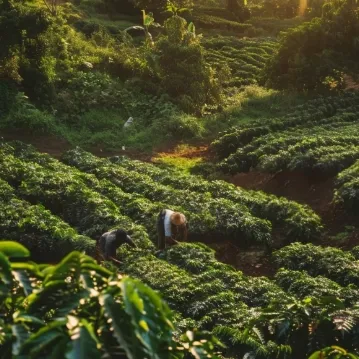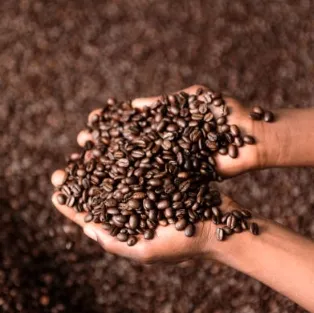
The convenience of popping a capsule into your machine and having a steaming cup in under a minute has revolutionized morning routines across America. Yet a silent frustration echoes in kitchens and office breakrooms everywhere: why does the resulting brew so often taste watery, flat, and uninspired?
Most K-Cup ranking articles will not tell you the real answer. The difference between a great K-Cup and a disappointing one is not about brand reputation or clever marketing. It is about manufacturing precision — specifically, how much coffee is actually inside that tiny plastic cup and how well the factory protected it from oxygen before it reached your pantry.
This guide takes you behind the retail shelf and into the production floor, equipping you with the same quality-control lens a packaging engineer would use. By the time you finish reading, you will never look at a box of K-Cups the same way again.
Why Most K-Cups Taste Disappointingly Weak
Before you can identify a great K-Cup, you need to understand why so many fall short. The disappointment in your mug is rarely your machine's fault. It traces back to two specific manufacturing decisions made long before the box landed on a supermarket shelf — and neither of them involves the coffee bean itself.
The Real Reason Your Coffee Is Watery: Underfilling
Keurig brewers operate on a rapid drip-brew mechanism. Hot water is injected through a needle, passes through the coffee grounds, and exits into your cup — all in roughly 20 to 30 seconds. In this extremely short contact time, the layer of coffee grounds inside the capsule acts as a resistance barrier. If that layer is too thin or loosely packed, the water rushes straight through without extracting the essential oils, sugars, and aromatic compounds that give coffee its body and character.
This is where manufacturing economics collides with your morning routine. Many generic and budget-brand capsules are produced on older, less precise co-packing equipment. These machines struggle to fill the maximum amount of coffee into the small cup without spilling grounds onto the sealing rim. When grounds contaminate the rim, the foil lid cannot form a proper seal, and the entire capsule fails quality control. To prevent this, manufacturers deliberately underfill — sacrificing your coffee experience for production yield.
The measurable consequence is stark. When coffee laboratories measure Total Dissolved Solids — the industry-standard metric for extraction quality — budget capsules routinely yield less than 1.0% TDS. For reference, the Specialty Coffee Association's Golden Cup Standard specifies an ideal range of 1.15% to 1.35% TDS, corresponding to a brew ratio of roughly 55 grams of coffee per liter of water, or approximately 1:18 (SCA Coffee Standards). A capsule falling below 1.0% is producing what is functionally hot water with a coffee-colored tint.
Brewing with a half-empty tea bag. You would never expect that to produce a satisfying cup. The physics inside a K-Cup are no different.
When the Seal Fails: How Oxygen Kills Flavor Before You Even Brew
Even when a capsule contains enough coffee, there is a second failure point most consumers never consider: the seal. Coffee is extraordinarily vulnerable to oxidation. Once roasted and ground, its delicate aromatic compounds — hundreds of distinct volatile molecules — begin reacting with oxygen in the air.
Research on single-serve capsule freshness, including studies led by Prof. Dr. Chahan Yeretzian at the Coffee Excellence Center of Zurich University of Applied Sciences, has demonstrated that the rate of aroma loss is directly tied to packaging integrity. A properly sealed capsule flushed with inert nitrogen gas can preserve coffee freshness for 12 to 18 months. A capsule with a compromised seal begins losing aromatic complexity within days (Yeretzian et al., "Freshness Indices of Roasted Coffee," Chimia, 2014).
Pick up a K-Cup from your pantry right now and look at the foil lid. Is it slightly puffed upward, with a gentle dome shape? That puffiness is nitrogen gas — a deliberate injection of inert gas that displaces oxygen before the lid is sealed. A puffed lid means the seal is intact. A flat or sunken lid suggests the gas has escaped, and oxygen has already begun its destructive work on the coffee inside.
The 11-Gram Rule: The Only Number You Need to Judge K-Cup Quality
If you take away only one tool from this guide, make it this: the 11-gram rule. It requires no tasting skill, no brand loyalty, and no expensive equipment. All you need is elementary arithmetic.
How to Calculate True Fill Weight (And Why Most Brands Hope You Won't)
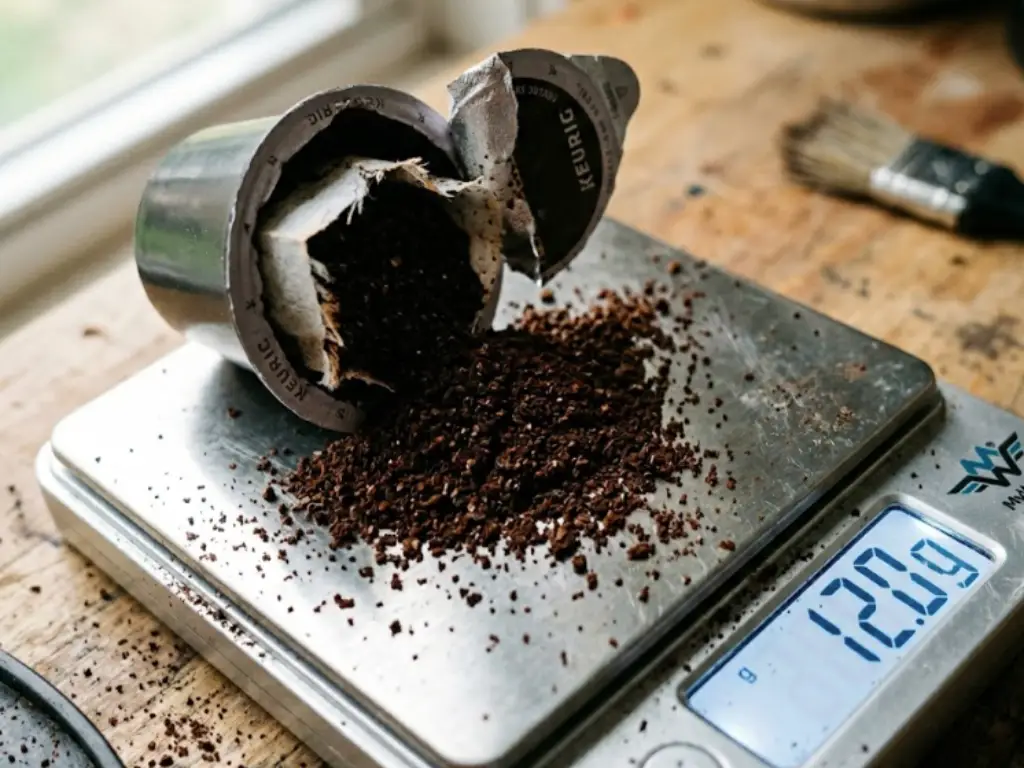
Flip any box of K-Cups over and find the net weight — the total mass of coffee inside the entire package, usually printed in grams or ounces. Divide that number by the number of capsules in the box. The result is the true fill weight per capsule.
That single number predicts more about your brewing experience than every flavor adjective on the front of the box combined.
Eleven grams is the threshold because the Specialty Coffee Association's brew ratio guidelines translate to roughly 11 to 12 grams of coffee for a standard 8-ounce Keurig brew cycle to fall within the Golden Cup range. At 10 grams, you are already on the edge. At 8 or 9 grams — common among budget supermarket pods — you are brewing at a ratio of approximately 1:28, nearly twice as dilute as the Golden Cup standard. No amount of dark roasting or "extra bold" labeling can compensate for that much missing coffee.
| Evaluation Metric | Budget Supermarket Pods | Premium Quality Pods |
|---|---|---|
| Fill Weight per Cup | 8–9 grams | 11–12+ grams |
| Brew Ratio (8 oz cup) | ~1:28 (far below standard) | ~1:17 (within Golden Cup range) |
| Roast Optimization | Generic bulk roasting | Profiled for short-contact extraction |
| Cup Result | Watery, thin body, weak aroma | Rich, full-bodied, satisfying |
Budget K-Cups carry a cruel irony: they are often more expensive per satisfying cup. A box of 8-gram capsules might cost $0.40 per pod on the shelf, but if you need to brew two of them to get a decent mug of coffee, your real cost is $0.80 — more than a premium 12-gram capsule at $0.65 that delivers a proper brew in one shot.
What 8 Grams vs 12 Grams Actually Tastes Like
Numbers on a page are one thing. The sensory difference is another entirely.
An 8-gram capsule brewed with 8 ounces of water produces a cup that looks thin in the carafe — translucent at the edges, with a weak brown tint rather than deep black. On the palate, it registers as vaguely coffee-flavored water: a hint of roast up front that vanishes almost immediately, leaving no body, no finish, and certainly no satisfaction. You finish the mug and wonder why you bothered.
A 12-gram capsule under the same conditions yields a cup with genuine presence. The crema — that thin layer of foam on top of a freshly brewed cup — is noticeably richer. The aroma fills the space around the machine. On the tongue, there is weight and structure: the coffee coats the palate briefly, delivers distinct roast character, and leaves a clean, pleasant finish. It tastes like coffee, not like a suggestion of coffee.
If you have ever wondered why the same Keurig machine produces wildly different results depending on which pod you use, this is why. The machine is constant. The fill weight is not.
Nitrogen Flushing and Seal Integrity: The Factory Secrets Behind Fresh K-Cups
Fill weight determines how much coffee flavor you get. But a second variable, equally important, determines whether the coffee inside the capsule still has any flavor left to give. That variable lives inside the factory, on the production line, in a process most coffee drinkers have never heard of.
How Precision Nitrogen Flushing Preserves Coffee Aroma
After a capsule is filled with ground coffee but before the foil lid is sealed, the machine injects a burst of pure nitrogen gas into the headspace. Nitrogen is inert — it does not react with coffee compounds — which makes it the perfect shield. By displacing oxygen from the sealed capsule, nitrogen flushing stops oxidation in its tracks.
The critical number is purity. Standard commercial nitrogen flushing on mid-range packaging equipment achieves roughly 99.5% purity, leaving about 0.5% residual oxygen inside the capsule. That sounds impressive until you consider what the remaining 0.5% oxygen can do over months on a warehouse or supermarket shelf. Even trace oxygen gradually degrades the volatile aromatics that distinguish a freshly roasted Ethiopian single-origin from stale brown powder.
Higher-precision filling and sealing equipment can push nitrogen purity to 99.9%, reducing residual oxygen to approximately 0.1%. These systems, built on servo-driven controls from component manufacturers like Siemens and Schneider, achieve the kind of gas-exchange precision that mid-range machines cannot match. The difference in shelf-life stability between a 99.5% and a 99.9% nitrogen flush is not marginal. It is the gap between a capsule that tastes vibrant at month 10 and one that already tastes flat.
The Puff Test and Other Ways to Check Freshness at Home
You do not need a gas chromatograph to evaluate K-Cup freshness. Three simple checks will tell you more than any marketing copy:
1. The Puff Test. Gently press the center of the foil lid with your thumb. A slight dome-shaped puffiness — a cushion of pressurized nitrogen — means the seal is intact and the gas barrier is working. A flat or indented lid means gas has escaped. Do not confuse this with bloating from spoilage; nitrogen-flushed capsules are supposed to be puffy. Flat lids are the warning sign.
2. The Aroma Burst. When you peel open a fresh capsule, bring it close to your nose immediately. A properly sealed, nitrogen-flushed capsule should release a distinct wave of coffee aroma — rich, complex, clearly identifiable as coffee. If you smell cardboard, stale grain, or nothing at all, oxidation has already done its damage.
3. The Date Check. Look for a production date, not just a "best by" date. Nitrogen-sealed capsules in high-barrier packaging (such as EVOH multi-layer films with oxygen transmission rates below 0.5 cc/m²/day) can maintain quality for 12 to 18 months from production. After opening a box, aim to consume the capsules within 7 to 10 days, as exposure to ambient air accelerates staling even in individually sealed pods.
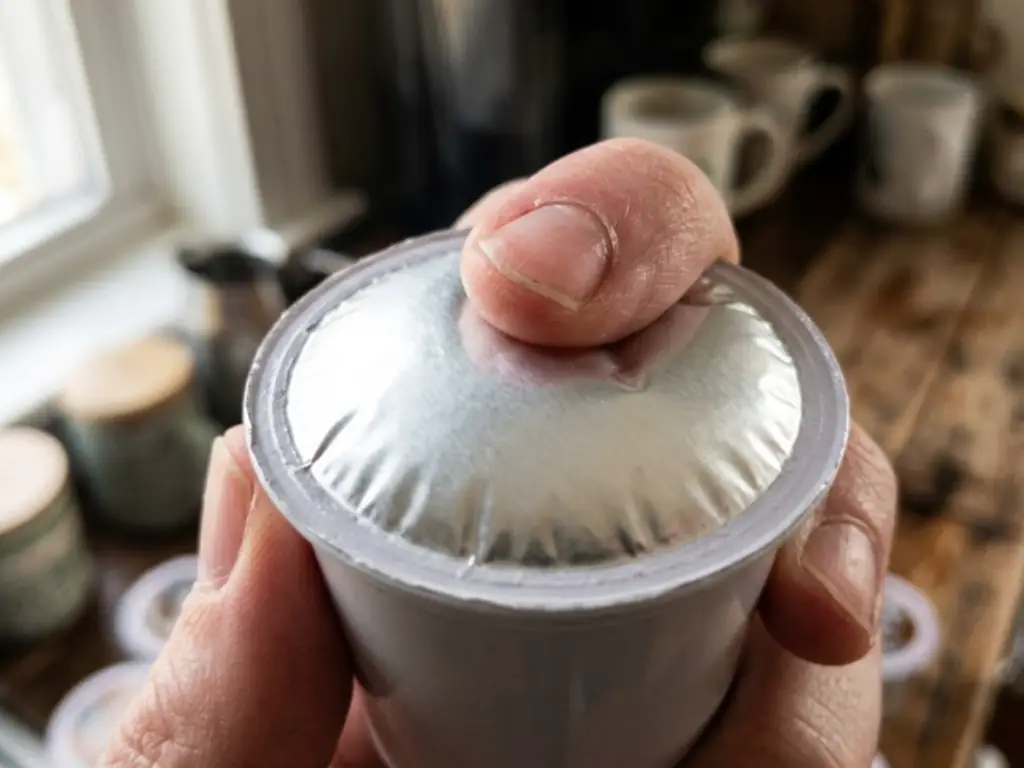
The puff is good news. It is not a defect — it is the manufacturer's quality commitment, physically visible on every capsule. A puffy lid is quietly telling you: "The coffee inside me is still alive."
Plastic, Aluminum, or Compostable: Does Pod Material Change the Taste?
The material of the pod body itself plays a supporting role in the freshness equation, though it often gets more consumer attention than the seal quality that matters far more. Each material has distinct trade-offs worth understanding.
- Aluminum = best freshness
- Plastic = good enough, recycle properly
- Compostable = check local facilities
| Material Type | Oxygen Barrier Quality | Taste Impact | Environmental Profile | Common Examples |
|---|---|---|---|---|
| #5 Polypropylene Plastic | Moderate (OTR ~100–200 cc/m²/day) | No taste impact but microplastic concerns for some consumers | Recyclable only if cleaned and separated — rarely happens in practice | Most mainstream supermarket brands |
| Aluminum | Excellent — near-zero oxygen transmission | No taste impact — chemically inert | Recyclable but energy-intensive to produce | Nespresso original capsules, some premium third-party pods |
| Plant-Based / Compostable (PLA + fiber) | Lower — relies on additional barrier coatings | No taste impact — plant-derived materials are neutral | Requires industrial composting facilities (58°C + humidity) | Emerging eco-conscious brands, specialty roasters |
Aluminum is the gold standard for oxygen protection — it is effectively impermeable. Plastic (typically #5 polypropylene) works well enough for coffee consumed within a few months of production but allows gradual oxygen ingress over extended storage. Compostable plant-based materials represent an important environmental innovation, but they currently require industrial composting infrastructure to break down properly; tossing them in backyard compost will not do the job.
The practical takeaway: if you prioritize absolute freshness above all else and plan to store capsules for extended periods, aluminum-bodied pods offer the best protection. If you go through your K-Cups quickly and prioritize recyclability, plastic is perfectly adequate. If environmental impact is your primary concern, look for capsules with certified industrial compostability — and verify that your local waste management system can process them.
Your 30-Second K-Cup Quality Checklist
You now have a manufacturing engineer's lens for evaluating K-Cup quality. Here is how to compress everything into a decision you can make in the coffee aisle in half a minute:
Step 1 — Do the math. Flip the box. Net weight ÷ capsule count. Below 10 grams? Put it back. No exceptions.
Step 2 — Check the lid. Press the foil. Puffy and domed? Good — nitrogen is on the job. Flat or indented? The clock has been ticking on this coffee since before you picked it up.
Step 3 — Note the material. Aluminum = best shelf life. Plastic = good enough if consumed quickly. Compostable = check for industrial certification and your local facility's capability.
Step 4 — Calculate the real cost. Total price ÷ number of capsules = cost per cup. If a "cheap" box actually needs two pods per satisfying mug, it is not cheap. An honest 12-gram capsule at $0.65 beats a deceptive 8-gram one at $0.40 every single time.
These four checks, performed in order, will steer you toward K-Cups that deliver what the box promises — and away from the ones that rely on your not knowing the difference.
If you happen to be on the other side of this equation — a coffee roaster, a co-packer, or an entrepreneur considering launching your own K-Cup brand — every quality variable discussed above converges on a single decision: the filling and sealing equipment you choose. Fill-weight precision (±0.1 gram), nitrogen-flush purity (up to 99.9%), and material compatibility (plastic, aluminum, and compostable alike) are not things a brand achieves through aspiration. They are things a machine either delivers or does not. Companies like Saneu, which has spent over 12 years building K-Cup filling and sealing equipment with servo-driven Siemens and Schneider controls and food-grade 304 stainless steel construction, understand that the difference between a forgettable capsule and a remarkable one is engineered, not marketed.
Great K-Cups do not happen by accident. They happen because someone on the production floor cared about the numbers that matter — and had equipment precise enough to honor that care.
References
- Specialty Coffee Association. "SCA Coffee Standards — Golden Cup Standard." https://sca.coffee/research/coffee-standards
- Yeretzian, C. et al. "Freshness Indices of Roasted Coffee: Monitoring the Loss of Freshness for Single Serve Capsules and Roasted Whole Beans in Different Packaging." Chimia, vol. 68, 2014. https://pubmed.ncbi.nlm.nih.gov/24801853/
- MTPak Coffee. "Roasted Coffee Packaging Research: How It Affects Freshness — Interview with Prof. Chahan Yeretzian." 2021. https://mtpak.coffee/2021/10/packaging-research-journal-chahan-yeretzian/
- Saneu. "K-Cup Filling Machines 2026." https://www.saneu.com/coffee-capsule-filling/k-cup-filling-machines/
- Saneu Homepage. https://www.saneu.com