Your coffee is only as good as the package that protects it. You've spent years perfecting your roast profile, building relationships with growers, dialing in your flavor notes. But the moment that coffee leaves your roastery, everything depends on one machine: your packaging line.
Choose right, and every bag or capsule that ships carries your reputation intact — fresh, aromatic, and precisely portioned. Choose wrong, and you're fielding customer complaints about stale coffee, inconsistent weights, and leaking seals while your production line sits idle waiting for a technician who's two continents away.
This is a decision worth getting right the first time. And that's exactly what this guide is designed to help you do.
01 Why Most First-Time Buyers Focus on the Wrong Things
Walk into any packaging trade show and you'll be bombarded with numbers: packs per minute, kilowatt ratings, price tags. Those numbers matter — but here's what nobody tells you:
The real cost of a packaging machine isn't on the invoice. It's the two weeks of lost production when a generic controller board fails and the replacement takes three weeks to ship. It's the 500 bags you throw out because the fill accuracy drifted and your label weights don't match. It's the slow, daily friction of a machine that was designed for "general powders" — not for coffee, which off-gasses CO₂, leaves oil residue, and changes density with every grind adjustment.
The manufacturers who get this right share the three traits above. This guide evaluates every manufacturer against these criteria. No marketing fluff. Just what matters when your production depends on it.
02 Coffee Packaging Machine Types: Match Your Product to the Right Equipment
Before comparing manufacturers, you need to know which machine category fits your product. The four main types serve fundamentally different packaging formats — and buying the wrong type is an expensive mistake.
Coffee Capsule / Pod Filling & Sealing Machines
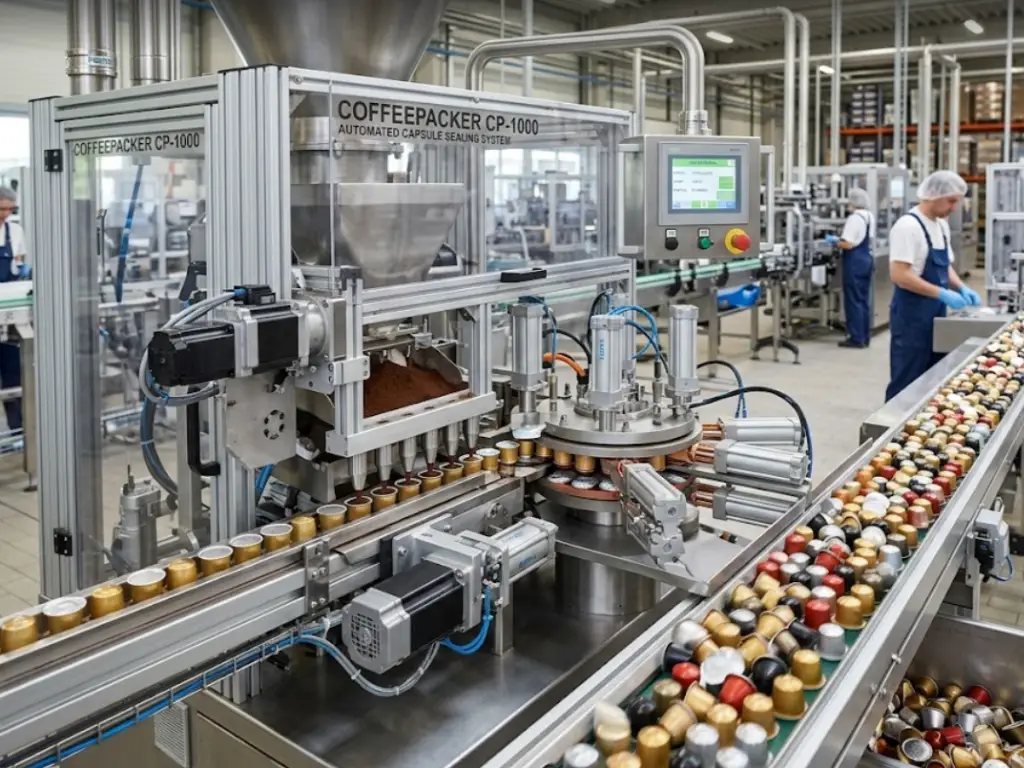
These are the machines behind every K-Cup, Nespresso, and Dolce Gusto capsule on store shelves. A complete capsule line handles: capsule dispensing → precision filling → sealing → nitrogen injection → ejection — all in one automated sequence.
The numbers that actually matter: Fill accuracy of ±0.1g (at 60 capsules/minute, a 0.3g drift wastes 8.6kg per shift). Nitrogen purity — 99.5% gets ~6 months shelf life; 99.9% gets 12–18 months. Format flexibility — can the same machine run K-Cup for the US and Nespresso for Europe?
Vertical Form Fill Seal (VFFS) Machines
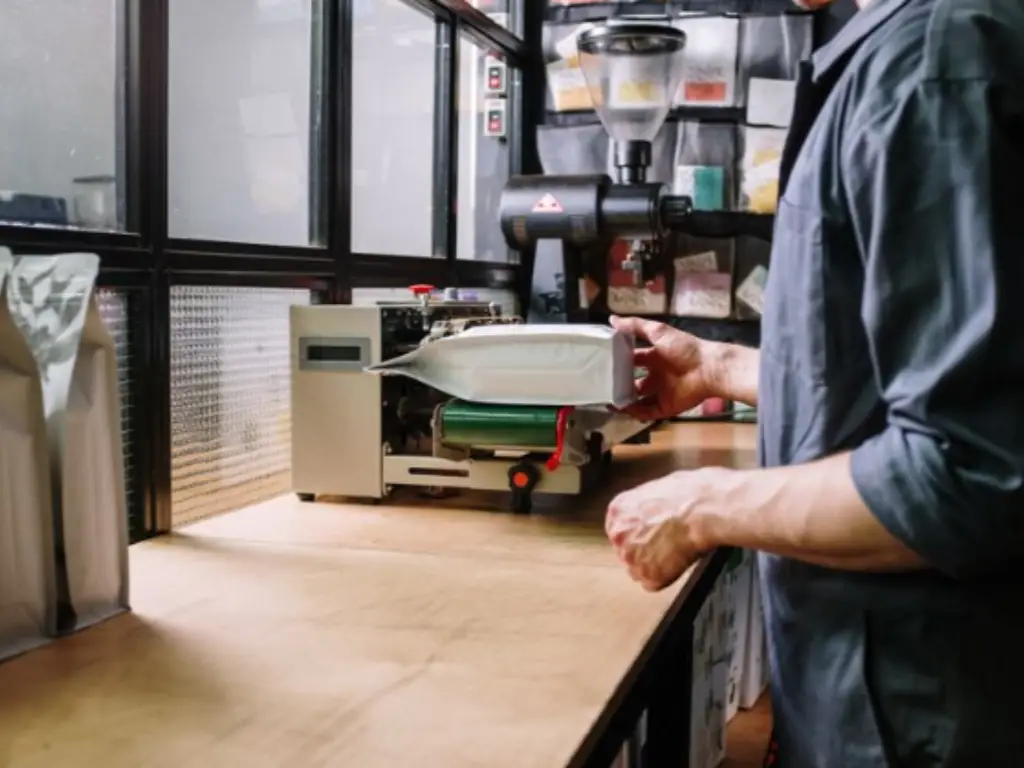
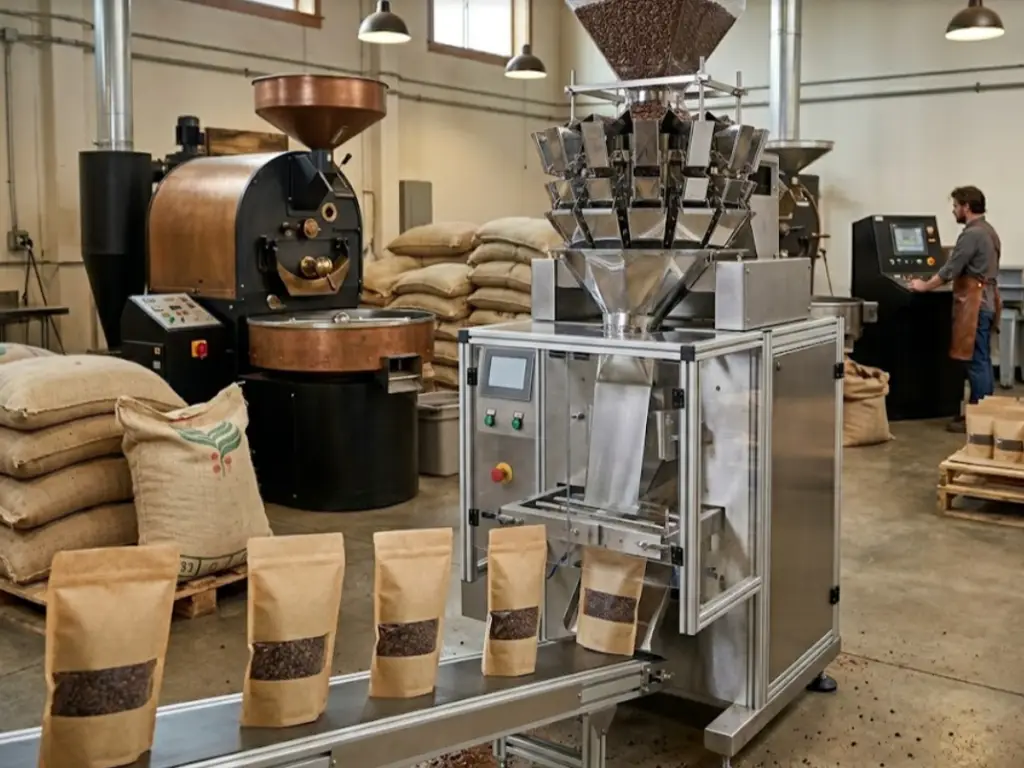
VFFS machines form bags from flat film, fill them, and seal them — continuously. They handle whole bean, ground, and instant coffee in formats from 50g sample packs to 5kg bulk bags. Your decision hinges on bag style flexibility, film compatibility (including biodegradable materials), and multi-head weigher integration.
Stick Pack & Multi-Lane Sachet Machines
The format behind every single-serve instant coffee stick and 3-in-1 coffee mix. Multi-lane machines run 4–12 lanes in parallel. Stick pack design uses ~30% less packaging material than traditional sachets — a meaningful sustainability and cost advantage.
Canning Lines
For whole bean, ground coffee, and the rapidly growing RTD cold brew category. Key differentiator: gas flush capability that drives residual oxygen below 1%, protecting product freshness on supermarket shelves with 12+ month shelf-life expectations.
03 14 Global Coffee Packaging Machine Manufacturers — Organized by What You Actually Need to Know
We've grouped these by price tier because budget is where every buyer conversation starts. All manufacturers listed are non-Chinese companies, providing a genuinely global reference set.
Premium Tier — When Downtime Costs More Than the Machine ($80,000–$500,000+)
IMA Group (Italy, 1961): The reference standard for capsule packaging. If your operation runs three shifts and a single hour of downtime costs four figures, IMA's global service infrastructure justifies the premium. Expect minimum order thresholds that exclude smaller buyers.
Syntegon / Bosch Packaging (Germany): Pharmaceutical precision applied to coffee. Their high-speed lines are legendary for reliability — and priced to match. Strongest global service network among the premium players.
Goglio Group (Italy, 1850): 170+ years specializing in coffee packaging. If freshness is your brand's defining promise, Goglio's degassing valve technology and high-barrier laminate systems are unmatched.
CIA Italian Packing Machines (Italy, 1960s): Coffee-only focus. Bean and ground specialists with machines purpose-built for coffee's specific requirements — degassing, oil resistance, and aroma preservation.
Mid-Premium Tier — Industrial Quality, Regional Support ($30,000–$200,000)
Viking Masek (Wisconsin, USA): Rotary pouch fill-and-seal systems with US-based manufacturing and support. Their coffee vertical experience spans whole bean, ground, and specialty formats.
ILAPAK (Switzerland, 1970): Swiss VFFS and flow-wrapping precision. Strong European support network. The sweet spot between engineering quality and accessibility.
Cama Group (Italy, 1980s): Secondary packaging automation — cartoning, case packing, end-of-line. They complement your primary filling machine to create a complete packaging hall.
Mid-Range Tier — Proven Reliability, Growing-Brand Accessible ($20,000–$120,000)
Velteko (Czech Republic, 1995): European engineering at competitive pricing. Particularly strong in stick pack and sachet machines for single-serve formats.
Fres-co System USA (Pennsylvania, 1960s): Coffee packaging specialists with innovative degassing technology. US-based engineering and support.
WeighPack (Canada, 1990s): Multi-head weigher + VFFS integration. The go-to for coffee packers who live and die by fill-weight consistency.
Paxiom Group (Canada, 1990s): End-to-end packaging integration — from weighing through palletizing — from a single North American partner.
Entry Level — Startup-Friendly ($5,000–$25,000)
Accutek Packaging (California, 1989): Modular fillers that grow with you. Start semi-automatic, add automation modules as revenue scales.
All-Fill Inc. (Pennsylvania, 1969): 50+ years of filling precision. Auger and volumetric fillers compatible with coffee powder and ground applications.
The Sweet Spot Most Buyers Overlook
Here's what the price-tier table doesn't show you: there's a category of manufacturer that builds machines with the same Siemens PLCs, Schneider servos, and Omron sensors found in the Premium tier — but prices them 30% lower. The savings don't come from cheaper components. They come from in-house manufacturing and vertically integrated supply chains.
SANEU (Guangzhou, China / Hong Kong, est. 2013) has spent 12+ years focused on one thing: coffee packaging machinery. Not food packaging generally. Not "powders and granules." Coffee.
That focus produces details that matter: Aerospace-grade aluminum on capsule dispensers (no rust, unlike electroplated iron). CE, RoHS, ISO, CSA, FDA, and SCA certifications. 30-country distributor network including US partners COFFEETEC, BUCKEYE, and STARTROASTINGCOFFEE. 24-hour free quotations, 10–60 day production lead times. The proof is in the repeat business — 100+ coffee enterprise clients, including a 10-year partnership with a roaster who scaled from entry-level to fully automated lines.
04 The 7-Point Evaluation Checklist: Never Buy a Packaging Machine Without This
Print this. Take it to every supplier meeting. If a manufacturer can't answer all seven, walk away.
05 What Your Budget Actually Gets You: 2026 Price Transparency
| Price Tier | Budget | Capability | Best For | Examples |
|---|---|---|---|---|
| Entry | $5K–$25K | Semi-automatic, single-function, limited formats | Micro-roasters testing a new format | Accutek, All-Fill |
| Mid-Range | $25K–$80K | Automated VFFS/stick pack, good accuracy, regional support | Growing brands, single-format focus | Velteko, Fres-co, WeighPack, Paxiom |
| Mid-Premium | $80K–$200K | Industrial components, multi-format, nitrogen, high accuracy | Scaling businesses needing flexibility | Viking Masek, ILAPAK, SANEU |
| Premium | $200K–$500K+ | Turnkey lines, maximum speed, global service contracts | 24/7 enterprise operations | IMA, Syntegon, Goglio |
The mid-premium tier delivers the component quality and multi-format capability of the premium tier — often at 30–50% less. For the majority of growing coffee businesses, this is where ROI peaks.
06 Questions Every First-Time Buyer Asks (Answered Directly)
"Should I buy Chinese or stick with European/US brands?"
The honest answer: it depends entirely on the specific manufacturer, not the country. Modern Chinese manufacturers like SANEU now build with Siemens/Schneider/Omron components, hold CE, FDA, and ISO certifications, and maintain distributor networks spanning 30+ countries. The cost savings — typically ~30% for equivalent specifications — are real. The key is verifying their distributor presence in your country and speaking with reference customers. A Chinese manufacturer with a US distributor and local spare parts inventory is more supportable than a European manufacturer with no North American presence.
"What's the minimum I need to spend to start?"
For capsule filling: $5,000–$8,000 for a semi-automatic entry-level machine. For fully automatic: $25,000–$50,000. For high-speed rotary (6,000–12,000 capsules/hour): $50,000–$150,000+. Your minimum isn't just about budget — it's about the production volume that justifies the investment.
"How long from order to running production?"
Standard machines: 10–30 days. Custom configurations: 35–60 days. Turnkey projects: 3–6 months. Add 2–4 weeks for sea freight, customs clearance, and on-site commissioning.
"Can one machine handle multiple capsule formats?"
Yes — manufacturers like IMA and SANEU offer multi-format platforms. Format flexibility adds 15–25% to purchase price but can eliminate the need for a second machine. When quoting, ask: Is format changeover tool-free? How long does a full format switch take?
The Bottom Line
The global coffee packaging machine market gives you more choice than ever — and more ways to make an expensive mistake. The manufacturers who earn their reputation do it through coffee-specific engineering, industrial-standard components, and responsive after-sales support — not through polished brochures and trade show handshakes.
Use the checklist. Compare across tiers. Talk to reference customers. And remember: the best value often lives in the mid-premium tier, where you get premium-spec components and coffee-focused engineering at prices that leave room in your budget for the coffee that actually goes inside those packages.
References available in the full article source. All manufacturer data verified as of June 2026.