
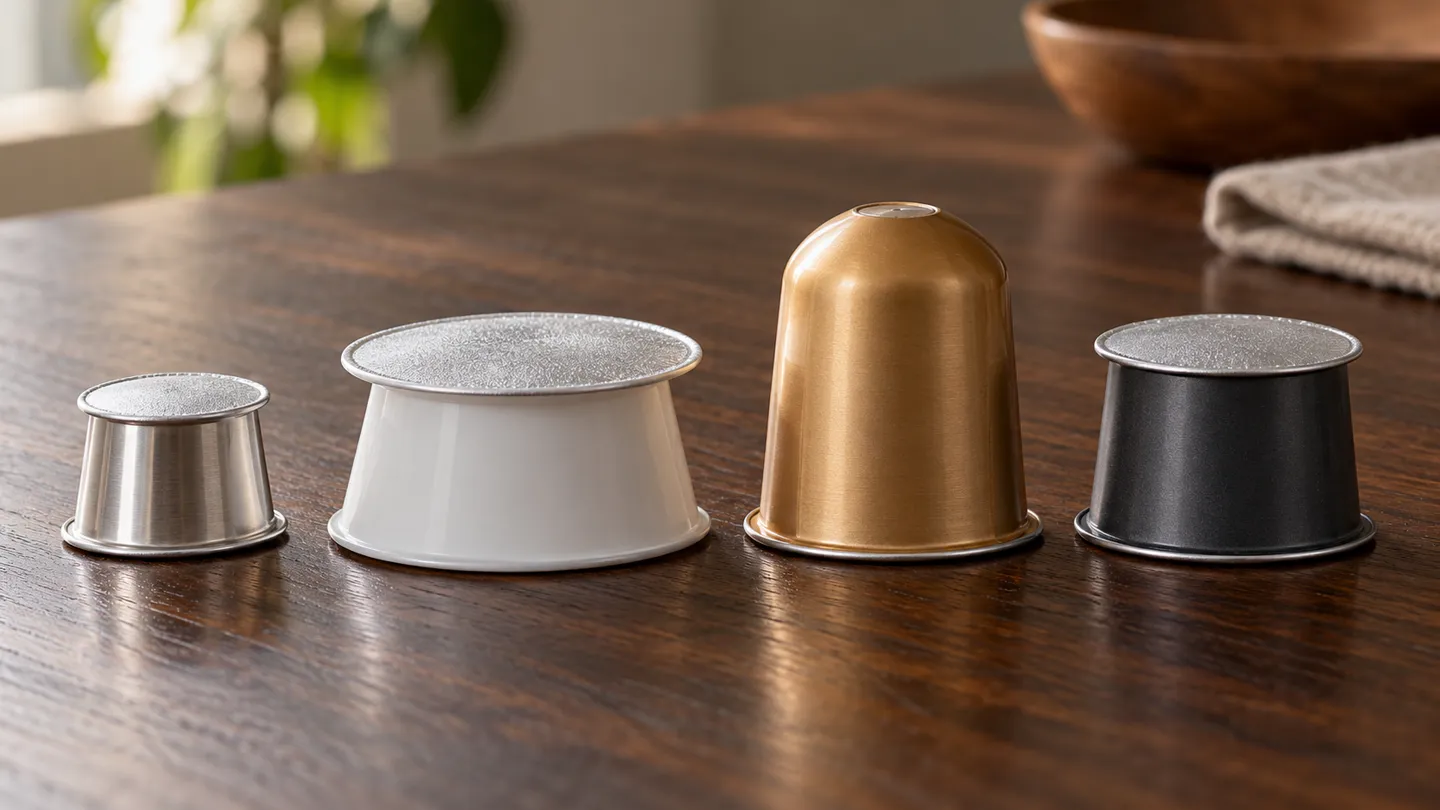
A capsule sits in your palm, barely 37 millimeters across, and the box next to it says “lungo”. The machine manual talks about 6 and 8 ounce cups. A supplier catalog lists 51 millimeter pods with a 13 gram capacity. Three numbers, all called “size”, none of them interchangeable. Most confusion around coffee pod sizes starts here, not with the capsules themselves.
What “Size” Actually Means on a Coffee Pod
Every “size” attached to a coffee pod answers a different question. Brew size answers “how much coffee comes out”: it is the water volume the machine pushes through the capsule, set in milliliters or ounces. Nespresso’s own cup guide runs from a 25 ml ristretto up to a 150 ml Gran Lungo across its Original and Vertuo ranges (Nespresso, 2026). Keurig brewers pour per button press, and the K-Elite, for example, offers five settings from 4 to 12 oz (Keurig, 2026).
Pod dimensions answer a different question: “will it physically fit”. A capsule’s diameter and height in millimeters decide which machines accept it. Fill weight answers a third question: “how strong will it be”, measured in grams of ground coffee sealed inside the capsule.
Not every “pod” is a capsule. Soft flat sachets, most commonly the 44 mm E.S.E. paper pods used in espresso machines, also travel under the name. This guide covers hard single-serve capsules only.
Brew size (ml / oz)
How much coffee comes out of the machine; set by the brewer button, not the capsule
Pod dimensions (mm)
Whether the capsule physically fits the machine; set by capsule diameter and height
Fill weight (g)
How much ground coffee is sealed inside; set by the filler, and the strongest lever a brand controls
The three numbers do not convert into each other. Knowing a capsule’s diameter tells you nothing about its brew volume, and knowing the brew volume tells you nothing about grams inside. Keeping them separate is what makes every size claim in the rest of this article checkable.
Physical Pod Sizes Across the Four Major Systems
Physical size is where compatibility is decided. A capsule fits a machine because its diameter, rim and height were engineered together with that machine’s chamber. The four major systems use different bodies, and none of them interchange.
Physical sizes across the four major capsule systems
| System | Cup diameter | Height | Typical fill weight | Compatibility boundary |
|---|---|---|---|---|
| K-Cup | 51 mm cup, 51.5 mm lid flange, ~37 mm base | 44 mm | 8-13 g | Keurig and K-Cup-compatible brewers only |
| Nespresso Original | 37 mm | 28 mm | 5-5.8 g | OriginalLine machines and compatible capsules |
| Nespresso Vertuo | dome-shaped body, diameter keyed to brew range | tall dome | 7-16 g class by blend | Vertuo machines read the rim, patented system |
| Dolce Gusto | dome-topped mid-size body | varies by variant | 6-9 g class | Dolce Gusto machines only |
K-Cup: the 51 mm standard
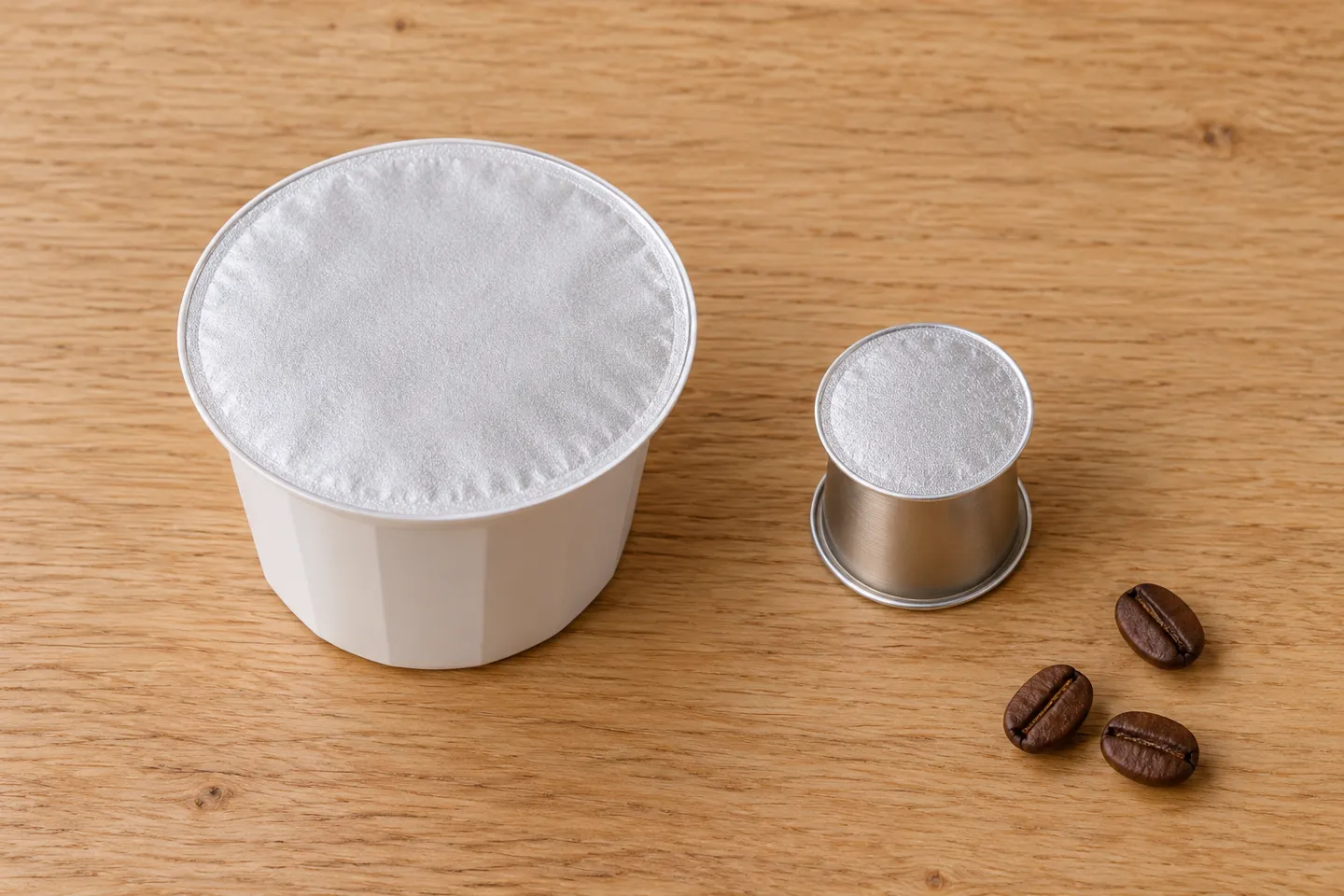
The K-Cup body measures 51 mm in cup diameter and 44 mm in height (K-Cup engineering specification guide, 2026). The lid flange runs around 51.5 mm, and the base tapers to roughly 37 mm. In inches that is about 2 inches across and 1.7 inches tall, which is where most consumer guides stop.
The conflicting numbers floating around search results mostly come from measuring different things. Some guides quote the flange diameter, some the tapered base, some round to whole inches. When two sources disagree on K-Cup dimensions, ask which part of the cone they measured. The manufacturing specs that matter for tooling are the cup diameter, the neck, the flange width and the height, and suppliers converge on the figures above.
Nespresso Original: the 37 mm capsule
The OriginalLine capsule is much smaller: about 37 mm in diameter and 28 mm tall (Nespresso-compatible capsule specifications, 2025). It holds roughly half the physical volume of a K-Cup, which is why the two look nothing alike side by side. That small body is also why OriginalLine capsules target espresso-strength extractions rather than mug-size pours.
Nespresso Vertuo: size by brew range
Vertuo capsules are dome-shaped and come in several diameters, each keyed to a brew range from espresso up to long mug and carafe serves. The machine reads the rim of the capsule to set its extraction parameters, which is why Vertuo capsules only work in Vertuo machines. The system is patented, so third-party supply is restricted to licensees, and capsule availability follows that license list rather than an open market.
Dolce Gusto: the mid-size dome
Dolce Gusto capsules sit between the two in physical class, with a dome-topped body and dimensions that vary by variant. Exact rim and height figures differ across the product range, so the practical rule is to request the dimensioned drawing from any capsule supplier before committing a production line. What stays constant is the machine boundary: Dolce Gusto capsules work in Dolce Gusto machines, not in K-Cup or Nespresso chambers.
Capsule size is machine binding
There is no universal pod: a compatible claim always means engineered to one chamber family, never close enough.
Fill Weight: The Size Number You Can Actually Set
Brew size is locked by the machine. Physical dimensions are locked by the system. Fill weight is the one number a brand decides for itself, and it is where strength, consistency and cost all live.
The Nespresso Original line carries 5 to 5.8 grams of ground coffee (Nespresso-compatible capsule specifications, 2025). Capsule makers treat 5.8 g as the point where extraction peaks on Original machines. K-Cup bodies hold 8 to 13 grams, with 10 to 13 g the common filled range (K-Cup capsule specifications, 2026). Filling equipment for both formats typically covers a 5 to 15 g dosing range, which is exactly the span between the two systems.
Nespresso Original
5-5.8 g
per capsule, extraction optimum at 5.8 g
K-Cup
8-13 g
capacity, 10-13 g typical fill
Typical filler dosing range
5-15 g
one line covers both formats
5.8 g
Fill weight is the one size number your brand sets. On the Nespresso Original line, extraction peaks at 5.8 g.
Undershoot the range and the cup reads thin. That gap sits behind most “capsules taste weaker than barista espresso” complaints: a traditional espresso dose runs 7 g or more against a 5 g capsule. Overshoot and the lid will not seal cleanly or the extraction runs incomplete. Fill weight also sets your cost floor. Grams per capsule multiplied by monthly volume is your coffee spend, so the number you pick trades strength against margin.
Production Specs: What to Demand From a Supplier
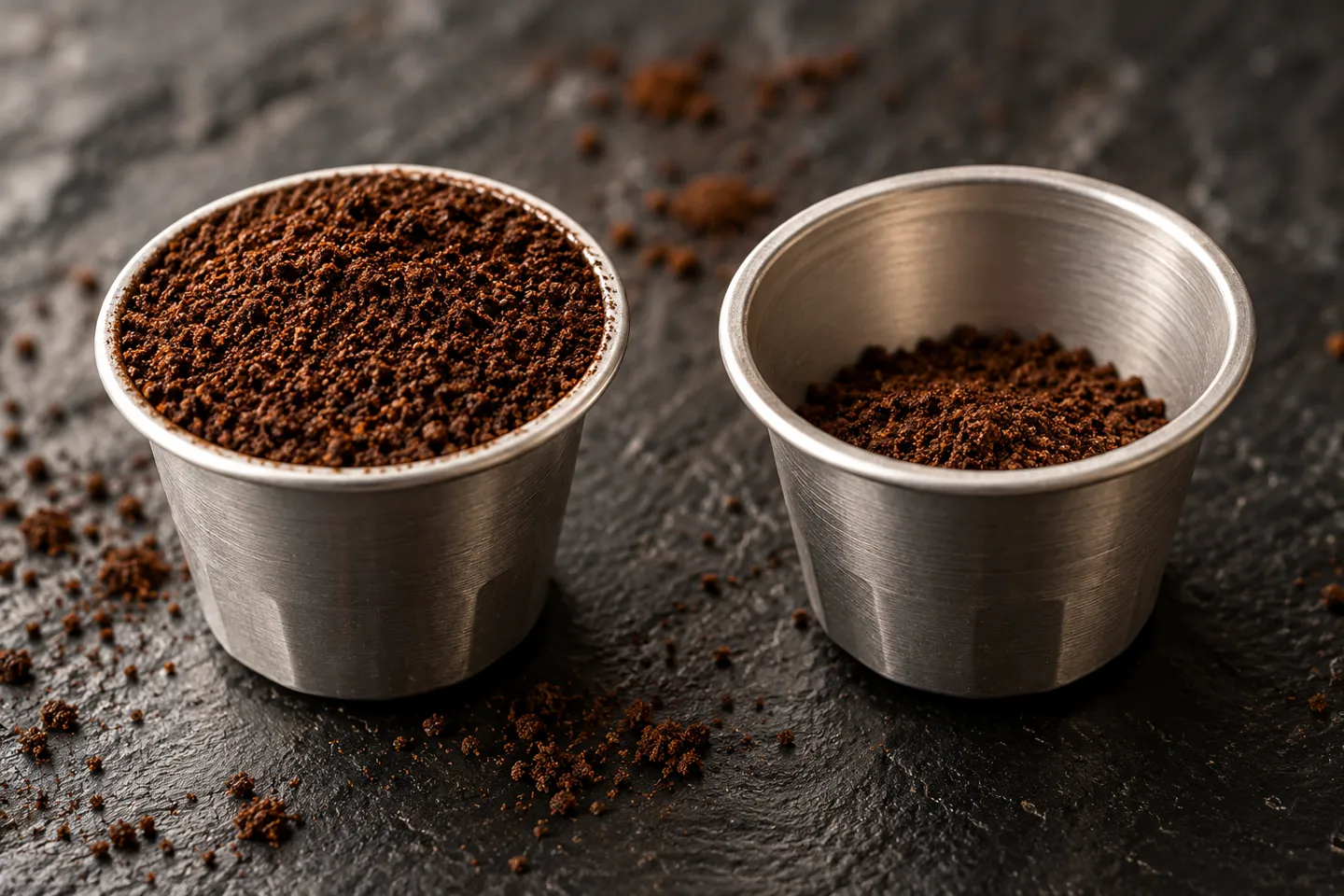
Once a format is chosen, the size numbers turn into equipment requirements. This is the step where dimensions stop being trivia and start being purchase orders, and it is where an unchecked number costs the most.
The boundary worth respecting: swapping formats later is not swapping a SKU. Fill range, moulds, lids and material supply are all sized to the format you start with. Confirm the specs below against your target format before comparing quotes on speed or price.
Filling and sealing specs
Ask whether the filler’s dosing range covers your target fill weight with margin. A 5-15 g range covers Nespresso’s 5-5.8 g and K-Cup’s 8-13 g in one line, while a narrower machine locks you into one system. Ask for dosing accuracy in writing. Servo-driven auger fillers at ±0.1-0.2 g keep every capsule inside the extraction window. Accuracy is what makes a 5.8 g claim real at 200 capsules per minute.
For freshness, ask how the line flushes oxygen. Nitrogen flushing that holds residual oxygen below roughly 0.5% is the benchmark capsule producers use to protect aroma. Finally, ask which capsule formats the changeover covers. A line that swaps moulds across Nespresso, K-Cup and Dolce Gusto bodies is a materially different purchase from a single-format machine.
Empty capsule and lid specs
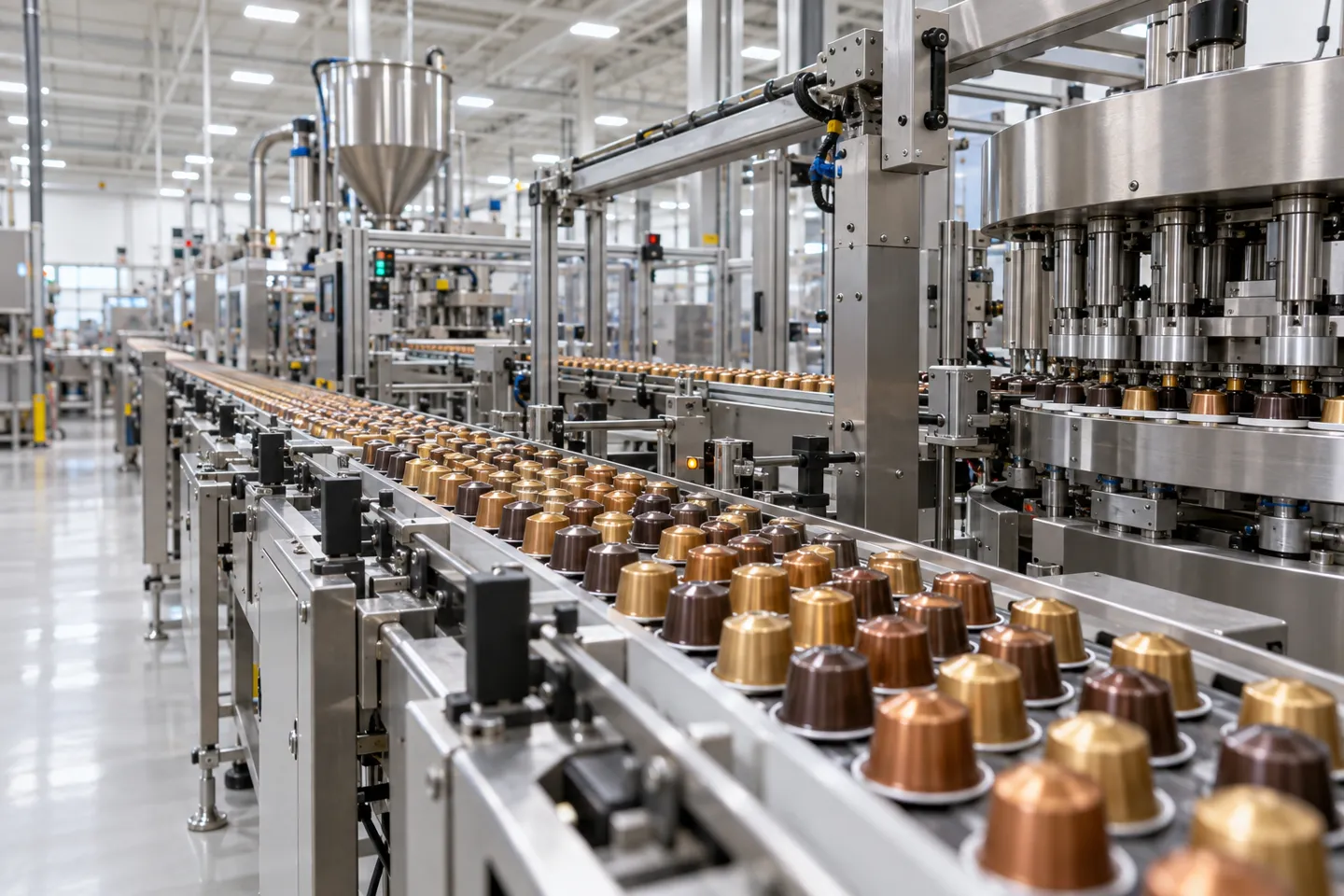
The capsules themselves carry the dimension tolerance, so check the drawing, not the description. Confirm cup diameter, neck diameter, flange width and height against the format’s standard: 51 mm class for K-Cup bodies, 37 mm class for Nespresso Original. Confirm the ring material at the capsule base, silicon or paper, because that ring decides how the capsule seals against the brew chamber. Confirm lid foil thickness: lacquered aluminum foil in the 33 micrometer class before embossing is the working spec, thickening after embossing. Confirm cup material options: food-grade PP with an EVOH oxygen barrier, pure aluminum, PLA compostable or paper. The choice has to match both your shelf-life target and your market’s disposal rules. Confirm cup weight as well, because freight and film costs scale with it. An aluminum Nespresso cup weighs about 1.3 g (Nespresso-compatible capsule specifications, 2025), while compostable and paper cups run near 2 g.
Supplier checklist
Where Compatibility Breaks
Dimensions and specs can all look right and a capsule program can still fail in the field. Four failure modes cause most of the damage.
Ring material is the first. A paper ring at the capsule base costs less per unit. A silicon ring seals against the brew chamber more reliably and holds compatibility with Original machines at close to full rate. If leak complaints or chamber fit issues show up in testing, check the ring specification before blaming the capsule body.
Sealing is the second. Sealing temperature, dwell time and lid foil thickness have to match; the wrong pairing leaks powder into the machine or leaves lids peeling. A desktop sealer and a rotary line reach this differently, so confirm the sealing window against your exact foil and cup combination, not a generic setting.
Oxygen barrier is the third. A cup without an EVOH layer or equivalent barrier lets oxygen in slowly and flattens aroma on the shelf. Capsule producers who test residuals report multi-year aroma life under nitrogen flushing with low residual oxygen. That outcome depends on barrier material and seal quality together, not on nitrogen alone.
The fourth is system boundary. Capsules only work inside their engineered chamber family, and patented systems accept only licensed supply. Before committing a format, confirm where your supplier’s compatibility list ends; a format that cannot be sourced openly is a supply risk regardless of its size numbers.
Four checks before launch: ring material (silicon vs paper), sealing window matched to your foil and cup, oxygen barrier in the cup wall, and the supplier’s written compatibility boundary. Each one is verifiable on a spec sheet before the first production run.
Choosing a Format as a Business Decision
Read back through the numbers and a pattern emerges. Every physical “size” in this article was decided by a system, and every system was decided by a business. Format choice is an ecosystem choice first and a dimension second.
The market itself is large and still growing. Coffee pods and capsules were valued at USD 34.66 billion in 2026 (Mordor Intelligence, 2026). Projections run the market to USD 46.91 billion by 2031 at a 6.24% CAGR. Growth attracts supply, so the practical questions are which format your target market brews, and whether that format’s supply is open. In North America the K-Cup ecosystem is the dominant single-serve format, and its compatible-capsule market is open. The Nespresso Original ecosystem is mature, with an established compatible-capsule market. Dome-shaped patented systems restrict third-party supply to licensees, which caps both sourcing options and margin.
The controllable variables are where differentiation lives. Brew size and capsule dimensions are fixed by whichever system you enter. The numbers you actually set, fill weight accuracy and barrier material, are what a buyer can verify between two otherwise identical compatible capsules. A roaster holding 5.8 g at ±0.1 g on an Original-compatible line is selling a verifiable claim, not a label.
For co-packers the same logic runs through the equipment. A line whose dosing range and moulds cover several open formats hedges the risk of any single format’s fortunes. A single-format line bets the factory on one chamber standard. Choose the ecosystem first, verify the dimensions second, and spend the differentiation budget on the numbers you control.
SANEU builds both sides of that decision. Our coffee capsule filling and sealing machines hold ±0.1-0.2 g dosing accuracy across a 5-15 g range, with nitrogen flushing to low residual oxygen (coffee capsule filling and sealing machines). One line changes moulds across K-Cup, Nespresso and Dolce Gusto bodies, so a format shift does not strand the factory. Our Nespresso-compatible empty pods come in aluminum, compostable and PP options. Patent-locked dome formats are not something we supply into, and we will tell you when a format is a supply risk rather than an opportunity.
Get a filling line spec for your capsule format
Send your target format, fill weight and monthly volume, and SANEU returns a machine specification and mould plan that covers them.
Start a spec reviewReferences
- Nespresso. “Which cup size for your coffee style.” 2026. nespresso.com/ch/en/news/which-cup-size-for-your-coffee-style
- Keurig. “Keurig K-Elite Single Serve Coffee Maker.” 2026. keurig.com/home-coffee-makers/keurig-k-elite-single-serve-coffee-maker
- Mordor Intelligence. “Coffee Pods and Capsules Market Size & Share Analysis.” 2026. mordorintelligence.com/industry-reports/coffee-pods-and-capsules-market


 English
 Spanish
 Arabic
 Russian