Yes, a K-Cup filling machine can support a profitable business in 2026. But the machine is not the business.
Profit appears when three things meet: you can sell enough pods, each sale leaves a healthy contribution margin, and the line runs often enough to carry its fixed costs. Miss any one of those and a shiny automatic filler becomes idle stainless steel. It is a bit like buying a delivery truck before opening the restaurant. The truck may be excellent. It still has nowhere useful to go.
This is a practical go-or-no-go guide for roasters, coffee shops, private-label manufacturers, and beverage brands. It covers demand, unit economics, equipment, quality, and the operational headaches brochures tend to forget.
The decision comes down to three questions:
- Can you sell the pods at a workable price?
- Can you make them reliably and safely?
- Can the margin pay for the complete production system?
If the answer to all three is yes, well, there may be money on the table.
Why K-Cup Production Still Deserves Attention in 2026
According to the National Coffee Association’s Spring 2026 data, nearly 195 million American adults drink coffee each week. Past-day and past-week consumption stood at 66% and 73% of adults. Among past-day drinkers, 82% had coffee prepared at home. The survey was based on a nationally representative sample of 1,850 adults collected in January 2026.
That is useful context. It is not your sales forecast.
Keurig Dr Pepper’s full-year 2025 U.S. Coffee net sales reached $4.0 billion, up 0.6%. It said increased K-Cup pod sales supported revenue, although total segment volume/mix declined. That is a fair picture of a mature category: big, durable, and competitive.
In short, people are buying pods. That does not mean they are waiting for yours.
Where a Smaller Operator Can Compete
A regional roaster is unlikely to win by copying a mass-market breakfast blend and charging more. Smaller businesses tend to have a better shot where scale is not the only advantage:
- a known local roast offered in a more convenient format;
- specialty or single-origin pods with a clear taste promise;
- private-label runs that are too small or awkward for a giant co-packer;
- office, clinic, hotel, and dealership programs with repeat demand;
- seasonal, flavored, decaf, tea, cocoa, or coffee-alternative products;
- quick lead times and flexible artwork for regional customers.
The opportunity is usually in a defined pocket, not “the K-Cup market” as one giant blob.
What a K-Cup Filling and Sealing Machine Actually Does
A K-Cup-compatible pod is a small brewing system. It normally contains a rigid cup, an internal filter, a measured dose of ground coffee, and a lidding material. If the terminology is still fuzzy, start with what a K-Cup is and how it brews.
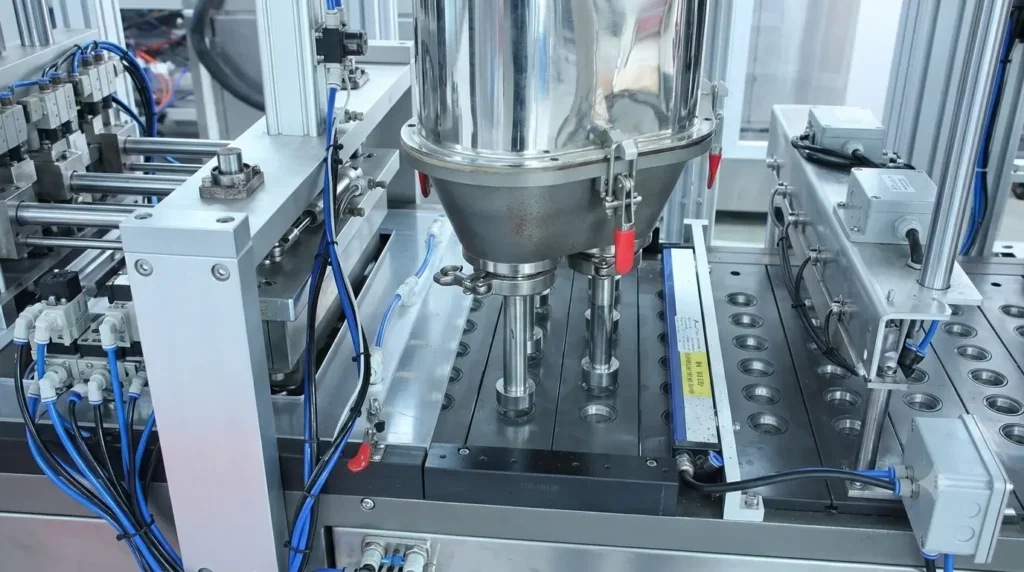
A commercial filling and sealing machine turns those inputs into a finished pod:
- Cup feeding: preformed cups are denested and placed in machine holders.
- Presence detection: a sensor confirms that a cup is in position.
- Dosing: an auger or another metering system delivers the coffee.
- Leveling or tamping: the bed is settled when the product and recipe require it.
- Rim cleaning: loose grounds are removed from the sealing flange.
- Nitrogen flushing: nitrogen displaces part of the oxygen around the coffee.
- Lid placement: pre-cut foil is picked and positioned, or roll stock is indexed and cut.
- Heat sealing: temperature, pressure, and dwell time activate the sealant layer.
- Coding and inspection: the line may add a lot code and check lids, weight, or cup presence.
- Discharge: finished pods move to collection, counting, cartoning, or case packing.
The sequence varies. Lines may add several flush points, vacuum coffee feeding, checkweighing, or vision inspection. Compact equipment leaves more tasks to operators. See the full K-Cup filling and sealing process for more detail.
A Filler Does Not Manufacture the Empty Cup
This distinction causes plenty of confusion.
A K-Cup filling machine normally fills preformed filtered cups. A separate cup-forming or K-Cup filter welding system produces the empty filtered capsule. Bringing that process in-house adds polymer or fiber sourcing, molds, filter placement, welding, dimensional inspection, and another quality system.
Vertical integration can suit a large pod factory. It is usually too much machinery for a roaster launching its first box. The customer buys the drink, not your cups-per-minute figure. Dose, oxygen, seal, flow, aroma, and taste must work together.
Five Ways a Coffee Pod Filling Machine Can Earn Revenue
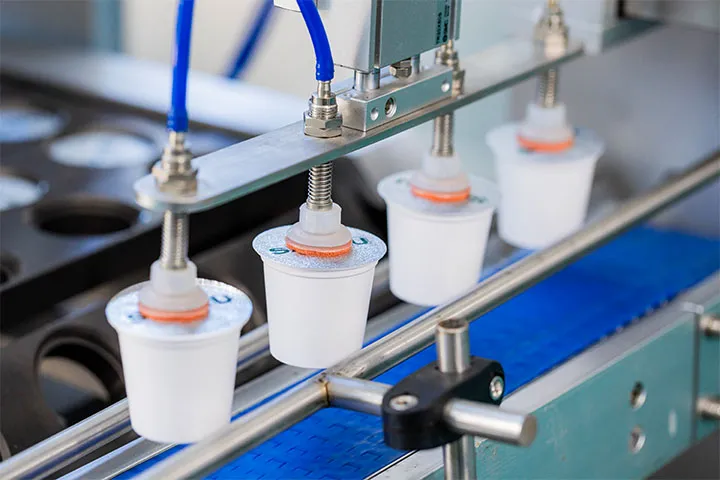
There is more than one K-Cup business. The revenue model should be chosen before the equipment.
1. Extend an Existing Coffee Brand
An established roaster can offer a known house blend in whole bean, ground, and single-serve forms. Watch for substitution, though. A buyer moving from a profitable bag to pods may shift revenue rather than add it. Track total spend and reorders.
2. Build a DTC or Subscription Product
DTC gives more control over pricing, data, bundles, and repeat offers. Subscriptions may smooth planning. Here’s the catch: payment fees, ads, discounts, fulfillment, damaged parcels, postage, and churn sit between list price and cash. Model net revenue.
3. Supply Offices, Hotels, and Other Foodservice Accounts
Offices, clinics, hotels, and dealerships can generate regular volume and may accept simple bulk packaging. They value dependable supply and predictable pricing. One contract can support base load, but it can disappear at renewal.
4. Offer Private-Label K-Cup Manufacturing
Private label can sell spare machine hours to cafés, retailers, creators, gift businesses, and other roasters.
A sensible quote separates:
- coffee and formulation;
- empty cups and lids;
- filling and sealing;
- setup and cleaning;
- printed cartons and master cases;
- coding, inspection, storage, and freight;
- development or sample work.
Small runs need a setup charge or minimum run fee. Otherwise, cleaning and adjustment can consume the day while the business invoices very few pods. Busy is not the same as profitable.
5. Fill Adjacent Beverages
Some equipment can fill tea, cocoa, chai, chicory, or functional powders. This improves utilization, but “powder is powder” is a bad assumption. Flow, density, static, dust, allergens, dose, and brewing behavior differ. Validate every formula.
| Business Model | Revenue Strength | Main Cost or Risk | Best Fit |
| Existing coffee brand | Current audience and brand trust | Sales may replace bag purchases | Established roaster |
| DTC or subscription | Price control and customer data | Acquisition, fulfillment, and churn | Strong online brand |
| Office or hospitality | Repeat volume | Price pressure and service commitments | Regional supplier |
| Private-label co-packing | Monetizes spare capacity | Changeovers and sales-pipeline risk | Process-focused operator |
| Adjacent beverages | More SKUs and market reach | Cleaning, allergens, and validation | Flexible manufacturer |
Build the Profit Model Before You Price the Machine
Profitability starts at the pod, then rolls up to the year. “The machine costs $50,000 and pods sell for 70 cents” is not a model. Too much sits between those numbers.
Step 1: Find Contribution Margin per Saleable Pod
Use this basic formula: contribution per pod = net selling revenue − variable cost per saleable pod
Net selling revenue is what remains after discounts, distributor margins, marketplace fees, commissions, and channel deductions.
Variable cost may include:
- roasted coffee;
- empty filtered cup;
- printed or plain lid;
- retail carton and master-case allocation;
- direct packing labor;
- nitrogen, compressed air, and variable power;
- coding and inspection consumables;
- expected scrap and rework;
- variable fulfillment or freight support.
Calculate on saleable pods, not cycles. If 100,000 cycles create 97,000 good pods, those good units carry the full run cost.
Step 2: Calculate Break-Even Volume
Then use: annual break-even pods = annual fixed operating costs ÷ contribution per pod
Fixed costs include items such as lease or depreciation, salaried labor, maintenance, insurance, floor space, software, calibration, and certification.
Suppose an illustrative line has $72,000 in annual fixed cost and earns $0.12 contribution per saleable pod. It needs 600,000 saleable pods a year to cover those fixed costs:
$72,000 ÷ $0.12 = 600,000 pods
That is 50,000 pods a month. It is only an illustration. At $0.07 contribution, break-even rises above 1.02 million pods. Five cents looks tiny in one cup; across a year, it is the whole plot.
Step 3: Estimate Cash Payback
Payback is usually framed as: installed project cost ÷ annual incremental operating cash flow
Installed cost includes the filler plus freight, duties, rigging, utilities, molds, coding, inspection, conveyors, spares, commissioning, training, lab tools, and working capital.
A $120,000 project generating $48,000 of incremental annual operating cash flow has a simple 2.5-year payback. Financing, taxes, ramp-up, and working capital change the real result.
Step 4: Run Three Demand Cases
| Input | Conservative Case | Base Case | Upside Case |
| Saleable pods per month | Proven floor | Expected orders | Capacity-backed opportunity |
| Net contribution per pod | Lower margin | Expected margin | Better mix, still credible |
| OEE / effective utilization | Low | Planned | Strong but achievable |
| Reject and giveaway rate | Higher | Expected | Controlled |
| Changeovers | Frequent | Moderate | Efficient campaigns |
| Annual cash contribution | Formula output | Formula output | Formula output |
| Estimated payback | Formula output | Formula output | Formula output |
Do not let the upside case approve the purchase. The conservative case must be survivable, and the base case needs evidence.
Four Variables That Swing K-Cup Machine ROI
Selling price after channel deductions. A wholesale pod and a DTC pod may carry very different revenue even if the product is identical.
Actual monthly sell-through. Production is not a sale. Finished inventory ties up coffee, packaging, labor, and cash.
Labor and changeovers. Small private-label jobs can command good prices, yet frequent cleanouts and artwork changes consume capacity.
Rejects and overfill. A leaking pod loses the whole product and may create a complaint. A pod filled slightly heavy may pass inspection while quietly giving away coffee every minute.
K-Cup Co-Packing vs In-House Production
Outsourcing can be the smartest way to buy information before buying equipment.
| Decision Factor | Co-Packing | Own Filling Machine |
| Upfront capital | Low | Medium to high |
| Minimum runs | Set by supplier | Set by your economics and workflow |
| Unit cost at high utilization | Usually higher | Can become lower |
| Quality and schedule control | Shared with supplier | Direct responsibility |
| Speed to first market test | Often faster | Slower during installation and validation |
| Operational burden | Lower | Higher |
| Product changes | Subject to supplier schedule | More flexible after validation |
| Idle-capacity risk | None | Carried by the owner |
Co-Pack First When Demand Is Still a Guess
Use outsourced production to test reorders, price, and product performance. Co-packing may remain right when volume is irregular, labor is scarce, or customers require certifications your facility lacks.
Bring Production In-House When the Bottleneck Becomes Strategic
Ownership becomes attractive when base volume is stable, co-packing fees compress margin, lead times block sales, or small runs matter. Private-label orders can absorb spare hours, but “we would probably buy” is not contracted volume.
Match the K-Cup Filling Machine to Saleable Demand
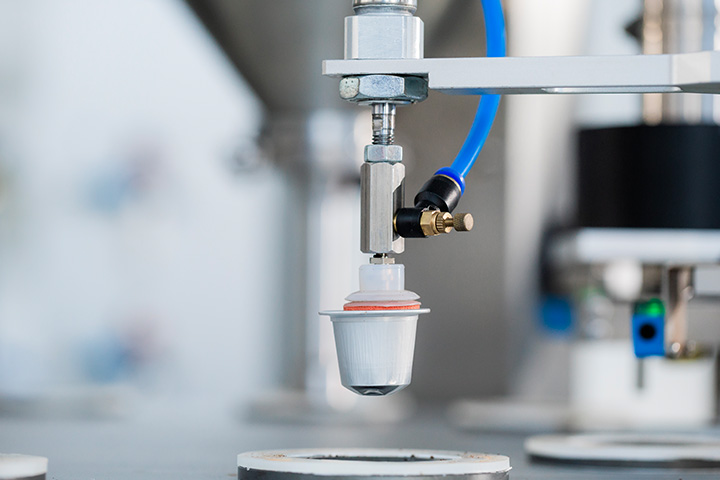
Machine labels are slippery. One supplier’s semi-automatic system may do more than another supplier’s entry-level automatic machine. Compare every operator action and every required accessory.
Manual and Tabletop Systems
Manual systems suit R&D, samples, and micro-volume. Labor quickly becomes the ceiling because every cup is handled, filled, lidded, sealed, and inspected. This is a test kitchen, not a tiny high-speed factory.
Semi-Automatic Machines
Semi-automatic equipment may automate dosing and sealing while operators load cups or lids. Ask how many people sustain quoted output. Feeding and cartoning labor can change the business case.
Single-Lane Automatic Machines
A single-lane automatic machine usually combines feeding, dosing, nitrogen, lid placement, sealing, and discharge. It gives a growing roaster repeatability without a large line’s complexity.
Compare models in the SANEU K-Cup filling machine range only after setting the required output, product, cup, lid, oxygen target, and available utilities. A feature list cannot choose capacity for you.
Multi-Lane Linear and Rotary Systems
Multi-lane machines raise output and can reduce labor per pod. They also increase the demands on feeding, replenishment, inspection, cartoning, maintenance, and changeover. Any upstream or downstream bottleneck can throttle the investment.
| Machine Tier | Typical Use | Main Advantage | Profitability Trap |
| Manual / tabletop | Samples and market tests | Low entry cost | Labor per pod stays high |
| Semi-automatic | Small commercial runs | Lower capital and flexibility | Hidden operator dependency |
| Single-lane automatic | Growing roaster or regional co-packer | Repeatable integrated process | Can be undersized after a major win |
| Multi-lane / rotary | High-volume manufacturing | Low labor per pod at utilization | Idle capacity and complex changes |
Size Capacity With OEE, Not Hope
Nameplate speed excludes much of real life: warm-up, cleaning, replenishment, jams, checks, maintenance, flavor changes, and cartoning.
Use this planning formula: required rated output = required saleable pods ÷ planned production hours ÷ expected OEE
OEE, or overall equipment effectiveness, combines availability, performance, and quality: OEE = availability × performance × quality rate
Imagine a 50-cup-per-minute machine. At 100% output for eight hours, the arithmetic says 24,000 pods. At 65% OEE, saleable output is closer to 15,600. That 65% is only an example; your process may perform better or worse. Measure it.
Do the same calculation backward from confirmed demand. If the business needs 200,000 saleable pods per month and plans 80 production hours, it needs 2,500 good pods per hour. At 65% OEE, required nameplate capacity is about 3,846 per hour, or 64 cups per minute. A nominal 50-CPM line would require more hours or a second shift.
For detailed manufacturer and specification comparisons, the 2026 K-Cup filling machine buyer’s guide is the next step after the business case is approved.
Cups, Coffee, and Lids Must Work as One Packaging System
A pod line does not fill an abstract container. It fills one particular cup with one particular product and seals it with one particular lid. Change a component and the process window can move.
Empty Cup and Filter Construction
K-Cup-compatible shells commonly use polypropylene or barrier structures. Recyclable-compatible and compostable alternatives are also sold. Material choice affects stiffness, heat response, barrier performance, flange behavior, storage, and end-of-life claims.
Dimensional tolerance matters. A cup that sits too tightly in a holder may fail to release. A warped flange can create an uneven seal. A weak filter weld may fail during brewing. Review actual empty K-Cup specifications and run material lots on the proposed machine.
Coffee Is a Moving Target
Coffee behavior changes with roast, degassing time, grind distribution, humidity, bulk density, oil, and static. A dark roast can be more brittle and less dense than a light roast. The same auger revolutions may not produce the same weight.
Freshly roasted coffee also releases carbon dioxide. Packing it too early can affect dosing and increase internal pressure. Waiting too long can sacrifice aroma. Establish a measured roast-to-grind-to-pack window instead of copying somebody else’s number.
The grind must balance flow through the filler with extraction in the brewer. Too fine may slow the beverage or push grounds through the filter. Too coarse may brew weak. There is no useful universal setting called “K-Cup grind.” Validate the particle-size distribution with the coffee dose, filter, brewer, and selected brew sizes.
Pre-Cut Lids or Roll Stock
Pre-cut lids simplify print handling and can support flexible artwork. Roll stock can suit continuous production but requires controlled registration, tension, and cutting.
In either case, the sealant must match the cup material. Check foil curl, lid pickup, print orientation, puncture, peel behavior, storage conditions, and lot variation. A lid can look perfect on a desk and behave like a potato chip in the feeder.
For a deeper comparison of polypropylene, barrier layers, lidding, and environmental options, review these K-Cup packaging material options.
Material Claims Need Evidence
Ask suppliers for food-contact declarations, composition information, migration support where required, and change-notification terms. Validate shelf life with the complete pod and actual coffee.
Be precise with environmental language. A recyclable carton does not make the filled pod recyclable. A material described as compostable may require an industrial facility. Claims should name the component, condition, certification, and disposal limitation where relevant.
Quality Controls That Protect Flavor and Margin
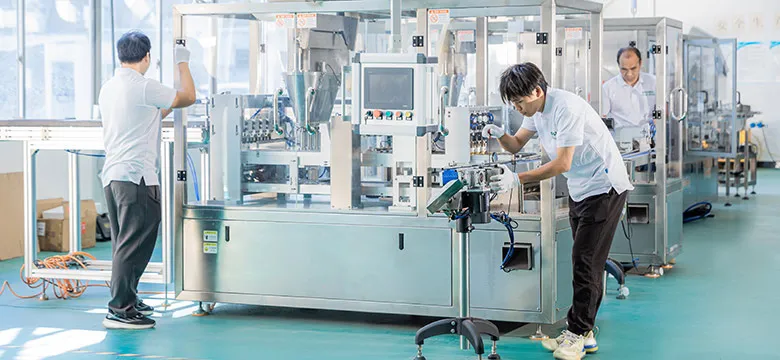
Quality is not a department that checks pods after the shift. It is the control system that keeps bad pods from being made in the first place.
Fill Weight: Control the Mean, Not Just the Rejects
Set a target, warning limits, reject limits, sampling frequency, and response plan. Track both average weight and variation.
Consider a line producing 1 million pods a year. If the average pod carries 0.20 grams more coffee than intended, the annual giveaway is 200 kilograms. That is not a safety margin. It is purchased coffee leaving for free.
On the other side, underfilled pods can brew weak and violate declared quantity controls. Centering the process is better than aiming high and hoping.
Residual Oxygen: Measure the Sealed Pod
Nitrogen flushing can slow oxidation, but nitrogen supply purity is not the same as residual oxygen inside a finished capsule. Final oxygen depends on purge flow, nozzle position, exposure time, line speed, cup volume, coffee, lid placement, and how quickly sealing follows the purge.
Set a validated residual-oxygen target based on shelf-life work. Measure sealed pods at defined intervals and after changes. This guide to choosing nitrogen-flushing equipment covers the equipment side; the final product test still belongs in the quality plan.
Seal Integrity: Four Variables, One Small Flange
Heat sealing depends on temperature, pressure, dwell time, and clean contact between compatible materials. Coffee on the rim can create a microscopic leak path. Excess heat can distort the cup or make opening and puncture behavior troublesome.
Useful checks may include visual inspection, peel-strength testing, dye penetration, bubble emission, vacuum decay, or a validated internal leak method. No single test answers every question. Choose methods that match the package, risk, and customer specification.
Brewer Compatibility and Sensory Testing
A pod that does not leak on the bench can still fail in a brewer. Test representative machines and brew sizes for:
- top and bottom puncture;
- water bypass and external leakage;
- grounds in the cup;
- beverage output and flow time;
- filter integrity;
- extraction and strength;
- aroma and flavor.
Include aged samples in shelf-life work. Fresh pods may brew nicely while oxygen, seal defects, or material changes reveal themselves months later.
Traceability and Finished-Pack Inspection
Record coffee lot, cup lot, lid lot, line, date, recipe, operator, and relevant process results. Verify lot codes and retail carton counts. Retain samples by run and rehearse a mock recall.
| Control Point | What to Measure | Business Risk Controlled |
| Dosing | Mean weight and variation | Giveaway and weak brew |
| Nitrogen flush | Residual oxygen in sealed pods | Staling and short shelf life |
| Rim cleaning | Residue on the flange | Leaks and seal rejects |
| Heat sealing | Strength and integrity | Returns and brand damage |
| Brewing | Flow, leakage, output, sensory result | Compatibility complaints |
| Coding | Readability and lot accuracy | Traceability and recall scope |
Facility, Utilities, People, and Standards
The machine needs a suitable home. Confirm floor area plus access for cleaning, change parts, electrical panels, and maintenance. Plan safe movement of coffee, cups, lids, cartons, waste, and finished goods.
Utility questions should be answered in numbers:
- voltage, phase, frequency, connected load, and grounding;
- compressed-air pressure, flow, quality, and receiver capacity;
- nitrogen pressure, flow, purity, and supply method;
- vacuum or dust-extraction requirements;
- room temperature and humidity limits;
- ventilation and heat load;
- network or data connections for coding and inspection.
Nitrogen may come from cylinders, a bulk supply, or an onsite generator. The best choice depends on consumption, logistics, purity requirements, local pricing, and backup needs. An air compressor that technically reaches the required pressure may still be too small to hold it during peak demand.
Food Safety and Quality Systems
In the United States, businesses that manufacture, process, pack, or hold food may have federal, state, and local responsibilities. FDA notes that current good manufacturing practice requires food sold or introduced into interstate commerce to be made under safe and sanitary conditions. Its guide to starting a food business points businesses to 21 CFR Part 117 and current labeling responsibilities.
Depending on the facility and product, the operating system may need:
- hazard analysis and preventive controls;
- sanitation standard operating procedures;
- supplier approval and incoming inspection;
- allergen cross-contact controls for flavored or mixed products;
- pest control and foreign-material prevention;
- traceability, complaint handling, and recall procedures;
- training and documented records.
Retailers or private-label clients may also require SQF, BRCGS, organic, kosher, or other certification. Those are commercial and product-specific requirements, not universal decorations for a website footer.
Machine Safety and Electrical Compliance
Safe machinery includes guards, interlocks, emergency stops, documented risk assessment, lockout/tagout provisions, clear manuals, and trained operators.
Relevant references may include ISO 12100 for machinery risk assessment and IEC 60204-1 for electrical equipment of machines. North American buyers may specify UL-related components or evaluation and NFPA 79. EU installations need the appropriate conformity route and CE documentation. Buyers planning beyond 2026 should also account for the EU transition from Machinery Directive 2006/42/EC to Machinery Regulation (EU) 2023/1230, which applies from January 2027.
Do not ask only, “Is it CE?” Ask which laws and standards were used, what the declaration covers, who assembled the technical file, and whether the delivered configuration matches it. Required approvals vary by destination and installation.
Where the Profit Plan Usually Breaks
Most bad outcomes are not dramatic. They are dozens of small losses repeated every day.
| Problem | Why It Hurts Profit | Practical Response |
| Machine bought before demand | Fixed cost sits idle | Co-pack a pilot and secure repeat orders |
| Nameplate speed used in forecasts | Saleable output is overstated | Model OEE, changes, rejects, and cartoning |
| Fresh coffee filled too soon | Gas and flow become inconsistent | Establish a measured degassing window |
| Coffee remains on the rim | Weak seals and leakage | Improve dosing, rim cleaning, and extraction |
| Average dose runs high | Coffee giveaway erodes margin | Center the process and track capability |
| Nitrogen purity is used as the quality result | Shelf life is assumed | Test residual oxygen in sealed pods |
| Too many tiny SKUs | Setup consumes the shift | Use campaign production and minimum run fees |
| Critical spare has a long lead time | Revenue stops with one component | Hold a risk-based spare-parts kit |
| Filler outruns cartoning | WIP and labor pile up | Balance the entire packaging line |
Another common problem is selling every available machine hour. A schedule with no room for maintenance, overruns, or urgent rework is already late. Protect planned maintenance time and a little recovery capacity.
How to Evaluate a K-Cup Machine Supplier
A strong supplier evaluation looks more like an engineering project than an online shopping trip.
Run Your Coffee, Cup, and Lid
Send shortlisted suppliers the actual coffee, cup, lid, target dose, desired speed, and residual-oxygen requirement. Ask for a sustained run, not ten carefully selected pods.
Have samples returned by identified run and setting. Weigh them. Leak-test them. Brew them in representative machines. If possible, place them into accelerated and real-time shelf-life programs.
Define the Quote Boundary
Confirm whether the quotation includes:
- cup and lid feeders;
- coffee hopper and vacuum loader;
- nitrogen injection hardware;
- air compressor or air treatment;
- nitrogen generator or regulator;
- printer or laser coder;
- checkweigher, vision system, and reject station;
- conveyors and accumulation;
- change parts and extra molds;
- spare parts and special tools;
- freight, insurance, customs, rigging, installation, and training;
- manuals, drawings, software backups, and documentation.
Two quotes are not comparable until their boundaries match.
Put FAT and SAT in Writing
A Factory Acceptance Test happens before shipment. A Site Acceptance Test happens after installation. Both should use agreed materials and measurable criteria.
Acceptance points can include sustained speed, runtime, fill-weight performance, residual oxygen, reject rate, seal results, no-cup/no-fill logic, alarm behavior, coding, changeover time, cleaning access, documentation, and operator training.
“Machine runs well” is not an acceptance criterion. “Produces 40 saleable pods per minute for two hours with agreed weight, seal, oxygen, and reject limits” is much closer.
Check Support Like a Production Manager
Ask what the warranty excludes, who answers after installation, and how remote troubleshooting works across time zones. Request lead times and prices for critical components. Review whether the PLC, servo, sensors, pneumatics, and temperature controls can be sourced in your region.
Good documentation matters on a bad Tuesday. The team should receive electrical and pneumatic drawings, parts lists, recipes, maintenance schedules, cleaning guidance, fault codes, and usable manuals.
Red flags include guaranteed profit, speed claims without test conditions, nitrogen claims based only on supply purity, refusal to trial your materials, inaccessible food-contact areas, vague component brands, and no written acceptance plan.
A Practical 90-Day Validation Plan
Days 1–30: Prove the Offer
Choose one coffee, one pod construction, one box count, and one customer group. Obtain pilot or co-packed samples. Put a real price in front of real buyers. Measure orders and reorder intent, not compliments.
Days 31–60: Prove the Numbers
Collect quotes for coffee, cups, lids, cartons, co-packing, equipment, utilities, labor, testing, freight, maintenance, and financing. Build conservative, base, and upside cases. Stress-test contribution margin and demand.
Days 61–90: Prove the Process
Run your materials on shortlisted machines. Test dose, oxygen, seals, brewing, cleaning, changeovers, and sustained output. Define FAT and SAT criteria. Then choose one of three perfectly respectable answers: keep co-packing, buy the right-sized machine, or stop the project.
Conclusion: Cash In on Demand, Not Hype
A K-Cup filling machine can create margin, faster launches, direct quality control, and a private-label revenue stream. It can also lock cash into equipment that runs every other Friday.
The investable case needs proven orders, positive contribution per saleable pod, realistic utilization, validated shelf life, a compliant facility, trained people, and reliable technical support. Start with sales. Calculate the whole system. Then buy the smallest line that can handle the next 12 to 18 months with sensible headroom.
That is less exciting than “buy now and cash in.” It is also how the cash-in part has a chance to happen.
FAQs
1. Is a K-Cup Filling Machine Business Profitable in 2026?
It can be. Profit depends on net selling price, material and channel costs, saleable volume, OEE, labor, rejects, fixed costs, and working capital. Market demand alone does not guarantee a return. Build conservative, base, and upside cases before buying equipment.
2. How Much Does a Commercial K-Cup Filling Machine Cost?
Prices vary widely by automation, speed, lanes, nitrogen system, controls, inspection, coding, and downstream scope. The meaningful number is installed project cost, including freight, duties, utilities, tooling, spares, commissioning, training, testing equipment, and initial packaging inventory.
3. How Many Cups per Minute Does a Small Roaster Need?
Work backward from required monthly saleable pods, planned production hours, and expected OEE. A 50-CPM nameplate does not mean 24,000 good pods in every eight-hour shift. Cleaning, changes, replenishment, inspection, rejects, and cartoning reduce practical output.
4. Is Co-Packing Cheaper Than Buying a K-Cup Machine?
At low or uncertain volume, usually. Co-packing avoids capital and idle-capacity risk. Ownership may lower unit cost at stable utilization and gives more schedule and quality control. Compare multi-year cash flows using the same product and service scope.
5. How Do I Calculate Break-Even for a K-Cup Line?
First calculate contribution per saleable pod: net revenue minus variable cost. Then divide annual fixed operating cost by that contribution. Test the result against confirmed demand and include ramp-up, rejects, downtime, and working capital.
6. Is Nitrogen Flushing Necessary for K-Cup Pods?
It is commonly used when longer shelf life and aroma protection matter. The correct target should come from product and shelf-life validation. Measure residual oxygen inside sealed pods; nitrogen supply purity or a high flow rate does not prove the final package result.
7. What Grind Size Works in a K-Cup Filling Machine?
There is no universal setting. The grind must flow through the dosing system and brew correctly with the chosen dose, filter, cup, coffee, and brewer. Validate particle-size distribution, flow time, beverage output, strength, and sensory quality.
8. How Often Should a Coffee Pod Filler Be Cleaned?
Cleaning frequency should follow the hazard analysis, product, changeover pattern, manufacturer instructions, and verified sanitation procedure. Contact areas may need cleaning between products or lots. Flavored and allergen-containing formulas often require stricter changeover controls.
9. Can One Machine Fill Tea, Cocoa, or Functional Powders?
Some machines can, with the correct dosing system and change parts. Each product behaves differently. Confirm flowability, bulk density, dose range, dust, allergen risk, sealing, cleaning, shelf life, and brewing performance through trials.
10. Which Standards Should a K-Cup Machine Meet?
Requirements depend on the destination and facility. Buyers may consider food GMPs and preventive controls, machine risk assessment, guarding, electrical standards, food-contact documentation, and customer certification demands. Confirm the applicable federal, state, local, and export requirements with qualified specialists.