
No, not automatically. A nitrogen generator supplying 99.9% purity does not prove that a sealed coffee capsule contains less than 0.1% oxygen.
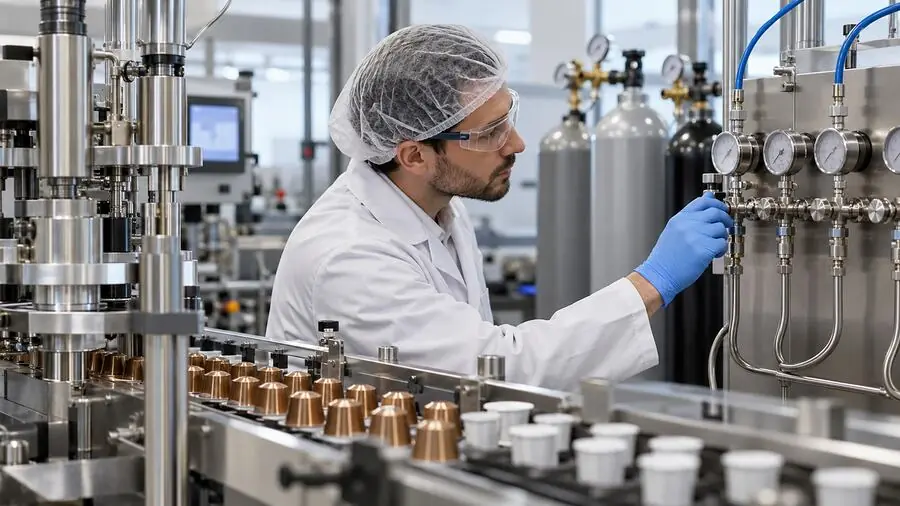
The numbers describe different samples. One concerns the incoming gas. The other concerns the gas remaining inside the finished package. Between those two points, coffee is handled, air is displaced, lids are positioned, and seals are formed. Plenty can change.
There is an arithmetic wrinkle too. Even in the same gas sample, 99.9% nitrogen does not establish a strict “less than 0.1% oxygen” result. The specification needs closer reading.
For a roaster, OEM factory, co-packer, or capsule brand, the useful question is not just “How pure is the nitrogen?” It is “What oxygen result can this complete process reliably achieve—and how will we verify it?”
Two Percentages, Two Different Samples
Nitrogen purity describes a gas supply under specified conditions. Residual oxygen describes oxygen remaining after a packaging process. Headspace oxygen usually means the oxygen concentration in the accessible gas space inside a sealed package.
These measurements are related, but they are not interchangeable.
| Measurement location | What the reading describes | What it does not prove |
| Generator outlet | Gas produced at the sampled conditions | Stable purity at every production demand |
| Machine inlet | Gas reaching the packaging machine | Effective displacement inside the capsule |
| Flushing enclosure | Atmosphere around the open product | The sealed capsule’s residual oxygen |
| Sealed capsule | Sampled headspace at the test time | Every capsule’s result or its full shelf life |
Think of clean water poured into a dirty glass. The water supply and the final glassful are different questions. High-purity nitrogen entering a capsule that still contains air faces the same basic problem: a clean input does not remove everything already there.
Keep the units consistent. 0.1% oxygen equals 1,000 parts per million by volume, or ppmv. That conversion applies when both values use the same basis.
Also, “below 0.1%” and “at or below 0.1%” are different acceptance statements. A rounded number on a screen is not enough to settle either one.
Why 99.9% Nitrogen Does Not Guarantee Sub-0.1% Capsule Oxygen
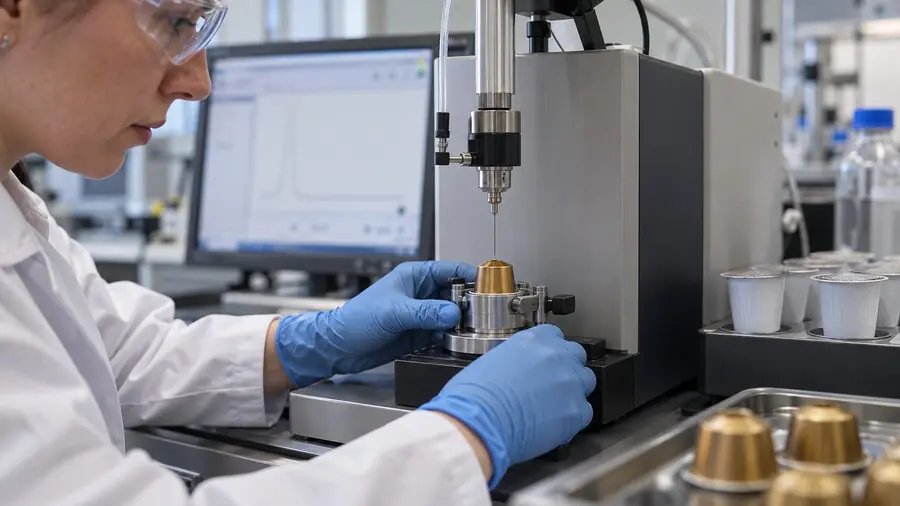
The remainder is not necessarily all oxygen
If a gas contains exactly 99.9% N₂ by volume, everything else totals 0.1%. Oxygen may be part of that remainder, alongside other constituents. It is incorrect to assume that every non-nitrogen molecule is oxygen.
Supplier conventions matter as well. Some specifications include argon or other inert gases in the reported nitrogen assay. Others infer a purity figure from measured oxygen rather than measuring every gas component directly.
Ask for the explicit oxygen limit, test method, units, and specification basis. Check whether the value is a minimum purity, typical reading, or guaranteed limit. Dry-basis and wet-basis results should not be casually compared either.
A little retained air can change the result
Here is a simplified illustration—not a machine-performance prediction.
Assume the purge gas contains 0.1% oxygen. Suppose 99% of the final gas volume comes from that supply, while 1% remains ambient air containing approximately 20.9% oxygen. With no reaction, outgassing, or further exchange:
Final O₂ = (0.99 × 0.1%) + (0.01 × 20.9%) = 0.308%
Just 1% retained air pushes the result above 0.3%. That is why improving displacement can matter more than another impressive decimal place on the generator brochure.
If incoming gas contains exactly 0.1% oxygen, dilution or displacement alone cannot bring an initially more oxygen-rich mixture below that feed concentration. Ideal replacement approaches the feed level. A stricter target may require lower feed oxygen, effective purging, and measurement margin.
Later readings can behave differently because coffee consumes oxygen, releases CO₂, or changes the gas balance. Those effects do not prove that the initial packing process achieved a lower oxygen exposure.
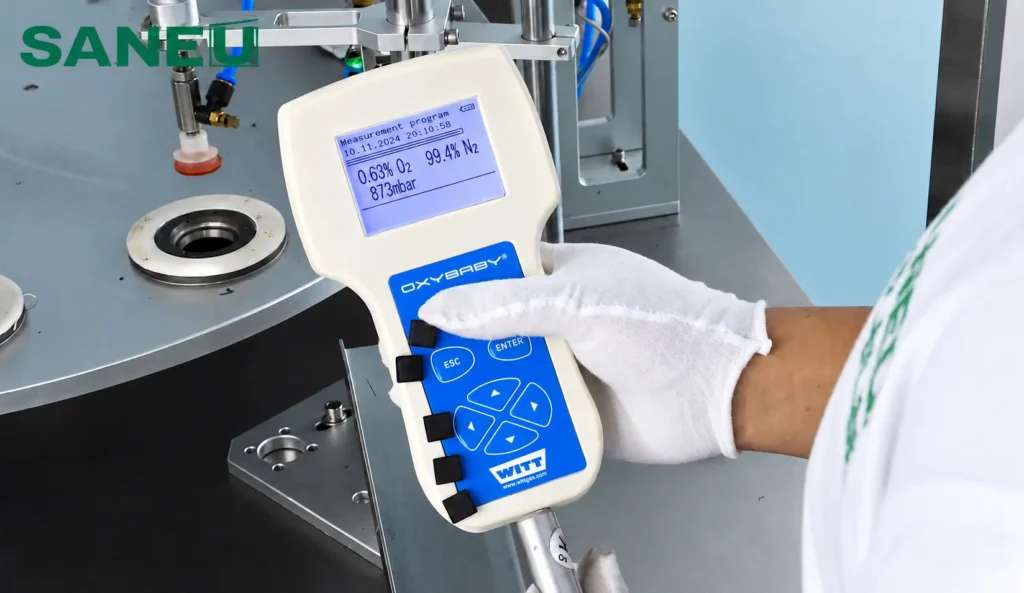
Where Oxygen Remains—or Gets Back In—During Pod Filling
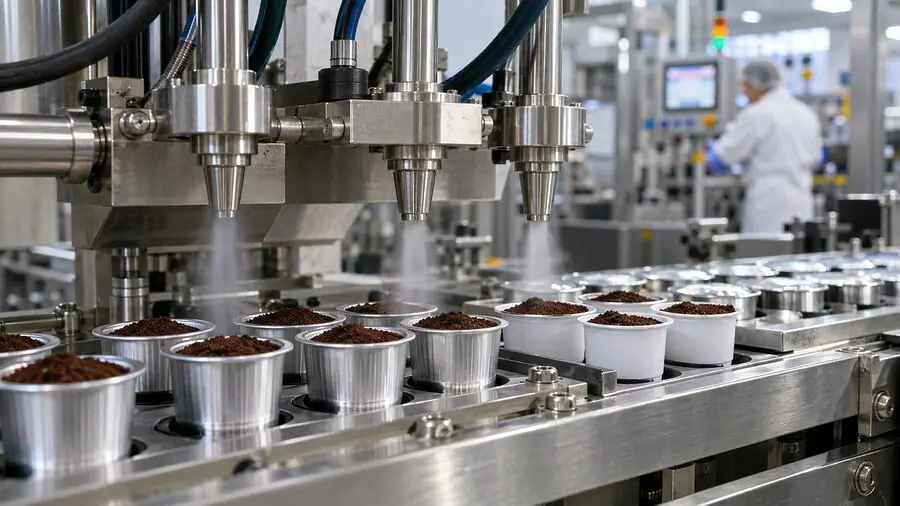
A coffee dose is not a solid plug. Air occupies spaces between particles, around filters, and inside the capsule. Flushing the visible space above the coffee may not replace gas throughout those spaces equally.
Grinding, transfer, hopper loading, and dosing can introduce or retain air. The process then has a limited time to displace it before sealing.
Nozzle position, gas flow, purge coverage, dwell time, and the delay between final flushing and sealing all matter. More flow is not automatically better. Poorly directed jets can disturb powder or entrain surrounding air in an open zone.
| Process issue | Why it matters | Check during trials |
| Air within the coffee dose | Headspace flushing may miss some spaces | Coffee handling and purge sequence |
| Short flushing time | Insufficient gas replacement | Actual production speed and dwell |
| Delay before sealing | Ambient air can re-enter | Transfer and lid-placement timing |
| Peak gas demand | Purity, pressure, or flow may drift | Supply at the machine during full production |
| Stops and restarts | Open capsules may lose their controlled atmosphere | Restart and reject procedures |
| Coffee dust on the rim | Seal integrity can suffer | Rim cleaning and seal inspection |
Vacuum-assisted processes can be useful, but vacuum is not universally required before nitrogen flushing. The appropriate approach depends on capsule geometry, coffee behavior, line architecture, and validated results.
For K-Cup-compatible products, the filling and sealing process sequence helps identify where dosing, rim cleaning, lidding, and sealing interact. Other capsule systems need their own trials. A setting that works for one cup, filter, and lid combination is not a universal recipe.
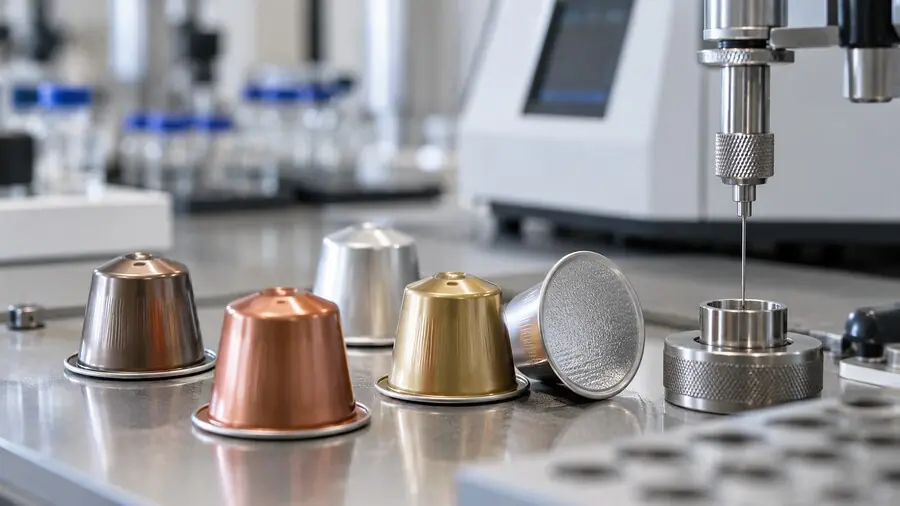
Can Your Analyzer Really Verify Less Than 0.1% Oxygen?
Here is the awkward bit: the test itself can become the weak link.
Resolution is not accuracy
Resolution is the smallest displayed increment. Accuracy describes how closely a reading represents the measured value under the stated conditions. Repeatability describes consistency between repeated measurements. These are different characteristics.
For a concrete example, AMETEK MOCON’s CheckPoint 4 specifications list 0.01% oxygen resolution for the stated oxygen configurations. They also list accuracy of ±(0.25% O₂ + 2% of readout) and a minimum sample volume of 5 ml.
Those are product-specific specifications, not a criticism of the instrument. They illustrate why a display reading of 0.08% cannot, on its own, establish compliance with a <0.1% requirement under that stated accuracy.
A scale displaying hundredths of a gram does not necessarily measure every hundredth correctly. The same idea applies here.
Choose an instrument and method suitable for the acceptance limit. Have QA or a qualified laboratory establish the uncertainty and decision rule. Do not invent a safety margin because a number looks comfortably below the line.
Small capsule headspace needs a suitable method
An analyzer requiring more gas than the capsule can reliably provide may produce misleading results. Sampling can reduce pressure, draw in outside air, or include gas from tubing rather than just the package.
Review the sample volume, needle, septum, tubing dead volume, pressure, sensor compatibility, and powder contamination risks. A blocked needle or poorly attached septum can spoil an otherwise careful test.
Small-volume or direct-in-package oxygen methods may be suitable, depending on the configuration. But “no gas extracted” does not automatically mean “non-destructive.” Piercing the lid still changes the package unless the method demonstrably preserves its integrity.
Define when and how the sample is tested
Record the time from sealing to testing, storage conditions, instrument configuration, calibration status, lot, lane, and operating state. Use appropriate calibration gases and checks around the intended measurement range.
There is no universal rule that every capsule must be tested exactly 24 hours after sealing. Establish test timing for the product and method. Immediate process checks and later agreed checks answer different questions.
And remember: headspace analysis is not a direct measurement of every bit of oxygen associated with the coffee. It is one useful measurement within a larger preservation assessment.
Package Materials Decide What Happens After Sealing
Low initial oxygen is helpful. Keeping the package intact afterward is a separate job.
An aluminum capsule body does not eliminate lid, coating, pinhole, or seal risks. PP and multilayer plastic performance depends on the actual structure and conditions. Compostable capsules need their own barrier, sealing, storage, and certification evaluation.
| Package element | Oxygen-control question |
| Aluminum body and foil lid | Are coatings, forming, pinholes, and seals sound? |
| PP or multilayer barrier body | What is the formed package’s barrier under relevant conditions? |
| Compostable structure | Does the exact system meet barrier and storage requirements? |
| Filter and coffee spaces | Can the purge reach the relevant gas spaces? |
| Lid and sealing interface | Are dust, alignment, and seal settings controlled? |
| Outer barrier wrap | Is preservation provided by the capsule, the wrap, or both? |
Permeation and leakage are different. Oxygen can pass through a material without a visible hole. It can also enter through a poor seal. A film oxygen-transmission result does not certify the complete formed capsule.
A 2024 study of specified coffee pod and capsule packaging tracked headspace oxygen and quality markers at 25°C and 40°C over 180 days. Its findings show why package structure and storage time belong in validation. They do not establish a universal oxygen target or shelf life for other capsule systems.
There is another trap: oxygen percentage may fall as coffee consumes oxygen or releases CO₂. A lower later percentage can therefore coexist with earlier oxidation. It is not a time machine that restores aroma.
When selecting empty coffee pods and capsule components, qualify the body, filter, lid, and sealing process together. Then validate the actual shipping and storage conditions.
Troubleshoot High Residual Oxygen Before Buying Purer Gas
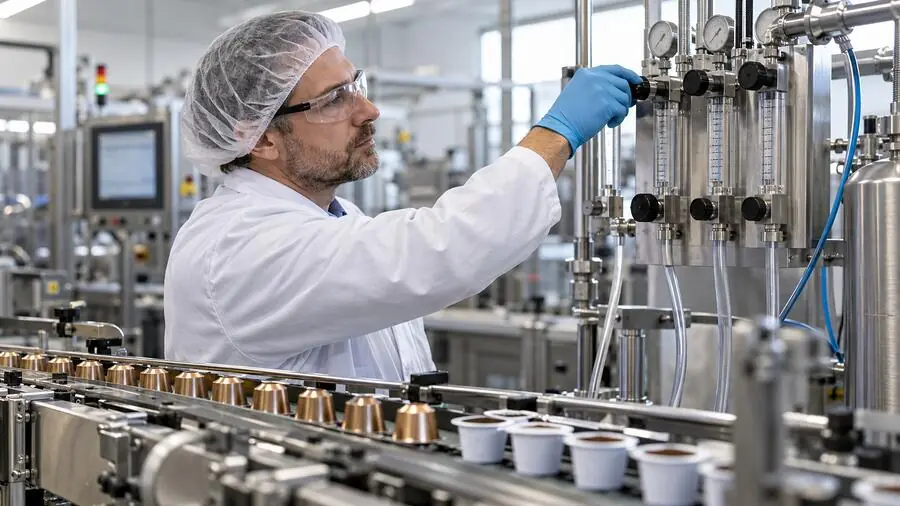
Start by confirming the measurement. Then compare the feed-gas oxygen at the machine with the finished-capsule result under actual production demand.
Parker’s food-grade nitrogen white paper describes a 2017 coffee-packing trial using feed conditions of 10 ppmv, 0.1%, and 0.5% oxygen. Finished-pack oxygen was measured separately against that project’s 2% limit. Reported samples remained below the limit.
This is a supplier case study for a specific packing application, not a capsule standard. It shows that feed and pack oxygen need separate tests. It does not prove that purity never matters or that 0.5% feed oxygen suits a sub-0.1% capsule target.
| Observed pattern | First checks | Action to validate |
| All lanes high immediately | Feed O₂, flow, timing, test method | Stabilize supply and improve displacement |
| One lane high | Nozzle, flow balance, seal station, sampling | Correct the local issue and compare lanes |
| Spikes after restart | Air re-entry, supply buffer, purge sequence | Validate restart controls |
| Higher O₂ at faster speed | Dwell, peak demand, seal delay | Test controlled speed and flow combinations |
| O₂ rises during storage | Integrity, barrier, conditions, testing | Investigate the whole package |
| Instruments disagree | Calibration, accuracy, volume, method | Compare with a suitable reference method |
Change one variable at a time where practical, and trend results rather than collecting only pass/fail ticks. Patterns across lanes, speeds, coffee lots, and stops often identify the problem.
A lower feed-oxygen specification may be necessary for a stricter target. It will not repair an ineffective nozzle or a contaminated seal. Reviewing the capsule filling and sealing machine functions can help turn a vague “nitrogen problem” into a specific process check.
Write an Oxygen Acceptance Specification, Not a Marketing Promise
Food-grade nitrogen and low capsule oxygen are separate requirements. A gas can meet the applicable food-use specification without guaranteeing the finished package’s atmosphere. Likewise, low headspace oxygen does not demonstrate that the gas supply meets all impurity requirements.
Check market-specific food-gas and food-contact obligations. Use supplier documentation, HACCP-based controls, calibration procedures, and recognized package-appropriate test methods. None of these automatically creates a mandatory <0.1% oxygen limit for all coffee capsules.
The customer specification should define:
- the coffee, dose, capsule body, filter, lid, and relevant outer packaging;
- line configuration, production speed, feed O₂, gas pressure, flow, and purge sequence;
- sampling across lanes, normal running, starts, pauses, changeovers, and material lots;
- test timing, conditions, instrument configuration, method, limit, and uncertainty decision rule;
- records, responsibilities, failure actions, retesting rules, and product-release authority.
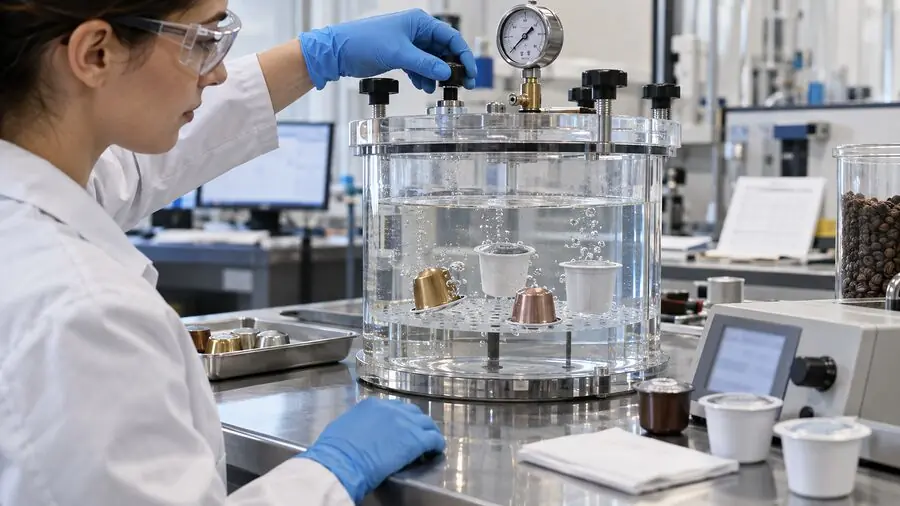
Factory acceptance testing, or FAT, and site acceptance testing, or SAT, should use agreed representative products and components. A slow demonstration with empty capsules is not equivalent to a commercial run with coffee at the contracted speed.
Roasters manage coffee preparation. Gas suppliers manage supply quality. Machine suppliers manage the agreed equipment capability. Converters support component performance. OEMs and co-packers operate the process, while QA teams or laboratories verify results. Put those boundaries in writing.
Finally, separate initial oxygen acceptance from shelf-life validation. Use retained samples, integrity checks, relevant storage and distribution tests, and sensory evaluation. The objective is coffee that still tastes right—not just a flattering number on packing day.
Conclusion
99.9% nitrogen does not automatically mean less than 0.1% oxygen inside a coffee capsule. Supply purity, gas displacement, package integrity, and measurement each need their own evidence.
A gas certificate describes the supply. A headspace test describes the sampled capsule at the test time. Neither alone guarantees the whole production lot or shelf life.
Set an oxygen target appropriate to the product, validate the method, and test the complete process. That is a stronger foundation than assuming two percentages describe the same thing.
Frequently Asked Questions
Does 99.9% nitrogen mean exactly 0.1% oxygen?
No. If N₂ is exactly 99.9% of the gas volume, other constituents total 0.1%; oxygen is not necessarily the entire remainder. Some supplier purity conventions also include inert gases. Ask for the explicit oxygen specification and measurement basis.
Is 0.1% oxygen the same as 1,000 ppm?
Yes, when ppm means parts per million by volume and both values use the same basis. One percent equals 10,000 ppmv, so 0.1% equals 1,000 ppmv. Confirm units before comparing certificates and instrument readings.
Can 99.9% nitrogen achieve less than 0.1% capsule oxygen?
The purity label alone cannot establish that result. If feed oxygen is exactly 0.1%, displacement alone cannot reduce a more oxygen-rich mixture below it. Lower actual feed oxygen and a validated process may support a stricter target. Later reactions can change readings.
What residual oxygen target should a coffee capsule use?
There is no universal target for every capsule. Select a limit using the coffee, package barrier, process, shelf-life objective, storage conditions, customer requirements, and suitable testing. Validate sensory performance rather than adopting an impressive number without product evidence.
Why is capsule oxygen higher than the nitrogen supply specification?
Retained air, powder handling, short purge time, poor nozzle coverage, air re-entry, or sealing problems can raise the result. Sampling errors can also distort it. Compare point-of-use supply and finished-package measurements before assuming the generator is at fault.
Is 0.01% analyzer resolution enough for a 0.1% limit?
Not by itself. Resolution describes display increments, not accuracy or total method uncertainty. Check the instrument configuration, low-range performance, sample-volume requirement, calibration, and decision rule. A reading just below the limit may not demonstrate compliance.
How should oxygen be measured in a very small capsule headspace?
Use a method validated for the available gas space and target concentration. Review sample draw, pressure, tubing dead volume, septum, needle, and contamination. Small-volume or direct-in-package methods may be suitable, but configuration and capsule-specific validation still matter.
Should capsules be tested immediately or after storage?
Both can be useful for different purposes. Immediate checks assess the packing process; later checks assess agreed equilibration or storage behavior. Define timing and conditions in the procedure. There is no universal waiting period applicable to every capsule and method.
Can aluminum capsules still allow oxygen in?
Yes. Even with a strong body barrier, oxygen can enter through damaged areas, pinholes, or imperfect lid seals. Assess the finished body-lid-seal system, not just the aluminum material. Handling and transport can expose weaknesses missed during initial tests.
Does low residual oxygen guarantee a long shelf life?
No. It helps assess oxygen control, but seal integrity, barrier, temperature, moisture, coffee condition, and prior exposure also matter. A lower later percentage may reflect oxygen consumption or CO₂ dilution. Use product-specific storage and sensory validation.