Europe looks wonderfully close together on a map. Move a pallet from Belgium to France and the distance may be shorter than one domestic US route. Easy, right?
Well, the map is the easy part.
Coffee habits, machine systems, retail price points, languages, waste collection and customer expectations can change at every border. A Nespresso-compatible aluminium capsule that feels natural in one premium retail channel may be too expensive for a discounter elsewhere. A compostable pod may fit a market with organised bio-waste collection but confuse consumers where that route barely exists.
The answer is not to make everything for everyone. That creates a cupboard full of tooling and slow-moving printed cartons. The smarter approach is a platform portfolio: a small number of repeatable coffee and packaging systems, adapted only where a market or channel gives a good reason.
Here is how to build one.
Europe Is a Region, Not One Coffee Capsule Market

Start by dropping the phrase “European consumer” for a moment. It hides more than it explains.
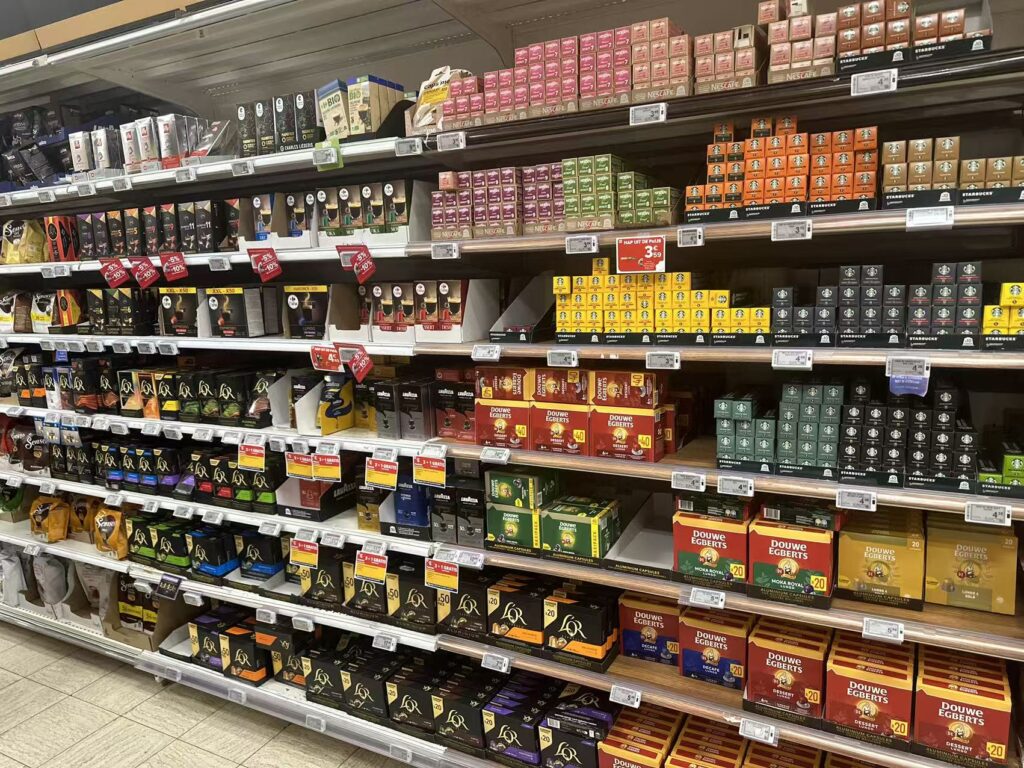
Italy has a deep espresso culture and several established capsule systems. France, Spain, Germany, Benelux and the UK each have different retail structures, price ladders and machine footprints. Hospitality buyers care about service reliability and case efficiency. Grocery buyers care about shelf architecture and promotions. A subscription brand can explain a novel material online; a supermarket capsule gets perhaps two seconds to make sense.
Europe also extends beyond one regulatory box. EU rules cover the Union, while the UK and Switzerland have their own frameworks. Norway participates in much of the single market through the EEA but still needs country-specific checking. Languages and extended producer responsibility arrangements add another layer.
So the first portfolio unit is not “Europe.” It is:
country or country cluster × channel × brewer system × price tier
That sounds fussy, but it prevents an expensive mistake: assuming a capsule format popular with one distributor will travel automatically across the continent.
Build a Market-Format-Channel Matrix Before Choosing Products
Create a one-page matrix for each priority country. Keep it commercial, not academic.
| Decision field | What to document | Why it matters |
| Target customer | Grocery, DTC, office, hotel, café or distributor | Changes pack size, service level and price |
| Brewer system | Installed formats confirmed by retailer and consumer evidence | Determines capsule geometry and tooling |
| Price tier | Value, mainstream or premium | Guides coffee, material and decoration |
| Expected volume | Base, downside and upside by SKU | Prevents excess tooling and printed stock |
| Waste route | Recycling, residual waste or bio-waste access | Shapes material and disposal communication |
| Label needs | Language, legal particulars and local claims | Determines artwork versions |
| Route to production | In-house, co-packer or hybrid | Sets lead time, MOQ and control |
Do not rely on broad market reports alone. Ask retailers what systems actually turn in their category. Review competitor shelves. Check ecommerce bestseller lists. Interview office-coffee distributors. Look at machine promotions, because a cheap brewer placed today can create capsule demand for years.
Give every assumption an evidence grade: confirmed, probable or exploratory. Only confirmed demand should justify dedicated tooling.
Choose Core Capsule Formats, Then Add Selective Ones
The SANEU overview of different coffee pod systems is a useful starting map. In practice, a multi-market producer should separate core platforms from selective opportunities.
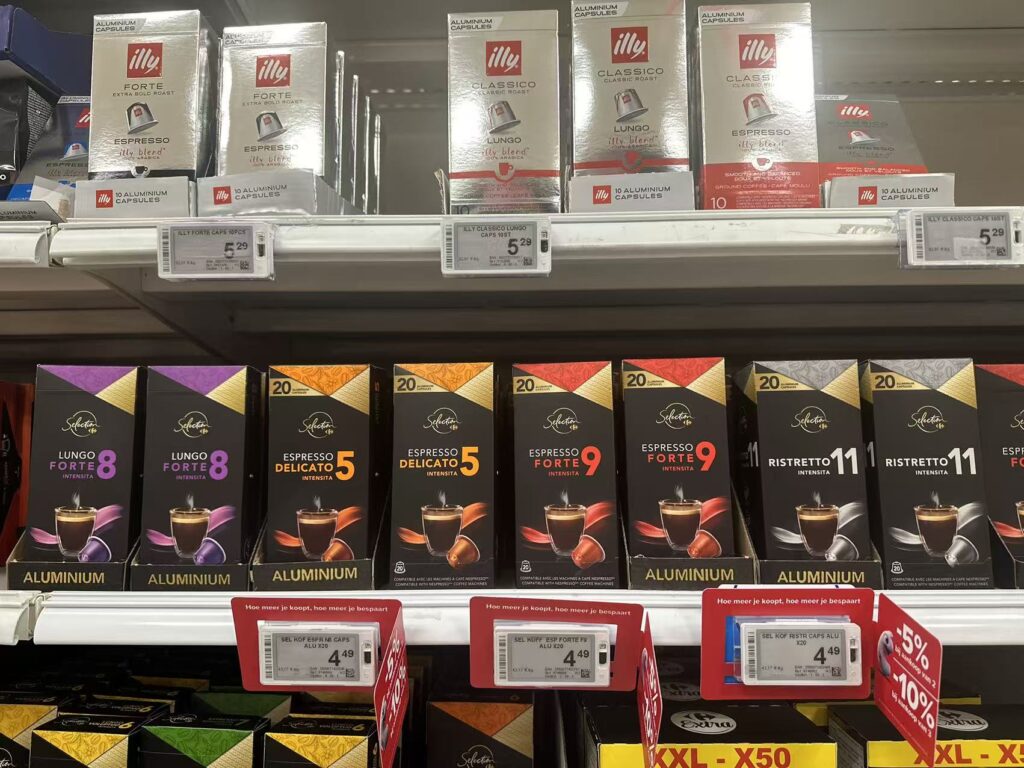
Nespresso Original-compatible as a common core
The Original-compatible form is widely recognised in European retail and ecommerce. It supports espresso and lungo positions, premium decoration and a large third-party supply ecosystem.
That does not make every capsule automatically compatible. Geometry, flange shape, puncture behaviour, lid resistance and extraction must work across representative machines. A capsule that behaves nicely in one old office brewer may jam in a newer home model. Charming in the lab, painful in the reviews.
Dolce Gusto-compatible for a different drinking occasion
Dolce Gusto-compatible pods serve larger beverages and milk-style drinks as well as coffee. They can suit grocery, family and mixed-beverage portfolios. The larger capsule changes dose, material cost, carton size and line tooling.
A producer entering this system should treat it as a separate product platform, not a larger version of an espresso capsule. SANEU’s Dolce Gusto filling-machine range shows how the format requires its own feeding, filling and sealing configuration.
ESE, soft pods and regional systems
ESE paper pods, Senseo-style soft pods, Tassimo T-Discs, Lavazza systems and other formats can be commercially relevant. They should enter the portfolio only when customer evidence supports them.
Some are more open to compatible production than others. Some may involve licensing, intellectual-property or technical-access questions. Have legal counsel review brand references and format rights before artwork or tooling is approved. “Everyone sells one” is not a legal opinion.
Keep export formats outside the European core
K-Cup-compatible products can matter for North American export or European office niches, but they should not quietly inflate a Europe-first range. Keep export platforms in a separate business case with their own demand, compliance and logistics.
Build a Good-Better-Best Capsule Architecture
A multi-market portfolio does not need a unique coffee for every country. Start with a small sensory backbone and adapt it carefully.
For example:
| Tier | Coffee proposition | Likely packaging direction | Commercial job |
| Good | Reliable espresso blend | Cost-efficient qualified structure | Entry price and volume |
| Better | Distinct origin or certified blend | Strong barrier with upgraded print | Mainstream differentiation |
| Best | Specialty, limited or traceable lot | Premium aluminium or validated high-barrier option | Margin and brand halo |
The same three coffee platforms can support several label languages and pack counts. That is much cleaner than building 18 recipes because six sales teams all asked for something “exclusive.”
Allow real local differences when they earn their keep. A darker profile may work for one channel. A lungo-oriented dose may suit another. Decaf may be essential in hospitality. But each exception should have an owner, forecast and exit rule.
A simple test helps: if a consumer cannot notice the difference and the retailer will not pay for it, the extra SKU is probably internal decoration.
Match Capsule Materials to Shelf Life, Waste Systems and PPWR
Material strategy is now a portfolio decision, not a late purchasing task. Aluminium, plastic and compostable structures differ in barrier, forming, sealing, cost, recovery route and consumer meaning. SANEU’s comparison of aluminium and plastic capsule packaging explains the basic trade-offs.
| Material path | Strength | Watch-out | Possible role |
| Aluminium | Excellent oxygen and light barrier; premium feel | Cost, forming and collection route | Premium and longer shelf-life ranges |
| Plastic/high-barrier plastic | Flexible decoration and established production | Structure and local recyclability vary | Value or mainstream programmes |
| Industrially compostable | Can travel with coffee grounds where systems accept it | Barrier, certification and collection access | Selected bio-waste-friendly markets |
| Fibre/paper-led | Strong natural visual language | Seal, barrier and machine performance need proof | Controlled pilots and short channels |
The EU Packaging and Packaging Waste Regulation, Regulation (EU) 2025/40, entered into force in February 2025 and generally applies from 12 August 2026. It brings packaging design, recyclability, labelling, minimisation and producer responsibility into a more harmonised framework.
Coffee capsules deserve special attention. The legal treatment differs between permeable units that soften after use and non-permeable machine capsules. Under the official PPWR text, Member States may require certain non-metal, non-permeable beverage capsules to be compostable when suitable collection and treatment conditions exist.
That wording is exactly why one material claim should not be copied blindly across Europe. Build a country disposal matrix. Verify certification, collection access, sorting guidance and required consumer wording. Also review national EPR registration, reporting and fees with local specialists.
Do not market “eco-friendly” as a foggy feel-good promise. Say what the capsule is made from, under which conditions it can be recovered, and what the consumer should do.
Adapt Coffee Dose, Grind and Extraction by Capsule Format
A coffee recipe is not portable software. Move it into a different capsule and the extraction physics change.
Capsule volume, filter or base design, lid behaviour, water pressure and brewer programme affect flow. So do grind distribution, dose, roast development and degassing. The producer needs a format-specific product brief covering:
- Target fill weight and tolerance
- Grind distribution, not just an average setting
- Brew buttons and beverage volume
- Flow time and cup yield
- Sensory reference
- Seal integrity and residual oxygen
- Shelf-life target
- Compatible brewer test panel
Test several machines bought from the target market. Older and newer brewer generations may behave differently. Record puncture, leakage, flow and sensory results. Consumer Reddit threads repeatedly complain about third-party capsules that fail to pierce or brew consistently; the anecdotes are messy, but the risk is real.
Nitrogen flushing can help lower residual oxygen. It cannot repair a weak seal or a poor barrier. Shelf-life work must use the final coffee, capsule, lid and distribution conditions.
Localise Labels Without Multiplying Finished-Goods Inventory
The EU’s food-information language rules require mandatory information in a language easily understood in the Member State where the food is sold. Countries may require one or more official EU languages within their territory.
That makes artwork architecture important. Common options include:
- A regional multilingual carton for several countries.
- A common capsule lid with market-specific cartons.
- A shared base carton plus compliant country label.
- Country-dedicated artwork for high-volume programmes.
The first option reduces inventory but can turn the back panel into a tiny newspaper. The fourth gives a clean shelf pack but creates more printed-stock risk. Choose based on volume, available label area and retailer requirements.
Maintain one controlled data source for product name, ingredients where required, allergens, net quantity, durability date, storage, operator details, origin statements and disposal directions. Translation should follow approved source text. Do not let six local agencies quietly invent six slightly different products.
For prepacked foods, the Commission’s mandatory food information guidance is a sound starting point. Country counsel should confirm the final pack, including voluntary intensity scales, certification marks and environmental claims.
Design Capsule Equipment for Controlled Flexibility
A multi-market portfolio does not necessarily need one machine that does absolutely everything. Universal machines sound lovely until every Monday begins with a long rebuild.
Consider three layouts:
| Equipment model | Best fit | Main trade-off |
| Dedicated line per major format | High, stable volume | More capital and floor space |
| Changeover-capable platform | Moderate volume across related formats | Tooling discipline and downtime |
| Hybrid in-house/co-pack network | New or uneven demand | More planning and external coordination |
A multi-format coffee capsule filling platform can support several projects through format tooling, but the business case must include changeover labour, validation, cleaning and spare parts. A producer with dominant Original-compatible demand and a small Dolce Gusto opportunity may be better with one dedicated core line and a co-packer for the secondary format.
Measure capacity in saleable capsules per scheduled hour. Include changeovers, sanitation, sampling, minor stops and rejects. Brochure speed is a ceiling, not a forecast.
Before buying equipment, send the intended coffees, capsules and lids for trials. Use a written acceptance protocol covering sustained speed, fill tolerance, lid placement, seal integrity, residual oxygen and reject handling. The practical coffee capsule machine selection guide can help frame supplier questions.
Map European Rules and Customer Standards Early

Compliance belongs at the front of portfolio planning because it can change materials, suppliers, labels and data systems.
Food-contact materials
The European Commission states that food-contact materials placed on the EU market must comply with Regulation (EC) No 1935/2004 and be manufactured under applicable GMP rules. Its food-contact materials overview also points to material-specific and national legislation.
Collect declarations of compliance, migration evidence where applicable, specifications and change notifications for capsule bodies, coatings, filters and lids. A supplier changing a colourant or seal layer can change the compliance file and the production result.
PPWR and national producer responsibility
PPWR is more harmonised than the old directive, but producer responsibility still needs market-by-market execution. Identify who is the legal producer, which registrations are required, what packaging data must be reported and who pays the fees.
EUDR and coffee traceability
Coffee falls within the EU Deforestation Regulation. In July 2026, the Commission confirmed that implementation would begin at the end of December 2026 and published updated support measures. The Commission’s EUDR update is a current official reference.
Portfolio teams should connect coffee-lot traceability with finished capsule lots. Repackaging the same blend in three formats must not break the evidence chain.
Customer standards
Retailers and private-label buyers may require IFS, BRCGS, ISO 22000, organic certification, Fairtrade or other schemes. These are not interchangeable. Map them by account before allocating production.
Roll Out the Portfolio in Waves
Do not launch five formats in eight countries because the spreadsheet allows coloured cells.
Use a three-wave plan:
Wave 1: Prove the core
Launch one high-confidence format in one or two markets. Use a small sensory architecture and limited pack counts. Validate compatibility, returns, repeat sales and forecast accuracy.
Wave 2: Extend the platform
Add adjacent countries or channels that can use the same capsule, material and coffee base. Localise the outer pack only where necessary. This is where the portfolio begins to gain leverage.
Wave 3: Add a new system selectively
Introduce Dolce Gusto-compatible, soft pod or another platform only after demand supports tooling and operational complexity. Keep co-packing available for pilots, peaks or specialist materials.
Review every SKU quarterly. Measure sales, contribution margin, service level, waste, changeover burden and printed-material exposure. Give weak SKUs a repair plan or an exit date. Portfolio pruning sounds harsh, but dead cartons are harsher.
Conclusion: Build a Platform, Not a Pile of Capsules
A successful European capsule portfolio begins with market evidence, not an equipment catalogue. Country, channel, brewer system and price tier define the commercial job. Coffee, material, label and production route then support it.
Keep the core small. Standardise what consumers cannot see. Localise what customers and regulators genuinely require. Validate every format with the final coffee and packaging. And treat PPWR, food-contact evidence, labels, EPR and EUDR as design inputs rather than launch-week paperwork.
Europe’s complexity is manageable when the portfolio has a platform underneath it. Without one, every new market becomes a new little factory. That gets tiring fast.
FAQs About European Coffee Capsule Portfolio Planning
1. Which coffee capsule format is most popular in Europe?
There is no single answer across all countries and channels. Nespresso Original-compatible capsules are widely visible, while Dolce Gusto, ESE, soft pods and regional systems can be important in selected markets.
2. Should a producer launch the same capsule range in every European country?
Usually not. Reuse the same product platforms where possible, but adapt format, pack count, language, price tier and disposal information to verified local needs.
3. What is a multi-market capsule portfolio?
It is a planned range of capsule formats, coffees, materials and packs designed to serve several national markets while sharing enough components and processes to remain efficient.
4. Are Nespresso-compatible capsules legal to sell in Europe?
Compatible products are widely sold, but producers should obtain legal advice on patents, trademarks, comparative references and artwork for the specific format and markets.
5. Can one filling machine produce several capsule formats?
Some platforms can change formats with dedicated tooling. The producer must verify changeover time, filling range, sealing configuration, validation work and realistic output.
6. Are coffee capsules considered packaging under PPWR?
PPWR expressly addresses both permeable beverage units and non-permeable machine capsules. Their compostability treatment differs, so the exact design and target Member State matter.
7. Must coffee capsules be compostable in the EU?
Not all capsules face one blanket rule. Certain permeable units have compostability requirements, while Member States may require some non-metal, non-permeable capsules to be compostable where suitable systems exist.
8. Is aluminium or plastic better for coffee capsules?
Aluminium offers excellent barrier performance and premium positioning. Plastic can offer cost and decoration flexibility. The better choice depends on shelf life, recovery route, equipment and market price.
9. What standards apply to compostable coffee capsules?
Certification commonly references recognised industrial or home-compostability standards, but the applicable PPWR rules, harmonised standards and national collection conditions should be verified for each launch.
10. How many coffees should a new capsule range include?
Start with a small sensory backbone, often a value or core espresso, a differentiated premium option and decaf where demand supports it. Add variants only after sales evidence appears.
11. Do coffee capsule labels need different languages?
Mandatory food information must be easily understood in the market where the food is sold, and Member States may specify official languages. Multilingual packs can serve several countries when legibility is maintained.
12. How should capsule compatibility be tested?
Use several brewer models from the target market. Check loading, puncture, leakage, flow time, beverage volume, extraction and consumer handling over repeated brews.
13. How does EUDR affect capsule producers?
Coffee is an in-scope commodity. Businesses should map their role and connect required coffee due-diligence and traceability data to roasted and finished capsule lots.
14. Is co-packing useful for a multi-market portfolio?
Yes. It can test a secondary format, cover peaks or provide a certified material route without buying dedicated equipment before demand is proven.
15. What is the biggest portfolio-planning mistake?
Adding formats and printed SKUs faster than demand can support them. The result is idle tooling, long changeovers, obsolete packaging and cash trapped in inventory.