A pallet of empty capsules is inventory. A tested capsule program is a business.
Coffee roasters are rarely worried about the cup price alone. They also fear poor extraction, lids that will not seal, late replenishment, and custom stock sitting for a year. A reseller who reduces those risks becomes useful. One who only forwards a price list is easy to replace.
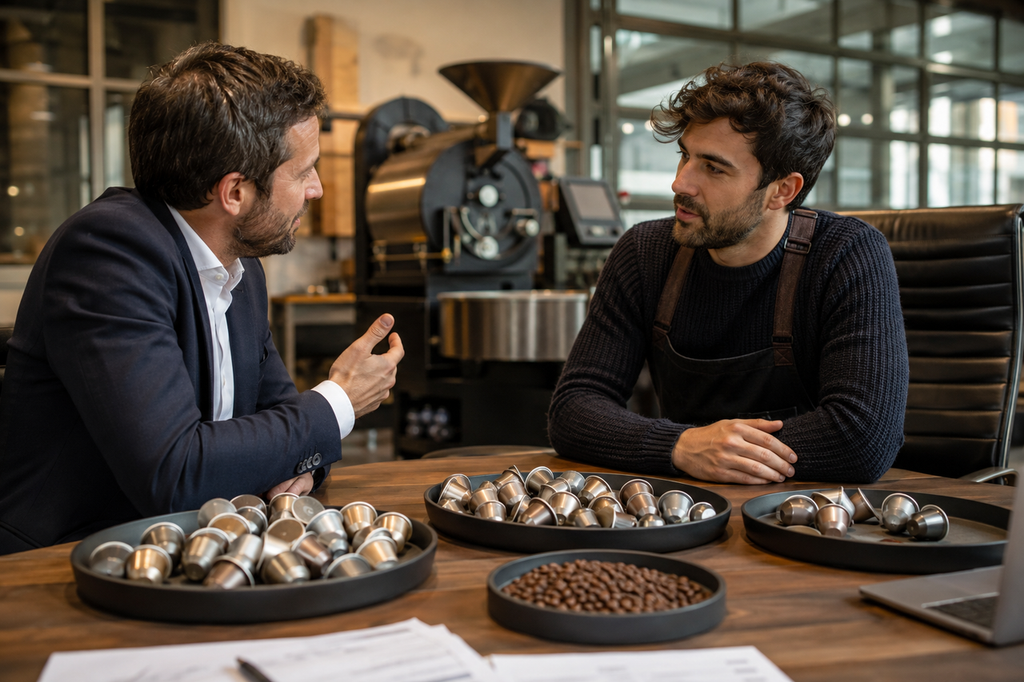
This guide focuses on independent resellers and distributors of empty capsules and matching lids intended for Nespresso Original-compatible products. It does not cover the resale of genuine filled Nespresso capsules. “Nespresso” identifies the intended machine system only; it does not suggest authorization, affiliation, sponsorship, or endorsement.
Start With the Right Coffee Roaster, Not the Longest Prospect List
The best partner is not always the largest roaster. A big company can discuss capsules for months while nobody owns the project. A smaller roastery with a clear customer base, project owner, and co-packing route may be ready now.
Start by asking practical questions:
- Which market and sales channel will receive the capsules?
- Are customers already asking for Original-compatible coffee?
- Will the roaster fill in-house or use a contract packer?
- Who can adjust the roast, grind, dose, and sensory target?
- How many products are planned for the first launch?
- Who approves samples, artwork, and purchase orders?
- What is the real launch date and budget?
Do not confuse enthusiasm with readiness. A roaster with no filling route, forecast, or trial approver is still a lead, but not yet a stock commitment.
| Readiness stage | What the reseller should verify | Sensible next step |
| Curious | No confirmed demand, production route, or budget | Discovery call and standard samples |
| Pilot-ready | Defined format, coffee, channel, owner, and test capacity | Joint product brief and trial |
| Scale-ready | Approved product, forecast, quality records, and reorder plan | Stock and service agreement |
Think of it like selling shoes. First check the size. Shipping a container and hoping the foot grows later is, well, a painful strategy.
Decide What Kind of Reseller Partnership You Are Offering
“We want to partner with roasters” sounds good on a website. It says almost nothing about the actual work.
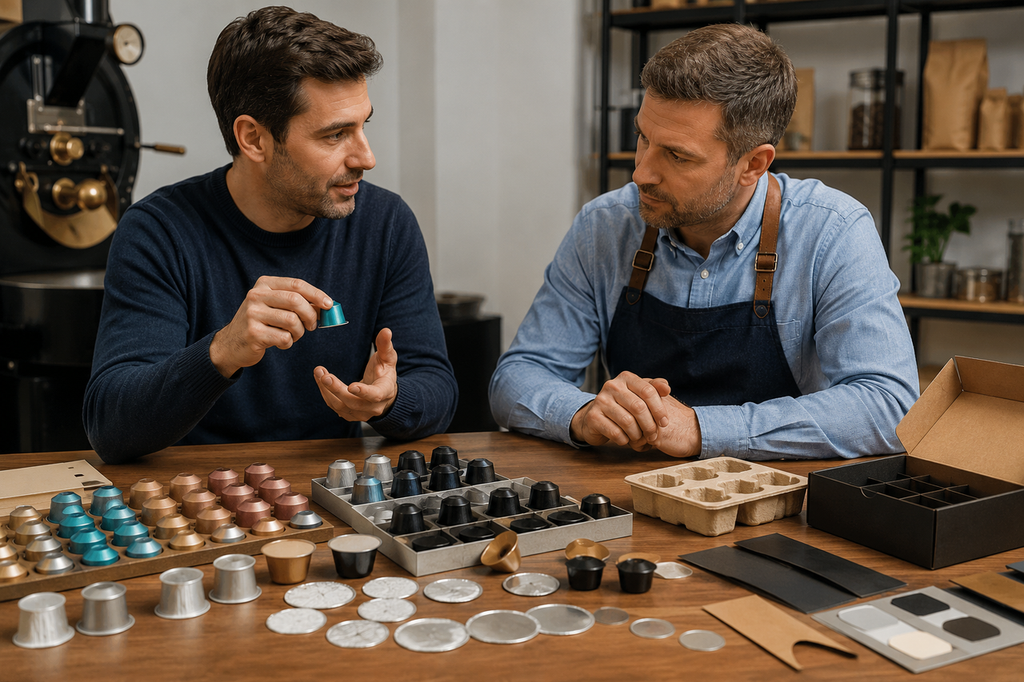
A supply-only distributor sells approved cups and lids. A local-stock partner shortens replenishment time. A development partner coordinates trials. A referral partner introduces a co-packer or equipment supplier. Some distributors combine roles, but each layer costs time and money.
| Partnership model | Reseller contribution | Best fit | Main risk |
| Component supply | Cups, lids, shipping, and basic documents | Experienced roaster with a technical team | Price-only competition |
| Local stock program | Buffer stock and planned replenishment | Stable regional repeat demand | Slow-moving inventory |
| Development support | Samples, trial records, and supplier coordination | First capsule launch | Unpaid technical work |
| Referral or co-selling | Qualified lead and specialist introductions | Roaster without filling capability | Unclear customer ownership |
| Protected territory | Market development against agreed targets | Proven distributor with real coverage | Broad exclusivity without results |
Price the service you provide. Unlimited testing, custom presentations, emergency deliveries, and troubleshooting cannot survive inside a thin component markup.
OEM, private label, contract manufacturing, and co-packing do not mean exactly the same thing to every supplier. The signed scope matters more than the label. SANEU’s guide to OEM coffee manufacturing roles helps when several companies will touch the product.
Exclusivity needs the same clarity. A reseller should not receive an entire country because it sent one email. A fair territory agreement can be linked to purchases, payment record, response time, marketing activity, and technical service.
Build One Product Brief Before Sending Samples Everywhere
Samples often go wrong before the courier arrives. The reseller thinks the project is aluminum. The roaster expects compostable capsules. The co-packer tests a different lid. Three companies are now solving three different products.
Create one short product brief that records:
- target capsule system and sales market;
- coffee style and intended beverage size;
- target dose range;
- capsule body, ring, coating, and color;
- matching lid construction;
- filling machine and relevant tooling;
- brewer models used for qualification;
- first-order and annual-volume estimate;
- retail pack concept and planned claims;
- project owner, approvers, and target date.
The manufacturer confirms the component specification and evidence. The reseller organizes samples and communication. The roaster owns the coffee target, while the co-packer controls filling and sealing. The brand owner remains responsible for its finished offer and claims.
When customization is required, use a written OEM and ODM empty-capsule ordering process rather than a chain of loose chat messages. A slightly boring brief is much cheaper than an exciting misunderstanding.
Keep Original, Vertuo, and Professional Separate
The project should name the exact system. The official Nespresso FAQ states that Original and Vertuo are different systems using different capsules. An Original-compatible empty capsule should not be offered as a Vertuo solution.
Use the same wording in quotations, samples, technical records, and finished packaging. Entry into one brewer is not proof of broad compatibility. The capsule must also puncture, extract, eject, and remain sealed.
Match the Cup, Lid, Coffee, and Filling Line as One System
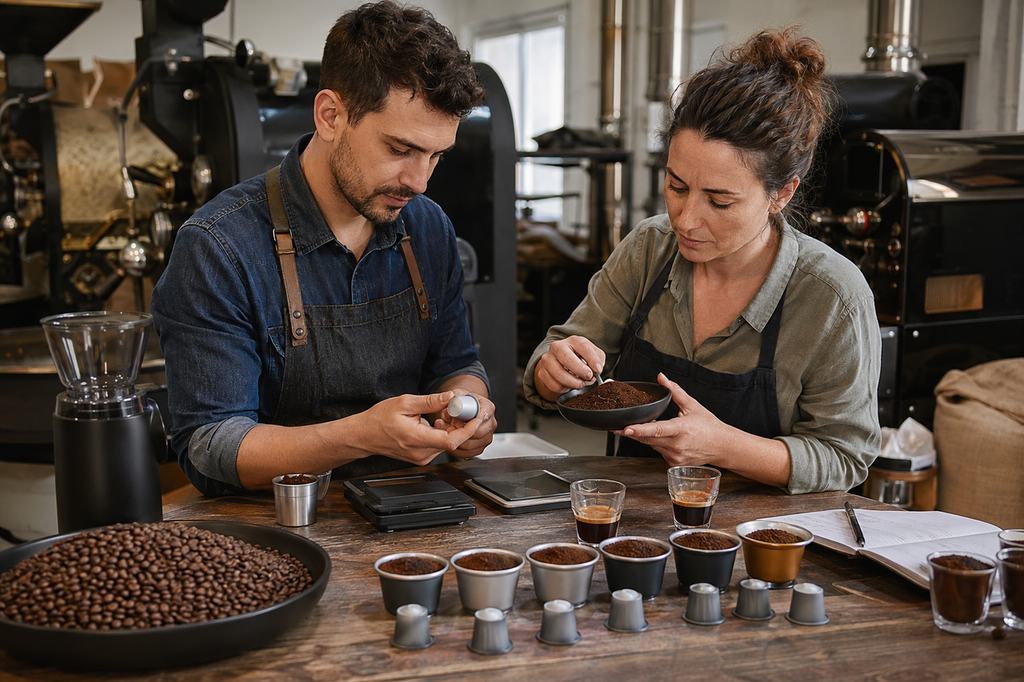
A reseller does not need to become a coffee scientist. It does need to understand that the empty cup cannot be qualified alone.
Choose material by market and process
Aluminum may offer strong barrier performance and a premium look. Its coating, flange, lid system, deformation behavior, and local collection route still matter.
PP or other barrier-plastic constructions offer structural and cost options. Ask which food-contact evidence covers the exact structure and whether a realistic local collection route exists.
Certified compostable capsules can stand out where storage, sealing, certification, and local organic-waste infrastructure line up. A material name alone does not support every finished-pack claim.
| Material route | Potential strength | Question before approval |
| Aluminum | Barrier and familiar premium presentation | Which coating, lid, seal window, and collection route apply? |
| PP or barrier plastic | Mechanical and cost flexibility | What evidence covers the exact material structure? |
| Certified compostable | Differentiation in a suitable market | What certification and local disposal route support the claim? |
Review the available Original-compatible empty capsule options with the actual filling and sales conditions in hand. If the roaster may later add other systems, the broader empty coffee capsule range can help map that expansion without mixing formats in the first pilot.
Treat the lid as part of the capsule
The lid is not a last-minute accessory. Its diameter, sealing layer, structure, and intended conditions must match the cup and process.
An unqualified combination may wrinkle, peel poorly, or leak. Coffee dust, worn tooling, or unsuitable heat, pressure, and dwell time can look similar. No universal setting fits every cup, lid, and machine.
Bring the coffee and filling line into qualification
Roast profile, particle-size distribution, dose, coffee-bed density, flange cleanliness, and sealing conditions all affect the result. Nitrogen flushing may support freshness, but gas purity at the inlet is not the same as residual oxygen measured in the finished package. The difference is explained in SANEU’s guide to nitrogen packaging and oxygen control.
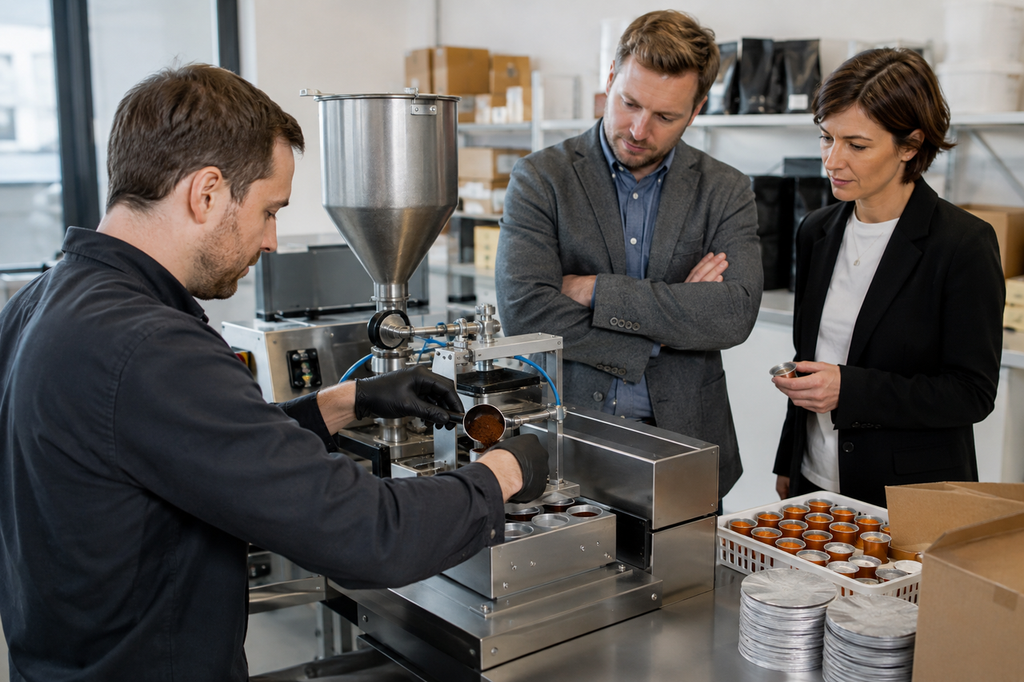
Confirm that the line has suitable cup handling, dosing, lid placement, sealing tooling, and change parts. If the roaster is still planning equipment, start with the practical factors in choosing a coffee capsule filling machine. Do not select a machine from a headline speed alone.
Run a Pilot That Can Produce a Yes or No
A useful pilot has written acceptance criteria. Otherwise, people inspect the same result and remember different expectations.
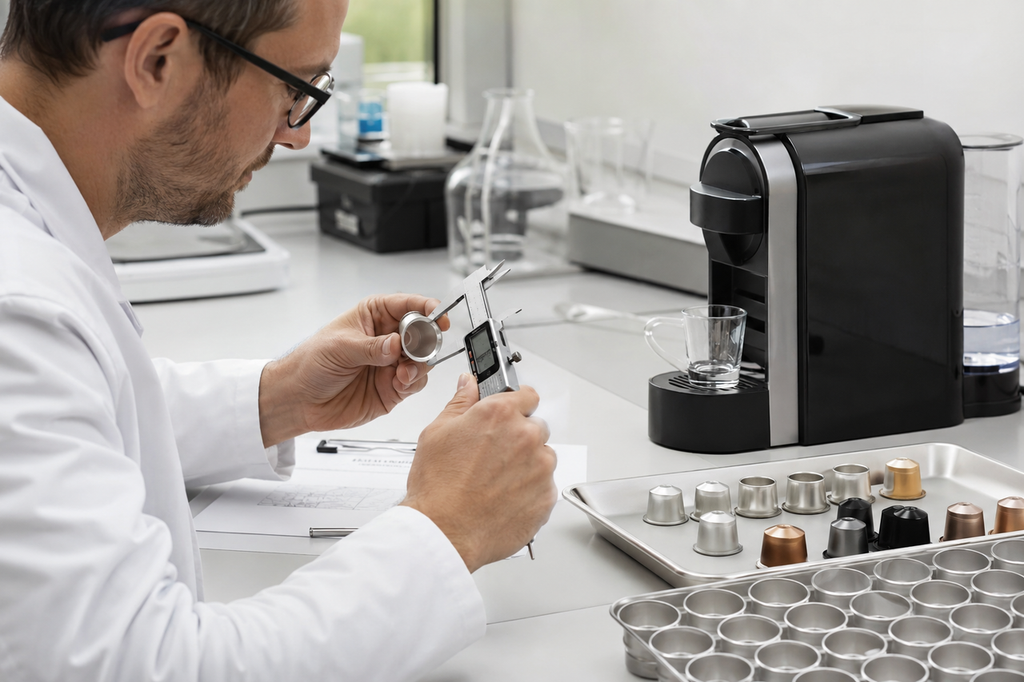
Begin with traceable, commercially representative samples. Record the cup and lid lots, then check dimensions and appearance before they enter the line.
Run a setup test, then a production-representative trial. Record fill variation, flange condition, seal settings, leaks, deformation, and rejects. Test agreed Original machines, not only the clean brewer in the meeting room.
Review puncture, extraction time, beverage weight, flow, taste, ejection, and leakage. Retain approved and failed samples; they become useful when a later batch is questioned.
| Pilot stage | Evidence to collect | Decision |
| Component check | Dimensions, appearance, lot, and lid match | Can it enter the line? |
| Line trial | Fill variation, flange condition, seal, and rejects | Is production stable? |
| Brewer test | Puncture, flow, beverage, ejection, and leaks | Does it meet the agreed use? |
| Shelf-life plan | Barrier, oxygen target, storage, and retained samples | Is the planned life supportable? |
Agree who signs approval and what requires another trial. A pilot with no pass/fail rule is like judging a football match after somebody moves the goalposts.
Make the Economics Work at Reorder Time
The reseller’s cost begins at the factory. Add freight, applicable duties and taxes, handling, samples, financing, rejects, technical time, local delivery, and margin.

The roaster adds coffee, grinding, filling, artwork, cartons, testing, fulfillment, channel margin, promotion, and returns. Working backward from a plausible selling price exposes uncomfortable numbers early. Good.
MOQ is rarely one number. Cups, custom colors, printed lids, cartons, cases, and line setup may each have a different minimum. The least flexible item controls the cash commitment.
For a first run, a standard color, qualified stock lid, simple outer pack, and one or two coffees may beat a beautiful six-product family. Fancy inventory is still inventory.
| Commercial issue | Question to settle |
| MOQ stack | Which component creates the real cash commitment? |
| Buffer stock | Who owns it, funds it, and accepts slow-moving stock? |
| Forecast | Is it indicative or linked to a purchase commitment? |
| Price review | Which freight, material, currency, or volume changes trigger it? |
| Payment terms | When does credit begin, and what limit applies? |
Put forecast frequency, lead-time assumptions, reorder points, safety stock, and specification changes in writing. Local stock is valuable because it shortens supply. It is dangerous when nobody has agreed who pays for the unpopular purple capsule after the roaster changes its branding.
Protect Leads Without Claiming an Entire Market
Channel conflict can ruin a technically good partnership. Set the rules before the first joint call.
Define lead registration, the protected account, its protection period, and quotation ownership. State whether the manufacturer may contact the roaster for technical work. Cover customer data, confidential pricing, artwork, samples, and repeat orders.
A named-account arrangement is often easier to manage than country-wide exclusivity. If a territory is granted, connect it to measurable purchases, payment performance, response times, market-development work, and service capability. Also define what happens when the reseller cannot support the opportunity.
Non-circumvention and exclusivity clauses can have legal and competition implications. Get appropriate advice for the actual markets. The practical aim is not to build a legal fortress. It is to stop surprises.
Put Quality and Compliance Responsibilities in Writing
Empty capsules and lids are food-contact components. The documents required depend on material, role, and destination market. As one regional example, the European Commission’s food-contact materials guidance explains that materials placed on the EU market must follow the applicable framework and good manufacturing rules.

The manufacturer maintains the approved specification, food-contact evidence, lot identification, production controls, and change notification. The reseller preserves traceability, stores components correctly, transfers current documents, and communicates changes.
The roaster or co-packer owns process controls, production records, finished-product checks, retained samples, and shelf-life work. The responsible brand owner or importer checks final labels and claims for the destination market.
ISO 22000:2018 provides a food-safety management framework for organizations across the food chain, including relevant packaging activities. Certification can support supplier qualification, but it does not approve one capsule SKU, a finished label, or an environmental statement.
When something goes wrong
Do not begin with blame. Quarantine the lot and collect its code, specifications, storage history, machine settings, fill data, flange photos, brewer model, failed samples, and complaint pattern.
| Problem | First evidence to collect | Parties likely involved |
| Leak or weak seal | Lot, lid, flange image, settings, and retained sample | Roaster, reseller, component maker |
| Slow or uneven flow | Grind, dose, beverage result, and brewer model | Roaster, co-packer, technical team |
| Capsule deformation | Incoming dimensions, tooling, line, and brewer evidence | Manufacturer, machine supplier, roaster |
| Claim or document gap | Exact SKU, market, wording, and available evidence | Brand owner, importer, supplier |
One symptom can have several causes. A clean evidence pack helps the correct party respond quickly and makes corrective action possible.
Help the Roaster Sell Without Taking Over Its Brand
A reseller kit can include precise system wording, specifications, sample labels, storage guidance, an approved test summary, technical FAQs, photos, and a non-affiliation statement.
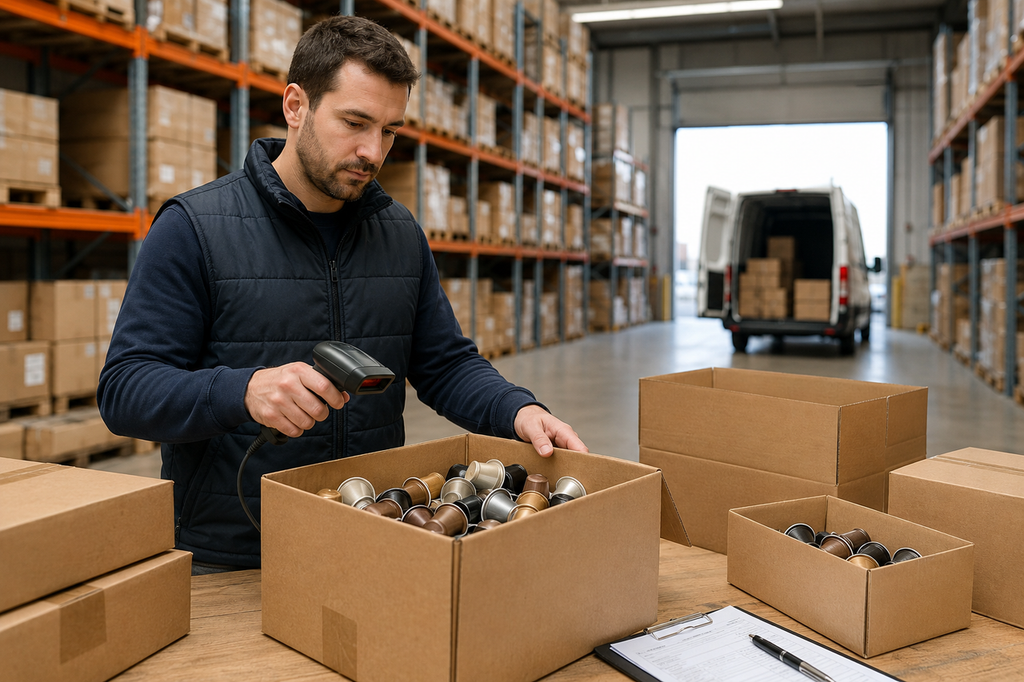
Train the roaster’s sales and operations teams on the basics. They should know which machine system the product targets, how the material is described, what has actually been tested, and which claims are off limits.
Joint tastings, technical webinars, and a simple launch checklist can help. So can an approved case study after the product has real results. Avoid promising consumer demand or giving the roaster a generic “green” story unsupported by the final pack and local infrastructure.
The roaster owns the coffee story. The reseller supports confidence in the component, test process, and supply plan. That division feels natural to buyers because it is.
Use the First 90 Days to Decide Whether to Scale
Agree on a small scorecard before commercial supply begins. Useful measures include qualified opportunities, sample-to-trial conversion, first-pass pilot approval, on-time delivery, complaint closure time, forecast accuracy, reorder interval, and aged stock.
| Metric | What it reveals |
| Trial-to-order conversion | Whether qualification is finding real projects |
| First-pass pilot approval | Whether technical preparation is effective |
| Forecast accuracy | Whether local stock can be planned responsibly |
| Complaint closure time | Whether escalation works under pressure |
| Reorder interval | Whether the relationship is becoming recurring business |
| Aged inventory | Whether customization or stock commitments are too aggressive |
Scale when reorders become predictable, technical issues remain controlled, and both parties retain healthy margins. Fix the program when the product works but forecasting, packaging, sales training, or replenishment does not. Stop or redesign it when support cost, defects, slow stock, or channel conflict makes the deal uneconomic.
The broader coffee capsule business-model comparison can help when a roaster outgrows component supply and begins comparing co-packing or in-house production.
Conclusion
An empty Nespresso cup reseller creates lasting value by removing friction and risk, not by adding a margin to a factory price. Start with one pilot-ready roaster, one clearly defined Original-compatible product, matched cups and lids, and written acceptance criteria. Then agree who funds stock, protects the account, supplies evidence, and handles a complaint.
The first carton proves that somebody can place an order. A clean, profitable reorder proves the partnership works. Resellers ready to build that kind of local channel can discuss the practical fit through SANEU’s distribution partner program.
Frequently Asked Questions
What does an empty Nespresso cup reseller actually sell?
The reseller supplies unfilled capsule bodies and, ideally, qualified matching lids for an identified Nespresso Original-compatible application. Services may also include samples, local stock, document transfer, trial coordination, and technical escalation. This is different from reselling genuine filled Nespresso coffee capsules.
Can a coffee roaster fill and sell Nespresso-compatible capsules?
Potentially, yes. The roaster needs a suitable filling and sealing route, a validated product, appropriate food-safety controls, compliant packaging, and accurate compatibility wording. The responsible businesses and exact legal requirements depend on where the finished capsules are made and sold.
Do Original-compatible empty capsules work in Vertuo machines?
No. Original and Vertuo are different systems and use different capsules. Quotations, sample labels, tests, and finished packaging should state the intended system clearly. Do not use a broad compatibility claim that suggests one capsule works across both platforms.
Should a reseller supply matching capsule lids as well as cups?
Usually, yes. Supplying a qualified cup-and-lid combination reduces one major source of sealing uncertainty. The roaster must still validate that combination on its own line with its coffee, tooling, process settings, packaging, and intended storage conditions.
Which capsule material is best for a coffee roaster?
There is no universal winner. Aluminum, barrier plastic, and certified compostable constructions have different barrier, processing, cost, presentation, and end-of-life considerations. Choose against the product, line, sales market, evidence, and local collection or composting infrastructure.
What MOQ should a roaster expect for empty coffee capsules?
It depends on the supplier and specification. Standard bodies may have one minimum, while custom colors, printed lids, cartons, and production runs have others. Ask for the complete MOQ stack and cash commitment, not one attractive number taken from a sales page.
How can a reseller help a small roaster test before ordering?
The reseller can qualify the opportunity, prepare a product brief, provide traceable cup-and-lid samples, coordinate the component maker and filling partner, document trial conditions, and agree pass/fail criteria. A small controlled trial is safer than jumping straight to customized volume.
What food-contact and quality documents should the parties request?
The exact file varies by material and market. It may include an approved specification, applicable food-contact declarations or test support, lot records, quality certificates, storage guidance, change notification, traceability information, and complaint procedures. Finished-product and label duties still need separate review.
Who is responsible when a capsule leaks or brews badly?
Responsibility follows the verified cause and the agreed contract. The body, lid, storage, coffee, flange condition, sealing process, tooling, transport, or brewer may contribute. Quarantine the lot, gather traceable evidence, test retained samples, and investigate jointly before assigning blame.
Can an empty-capsule reseller introduce filling machines or co-packers?
Yes, if the reseller has qualified partners and explains its role honestly. A good introduction can shorten the roaster’s launch path. Account ownership, referral fees, confidentiality, technical responsibility, and after-sales support should be agreed before customer details move between companies.