Your co-packer is booked for weeks. A retail customer wants shorter lead times. Then a filling-machine quote lands in your inbox, and in-house production suddenly looks obvious.
Well, maybe it is. But a fast machine can still be a bad investment. Demand may be patchy. Printed lids may tie up cash. Changeovers may eat half a shift. And the tidy output number in the brochure may have little to do with the capsules you can actually sell.
A useful business case joins four views: sales, operations, quality, and finance. It tests whether your demand can support a complete production system—not merely a filler. This guide shows how to build that case without hiding the awkward assumptions.

Here, “Nespresso-compatible” means capsules designed for the Nespresso Original system unless stated otherwise. Nespresso is a trademark of Société de Produits Nestlé S.A. Compatibility does not imply affiliation or endorsement.
Start With the Decision, Not the Machine Quote
Before touching a spreadsheet, write the decision in one sentence. For example:
Decide whether to install an Original-compatible filling line by Q3 to serve two retail accounts and the direct-to-consumer range over the next five years.
That sentence creates boundaries. Name the capsule format, materials, planned SKUs, markets, output range, launch date, and evaluation period. Also name the decision owner. A proposal with no owner tends to wander around the company until the quote expires.
Next, define the alternative. The choice is rarely “buy a machine or do nothing.” It may be:
- stay with the current co-packer;
- negotiate a better co-packing agreement;
- qualify a second supplier;
- bring short runs in-house while outsourcing base volume;
- lease or buy a smaller machine first;
- delay the purchase until signed volume clears an agreed threshold.
Be precise about who supplies the coffee, capsules, lids, artwork, cartons, testing, and finished-goods storage. If those roles are still blurry, first separate OEM, private label, and co-packing responsibilities. Otherwise, you may compare two costs that include entirely different jobs.
Prove the Demand the Line Is Supposed to Serve
A business case should begin with evidence from your business, not a global capsule-market forecast. Market growth cannot keep your machine busy on Tuesday afternoon.

Start with the last 12 months of shipped volume by customer and SKU. Add confirmed launches and signed orders with their actual timing. Keep qualified pipeline separate. Put hopeful growth in the upside case, where it belongs.
| Demand layer | Evidence | Treatment in the model |
| Repeat volume | Invoices and reorder history | Base demand, adjusted for seasonality |
| Committed business | Contract, purchase order, or firm launch plan | Add from its realistic start date |
| Qualified pipeline | Named account, stage, volume, and close date | Risk-adjust or keep in the upside case |
| Speculative growth | A broad market ambition | Do not use to justify base-case capacity |
Check customer concentration too. Three million annual capsules sound reassuring. If 70% depend on one retailer that can delist the range with little notice, the risk is quite different.
Include samples, safety stock, and normal launch inventory, but do not confuse production with sales. Unsold capsules fill a warehouse, not a payback calculation. A separate guide explains when a Nespresso-compatible filler starts to make operational sense; this business case takes the next step and asks whether it also makes financial sense.
Define the Product Before You Define the Line
“Nespresso machine” is not a complete specification. The Nespresso system FAQ confirms that Original and Vertuo use different capsules and work differently. Professional is another scope again. State which system and which target brewer models your product must support.
Then lock the commercial product brief:
- coffee blend, roast, grind distribution, and dose;
- aluminum, plastic, or certified compostable capsule construction;
- pre-cut or roll-stock lid and sealing layer;
- target beverage size and sensory result;
- carton, case pack, coding, and traceability;
- expected shelf life and storage conditions;
- approved compatibility test matrix.
Materials are not decoration. Aluminum, polymer structures, coatings, inks, adhesives, and lids affect barrier performance, sealing temperature, handling, extraction, waste, and cost. Ask suppliers for applicable food-contact documents and change-notification terms. If capsule sourcing is part of the project, define the approved empty Nespresso-compatible capsule before the machine trial.
Now draw a box around the complete production system. It may include coffee grinding and handling, degassing control, filler/sealer, capsule and lid feeding, nitrogen, compressed air, coding, inspection, cartoning, QC instruments, utilities, storage, operators, and maintenance. This guide to coffee capsule filling and sealing machines helps expose equipment that a filler-only quotation can miss.
Buying the filler and forgetting the rest is a bit like buying an oven and calling it a bakery. The oven matters. So do the recipe, ventilation, trays, people, boxes, and customers waiting outside.
Turn Rated Speed Into Saleable Capacity
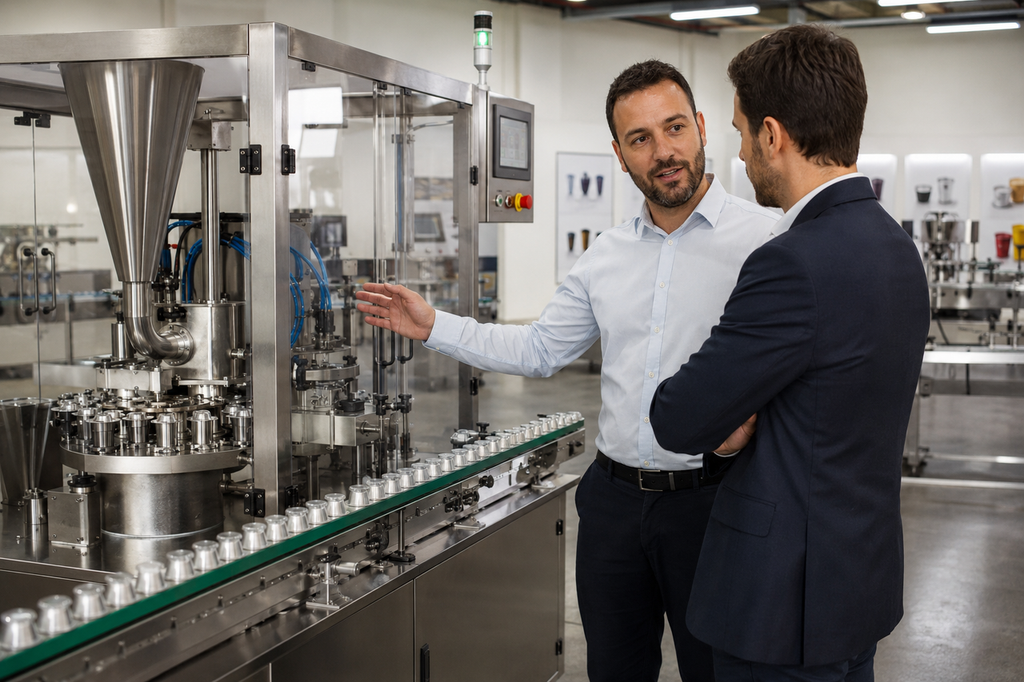
A brochure may state 3,000 capsules per hour. Your model needs good capsules per scheduled hour, across the real SKU mix.
Use this structure:
Saleable capacity = rated speed × scheduled minutes × availability × performance × first-pass yield
Availability removes breakdowns, maintenance, setup, and other downtime. Performance reflects the speed the line sustains with your coffee, capsule, and lid. First-pass yield removes leaking, underweight, overweight, oxygen-failed, damaged, or badly coded units.
Suppose a line is rated at 50 capsules per minute. One eight-hour shift gives 24,000 theoretical cycles. At 80% availability, 90% performance, and 97% first-pass yield, the illustrative result is about 16,760 good capsules. That is not an industry benchmark. It simply shows why 24,000 should not go into the financial model untouched.
| Capacity input | Evidence to request | Why it matters |
| Rated speed | Supplier specification | Provides the starting point only |
| Stable speed | Timed run with agreed materials | Shows practical performance |
| Availability | Changeover, cleaning, and maintenance plan | Removes unavailable minutes |
| First-pass yield | Weight, seal, oxygen, and visual data | Converts cycles into saleable capsules |
| Downstream rate | Coder, conveyor, and cartoner output | Finds bottlenecks outside the filler |
SKU mix matters as well. Six short runs can consume much more time than one long run with the same annual volume. Add cleaning, material loading, format changes, label checks, and startup rejects. Empty capacity has no value unless sales can use it.
Build the Full Initial Cash Requirement
The machine price is only the first line. Build the cash request from the factory floor outward.
| Cash layer | Possible items |
| Core equipment | Filler, format tooling, conveyors, coder, inspection, cartoner |
| Landed and installed | Freight, duty, rigging, electrical work, air, nitrogen, commissioning |
| Readiness | Product trials, testing, training, documentation, initial spares |
| Working capital | Coffee, capsules, lids, cartons, deposits, and finished inventory |
| Contingency | An approved allowance tied to named risks |
Add change parts for every approved capsule body and lid. Include a compressor or nitrogen system where needed. Include voltage changes, extraction, floor work, guarding, inspection equipment, technician travel, training, and spare parts. Check whether taxes are recoverable and whether freight terms leave local costs outside the quote.
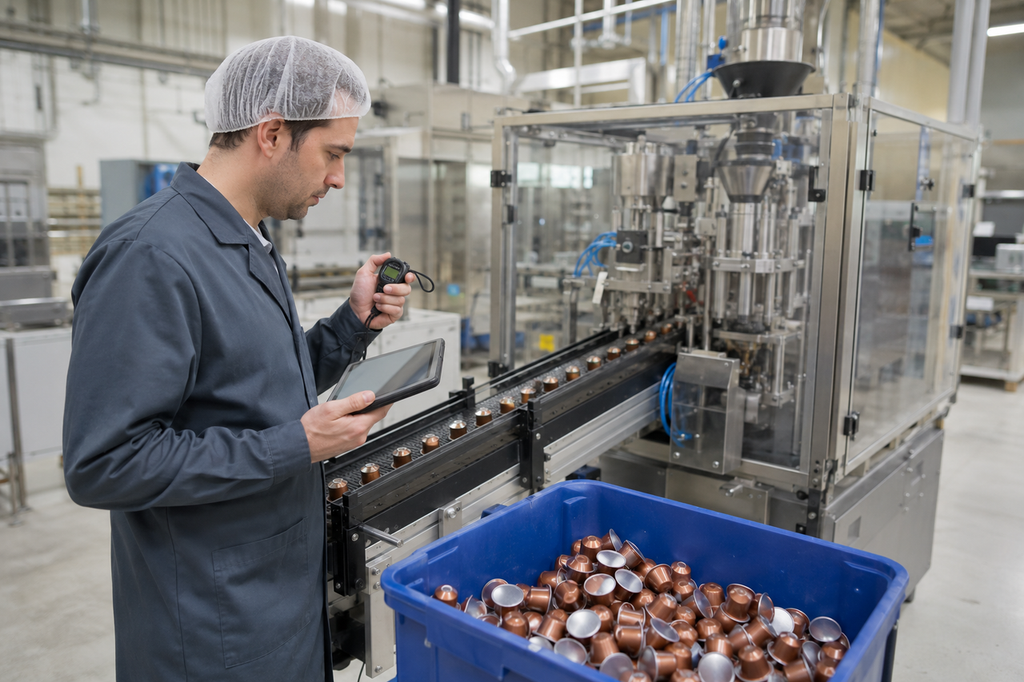
Working capital deserves its own line. Custom capsule colors, printed lids, and cartons often have different minimum orders. A low conversion cost is less exciting when six months of packaging sits on a pallet. Map supplier deposits, transit time, incoming stock, production, customer credit terms, and the date cash is collected.
Use current quotations for the actual project. Broad coffee packaging machine price factors can help build the checklist, but they are no substitute for a landed and installed quote.
Calculate Cost per Good Capsule
Build the in-house unit cost from good output, not total machine cycles.
| Cost group | Typical inputs | Easy-to-miss issue |
| Materials | Coffee, capsule, lid, carton, and case | Scrap, overfill, and obsolete printed stock |
| Conversion | Direct labor, nitrogen, power, and cleaning | Labor that remains after automation |
| Quality loss | Rejects, rework, leaks, and samples | Dividing cost by gross cycles |
| Ownership | Maintenance, spares, service, and insurance | Treating the invoice as total ownership cost |
| Accounting | Depreciation and allocated overhead | Mixing accounting expense with cash payback |
Coffee giveaway can be material. If the target dose is 5.5 grams but the process runs heavy to avoid underfills, the extra coffee travels into every capsule. Use trial data to estimate the distribution, not only the stated filling tolerance.
Keep two views. The cash operating cost supports payback and cash flow. The fully loaded cost, including depreciation and suitable overhead, supports pricing and profitability. Depreciation allocates an asset’s cost through the accounts; it does not repeat the original cash payment each year.

Avoid heroic labor savings. If three operators become two but the third person still works on the line during changeovers, the saving is not one full salary. Count eliminated overtime, contractors, vacancies not replaced, or measurable productive redeployment.
Compare Co-Packing, In-House Production, and a Hybrid
Use the same product, volume, quality standard, packaging scope, and delivery requirement in every option.
For co-packing, include the processing fee, transport, setup charges, MOQ effects, storage, rush fees, rejects, lead time, and inventory held while waiting. For in-house production, include materials, conversion, fixed people, maintenance, capex, working capital, learning-curve losses, and downtime exposure.
A hybrid can be surprisingly sensible. A roaster might bring sampling, small private-label orders, and urgent replenishment inside while leaving long base runs with a co-packer. That limits early capital risk and provides backup during commissioning.
Also score benefits that do not fit neatly into a dollar column: lead-time control, lower practical MOQs, confidential recipes, faster product development, quality visibility, customer service, and supply resilience. Keep these strategic benefits separate unless you can defend their cash value.
For a useful cross-format comparison, see the K-Cup filling machine business-case framework. Do not copy its material or market assumptions into an Original-compatible model.
Use Four Financial Measures, Not One Magic ROI Number
First calculate incremental contribution per good capsule:
Avoided external production cost − incremental in-house variable cost
Then calculate annual net cash benefit:
Incremental contribution × saleable volume + proven cash savings − added annual fixed cash costs
From there, use four measures:
Simple Payback
Initial cash requirement ÷ annual net cash benefit
Payback is easy to understand, but it ignores cash flows after recovery and usually ignores the time value of money.
Simple ROI
Annual net benefit ÷ total investment
Define the period and numerator. Companies use “ROI” in different ways, which creates suspiciously cheerful meetings.
Break-Even Volume
Added annual fixed cash costs ÷ contribution per good capsule
This shows the volume the operation must sell—not merely produce—to cover its added fixed cash costs.
Net Present Value
NPV discounts after-tax project cash flows at the company’s required return and subtracts the initial outlay. Ask finance to supply the discount rate, tax treatment, depreciation method, financing assumptions, and terminal value.
Do not count the same benefit twice. If avoided co-packing cost already represents the processing improvement, do not add the entire capsule gross margin again. And if faster capacity has no associated sales, its current cash benefit is zero.
Stress-Test the Case Before Management Does
Build low, base, and upside cases. The base should use defensible demand and conservative trial performance. The upside shows expansion potential; it should not rescue a weak purchase.
| Scenario | Demand assumption | Operating assumption | Decision use |
| Low | Delayed launch or lost customer | Slower ramp and lower yield | Tests cash survival and fallback needs |
| Base | Repeat and committed volume | Conservative, demonstrated performance | Supports the approval decision |
| Upside | Additional qualified wins | Added shifts or improved performance | Shows the expansion route |
Change one input at a time. Test volume, selling price, co-pack fee, coffee cost, capsule and lid cost, OEE, reject rate, labor, changeover, downtime, launch delay, and working capital. Rank them by their effect on NPV and cash need.
Then set a boundary. Perhaps the project is deferred if committed volume falls below the modeled break-even level, or if the material trial cannot sustain the required yield. A business case with no rejection condition is usually a sales pitch wearing a spreadsheet.
Put Quality and Standards Into the Economics
Quality failures are financial events. A leaking seal creates scrap, complaints, replacement freight, and possibly a lost account. These risks belong in the case and in machine acceptance.
The facility should control hygiene, traceability, supplier approval, cleaning, batch coding, food-contact documentation, and applicable allergen risks. ISO 22000:2018 provides a food-safety management framework for organizations in the food chain. Certification, however, does not automatically approve a machine, packaging material, label, or finished capsule.
Machinery requirements depend on where the equipment is placed on the market and operated. Relevant work may include risk assessment, guarding, electrical
and control safety, technical documentation, and local conformity procedures. For EU planning, the official machinery safety summary states that Regulation (EU) 2023/1230 applies generally from January 20, 2027. Confirm the rules and transition that apply on the actual placement date.
Connect acceptance tests to the financial model. A factory acceptance test and site acceptance test should use agreed capsule bodies, lids, and representative coffee. Measure stable speed, fill-weight distribution, seal integrity, rejects, alarms, changeover, cleaning, utility use, and operator training.
For freshness, specify the residual oxygen measured inside the sealed package. Do not accept nitrogen-generator purity as a substitute. The distinction is explained in SANEU’s guide to nitrogen packaging and residual-oxygen control.

When comparing suppliers, put these acceptance points into the user requirement specification and purchase contract. A general guide to choosing a coffee capsule filling machine can support the technical shortlist.
Turn the Spreadsheet Into a One-Page Approval Memo
The spreadsheet holds the workings. The memo should make the decision visible.
Include:
- the approval requested and deadline;
- product and system scope;
- demand evidence and customer concentration;
- alternatives considered;
- initial cash and working capital;
- low, base, and upside cash results;
- payback, ROI, break-even volume, and NPV;
- the five largest risks and named owners;
- FAT and SAT acceptance criteria;
- implementation milestones and stop/go gates.
Use staged approval. Approve the demand and product brief first. Then approve the RFQ scope and material trial. Release the order only after the finance case passes. Link payment milestones to documentation and acceptance where commercially possible.
Do not switch off outsourcing the day the machine arrives. Keep a fallback through installation, training, and commercial ramp-up. Once the evidence supports the investment, compare the required output and options across SANEU’s Nespresso-compatible filling machines.
Conclusion
A strong business case does not begin with speed. It begins with demand you can defend. It then converts that demand into good output, maps the complete installed system, and compares its cash flows with realistic alternatives.
The best proposal may support a fully automatic line. It may also support a smaller machine, a hybrid model, or “not yet.” That is fine. The purpose is not to make every investment look attractive. It is to let sales, operations, quality, procurement, and finance see the same decision—warts, working capital and all.
Frequently Asked Questions
How much does a Nespresso-compatible filling machine cost?
There is no useful universal price. Automation, lane count, capsule material, lid feeding, nitrogen, inspection, coding, tooling, and downstream packaging change the quote. Compare total landed and installed cash, not the filler invoice alone.
How many Nespresso-compatible capsules can a filling machine produce per hour?
Suppliers state rated output, but saleable output is lower. Adjust rated speed for scheduled time, availability, real operating performance, changeovers, and first-pass yield. Confirm stable speed using your agreed coffee, capsule, and lid.
At what volume does in-house capsule production make sense?
The threshold depends on avoided co-packing cost, contribution per good capsule, fixed operating cost, investment, and risk. Use repeat and committed sales to calculate break-even volume. Do not justify the base case with speculative pipeline.
How do you calculate ROI on a coffee capsule filling machine?
Define ROI first. A simple version divides annual net benefit by total investment. Also calculate cash payback, break-even volume, and NPV. One ratio cannot show timing, working-capital pressure, or value after the payback date.
What costs should be added to the purchase price?
Include tooling, format parts, freight, duties, rigging, utilities, nitrogen, compressed air, coding, inspection, cartoning, commissioning, training, testing, spares, facility work, contingency, and initial packaging and coffee inventory.
Is a semi-automatic or fully automatic filler better for a growing roaster?
Choose the smallest system that meets demand, quality, labor, and service needs with sensible headroom. Semi-automatic equipment can reduce capital risk. Full automation becomes useful when stable volume and labor constraints support its fixed cost.
Do Nespresso-compatible capsules need nitrogen flushing?
Ground coffee oxidizes, so many commercial producers use nitrogen and high-barrier packaging. The required process depends on the product and validated shelf life. Specify sealed-capsule residual oxygen and seal performance, not only gas purity.
Can one machine handle aluminum, plastic, and compostable capsules?
Some equipment can use change parts and different sealing recipes, but “multi-material” should be demonstrated. Feeding behavior, rigidity, flange shape, lid structure, sealing window, static, and changeover time may differ substantially.
What utilities and space does a capsule filling line need?
Check the whole system: floor area and access, electrical supply, compressed air, nitrogen source, ventilation, coffee and packaging storage, QC space, cleaning, operator movement, and room for coding or cartoning equipment.
How should a roaster compare co-packing with in-house production?
Model the same product, volume, quality, packaging, and service level. Compare cash cost, working capital, MOQ, lead time, flexibility, quality control, downtime, customer concentration, and risk. Include a hybrid option rather than forcing a binary choice.