Your regulars already know the smell of your house blend. They know the cup, the counter, maybe even which barista remembers their order. A retail coffee pod asks that same trust to travel home in a small sealed package.
That sounds simple. It is not quite. A good café drink can turn flat, weak, or oddly bitter inside a capsule. A handsome box can lose money on every wholesale order. And a “sustainable” material can create more questions than it answers.

This guide follows the decisions in the order a coffee shop actually faces them. It starts with customer evidence, not machinery. Then it moves through format, coffee development, production, pricing, packaging, standards, launch, and scale.
Your Café Already Has What Most New Pod Brands Do Not
A start-up pod brand usually begins with a logo and a guess about its customer. A coffee shop begins with transaction history, direct feedback, trained staff, and people who already pay for its coffee. That is a much better hand.
The café also has a live tasting room. A roaster can test two blends on Saturday, talk to customers, and check sales by Monday.
Still, affection for the café does not automatically create pod demand. A flat-white regular may own only a drip brewer. Another may use different machines at work and home.
So the opportunity is not “our coffee is popular.” The useful question is: Which existing customers want which café experience at home, in which machine, at a price that leaves the business enough room?
That is the thread for the whole project. The pod is not a tiny souvenir. It is a packaged food product with its own brew system, cost structure, shelf life, and retail job.

Prove Customers Want the Product Before You Build It
Begin with evidence that costs almost nothing. Pull point-of-sale data on take-home coffee, popular roasts, decaf demand, and repeat purchases. Bean sales are not a perfect proxy for pod demand, but they show which flavors already travel beyond the counter.
Next, ask about equipment. “Would you buy our coffee in a capsule?” is too easy to answer politely. Try three tighter questions at checkout or in a short loyalty survey:
- Which single-serve machine do you use most often?
- How many pods or capsules does your household use in a normal week?
- At what pack size and price would you actually try ours?
Machine ownership matters more than enthusiasm. Fifty eager customers split across five incompatible systems are not one launch audience. They are five small audiences.
Then ask for a small commitment through a refundable reservation, limited preorder, or paid sample sleeve. Money is clearer than a heart emoji. If people will not reserve a box at a plausible price, prettier packaging probably will not fix the idea.
| Evidence | What it tells you | How much to trust it |
| Social poll or casual comments | General curiosity and language customers use | Low |
| POS and loyalty data | Which coffees already earn repeat purchases | Medium |
| Machine-ownership survey | Whether a usable format has enough local reach | Medium to high |
| Paid tasting or sample sleeve | Whether the brewed product earns money | High |
| Preorder at the intended retail price | Whether demand survives contact with the price | Very high |
| Second purchase within 30–60 days | Whether the product is becoming a habit | Highest |
Set a pass line before the test. It might be a minimum number of paid preorders, a target sample-to-box conversion rate, or a reorder threshold. The exact number depends on your traffic and minimum order quantity. What matters is deciding before excitement starts moving the goalposts.
Choose the Coffee Pod Format Your Customers Can Actually Use
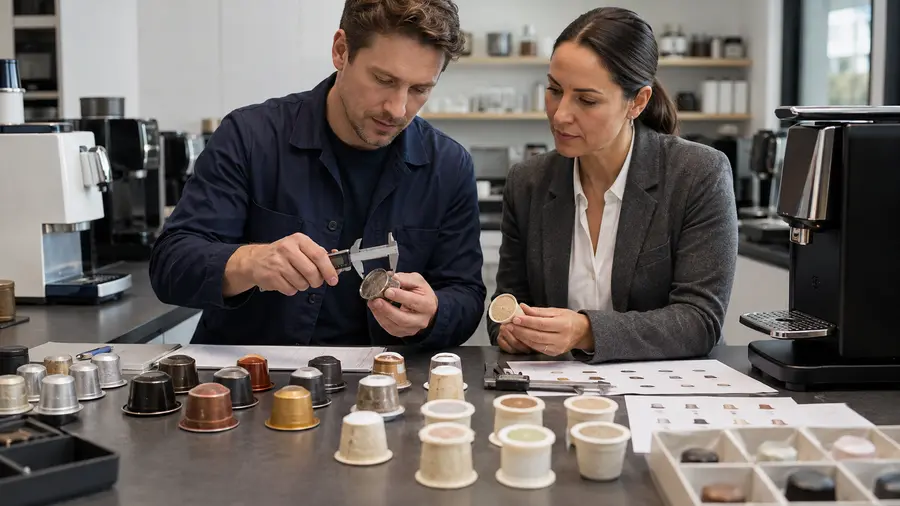
“Coffee pod” is used as a catch-all phrase, but formats are not interchangeable. K-Cup-compatible pods, Nespresso Original-compatible capsules, ESE paper pods, and coffee bags all use different brewing methods. Even the words pod and capsule vary by market.
Customer machines should lead this choice. Your café aesthetic comes second. A beautiful aluminum capsule is useless to a regular whose kitchen has a Keurig brewer.
| Format | Common use | Coffee style and practical notes | Best fit for a café when… |
| K-Cup-compatible pod | Longer cups, especially in North America | More internal volume; customers may choose several brew sizes | Survey data shows a strong Keurig-compatible user base |
| Nespresso Original-compatible capsule | Short espresso-style drinks | Small dose and tighter extraction window; often chosen for premium presentation | Customers own Original-line machines and want espresso-style coffee |
| ESE paper pod | Espresso machines with an ESE-compatible basket | Standard 44 mm paper pod; less common in some consumer markets | Local machine use and foodservice demand justify it |
| Single-serve drip bag | Pour-over style without a dedicated machine | Requires a cup and hot water; easy to understand while traveling | Customers value specialty flavor but machine ownership is fragmented |
If the terminology still feels muddy, compare the main single-serve coffee formats before requesting supplier quotes.
Start with one system unless demand strongly supports two. Every extra format multiplies trials, packaging, components, stock-keeping units, checks, and inventory. It is like adding a second breakfast menu before the first has left the kitchen.
K-Cup-Compatible Pods
This route suits customers who want a full mug from compatible brewers. Machine settings vary, so test several water volumes, including the setting most likely to expose a weak cup.
Coffee shops specifically weighing this system can study the operational choices involved in launching a K-Cup-compatible line from a coffee shop.
Nespresso Original-Compatible Capsules
Original-compatible capsules suit espresso-led cafés. The small dose leaves little room to hide poor grinding or sealing. State compatibility carefully: your capsule fits a system; it is not made or endorsed by that machine brand.
For a focused feasibility check, see the guide to selling a café-branded Nespresso-compatible capsule.
Do Not Choose a Format from National Averages Alone
Broad market data is useful for context, not for choosing your first SKU. The U.S. National Coffee Association reported in 2026 that 82% of past-day coffee drinkers prepared coffee at home and 28% had coffee prepared out of home. That supports the at-home occasion, but it does not reveal what sits on your customers’ counters. Your own survey closes that gap. See the NCA consumer coffee update for the wider picture.
Make the Café’s Coffee Work Inside a Pod
Putting the house blend into a capsule does not preserve the café cup by magic. The brewer, water volume, pressure, flow, dose, grind, oxygen exposure, and milk all change the result.
Think of it this way: pouring your signature soup through a straw would not make it the same lunch in a smaller format. The delivery system changes what the customer experiences. Coffee behaves much the same way.
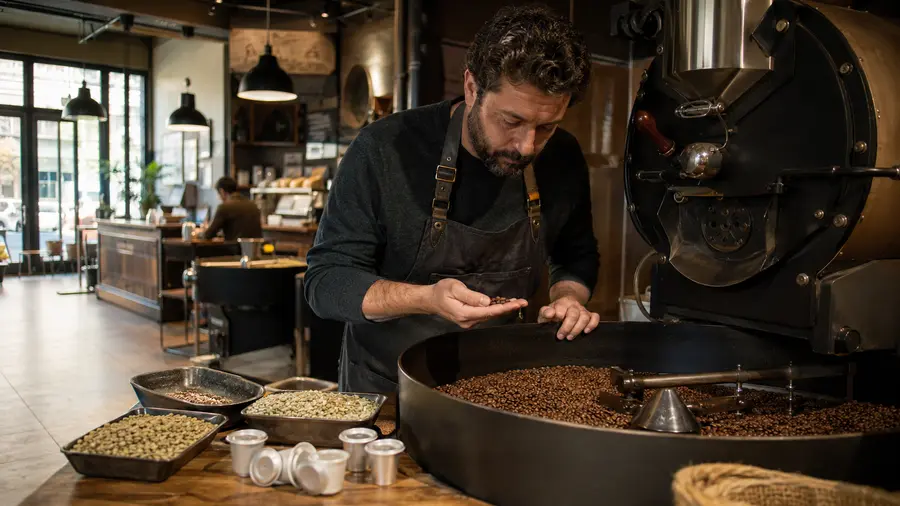
The development goal is therefore not to copy the espresso-bar recipe gram for gram. It is to carry over its recognizable character. If regulars love a chocolate-heavy, low-acid house espresso, the pod should land in that neighborhood. It may need a different roast development, component ratio, grind distribution, or dose to get there.
Build a Clear Sensory Brief
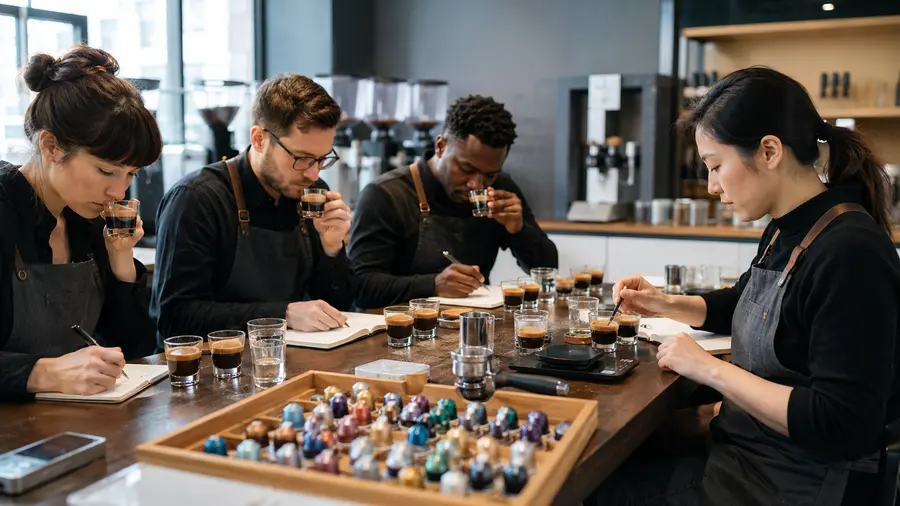
Give the roaster or manufacturing partner a short target that can be tested. “Premium” is too vague. “Round cocoa aroma, low sharpness, syrupy body, and enough strength for 120 ml of milk” is useful.
Include:
- the intended black beverage volume;
- whether customers commonly add milk or sugar;
- three desired flavor traits;
- two defects that are unacceptable;
- a reference café drink or current retail pod;
- the target compatible brewer and settings.
Test more than one production sample. Fresh bench-ground coffee is not the finished product. Evaluate packed capsules after transport simulation and during the proposed shelf life.
| Variable | If it is poorly controlled | What to test |
| Roast profile | Baked, smoky, hollow, or overly sharp cup | Fresh roast and rested production lots |
| Grind size and distribution | Choking, fast flow, weak extraction, sediment | Brew time, beverage mass, strength, sensory result |
| Dose and headspace | Thin cup, uneven flow, sealing trouble | Fill-weight range and brew repeatability |
| Coffee density | Volumetric fillers may deliver inconsistent mass | Weight checks across a production run |
| Lid and body barrier | Aroma loss and stale flavor | Oxygen performance and aged samples |
| Seal settings | Leaks, channeling, lid failure | Visual seal checks, leak tests, brew tests |
| Machine and cup size | A good recipe becomes watery or harsh | Several common brewers and user settings |
Taste blind where possible. Compare coded café coffee, prototypes, and market references. Include ordinary customers; they notice different things while making breakfast and searching for car keys.
Pick a Production Model That Fits the Café’s Current Advantage
Most cafés are good at hospitality, recipe development, and local relationships. They are not automatically good at high-speed packaging, barrier-material sourcing, preventive maintenance, or traceability. Your production model should use the advantage you already have without pretending the missing capabilities are trivial.
| Production model | Your control | Capital and operational load | Good starting situation |
| White label | Choose from a supplier’s existing coffee and pack options | Lowest | Fast market test matters more than a unique recipe |
| Private label | Brand an existing or lightly adjusted product | Low | You need a practical first SKU with modest development |
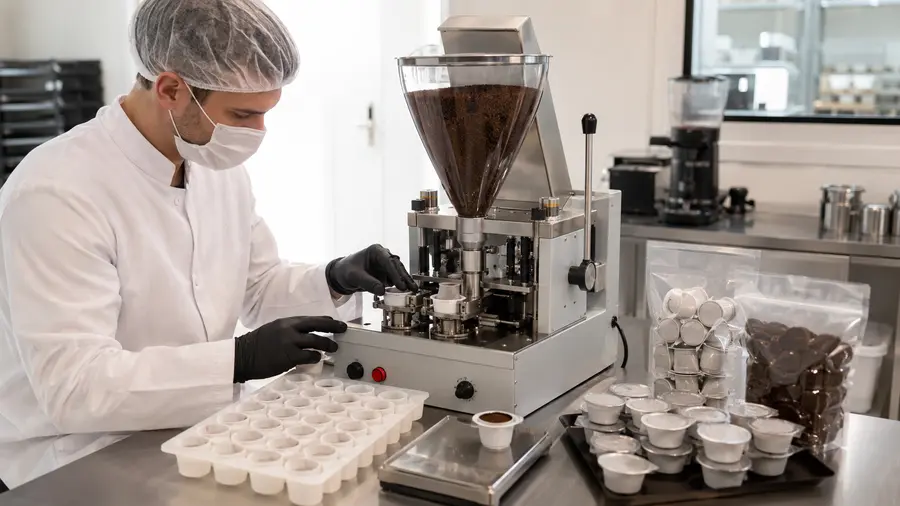
| Contract packing or co-packing | Supply or specify coffee while a partner fills and seals it | Medium | Coffee identity matters, but factory work is not your strength |
| In-house filling | Control production equipment, labor, process, and scheduling | Highest | Stable volume and strategic control justify the fixed cost |
| Hybrid | Outsource steady runs while building selected in-house capability | Medium to high | You need resilience or want to learn before a full transition |
Terms overlap between suppliers. One company may call a custom-roasted product “private label,” while another calls it OEM. Before comparing quotations, define OEM, private-label, and co-packing responsibilities. Also compare coffee capsule business models on the same assumptions.
Questions to Put in Every Supplier Brief
Ask each prospective partner to quote the same specification. Otherwise, the cheapest proposal may simply exclude more work.
- Which systems and materials are offered?
- Is the coffee stock, adjusted, or custom?
- Who owns the recipe and approved artwork?
- What is the minimum order by flavor and packaging version?
- Are setup, plates, cylinders, tooling, and samples charged separately?
- What are the first-order and reorder lead times?
- How are fill weight, seal integrity, oxygen exposure, and brew performance checked?
- What lot records come with a shipment?
- Who buys unused printed components?
- What happens if a lot fails the agreed specification?
- Can the partner support the countries where you plan to sell?
Request production samples, not only showroom samples. A glossy carton says little about hygiene, changeovers, or rejected capsules.
Why Outsourcing Is Often the Sensible First Step
A co-packer turns fixed investment into a per-unit cost. It may look expensive per pod yet remain cheaper while demand is uncertain.
The tradeoff is less scheduling freedom and dependence on another company. Put specifications, acceptance criteria, ownership, change approval, and complaint handling in writing. A friendly relationship is not a quality system.
Build the Retail Math Before Setting the Shelf Price
Cafés often start with a price that “feels premium” and work backward only halfway. Retail math is less forgiving. The shelf price must cover the retailer, any distributor, the product, freight, samples, promotions, and the slow boxes that do not sell.
Start with landed cost of goods, not the factory’s pod price.
Landed COGS per retail box = filled pods + retail carton + labels or sleeves + inbound freight + duties and taxes where applicable + inspection or testing + expected waste
Then add variable selling costs to understand contribution margin. These may include payment processing, pick-and-pack, outbound shipping subsidy, marketplace fees, commissions, and promotional allowances.
Work Backward from the Channel
A box sold at your café has different economics from the same box sold through an independent grocer. At the café, your business keeps the retail spread but pays staff and occupies shelf space. In wholesale, the retailer needs its margin. A distributor may also take a share.
Here is a deliberately simple hypothetical example. It is not a margin benchmark.
| Item per 10-count box | Café counter | Direct online | Wholesale to retailer |
| Consumer shelf price | $10.00 | $10.00 | $10.00 |
| Revenue received by café brand | $10.00 | $10.00 | $5.50 |
| Landed COGS | $3.20 | $3.20 | $3.20 |
| Channel-specific variable costs | $0.45 | $2.10 | $0.35 |
| Contribution before fixed overhead | $6.35 | $4.70 | $1.95 |
The wholesale column looks much tighter because the retailer keeps part of the shelf price. If a distributor sits between you and the store, work backward through both margins. Do this before promising a wholesale price.
MOQ Is a Cash Question, Not Just a Unit-Cost Question
A larger run normally lowers cost per box. It can also bury cash in six months of stock. Printed components may have different minimums from filled pods, which creates awkward leftovers after an artwork update.
Model slow, expected, and strong demand. For each, calculate:
- cash required before the first sale;
- months of inventory at realistic sell-through;
- product and packaging left near the end of shelf life;
- reorder timing relative to supplier lead time;
- cash tied up in slow flavors;
- break-even boxes after launch and design costs.
Do not confuse gross margin with profit. Samples, shipping, discounts, spoilage, and staff time eat the result. Contribution margin shows whether the next box helps pay fixed bills.
One more small trap: compare quotes on saleable units. A line may fill 100 capsules a minute in ideal conditions, but changeovers, startup waste, inspections, stoppages, and rejects decide how many good boxes reach inventory.
Choose Materials and Packaging as One Retail System
The customer sees a capsule and a box. The product team should see a system: coffee, filter if used, capsule body, lid, seal, protective atmosphere, carton, case, and transport conditions. One weak layer can shorten the useful life of everything inside it.
Primary packaging touches or directly protects the coffee. Secondary packaging groups units for sale. Tertiary packaging moves cases through the supply chain. All three affect cost and damage rates.
| Choice | Potential advantage | Question to resolve before launch | Wholesale to retailer |
| Aluminum capsule | Strong barrier potential and premium feel | Does the complete capsule, coating, lid, and seal suit the target system? | $10.00 |
| PP plastic capsule | Flexible design and common production options | Is its barrier performance adequate for the intended shelf life? | $5.50 |
| Compostable structure | Can support a lower-waste proposition in the right system | Under which certified conditions can it compost, and can customers access them? | $3.20 |
| Paper pod or filter | Familiar fiber-based format | Does it need an outer barrier pack to protect aroma and freshness? | $0.35 |
| Individual overwrap | Extra protection and portion separation | Does the performance gain justify more material and packing cost? | $1.95 |
| Seal settings | Leaks, channeling, lid failure | Visual seal checks, leak tests, brew tests | |
| Machine and cup size | A good recipe becomes watery or harsh | Several common brewers and user settings |
There is no universally “best” capsule material. Use the target machine, filling process, barrier need, local recovery infrastructure, and verified claims to make the choice. This comparison of aluminum and plastic capsule materials helps organize the tradeoffs.
Be especially careful with environmental language. Recyclable, recycled, compostable, and biodegradable do not mean the same thing. A technically recyclable capsule may not be accepted by local collection. An industrially compostable product may not break down in a garden compost pile. State the material, conditions, certification, and disposal route plainly. Clever green wording is no substitute for an accessible end-of-life path.

Make the Box Ready for a Real Retail Shelf
A café customer can ask a barista what the house blend tastes like. A supermarket box has to answer by itself, usually in a few seconds.
The front panel should establish the brand, compatible system, coffee style, count, and a useful flavor cue. Compatibility should be easy to find but should not impersonate the machine brand. On another panel, give the customer a brew recommendation and a short reason this coffee belongs to your café.
Good packaging hierarchy works like a good menu: it helps the eye make one decision at a time. Ten loud claims become noise.
For practical creative guidance, see how to design coffee packaging that works on a retail shelf.
Retail Data and Case Configuration
Before printing, confirm how the product will be received, scanned, stored, and replenished. Depending on the market and channel, the setup may include:
- a retail GTIN and scannable barcode;
- a different identifier for the shipping case;
- retail unit dimensions and weight;
- units per case and case dimensions;
- pallet pattern for larger accounts;
- lot code and date-code location;
- country-of-origin and responsible-business details;
- ingredient, allergen, net quantity, and nutrition information where required.
A barcode needs the correct identifier, size, quiet zone, contrast, print quality, and placement. Test printed production material, not only a PDF.
Menu Rules Do Not Automatically Cover Packaged Food
Once coffee leaves the counter as a retail product, different labeling and food-business requirements may apply. These depend on the selling country, product composition, claims, and channels. In the United States, the FDA’s Food Labeling Guide is a useful starting index. The FDA notes that portions are being revised, so check the linked current resources too. It is not a global checklist or legal opinion.
Have a qualified local specialist review final artwork. Check each selling market and any registration, food-facility, tax, producer-responsibility, or retailer requirements. Boring paperwork has a talent for becoming urgent on launch week.
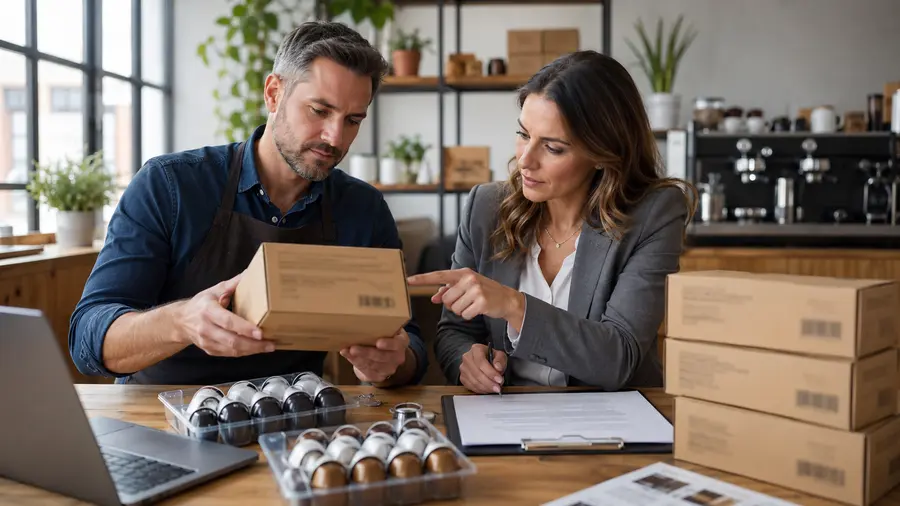
Quality Control Must Protect the Café’s Name
Customers forgive an experimental weekend pastry. They are less relaxed about a box of ten capsules where three leak and two taste stale. The retail product can sit in a cupboard for months, far from the barista who normally protects the cup.
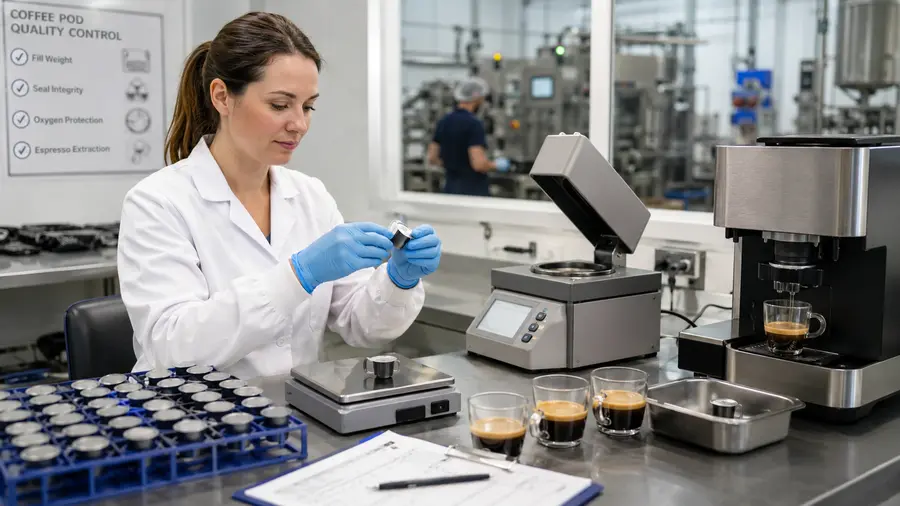
Write a finished-product specification before approving production. Sensory language can be structured with established industry methods; the Specialty Coffee Association publishes coffee standards and Coffee Value Assessment resources. Use an agreed method consistently rather than borrowing a score with no clear testing context.
| Quality gate | What to record | Why it matters |
| Incoming coffee | Lot, roast date, moisture or agreed checks, sensory approval | Prevents unsuitable coffee entering production |
| Fill control | Target weight, tolerance, sampling frequency | Supports consistent extraction and legal quantity control |
| Seal inspection | Temperature, pressure, dwell time, visual defects, leak result | Protects freshness and machine performance |
| Brew compatibility | Machine models, cup setting, flow, beverage mass, ejection | Finds real-use failures before customers do |
| Sensory release | Aroma, flavor, body, defects, reference comparison | Keeps the pod recognizable as the café’s coffee |
| Pack coding | Lot and date accuracy, barcode verification | Enables traceability and retail handling |
| Retained samples | Quantity, storage condition, review dates | Supports shelf-life checks and complaint investigation |
Food-safety controls should cover ingredients, packaging contact materials, sanitation, foreign-material risks, pests, personnel practices, traceability, recall readiness, and supplier approval. Many manufacturers use HACCP-based plans and good manufacturing practices. Certifications such as ISO 22000 or FSSC 22000 may help meet customer requirements, but they are not universal substitutes for local law or a product-specific control plan.
Shelf Life Must Be Demonstrated
Do not choose a best-before period because another coffee box uses it. Barrier structure, residual oxygen, seal quality, roast, grind, transport heat, and storage all affect the result.
Create a study plan with the manufacturer or a competent laboratory. Check pack integrity, brew behavior, and sensory change. Real-time data is strongest; accelerated tests need expert interpretation.
Keep retained samples from each commercial lot. If a customer reports a weak or leaking capsule, the lot code should lead back to coffee, materials, packing date, machine settings, inspections, and distribution. Traceability is basically a time machine for a bad Tuesday.
Launch the Pod Line Through the Café Before Chasing Supermarkets
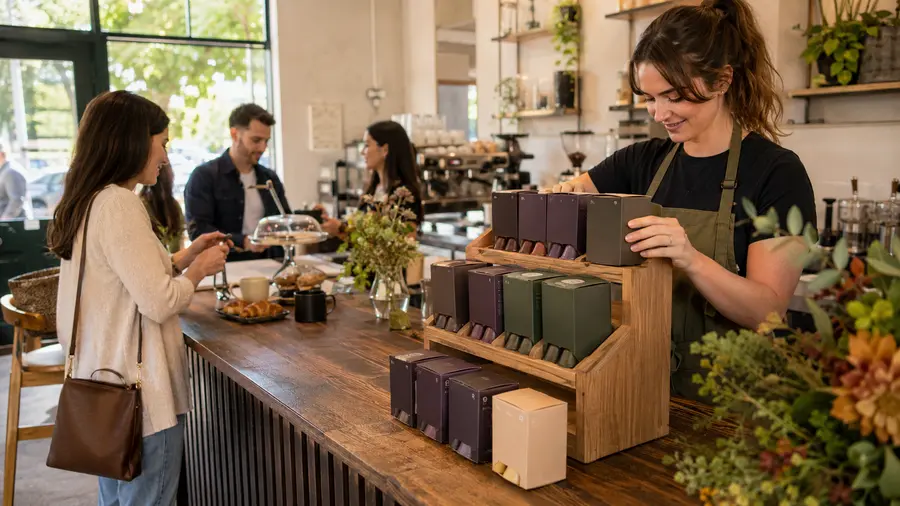
The café counter is a cheap, information-rich first retail channel. Use it. A grocery buyer may ask about weekly sales, repeat purchase, spoilage, and promotional support. Your own store can create those answers before you pay for broad distribution.
Place the box where customers wait or pay, not on a lonely shelf near the restroom. Brew samples at the intended serving size. Let staff explain the product in one natural sentence: “It is our chocolatey house-style coffee for Nespresso Original-compatible machines.” That is enough. A speech about packaging polymers will hold up the queue.
Bundle thoughtfully. A drink-and-box offer can turn a taste into a take-home decision. Avoid permanent launch discounts; they make the normal price harder to learn.
A Practical Eight-Week Café Pilot
| Week | Action | Decision signal |
| 1 | Train staff, check stock records, soft-launch to regulars | Can staff describe compatibility without confusion? |
| 2 | Run paid tastings at two times of day | Which sample converts, and at what price? |
| 3 | Test two shelf positions, keeping price constant | Does visibility materially change sales? |
| 4 | Review complaints, brew failures, and returns by lot | Is any product or compatibility issue emerging? |
| 5 | Send a reorder prompt to verified buyers | Do customers buy again without a deep discount? |
| 6 | Test one bundle against the box alone | Does the bundle add volume without erasing contribution? |
| 7 | Approach a few aligned local offices or retailers | Can the product and case format survive a small wholesale order? |
| 8 | Review cash, sell-through, repeat rate, and stock age | Continue, adjust, reorder, or stop? |
Track more than boxes sold. Useful measures include sample-to-purchase conversion, boxes per transaction, repeat rate, weekly sell-through by location, returns, complaints per thousand capsules, contribution per box, stock age, and out-of-stock days.
Separate trial from repeat behavior. Launch-week curiosity is noisy; a full-price reorder matters more. Tag complaints by machine and cup-size habit so instructions or the product can be adjusted.
Prepare for a Retail Buyer Before the Meeting
A retailer needs more than a nice story. Build a sell sheet with the system, case pack, prices, shelf-life details, lead time, order minimum, barcode, and early sell-through.
Be ready to explain why the box belongs in that store. “Our Instagram followers like it” is soft. “Thirty-two percent of paid tasters bought a box, and 24% of those buyers reordered within six weeks” is a business conversation. Use your real figures, of course.
Start with accounts that overlap your audience: neighborhood grocers, boutique hotels, offices, or gift shops. Offices may value reliable reordering; gift shops may value local identity. Adjust the pitch.
Scale Only When Reorders Justify More Control
Buying filling equipment can reduce unit cost and increase scheduling control at the right volume. It also brings material sourcing, operators, utilities, compressed air or gas where required, preventive maintenance, spare parts, sanitation, testing, rejects, and production records into your building.
Use a capacity and cash model, not machine excitement. Compare the annual co-packing cost with the full annual cost of owning the process. Include financing, floor space, labor, training, quality staff, changeover waste, downtime, parts, and working capital.
A complete line may also need feeding, denesting, dosing, seal-area cleaning, lid placement, gas flushing, inspection, rejection, coding, and cartoning. If volumes justify the study, compare coffee capsule filling and sealing solutions against actual output needs.
The sensible trigger is not “we can afford a machine.” It is “repeat demand, required control, and saleable output make ownership stronger than outsourcing.” Sometimes the best decision is to stay with a reliable co-packer and invest in selling more coffee. That counts as scaling too.

Common Mistakes That Turn a Promising Pod into Slow Stock
- Choosing a capsule before checking customer machine ownership.
- Copying the café recipe instead of developing for the pod brewer.
- Launching several roasts and formats at once.
- Comparing supplier prices that include different work and materials.
- Setting a shelf price without wholesale and distributor math.
- Treating the factory quote as complete landed COGS.
- Printing environmental claims before verifying conditions and local disposal routes.
- Ordering a large printed run before barcode, copy, and regulatory review.
- Accepting a shelf life with no product-specific evidence.
- Buying equipment based on headline speed instead of saleable output and repeat demand.
Most of these mistakes come from jumping ahead. The cure is not a giant strategy deck. It is a sequence of small gates, each supported by evidence.
Conclusion
A coffee shop does not need to become a national capsule company on day one. It needs to prove that known customers want a specific format, make a product that still tastes like the café, and sell it at a price that works beyond the counter.
Start with machine ownership and paid demand. Develop for the brewer. Put supplier duties and quality limits in writing. Count every cost. Then use the café as a living retail test before expanding distribution or bringing production in-house.
The tiny capsule is the easy part to notice. The repeatable system around it is the real business.
FAQs
Can a coffee shop sell coffee pods under its own brand?
Yes. A café can use white-label coffee, develop a private-label recipe, hire a co-packer, or fill in-house. Choose by control, minimum order, budget, requirements, and expected sales. Confirm local labeling, trademark, food-safety, and tax obligations.
Does a café need its own roastery or capsule factory?
No. Many cafés use a roaster and capsule packer. Outsourcing limits first-run equipment risk, but the café still needs an approved specification, supplier checks, traceability, and a process for rejected lots and complaints.
Should a coffee shop launch K-Cup-compatible pods or Nespresso-compatible capsules?
Choose the system enough paying customers already use. K-Cup-compatible pods often suit longer mugs; Nespresso Original-compatible capsules suit espresso-style drinks. Survey machine ownership and test common brewer models.
Can the café use its existing house blend in a pod?
It can be the starting point, but a pod changes dose, grind, flow, water, and storage. Reproduce the blend’s recognizable character rather than copying the bar recipe. Test production-packed samples black and with milk.
What is a normal minimum order quantity for private-label coffee pods?
There is no universal MOQ. It varies by supplier, format, customization, components, and packing method. Ask by SKU and packaging item, including who owns leftover printed materials after an artwork change.
How much does it cost to start a coffee pod business in a café?
Costs range from a modest outsourced test to a major in-house project. Include development, design, review, barcodes, testing, inventory, freight, storage, launch, and working capital. For equipment, add installation, labor, utilities, maintenance, quality control, and packing.
How long do coffee pods stay fresh?
Shelf life depends on coffee, residual oxygen, barrier, seal, packing atmosphere, and storage. Do not use a generic number. Run a product-specific study covering sensory and physical performance, then print an evidence-based date period.
What labels, licenses, or standards are required for coffee pods?
Requirements depend on production and sales markets, ingredients, claims, and channels. Rules may cover product identity, quantity, business details, ingredients, allergens, nutrition, origin, lot codes, and dates. Check local authorities and use a qualified reviewer.
Are recyclable or compostable coffee capsules better?
Neither word guarantees a better real-world result. Check performance, certification, local collection or composting, instructions, and the total pack. Make claims precise: industrially compostable does not mean home-compostable unless evidence says so.
When should a coffee shop buy its own capsule filling machine?
Consider it when repeat sales are stable and ownership beats co-packing on cost, control, capacity, and risk. Calculate saleable output, including labor, space, utilities, sanitation, checks, downstream packing, downtime, spares, waste, and working capital.