A roaster visits a machine demo. A vacuum-plus-nitrogen trial produces three capsules at 0.7% oxygen. A simpler nitrogen-flush run, done faster, produces samples around 1.4%. Easy choice? Maybe. But those three pretty samples say nothing about the next six hours, the one troublesome lane, or how the coffee tastes in month six.

Here’s the useful comparison: nitrogen flushing replaces much of the air before sealing; vacuum-only packaging removes gas and leaves the capsule at reduced pressure; a hybrid pulls out gas, then refills with nitrogen before the lid is sealed. The hybrid may lower initial oxygen, but only a trial with the actual coffee, cup, lid, production speed, and shelf-life route can show whether it’s worth the extra machinery.
First, Stop Calling Three Different Processes “Vacuum”
Nitrogen-only displacement
An open capsule is purged, coffee is dosed, nitrogen flows across the coffee bed and headspace, and the lid is sealed. The gas doesn’t destroy oxygen; it displaces or dilutes air. Some remains between grounds. Nitrogen-only packaging is a form of modified-atmosphere packaging (MAP).
If the process itself is unfamiliar, how nitrogen flushing drives oxygen out of a capsule walks through the cup, dose, and lid steps. This article stays with the choice between processes.
Vacuum as the final sealed atmosphere
A machine extracts gas, then closes the cup without backfill. Low internal pressure may remain for a while. “Vacuum” never guarantees zero oxygen; released CO₂ can change the pressure again.
Nor does a rigid K-Cup necessarily become a squashed bag. Its walls may hold their shape while a foil lid bows inward, a filter moves, or loose grounds shift. Test the actual cup and lid. Flexible vacuum-packed bean bags behave differently.
Vacuum followed by nitrogen backfill
In a hybrid sequence, evacuation is a short process stage. Nitrogen backfill restores a protective gas atmosphere before closure. The final capsule need not remain under vacuum. PAC Machinery’s Coffee Pac illustrates vacuum-only, gas-only, and vacuum-then-gas choices on a real coffee-bag machine. It proves those routes can coexist conceptually. It does not tell us how fast a cup filler runs or what happens to a capsule lid.
| Route | What it changes before closure | What a capsule trial must prove |
| Nitrogen only | Replaces or dilutes air with N₂ | Repeatable O₂ across lanes without excessive gas |
| Vacuum only | Removes gas, leaving lower pressure | Cup/lid stability, retained gas, CO₂ and seal behavior |
| Vacuum + N₂ | Removes gas, then backfills with N₂ | Whether extra stages improve quality enough to justify time and cost |
The Coffee Bed, CO₂, and Lid Change the Choice
A low percentage doesn’t tell you every oxygen story
Ordinary room air contains about 21% oxygen. Vacuuming that air reduces the amount of all its gases. The oxygen share of any air left behind may still be roughly 21%, even though its total oxygen amount is smaller. Nitrogen backfill changes the gas composition as well as the amount.
Headspace analyzers usually report oxygen as a percentage of sampled gas. Pressure, free volume, and air between coffee particles affect total exposure. The lower percentage need not mean less total oxygen. Record method and pressure. For the metric itself, see what residual oxygen measures in a sealed capsule.
Fine or fluffy grounds bring air into the cup. Vacuum may extract some, but not every gap. Change the grind or dose and you may change the result. Coffee refuses to behave like an empty cup.
Don’t borrow a valve-bag rule for a sealed cup
Roasted coffee releases CO₂ after packing. How much and how quickly varies with roast, grind, rest time, and storage temperature. A flexible whole-bean bag may use a one-way degassing valve. A hermetically lidded capsule usually has a different pressure and package design, so “wait exactly 24–48 hours” is no universal capsule recipe. Rest the coffee as needed for your dose and cup, then document it.
The Specialty Coffee Association’s review of coffee-staling research reports beneficial results for both inert-gas and vacuum-packed coffee bags. One historical near-zero oxygen case used repeated vacuum and gas flushing, not vacuum-only capsules. The review also cautions that few packages were compared directly and coffee/sensory methods varied. That’s reason to test your capsule, not reason to crown a bag study the winner.
Check lids after packing and degassing. Inward deflection, swelling, filter movement, or extraction changes may matter despite low initial O₂. Positive pressure does not automatically strengthen a seal; clean rims and correct sealing conditions do.
What Each Route Buys You—and What It Cannot Fix
Gas-only flushing is often simpler. It still needs a placed nozzle, controlled flow, quick closure, and food-grade nitrogen. Excess flow may stir in room air and waste gas. More N₂ isn’t always better.
Vacuum-only avoids backfill gas but needs a viable way to evacuate and seal the cup. The pump, chamber, lid geometry, coffee dust, pressure differential, and subsequent CO₂ release all become part of the trial. It may be useful for some specifically designed formats. It is not automatically the cheaper or fresher choice for any K-Cup you buy off a catalog page.
Hybrid vacuum and N₂ may extract stubborn air before backfill. But added stages affect cycle time, pump care, rejects, and gas use. How big is the full-speed gain? Ask for data.
Imagine two hypothetical brands: a café makes local short-run pods, while a co-packer exports capsules for months of retail. The café may validate gas-only; the exporter may test hybrid. Either could find the opposite. Let trials, not slogans, decide.
None of these routes can repair coffee that has already lost its aroma. None can make a pinholed lid into a good barrier. Also, lower oxygen slows certain quality losses; it is not a microbial kill step. Hygienic filling and relevant food-safety controls have their own jobs.
Your Cup, Lid, and Outer Pack Have Their Own Vote
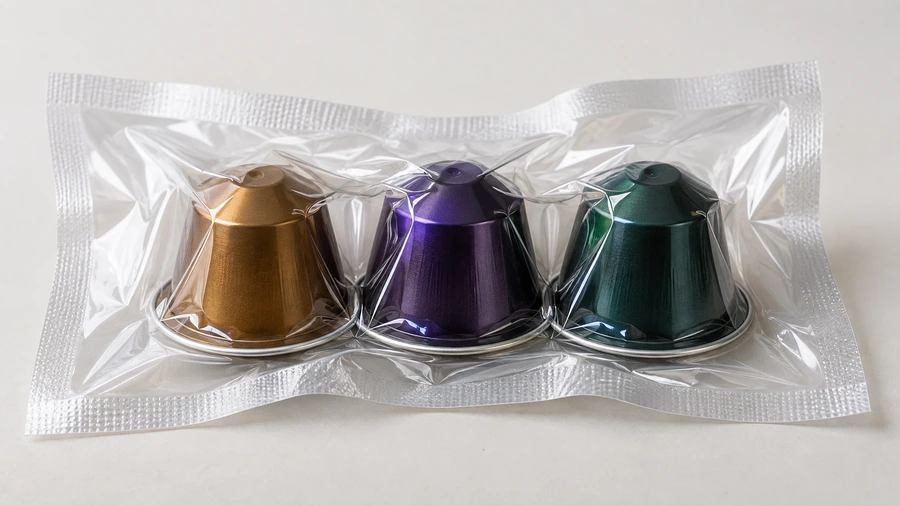
Nitrogen and vacuum mainly shape the starting conditions. A capsule wall, lid, and seal decide how much outside air gets in later. Think of it as fixing the air inside a room and then checking whether the door closes. The first job doesn’t cancel the second.
Aluminum cups and foil lids can offer strong oxygen and light barriers. Plastic ranges from basic PP to better-performing multilayer or coated structures. EVOH/coatings vary with humidity and processing. Recyclable or compostable labels aren’t transmission numbers. Compare aluminum and plastic capsule material trade-offs with seal compatibility.
Film oxygen transmission rate (OTR) and water-vapor transmission rate (WVTR) screen materials. They won’t reveal seam dust, formed-cup weak spots, creases, or leaks. Examine filled, sealed cups and overwrap after handling. A film number isn’t a tasting note.
A Trial That Can Settle the Argument
Keep everything but the gas route consistent
Use the same roast, grind, rest, dose, cup, filter, and lid at intended speed. If hybrid meets its target only when slowed, that is part of the answer.
Run gas-only, vacuum-only if the offered equipment and cup design allow it, and hybrid if the vendor actually offers it. Don’t assume a “vacuum” feature means the cup itself is evacuated: it could describe a chamber, a gas-replacement stage, or a separate bagging station after capsules are filled. Get a simple process diagram. Sample every lane at startup, steady running, after a stop/restart, and after material changes.
Record inlet gas flow/purity, vacuum setting, pressure indicator, and cycle time. Check dust in pumps and near flanges; it can spoil a seal.
Decide pass/fail before looking at the best capsule
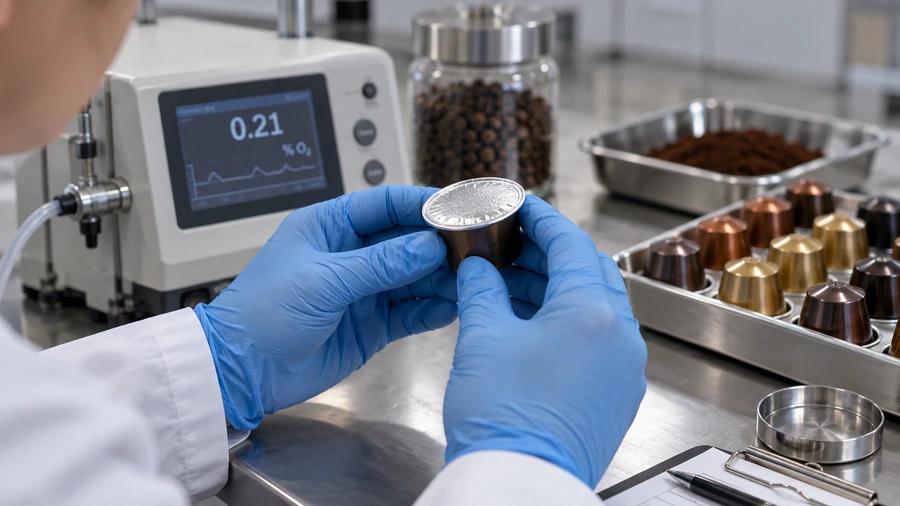
Agree on the oxygen target, when samples are tested after sealing, sample count per lane, individual maximum, spread, calibration and acceptable defects. Keep time-zero and aged-package targets separate. The nitrogen inlet saying “99.9%” doesn’t mean each finished capsule contains 0.1% oxygen. Air still enters with coffee and through poor sampling or sealing.
Small headspaces are awkward. A needle may draw more gas than the cup can safely supply and pull room air around the puncture. An optical sensing spot works only with the right sensor placement and optical access. Select a validated method for the actual material and cup volume; measuring headspace oxygen in K-Cups and Nespresso capsules is a useful format-specific next step.
For vacuum-only cups, sampling may alter pressure. A percentage compares composition, not necessarily total oxygen. Don’t toss bad readings and retest into compliance. Investigate.
Let the shelf and the brewer weigh in
Retain capsules from each route. Test at a defined release interval and through the intended shelf life under realistic temperature and handling conditions. Pair oxygen trends with leak/seal tests, lid shape, pressure/CO₂ where relevant, moisture, and a controlled sensory brew against fresh reference coffee. If an accelerated test is used, explain its purpose; don’t convert hot days into an exact “months on shelf” guarantee.
A hybrid’s 0.7% day-one reading may mean little if the seal fails. The 1.4% gas-only pack might age better—or not. Define end-of-life acceptance with the buyer. Brew it.
The Real Price Is Per Good Capsule, Not Per Nitrogen Cylinder
Compare gas per accepted capsule, electricity for vacuum pumps, generator or cylinder logistics, nozzle/chamber upkeep, dust cleaning, lid and cup costs, speed loss, rejects, and QA labor. A cheap cylinder bill is no win if more packs fail seals. A low O₂ reading is no win if the line has to crawl.
In an OPTIMA coffee-capsule nitrogen retrofit, the supplier initially expected 10–15% potential nitrogen savings from a gas-flow redesign. It later reported exceeding that expectation in its pilot while keeping before/after residual-O₂ values comparable and improving lane uniformity. That’s a particular retrofit, not a promise that adding vacuum always saves 15% gas. The wider lesson: optimize flow and lane consistency before paying for more process stages.
Ask for two costed scenarios at the same output rate and release specification. If the hybrid cannot meet speed, put the throughput penalty in the model. If gas-only is unstable on one lane, put its rejects in too. The best route is the one that delivers saleable coffee, repeatedly.
Which Machine Question to Ask for K-Cups or Nespresso Cups
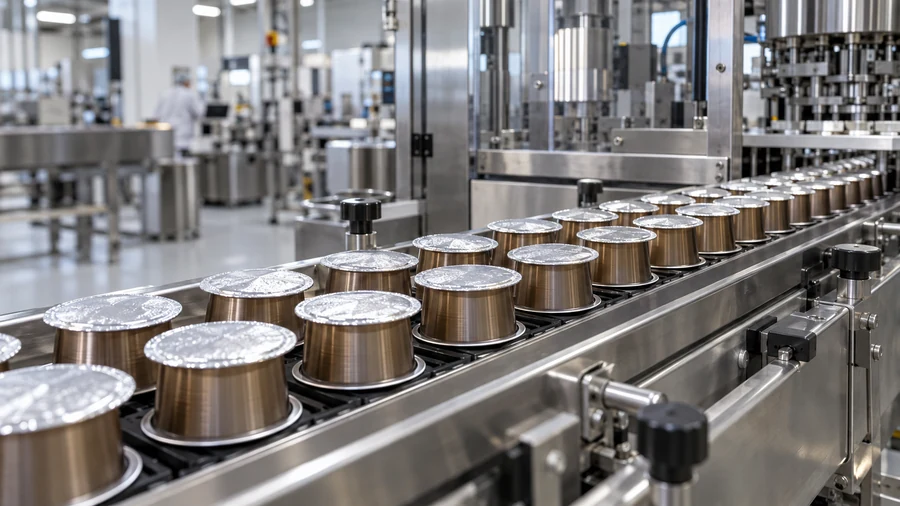
Cup geometry matters more than a feature badge. The common K-Cup format and compact Nespresso Original-compatible cups use different bodies, lids, filters, doses, and available gas space. Nespresso Vertuo is a separate system; don’t call every “Nespresso-compatible” capsule interchangeable.
| Format | What to ask the vendor | Relevant production trial |
| K-Cup | Where does N₂ enter? Is evacuation in the cup or a surrounding chamber? | Actual filter, cup, lid, all lanes, full speed |
| Original-compatible cup | Can a small headspace be purged or sampled reliably? How does the lid respond to pressure changes? | Actual cup/lid pair, brew-machine fit, aging checks |
| Vacuum + N₂ | Removes gas, then backfills with N₂ | Whether extra stages improve quality enough to justify time and cost |
Compare proposed K-Cup filling machine options on their lane architecture and test access. Compare Nespresso-compatible filling machine options with the actual small-cup geometry. In both cases, make factory acceptance testing (FAT) and site acceptance testing (SAT) use your coffee and your agreed limits—not a showroom blend.
When Results Go Sideways
Sort misses by route, lane and age before turning every knob. Hold suspect lots under the written QA plan.
| Pattern | First check | Likely next question |
| All gas-only lanes read high fresh | Analyzer, inlet N₂, flow and exposure time | Is room air mixed back in? |
| One lane rises | Nozzle and rim/seal at that lane | Is coffee dust crossing the flange? |
| Vacuum cycle disturbs dose | Pump path, cup/filter and drawdown | Does bed movement change seal or brew? |
| Hybrid passes fresh, rises on shelf | Leak and barrier tests | Was the good first reading temporary? |
| Lid shape changes after rest | CO₂ and pressure history | Is cup/lid integrity still sound? |
Recheck the method before loosening the release limit. If lane behavior is hard to isolate, coffee capsule technical support can work through gas settings, sealing and samples together.
Standards Are Tools, Not an Oxygen Trophy
ASTM F2714-08(2021) describes fluorescent-decay headspace oxygen testing when a sensor inside the pack has optical access. An opaque aluminum cup without a suitable window may need another method. ASTM D3985-24 tests oxygen transmission through plastic film/sheeting; ISO 15105-2:2025 addresses film/sheet gas transmission. Finished capsules still need suitable leak and seal checks.
These methods don’t impose a universal coffee-capsule limit below 1% or 2%. Customer contracts, food-contact material rules and workplace nitrogen ventilation need review for the actual market. Keep oxygen control as one piece of packaging QA, not a shortcut around safety.
Conclusion
Nitrogen-only can be the clean, simple choice. Vacuum-only may suit a designed format. A brief vacuum followed by nitrogen can earn its extra complexity if the line proves a repeatable gain. Decide with your coffee and cup at real speed, then watch the sealed product age and brew it. The smallest number on a demo screen isn’t the whole coffee business.
FAQs
Is nitrogen flushing better than vacuum sealing for K-Cups?
Not universally. Gas-only flushing is often easier to integrate, but a designed vacuum or hybrid route might improve a specific product. Compare oxygen, seals, speed, and brewed coffee at the agreed shelf-life endpoint.
Can a rigid coffee capsule be vacuum sealed without collapsing?
Possibly. A rigid body may keep its shape while the lid, filter, or coffee bed shifts. Test that exact cup/lid under the planned pressure and after CO₂ release. Don’t apply flexible-bag behavior to every capsule.
Is vacuum-plus-nitrogen the same as vacuum-only packaging?
No. Vacuum-only leaves reduced gas pressure at closure. The hybrid evacuates gas, then backfills with nitrogen before sealing. Its finished atmosphere and pressure can be quite different.
Why do some capsule machines use vacuum before nitrogen?
Brief evacuation may remove air that a gas nozzle struggles to displace, including some air among grounds. Backfill creates a nitrogen-rich atmosphere. Whether the extra cycle pays off needs a full-speed trial.
Does vacuum remove all oxygen trapped in ground coffee?
No guarantee. Gas can remain in particle gaps, and the amount changes with grind, fill, drawdown and time. Check the finished pack with a valid method, then check the retained samples.
Does 99.9% nitrogen guarantee 0.1% oxygen in the sealed capsule?
No. Gas purity describes the inlet. Headspace oxygen describes what remained after dosing, air mixing, purging and sealing. Measure capsules from every lane rather than trusting the gas certificate.
Do capsules need a degassing valve like whole-bean bags?
Usually not by default. A sealed capsule has its own lid, cup and pressure design. Fresh coffee’s CO₂ still matters, so validate roast/rest timing and lid behavior for the chosen format.
What changes if fresh ground coffee releases CO₂ after sealing?
Pressure and headspace gas composition can change. A vacuum-only capsule may no longer look or behave as it did right after sealing. Check lid shape, integrity, oxygen trend and extraction.
Should a co-packer choose the lowest day-one oxygen reading?
Not by itself. Look for the maximum and spread across lanes, full-speed rejects, seal quality and aged sensory results. One very low demo capsule can hide an unstable process.
How can I compare gas and energy costs without sacrificing flavor?
Calculate both routes per accepted capsule at the same speed and release limit. Include pump power, gas, downtime and rejects. Then confirm the chosen route’s end-of-shelf-life brewed coffee still meets the sensory promise.