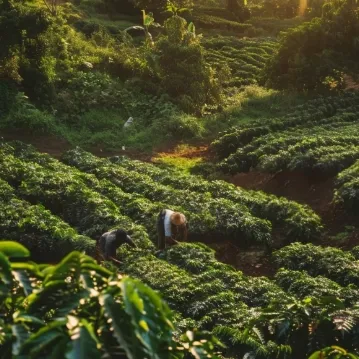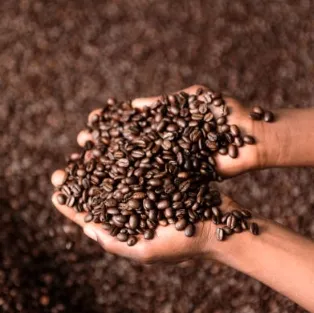
Two cups can start with the same coffee and taste oddly different. One is lively. You notice fruit, sweetness, and a clean finish. The other tastes quiet, a bit woody, maybe just tired. The roast did not change. Its exposure to air did.
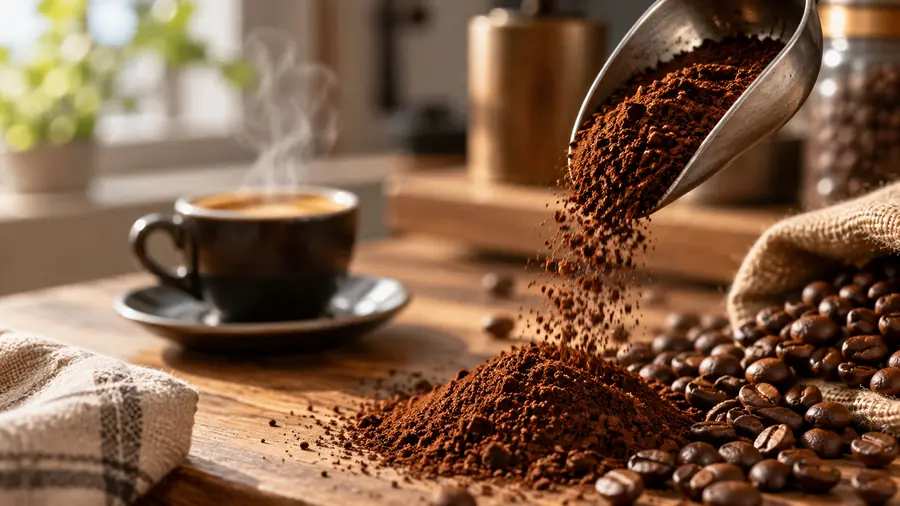
Oxygen reacts with vulnerable compounds in roasted coffee. It also helps create unwanted flavors as time passes. Meanwhile, aroma molecules escape and carbon dioxide leaves the bean. These processes overlap, but they are not the same thing.
So, oxygen is a major part of coffee staling. It is not the whole clock. Grind size, heat, moisture, light, packaging, seals, and storage time all decide how quickly the difference reaches the cup.
Oxygen Does More Than Make Coffee “Lose Aroma”
Oxidation sounds technical, but the basic idea is simple. Oxygen meets a reactive compound and changes it. In coffee, that can affect aroma molecules, oils, and other flavor-related components.
At the same time, some desirable volatile compounds simply move out of the coffee. Think of a small band playing in a room. If two musicians leave and another starts playing off-key, the song changes for two reasons. Coffee aroma behaves a little like that. Some notes fade. Other, less pleasant notes can grow.
Chemical Freshness and Physical Freshness Are Different
Chemical freshness describes changes in coffee’s aroma and flavor chemistry. Oxidation belongs here.
Physical freshness includes carbon dioxide release, usually called degassing. Roasting produces CO₂ and traps much of it inside the porous bean. That gas escapes over time. Grinding opens many more routes out, so degassing speeds up.
CO₂ loss can change bloom, crema, and extraction behavior. Still, it is not another name for oxidation. A coffee can be degassing while oxygen-driven reactions are happening at the same time.
Roasting creates hundreds of aroma compounds, but they do not all age at one speed. The Specialty Coffee Association’s review of coffee staling cites one study in which methanethiol fell to about 30% of its original amount after eight days. That is a study result, not a timer for every roast. Its real lesson is that aroma balance keeps moving after roasting.
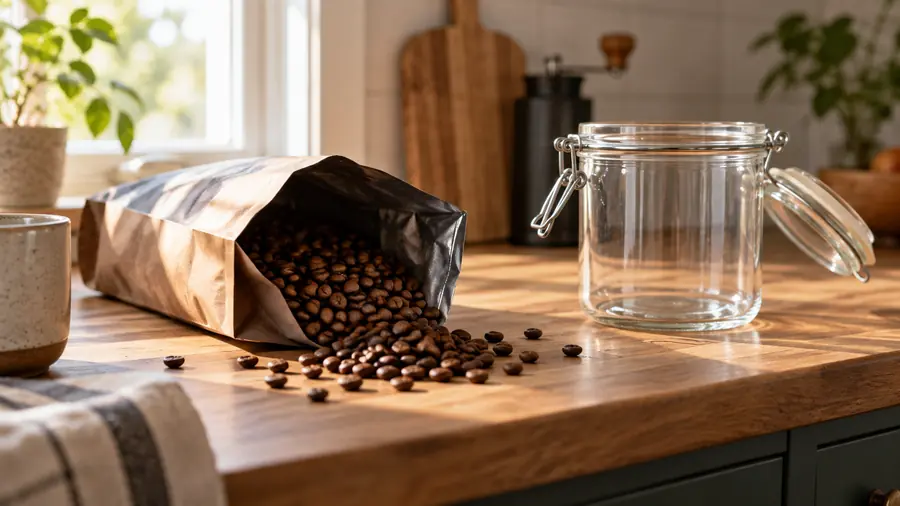
What Oxidized Coffee Tastes and Smells Like
Oxidation does not add one universal “old coffee” flavor. The result depends on the bean, roast, storage, package, and brewing method. Yet a few patterns turn up often.
The first change may be subtraction. Florals feel softer. Fruit becomes harder to name. Sweetness and clarity seem lower. The cup can taste flat even when it is not obviously unpleasant.
Later, addition becomes more noticeable. Lipid oxidation and secondary reactions can contribute papery, cardboard-like, woody, or rancid impressions. Imagine leaving a packet of crackers open in a warm cupboard. It may still look normal, but the clean toasted smell is gone. Coffee can fade in a similarly sneaky way.
| What changes | Likely process | Possible cup impression | Important caution |
| Sensitive aroma balance | Volatile loss and oxidation | Less fruit, floral character, sweetness, and clarity | Compounds disappear or change at different rates |
| Coffee lipids | Oxygen-driven reactions | Papery, woody, stale, or rancid notes | Heat, moisture, roast, and time also matter |
| Carbon dioxide level | Degassing | Different bloom, crema, and extraction behavior | CO₂ loss is not oxidation |
| Overall extraction | Changes in gas and aroma composition | A cup that feels dull, sharp, hollow, or less balanced | Water, recipe, and brew method can mask or reveal the change |
Espresso may make a change feel intense because the beverage is concentrated. Filter coffee can expose lost clarity. Milk can hide some stale notes while muting delicate aromas anyway. A dark roast may show oxidation differently from a floral light roast. So, sensory judgment needs a control sample and a consistent recipe.
Why Oxygen Shortens Shelf Life but Cannot Set It Alone
Coffee shelf life is not simply the time until a product becomes dangerous. For dry roasted coffee, the practical endpoint is often sensory: the point at which aroma, flavor, or brewing performance no longer meets the brand’s promise.
That promise varies. A rare microlot sold near the roastery may have a narrow freshness window. A retail capsule may need to taste consistent after months in distribution. Neither target is automatically better. They are different products with different jobs.
Coffee also does not become unsafe the moment it tastes stale. Quality loss and food safety are separate questions. If moisture enters, mold develops, or the product becomes contaminated, that is a safety and handling issue. A dry bean that has merely lost its sparkle is usually a quality disappointment instead.
Research on coffee freshness after a package is opened also shows why packaging claims need context. Even strong storage systems cannot stop every intrinsic freshness change. Once a package is opened repeatedly, fresh air enters and the problem changes again.
Whole Beans, Grounds, and Capsules Age Differently
A whole bean offers less exposed surface than the same bean after grinding. Grinding is like turning a loaf into crumbs. Far more area meets air, and gases have shorter paths out.
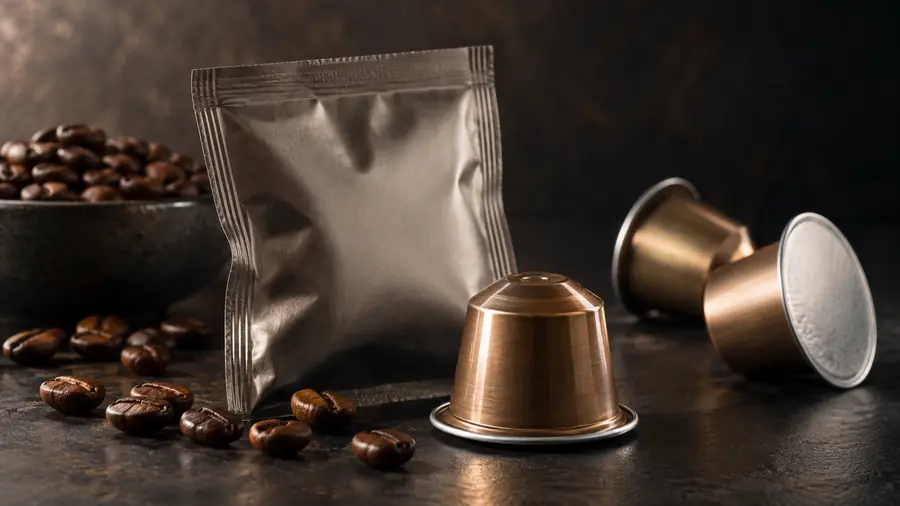
Pre-ground coffee therefore needs faster handling and stronger packaging control. Coffee capsules raise the stakes again. They often use fine grounds and must survive a long retail route. The good news is that each dose can be sealed once and opened only during brewing. With the right cup, lid, barrier, gas process, and seal, a capsule can protect that small dose very well.
The Three Oxygen Problems Inside a Sealed Coffee Pack
A sealed pack can fail in three different stages. Treating them as one problem makes troubleshooting messy.
Oxygen Present at Sealing
Normal air contains roughly 21% oxygen. Filling a bag or capsule in open air can leave some of that oxygen in the headspace and between coffee particles.
Production teams often measure residual oxygen inside a sealed coffee capsule. The result is usually the oxygen concentration in a sampled gas space at a defined time. It is useful, but it is not the total oxygen inventory of the coffee and package.
Oxygen Hidden Beyond the Headspace
Ground coffee contains small spaces between particles. Gas can sit there. Coffee and package surfaces may also take up or release gases after sealing. That is why a reading taken immediately after sealing may differ from one taken after a fixed stabilization period.
Incoming nitrogen purity is not the finished-pack result either. A supply marked 99.9% nitrogen can still produce a package with more oxygen if room air mixes into the cup, the purge is poorly placed, or air remains in the coffee bed.
Oxygen That Arrives Later
Oxygen may pass slowly through a package material. It may also enter much faster through a pinhole, a seal channel, a faulty valve, or coffee dust caught under a lid.
These are different failures. Oxygen transmission rate, or OTR, describes permeation through a material under stated conditions. A leak is a physical path. A low-OTR film cannot rescue a bad seal.
This is also why choosing a realistic oxygen target requires more than picking the smallest percentage. The target must be tied to the test method, sample timing, package format, distribution route, and sensory shelf-life result.
Bags, Cans, and Capsules Need Different Protection
Packaging has three basic jobs here: reduce the oxygen present at closing, slow future ingress, and survive handling without losing its seal. The best structure depends on the product.
Aluminum foil is a strong barrier to oxygen, moisture, and light when it is intact. Metallized film uses a much thinner metal layer and can offer useful performance with less material, though it is not identical to foil. Multilayer plastics may add EVOH or another barrier layer. Their performance depends on thickness, humidity, processing, and the full structure.
Paper can provide stiffness and printability, but paper alone is not usually a high oxygen barrier. Compostable and recyclable claims also tell you little about OTR. Sustainability and flavor protection need to be tested together.
For capsules, compare the formed cup, lid, sealant, and rim—not just a flat sheet from a supplier. The practical aluminum and plastic capsule barrier trade-offs include machinability, seal compatibility, piercing behavior, and the intended storage route.
Match the Format to the Application
- Freshly roasted whole-bean bags: A one-way valve can release CO₂ while limiting air entry. A resealable closure helps after opening, though it does not remove the air already inside.
- Ground-coffee bags: Higher surface area makes fast filling, a good barrier, and gas control more important.
- Cans: The body can provide an excellent barrier, but seams, closures, and the gas inside still need attention.
- K-Cups and Nespresso-compatible capsules: Cup walls, foil lids, filters, small headspace, seal cleanliness, and line speed all interact.
- Secondary pouches or overwraps: These can add protection when an individual capsule structure alone does not meet the intended route.
These choices affect specialty roasters, private-label plants, cafés moving into retail, hotel and office suppliers, e-commerce brands, and exporters. A café selling locally may prioritize rapid turnover. A brand shipping through hot warehouses needs a tougher margin. Same coffee, very different trip.
How Roasters Reduce Oxygen Without Fooling Themselves
Lower oxygen is useful only when the process can repeat it and the package can hold it.
Lower the Initial Exposure
Keep the time between grinding, dosing, and sealing controlled. Avoid leaving coffee in a half-empty hopper for hours. Then choose a gas process that fits the format.
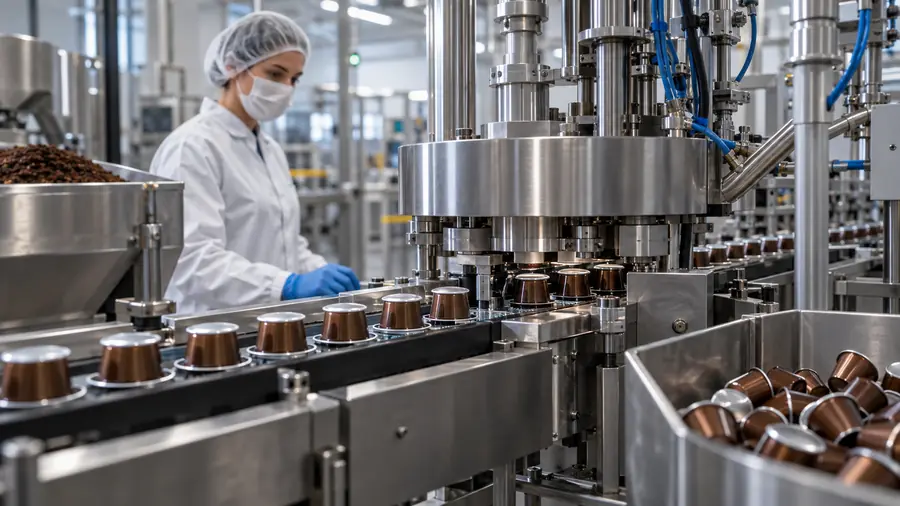
Nitrogen flushing displaces oxygen with an inert gas. The steps behind how nitrogen flushing pushes air out of a capsule matter more than a nitrogen label on the machine. Nozzle position, flow, enclosure, dwell time, dose, line speed, and sealing timing all affect the pack.
Vacuum removes gas instead of diluting it. Vacuum followed by nitrogen combines both approaches. The right choice depends on cup strength, coffee behavior, output, cost, and the required result. A fuller comparison of nitrogen flushing and vacuum sealing for capsules belongs in the process-selection stage.
Oxygen scavengers may help in some package systems. They need suitable food-contact approval, enough capacity, and evidence that they work with the coffee and storage conditions. They are not a patch for an uncontrolled seal.
Keep Oxygen From Returning
Seal temperature, dwell time, pressure, lid placement, rim design, and cleanliness need a stable operating window. Coffee dust is tiny, but it can behave like a pebble in a door seal. One dirty rim can undo a very good purge.
Check performance at normal production speed, not only during a slow demonstration. Sample every lane. Recheck after film or lid changes, stops, warm-up, cleaning, and maintenance.
Measure Four Different Things
- Fresh-pack headspace oxygen shows how filling, flushing, and sealing performed at a defined test time.
- Oxygen during storage shows whether the result remains stable or starts climbing.
- OTR and integrity tests separate material permeation from leaks and seal defects.
- Sensory testing shows whether the coffee still meets the intended flavor promise.
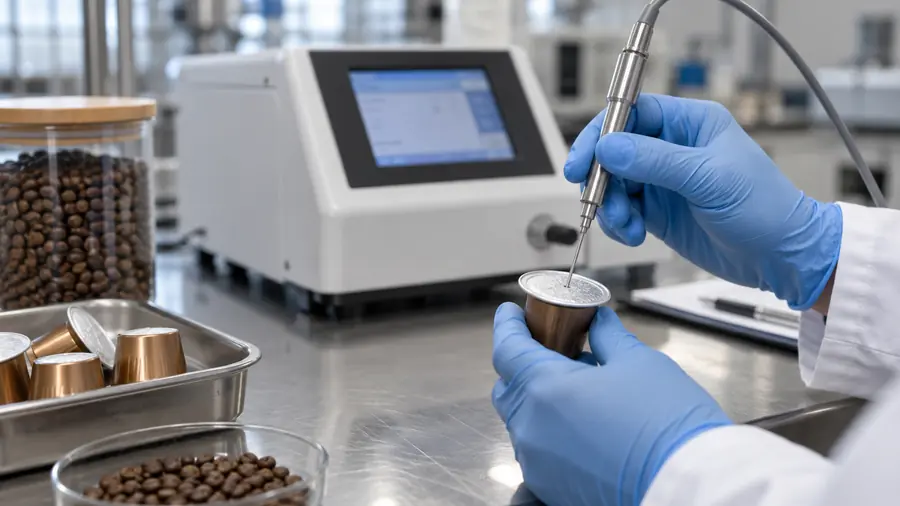
Small capsules make sampling awkward. A needle can draw a meaningful part of the free gas volume or pull room air through a poor puncture. Use a validated procedure for the actual cup. This guide to measuring oxygen in K-Cups and Nespresso capsules covers that format-specific work.
No single test answers every question. Relevant methods include the official ASTM F2714-08(2021) headspace oxygen method, ASTM D3985-24 for oxygen transmission through plastic film and sheeting, and ISO 15105-2:2025 for gas-transmission testing. None of them sets a universal pass level for coffee flavor.
| Standard or method | What it can support | What it does not decide |
| ASTM F2714-08(2021) | Headspace oxygen analysis by fluorescence decay in a suitable sealed package | A universal acceptable oxygen percentage for coffee |
| ASTM D3985-24 | OTR of plastic film and sheeting with a coulometric sensor | Performance of every formed package, seal, or valve |
| ISO 15105-2:2025 | Gas-transmission testing for films, sheets, and related structures | Finished coffee flavor life by itself |
| Product-specific sensory study | The point at which trained assessors or target consumers reject the stored product | The cause of a failure without oxygen, leak, and material data |
A Practical Oxygen-Control Plan for Coffee Brands
Picture a roaster preparing a premium capsule for retail. A reading of 0.8% oxygen on three samples looks nice. But the capsules will cross a warm distribution network and sit on a shelf for nine months. That same-day number is only the starting photo, not the whole movie.
A workable plan looks like this:
- Define the promise. State the intended flavor, shelf life, markets, transport, and storage temperature.
- Build one package system. Test the actual coffee, grind, dose, cup, lid, sealant, and secondary pack together.
- Write the measurement rule. Define the oxygen target, test method, sample time, number of units, lanes, and response to a failure.
- Run real storage trials. Include intended conditions and a justified challenge condition. Track oxygen, leaks, and package changes over time.
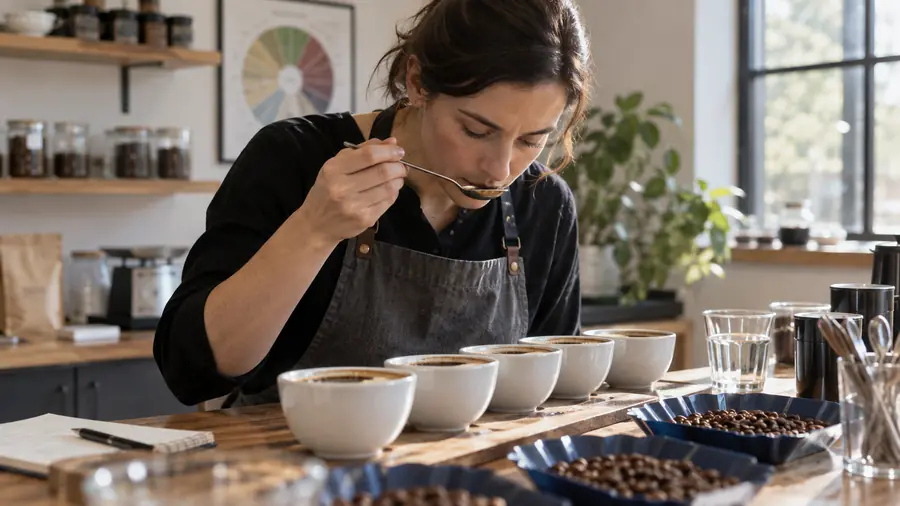
- Taste blind. Compare stored samples with a control using a consistent brew recipe and a written acceptance rule.
When evaluating coffee capsule filling and sealing equipment, put those requirements into factory and site acceptance tests. Use your coffee and production speed. A machine should hold a repeatable window across lanes and shifts. One heroic sample does not run a business.
Conclusion
Oxygen changes coffee in two broad ways. Desirable aroma can fade or shift, while stale and rancid impressions may develop. The cup loses detail before the package looks wrong.
Still, oxygen is only one part of the shelf-life system. Coffee form, roast, temperature, moisture, initial headspace, later ingress, materials, and seals all matter. The sensible approach is to measure the package and taste the coffee over time.
A low oxygen number is useful. But if the package protects the number and not the cup, well, the job is not finished.
FAQs
What Does Oxidized Coffee Taste Like?
It may taste flat, dull, woody, papery, cardboard-like, or rancid. Delicate fruit, floral notes, sweetness, and clarity may fade first. The exact result depends on the coffee, roast, storage, and brewing method.
How Quickly Does Oxygen Make Coffee Go Stale?
There is no universal timer. Ground coffee can change faster than whole beans because more surface meets air. Temperature, moisture, packaging, opening frequency, and the brand’s sensory limit all change the useful freshness window.
Why Does Ground Coffee Stale Faster Than Whole Beans?
Grinding creates far more exposed surface and shorter paths for gases and volatile compounds. Oxygen can reach more coffee at once, while aroma and CO₂ escape faster.
Can Coffee Oxidize in an Unopened Bag or Capsule?
Yes. Oxygen may remain at sealing or enter later through the material, valve, pinhole, or seal. An unopened pack slows exposure only when its complete barrier and closure system work as intended.
Is Stale or Oxidized Coffee Unsafe to Drink?
Staling is usually a quality issue, not an automatic safety issue. Discard coffee that shows mold, moisture damage, contamination, or an abnormal odor that suggests spoilage. Follow the manufacturer’s handling guidance.
Is Coffee Degassing the Same as Oxidation?
No. Degassing is mainly the physical release of CO₂ produced during roasting. Oxidation is a set of chemical reactions involving oxygen. Both can occur during storage and both can affect the cup.
Does Nitrogen Flushing Stop Coffee Oxidation Completely?
No. It reduces the oxygen initially available, which can slow oxidation. Some oxygen may remain or enter later, and aroma loss and other intrinsic changes can continue even in a low-oxygen pack.
Does Lower Residual Oxygen Always Mean Longer Shelf Life?
Not by itself. Lower starting oxygen is helpful, but weak barriers, leaks, heat, moisture, or a sensitive coffee can still shorten flavor life. The number needs storage and sensory validation.
What Is the Difference Between Residual Oxygen and OTR?
Residual oxygen is the measured oxygen concentration inside a sealed package at a defined time. OTR is the rate at which oxygen passes through a material under stated test conditions. They answer different questions.
How Can a Roaster Test Whether Packaging Protects Flavor?
Combine fresh-pack oxygen measurements, aged oxygen readings, leak or seal tests, material data, and blind sensory checks. Test the finished package with the actual coffee under the intended distribution and storage conditions.