
One capsule reads 0.7% oxygen. Nice. The next lane reads 1.8%, and the first capsules after every restart are even higher. Meanwhile, the nitrogen supply is marked 99.9% pure.
That is a normal production puzzle. It also explains why one low reading does not prove that a line is under control.
Getting below 1% residual oxygen takes more than turning up a gas valve. The coffee, nitrogen, purge zone, cup, lid, sealing window, and test method must work as one system. The target can be useful for protecting flavor and supporting longer distribution, which is why many capsule brands specify residual oxygen below 1%. Still, it is a process target—not a guaranteed shelf life.
Here is how to build a result that can survive a full shift, not just a machine demonstration.
First, Define What “Less Than 1%” Means
Most packaging teams mean less than 1% oxygen by volume in the free gas inside a sealed capsule. A headspace analyzer draws a gas sample and reports its oxygen concentration.
That number is useful, but it is not the total amount of oxygen associated with the product. Fine coffee contains tiny spaces between particles. Air may remain inside that bed even when the visible headspace has been purged. Coffee and packaging surfaces can also release or take up gases after sealing. This distinction matters when defining residual oxygen in coffee capsule packaging.
Supply purity is another number. If the incoming gas is 99.9% nitrogen, it contains little non-nitrogen gas. Yet room air can mix into the capsule during filling, lid placement, or transfer. So, 99.9% nitrogen does not automatically produce 0.1% oxygen in the finished pod.
A proper specification needs a method and a clock. For example:
Less than 1.0% O₂ by volume, measured 20 minutes after sealing with the approved analyzer and sampling procedure, at normal production speed.
The exact test time should come from your validation work. What matters is using the same rule every time. Also remember that the ideal oxygen target depends on the product and route. A nearby café and a capsule exported through warm warehouses do not face the same journey.
Build the Conditions for a Sub-1% Result
Start upstream. Ground coffee behaves a bit like a bucket of dry sand. Air sits in the gaps, not only above the surface. A finer grind, a fluffy dose, or a change in bulk density can alter how much air travels into each capsule.
Keep roast-to-pack timing, grind, dose weight, product temperature, and hopper residence time within defined ranges. Coffee should not wait in a half-empty hopper all afternoon. At the same time, packing very fresh coffee without understanding its CO₂ release can create unstable readings and package pressure. There is no magic resting period for every roast. Validate a window for the actual blend and grind.
Use nitrogen that is suitable for food packaging and delivered at stable pressure and flow. A generator, cylinder bank, or bulk source can all work. In the United States, 21 CFR §184.1540 states that nitrogen must have purity suitable for its intended use and be used according to current good manufacturing practice.
Finally, treat the cup, filter, lid, and sealant as one package. Aluminum offers a strong oxygen and light barrier when intact. Multilayer plastic may use EVOH or another barrier layer. Its real performance depends on the full structure, thickness, forming process, humidity, and seals. A low oxygen transmission rate, or OTR, cannot rescue a channel through the seal.
| Variable | Why it changes the result | What to control | How to verify |
| Coffee bed | Holds air between particles | Grind, dose, density, temperature, pack timing | Batch records and weight checks |
| Nitrogen supply | Sets the best atmosphere available to the process | Purity, pressure, flow, dryness | Supplier data and point-of-use checks |
| Purge zone | Decides how much room air mixes back in | Shielding, nozzle position, dwell, line speed | Lane-by-lane oxygen trials |
| Cup and lid | Slow later oxygen ingress | Material structure, OTR, handling damage | Supplier data and aged-pack tests |
| Heat seal | Blocks direct leak paths | Clean rim, temperature, pressure, dwell | Seal and integrity testing |
Tune the Filling and Sealing Line in the Right Order
Changing three settings at once creates impressive confusion. Work through the line in a fixed sequence.
Establish a Lane-by-Lane Baseline
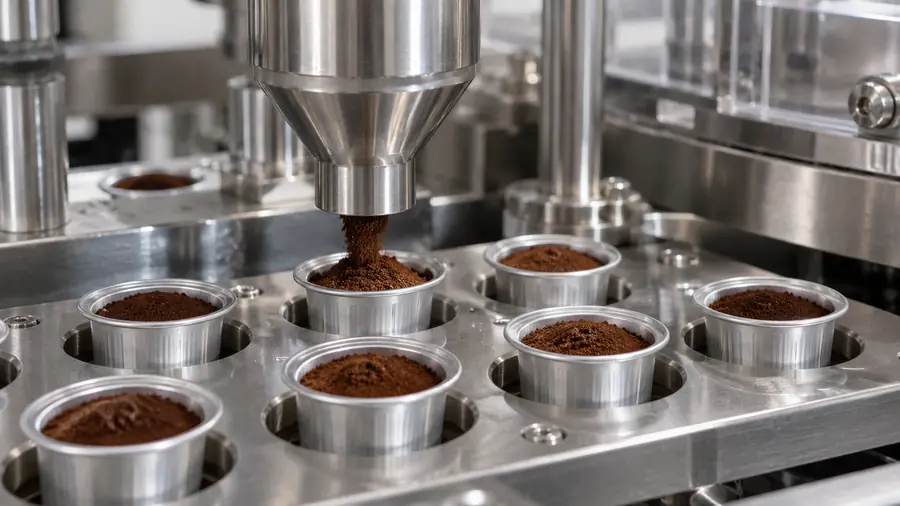
Use the intended coffee, capsule, filter, and lid. Run at normal speed until gas flow and sealing temperatures reach steady state. Then sample every lane separately.
Do not hide a weak lane inside an average. Four readings of 0.6%, 0.7%, 0.8%, and 2.1% do not describe a 1.05% process. They describe one lane that needs attention.
Reduce Room-Air Entrainment
Nitrogen flushing works by replacing the air around and inside the open capsule. This overview of how nitrogen flushing displaces oxygen in coffee capsules explains the basic mechanism.
On the line, protect the purge area from drafts. Reduce the distance and time between final purging, lid placement, and sealing. A controlled tunnel or enclosure can help, especially on fast multi-lane machines. The goal is not to make the whole room oxygen-free. It is to stop fresh air from rushing back into a tiny open cup at the worst moment.
Balance Nozzle Position, Flow, and Dwell
The gas has to reach the spaces where air remains. A jet that skims over the rim may produce an attractive flow-meter number while doing little inside the coffee bed. On the other hand, excessive velocity can disturb grounds, contaminate the rim, and create turbulent mixing.
Adjust one variable at a time. Map results by lane. Check the manifold, regulator, hoses, restrictions, diffuser geometry, and nozzle height. Look for pressure loss at the lanes farthest from the supply.
A capsule-packaging CFD study by Spanu and Vignali shows why distribution matters. The researchers redesigned a nitrogen distribution plate from four inlets to eight. In the simulation, mean oxygen at the capsule center fell from 2.70% to 0.66%. Experimental work supported the improved configuration. There is an important catch: the study used empty capsules to isolate the gas system. It proves that geometry matters, not that its settings can be copied onto every filled line.
Add Vacuum Only When the Format Benefits
A vacuum pre-pull can remove some air before nitrogen enters. This may help when ground coffee traps too much air or when a simple flush cannot reach the target economically.
But vacuum adds moving parts and cycle time. It can lift coffee, distort a filter, deform a thin cup, or send grounds toward the rim. Review the practical trade-offs between vacuum sealing and nitrogen flushing for coffee capsules before choosing a process. For some lines, staged nitrogen purging works well. For others, vacuum plus nitrogen is more repeatable.
Seal Before Air Comes Back
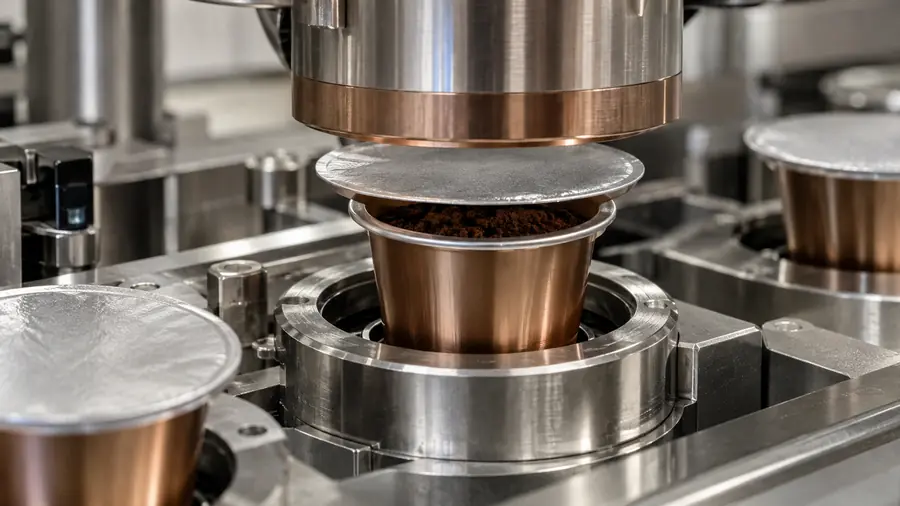
Coordinate the last purge with lid placement and heat sealing. Establish a process window for seal temperature, pressure, and dwell time. The strongest-looking setting is not automatically best. Too little energy can leave an incomplete bond. Too much can distort the flange or damage the sealant layer.
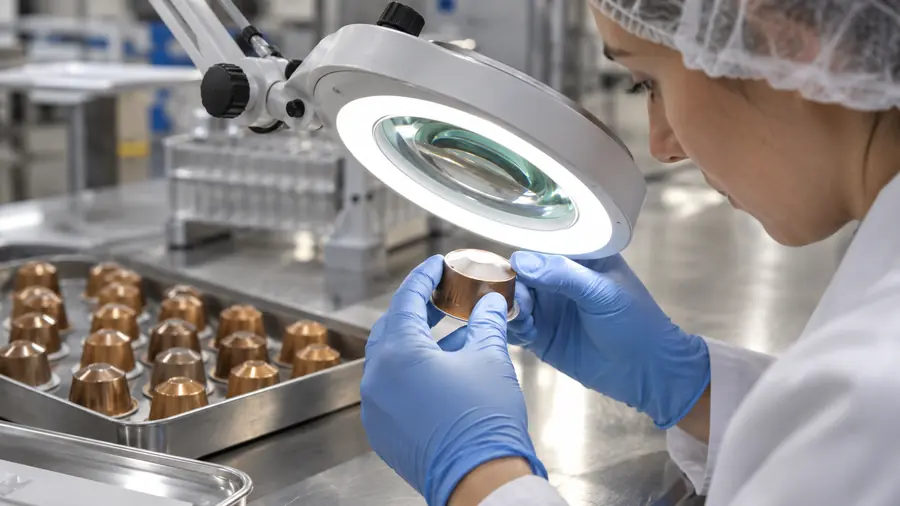
Keep the rim clean. A few coffee particles can behave like crumbs caught in a jar lid. The lid appears closed, but a narrow path remains.
Challenge the Settings
Repeat the study at full speed. Include startup, steady production, short stops, restarts, changeovers, new lid rolls, different coffee lots, and more than one operator. Check gas use as well as oxygen. A process that reaches 0.7% only by wasting nitrogen may not be commercially stable.
Measure Without Spoiling the Sample
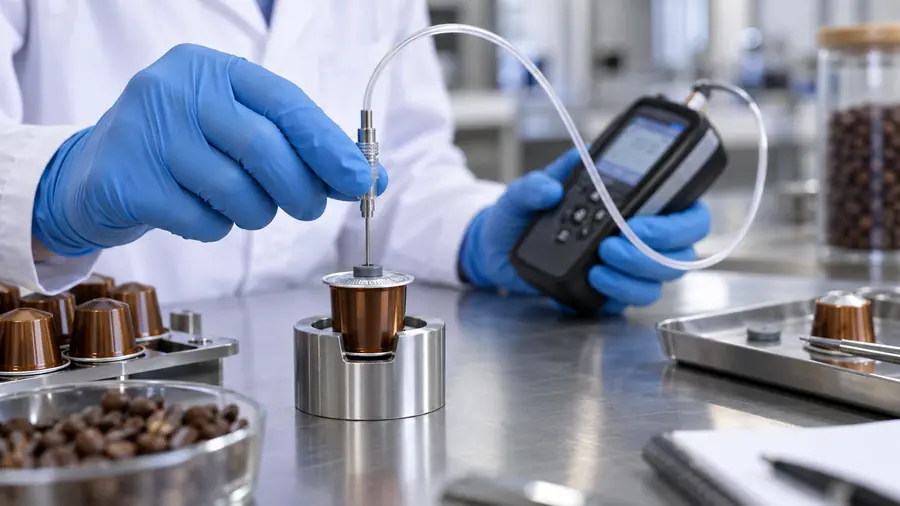
Small capsules are awkward test packages. The analyzer may withdraw a meaningful share of the available gas. A poor puncture can also pull room air through the needle hole and turn a good capsule into a bad-looking result.
Follow the instrument maker’s zero, span, warm-up, and calibration instructions. Apply the correct septum over a suitable flat area before puncturing. Insert the needle cleanly, and make sure the instrument’s sample-volume requirement fits the capsule. Use one written method for both K-Cups and Nespresso-compatible capsules, with format-specific details where necessary. The full procedure for measuring residual oxygen in small coffee capsules is worth standardizing before the team starts adjusting machinery.
A useful sampling plan covers:
- every lane after startup;
- the beginning, middle, and end of a batch;
- production after a stop or material change;
- each shift and operator during validation;
- fresh packs and retained packs at defined ages.
Record the coffee lot, capsule and lid lots, lane, speed, gas pressure or flow, sealing settings, operator, test time, and analyzer ID. A trend chart is more helpful than a folder of isolated pass results.
Fresh-pack oxygen mainly tells you how filling, purging, and sealing performed. If oxygen rises during storage, investigate barrier permeation, a microleak, seal damage, or the test method. Pair oxygen readings with package-integrity checks and blind sensory work.

Why Is the Reading Still Above 1%?
Turning up the gas is only one possible response. Use the pattern in the data first.
| Observed pattern | Likely cause | Check first | Corrective direction |
| All lanes are high | Poor supply, short purge, open purge zone, or test error | Gas at point of use and analyzer check | Restore stable supply; confirm method; then tune flow and dwell |
| One lane is high | Uneven manifold, blocked nozzle, wrong height, or local seal issue | Compare that lane’s hardware and seal | Clean, align, balance, and retest the lane |
| First capsules after a stop are high | Purge zone lost its atmosphere | Restart sequence and gas lead time | Add a controlled pre-purge or reject startup units |
| Oxygen rises at higher speed | Too little displacement or too much delay before sealing | Cycle timing at normal and high speed | Rebalance dwell, shielding, and sealing sequence |
| Fresh packs pass; aged packs fail | Leak, poor barrier, or handling damage | Seal integrity and material lots | Fix the seal window or package structure |
| Results jump on similar samples | Sampling leak, low sample volume, or analyzer drift | Septum, needle, calibration, repeatability | Correct the test method before changing the line |
| Nitrogen is pure but capsules are high | Room air remains in the coffee bed or returns before closure | Nozzle position and open-cup time | Improve displacement and shorten the path to sealing |
Run controlled trials. Change one factor, record it, and compare enough samples. Otherwise, the team ends up chasing yesterday’s lucky capsule. Yep, that happens.
Standards Help With Methods, Not With Your Flavor Promise
The official ASTM F2714-08(2021) method covers headspace oxygen analysis by fluorescence decay in suitable sealed packages. Needle-based analyzers use a different sampling approach, so the method named in a specification must match the equipment actually used.
ASTM D3985-24 and ISO 15105-2:2025 support gas-transmission testing for films and sheets. ASTM F88/F88M can support seal-strength evaluation. An appropriate leak method can help find gross leaks or channels. The method still has to suit the capsule geometry and failure mode.
Add normal GMP and HACCP controls. Approve the gas supplier. Protect gas lines from contamination. Maintain ventilation because nitrogen can displace oxygen in a work area. Include equipment calibration, cleaning, foreign-material control, lot traceability, and corrective-action records.
None of these standards declares that every coffee capsule must contain less than 1% oxygen. They also do not grant a 12-, 18-, or 24-month flavor claim. That evidence must come from the actual coffee, finished package, storage conditions, and sensory acceptance criteria.
Put the Target Into Machine Acceptance Tests
A brochure number is a starting point. The purchase specification should define how the number will be demonstrated.
During the factory acceptance test, use the intended capsule components and, where practical, the buyer’s coffee. State the production speed, active lanes, sample count, test timing, oxygen limit, gas consumption, and treatment of an outlier. Save the successful settings and raw results.
Repeat the test after installation. Local nitrogen supply, compressed air, voltage, room drafts, operators, and materials can change the outcome. The site acceptance test should cover restarts and a reasonable production run, not five carefully selected capsules.
For a small or pilot operation, a validated nitrogen-flushing coffee capsule sealer may reach the target without a large automatic line. The key question is the same: can the system repeat the result with your product, at your real speed, under a written test rule?
Conclusion
Less than 1% residual oxygen is not one clever machine setting. It is the result of a controlled chain: stable coffee, suitable nitrogen, balanced gas distribution, fast closure, a clean seal, a capable barrier, and a test method people follow the same way.
Define the target first. Then tune each lane, verify at production speed, and watch what happens during storage. That approach may feel slower than turning a valve. In practice, it saves a lot of guessing—and quite a bit of nitrogen too.
FAQs
Is Less Than 1% Residual Oxygen Necessary for Every Coffee Capsule?
No. It is a useful premium process target, not a universal law. Set the limit through shelf-life and sensory testing for the actual coffee, package, market, and distribution time.
Does 99.9% Nitrogen Guarantee Less Than 0.1% Oxygen in a Sealed Capsule?
No. Supply purity and finished-pack oxygen are different measurements. Air can remain in the coffee bed, mix into the purge zone, or enter before the lid seals.
Can Nitrogen Flushing Alone Achieve Below 1% Oxygen?
Yes, on a well-designed and well-shielded process. Difficult coffee beds or capsule formats may benefit from staged purging or vacuum plus nitrogen.
What Nitrogen Purity Is Suitable for Coffee Capsule Packaging?
Use food-suitable nitrogen that supports the validated result and local rules. High purity is normally needed, but the exact supply specification should be set with the gas supplier and process data.
How Soon After Sealing Should Residual Oxygen Be Measured?
Use a fixed time established during validation. Testing immediately may miss gas redistribution. Waiting without a rule makes batches hard to compare. Many teams use both an early process check and later retained-pack checks.
Why Does One Filling Lane Show More Oxygen Than Another?
Common causes include unequal manifold flow, nozzle blockage or height, different exposure time, and a local sealing problem. Sample and troubleshoot each lane separately.
Does Coffee Degassing Affect the Oxygen Reading?
Yes. CO₂ release changes the gas composition and pressure inside the capsule. Roast age, grind, temperature, and test timing should therefore remain controlled.
Which Capsule Material Is Best for Holding a Low Oxygen Level?
Intact aluminum is a strong barrier. High-barrier multilayer plastics can also work. Judge the formed cup, lid, sealant, and seal together rather than relying on the base material’s name.
How Often Should an Oxygen Analyzer Be Calibrated?
Follow the analyzer manufacturer’s schedule and verify it with known gases as required by your SOP. Add checks after maintenance, transport, suspicious readings, or a long idle period.
Can a Small Roaster Reach Below 1% Without a Fully Automatic Line?
Potentially, yes. A controlled semi-automatic sealer, suitable gas supply, compatible high-barrier components, and disciplined testing can work. Output will be lower, and operator technique may have a larger effect.